The American Cinema

From Film Society Review (Vol. 4, No. 5, January 1969) — the first magazine, apart from school and college publications, where I ever published film criticism, for a total of three issues. This was my third and final piece for them. — J.R.

Jon Rosenbaum

THE AMERICAN CINEMA: DIRECTORS AND DIRECTIONS 1929-1968, by Andrew Sarris, New York: E.P. Dutton & Co., Inc., 1968. 383 pp. $7.95, $2.95 (paperback).

Ever since it came out, I have been stubbornly holding on to the Spring 1963 issue of FILM CULTURE, which features a 68-page extravaganza by Andrew Sarris entitled THE AMERICAN CINEMA. ‘Extravaganza’, is not, I think, an overblown word to use here: the program includes detailed descriptions, evaluations and filmographies of over 100 film directors, with a supplementary list of more than 150 “Other Directors” and a “Directorial Chronology” of American films from l9l5 to 1962. At the time, the very fact that one man had seen enough movies to reach this kind of astronomical overview was staggering enough. Just as challenging — and in its own way, unnerving — were the nine categories under which the first hundred-odd directors were pigeon-holed: “Pantheon Directors,” “Second Line,” “Third Line,” “Esoterica,” “Beyond the Fringe,” “Fallen ldols,” ”Likable But Elusive,” “Minor Disappointments” and “Oddities and One Shots” — an almost metaphysical ordering of the American movie universe that looked so painstaking it was painful — and rather threatening, I believe, even to some of the most veteran of moviegoers. Read more

New Waves from Europe

From American Film (February 1979). This article was specifically conceived as a sort of sequel/companion-piece to “Aspects of the Avant-Garde: Three Innovators,” an article published in American Film almost half a year earlier. This plan was undermined in various ways by the editors, who gave it a title derived from a middle-class French comedy of the period  (“Jean-Luc, Chantal, Danièle, Jean-Marie, and the Others”) that caused Akerman herself to reproach me for the piece (assuming that I’d dreamed up that title myself). I no longer recall what my original title was, but I’ve tweaked this piece in a few other minor ways to make it a little less unbearable to me. (By and large, most of my articles written for American Film qualified at least partially as hackwork done to pay my rent.) — J.R.

If American avant-garde films are often chancy to come by, even the most exciting European examples are apt to be regarded in this country as only distant legends. To cite one characteristic but scarcely isolated phenomenon: The welcome once given by the New York Film Festival to the works of Jean-Luc Godard and the team of Jean-Marie Straub and Danièle Huillet hasn’t been extended to any of their recent films, and none of the movies of Chantal Akerman has have ever been shown here. Read more

La Petite Marchande d’Allumettes

From Monthly Film Bulletin, April 1975 (Vol. 42, No. 496). — J.R.


Petite Marchande d’Allumettes, La

(The Little Match Girl)

France, 1928

Directors: Jean Renoir, Jean Tedesco

Cert-U. dist–Contemporary. p–Jean Renoir, Jean Tedesco . asst. d–

Claude H eymann. Simone Hamiguet. Sc–Jean Renoir. Based on the

storv bv Hans Christian Andersen. ph–Jean Bachelet. a.d—Eric Aës.

m -excerpts from works by –Schubert, Strauss, Wagner, Mendelssohn.

m. d–Manuel Rosenthal, Michael Grant. Lp—Catherine Hessling (Karen,

the Little Match Girl), Jean Storm (Young Man/Soldier), Manuel Raby

[Rabinovitch] (Policeman/Death), Amy Wells (Dancing Doll). 1,030 ft.

29 mins. (16mm; also available in 35 mm.). English titles.


Karen leaves her humble-cottage to sell match boxes under a heavy

Snowfall. She gazes wistfully at a handsome young man emerging

from a restaurant, then looks through a frosted pane at the people

eating inside until boys throw snowballs at her. As she gathers up her

spilled boxes a policeman arrives, and together hey look at a display

of dolls and other toys in a shop window. After lighting matches in

an effort to warm herself, she falls asleep and dreams that she enters

the toy shop — having become the same size as the dolls –- and sets

them all in motion. Read more

Faithless Re-creation [the GLORIA remake]

From the Chicago Reader (January 29, 1999). — J.R.

gloriakid

Gloria

Rating * Has redeeming facet

Directed by Sidney Lumet

Written by Steven Antin

With Sharon Stone, Jean-Luke Figueroa, Jeremy Northam, Cathy Moriarty, Mike Starr, Bonnie Bedelia, and George C. Scott.

gloria-longshot

I don’t much relish remakes, especially of movies I like — I’ve avoided seeing the new Payback, a retooling of John Boorman’s Point Blank (1967) — but the idea of Sidney Lumet remaking John Cassavetes’s Gloria (1980) with Sharon Stone seemed to offer possibilities. After all, Cassavetes wrote the script for MGM thinking someone else would direct it; he wound up directing it himself for Columbia only because his wife, Gena Rowlands, was the star and the studio asked him to. “Look, I’m not very bright,” he insisted in an interview. “I wrote a very fast-moving, thoughtless piece about gangsters. And I don’t even know any gangsters. Gloria has a wonderful actress and a very nice kid [John Adames] who’s neither sympathetic nor unsympathetic. He’s just a kid. He reminds me of me — constantly in shock, reacting to this unfathomable environment.” Later he added that when he began shooting Gloria, “I was bored because I knew the answer to the picture the minute we began….All Read more

Red Desert

From the Chicago Reader (October 5, 1990). — J.R.

Michelangelo Antonioni’s first feature in color (1964) remains a watermark for using colors creatively, expressionistically, and beautifully; to get the precise hues he wanted, Antonioni had entire fields painted. A newly struck and restored print of the film makes clear why audiences were so excited a quarter of a century ago by his innovations, which include not only expressive uses of color for moods and subtle thematic coding but striking uses of editing as well. This film comes at the tail end of his most fertile period, immediately after his remarkable trilogy consisting of L’avventura, La notte, and L’eclisse; Red Desert may not be quite as good as the first and last of these, but the ecological concerns of this film look a lot more prescient today than they did at the time. Monica Vitti plays an extreme neurotic married to industrialist Richard Harris, and Antonioni does eerie, memorable work with the industrial shapes and colors that surround her, which are shown alternately as threatening and beautiful; she walks through a science fiction lunar landscape spotted with structures that are both disorienting and full of possibilities. Like any self-respecting Antonioni heroine, she’s looking for love and meaning — more specifically, for ways of adjusting to new forms of life — and mainly finding sex. Read more

Introduction to a Proposed Collection

[IN DREAMS BEGIN RESPONSIBILITIES: A JONATHAN ROSENBAUM READER]

This is an early, abbreviated draft of an introduction to a proposed collection of mine that has subsequently found a publisher (Hat & Beard Press [Los Angeles]/Invisible Republic [Chicago]). I posted this early draft to use in a workshop that I was conducting at Kino klub Split (June 17-22) in Croatia, based on certain concepts proposed in this book. –- J.R.

So complex is reality, and so fragmentary                                      and simplified is history, that an 
omniscient observer could write an 
indefinite, almost infinite, number of 
biographies of a man, each emphasizing 
different facts; we would have to read 
many of them before we realized that 
the protagonist was the same.
               Jorge Luis Borges, 1943

I get a great laugh from artists who 
ridicule the critics as parasites and 
artists manqués —- such a horrible joke. 
I can't imagine a more perfect art form, 
a more perfect career than criticism. I 
can't imagine anything more valuable to 
do, and I’ve always felt that way.
                     Manny Farber, 1977

First, a few ground rules. Because most of us live in a culture where our marketers also tend to be our preferred epistemologists, editors, and censors, I want to override their usual restrictions that govern collections of this kind by drawing upon my literary criticism and my music criticism (mostly of jazz) as well as the film criticism that I’m usually known for, meanwhile charting some of the potential and actual interactivity between these arts in order to define some of the attributes of my own particular niche-market, at least as I’m defining and addressing it here. Read more

I, Robot

From the Chicago Reader (July 16, 2004). — J.R.

i-robot

It’s much more of an action flick than either Metropolis or Blade Runner, but there’s a provocative and visionary side to this free adaptation of Isaac Asimov’s SF classic that puts it in the same thoughtful canon. The story is set in Chicago in 2035, and the cityscape, designed by Patrick Tatopoulos, is futuristic yet Victorian around the edges. Built into the mystery plot are reflections about robots as extensions of human will that build up to a wide-ranging but unpreachy critique of everything from corporate malfeasance to the Patriot Act. Will Smith plays an old-fashioned homicide cop investigating the ostensible suicide of a scientist; Bridget Moynahan is an expert in robot psychology. Alex Proyas (The Crow, Dark City) directs a script by Jeff Vintar and Akiva Goldman that’s lively enough to justify a few hokey flourishes. R, 100 min. Burnham Plaza, Century 12 and CineArts 6, Chatham 14, Crown Village 18, Davis, Ford City, Gardens 1-6, Golf Glen, Lawndale, Lincoln Village, Norridge, North Riverside, River East 21, 62nd & Western, Village North, Webster Place. Read more

Bene’s Salome and Chabrol’s Nada

From Oui (June 1974). –- J.R.

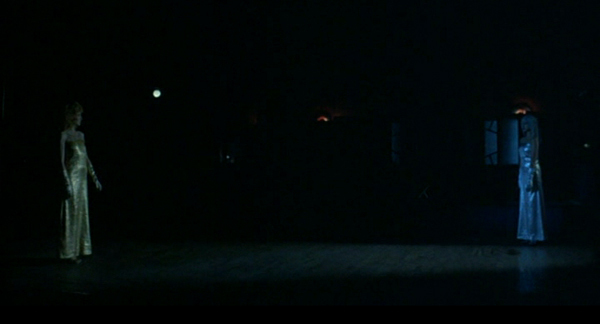
Salome. Meet Carmelo Bene, a vital figure in the Italian avant-garde

whose introduction to American moviegoers is long overdue. Salome,

freely adapted from the Oscar Wilde play, is the latest and perhaps the

most ravishing of his lavish camp spectacles. (Earlier efforts include

Our Lady of the Turcs, Don Giovanni, and One Hamlet Less.)

The title role is played by Veruschka –- the high-fashion model who

writhed under the photographer hero at the beginning of Blow-Up

–- appearing bald, nude, and zombielike as she steps out of the water,

decorated from head to foot with multicolored gems. Bene as Herod

upstages everyone with his hysterical nonstop monologues and

Woody Woodpecker laughs. Visually, it’s a riot of extravagant colors

(fluorescent costumes, Day-Glo sets) and opulent debaucheries

flashing by so quickly that everything remains in delirious flux, and

none of the fancy scenic splendors stands still long enough to be

contemplated. Try to imagine Orson Welles’ Macbeth colored in

with a Fellini paintbox, recut by Kenneth Anger, accompanied by

Schubert’s Unfinished Symphony and the Beer-Barrel Polka,

and you’ll get a fraction of a notion of Bene’s giddy madness.

Depravity, thy name is Salome. Read more

Phantom India

From the Chicago Reader (November 1, 1999). — J.R.

phantomindia_01_original

Louis Malle’s seven-part, 378-minute 1968 documentary series is one of my favorites among his works. His upper-class misanthropy and morbidity usually alienate me, but this essayistic travel diary avoids any pretense of objectivity in order to present itself as a highly personal search — narrated in excellent English by Malle himself in the version I’ve seen, but in French with subtitles in this version. In the first episode he addresses the problem of everyone he meets in India describing the country in Western terms, then goes on to reflect on how his filmmaking affects his subjects; from there he takes in everything from a water buffalo being devoured by vultures to interviews with a few European hippies about why they’re in India. With his wide-ranging but rambling approach Malle undoubtedly misses or skimps on certain topics, but his mercurial intelligence keeps this lively and fascinating. (JR) Read more

Love’s Labour’s Lost

From the Chicago Reader (May 29, 2000). — J.R.

peines_d_amour_perdues_love_labour_s_lost_1999_portrait_w858

Whether Kenneth Branagh deserves to be regarded as the successor of Laurence Olivier — or even Franco Zeffirelli — when it comes to Shakespeare is far from settled, but this misguided version of one of the Bard’s best comedies strongly suggests he’s the successor of Ed Wood when it comes to musicals. Set in 1939, on the eve of World War II, his feeble attempt to do a 30s musical is so poorly conceived, staged, and edited that it nearly rivals Mae West’s last opus, Sextette. (Peter Bogdanovich’s reviled At Long Last Love is a masterpiece by comparison.) The only performer who emerges unscathed from the clunkiness is dancer Adrian Lester, and so many of Shakespeare’s lines are hacked away to make room for songs by Porter and Berlin that the play is enfeebled in the bargain. Others in the cast include Alessandro Nivola, Matthew Lillard, Natascha McElhone, Alicia Silverstone, Nathan Lane, Carmen Ejogo, Emily Mortimer, and Stefania Rocca. 93 min. (JR)

song-and-dance2 Read more

Outfoxing the Film Industry

From the Chicago Reader (July 30, 2004). — J.R.

Outfoxed: Rupert Murdoch’s War on Journalism

Directed by Robert Greenwald.

DVDs are bringing about rapid and substantial changes in the way we consume movies, and in film culture itself. A case in point is Robert Greenwald’s Outfoxed: Rupert Murdoch’s War on Journalism, which premiered July 13 on DVD and video rather than in theaters. You could have seen it at one of more than 3,000 “house party” viewings organized by MoveOn.org two Sundays ago, or you can just buy it online for $9.95 plus shipping as I did. There must be lots of others like me, because Outfoxed has been Amazon’s top-selling video title for over a week now, and the last time I looked it had 133 customer reviews.

Watching the muckraking examination of the Fox News Channel at home had its advantages: as soon as it was over, I was able to switch directly to Fox to see if it really was as awful as Greenwald’s documentary maintained. (It was.) There are also advantages to keeping a DVD like this on the shelf: you can refer back to certain points in the film for clarification. And facts aren’t all you might want to go back to: if it’s an art film, for instance, you can jump to a favorite passage — a camera movement, a facial expression, a composition, or the delivery of a line of dialogue — the same way you can open a book to revisit some favorite lines of poetry. Read more

Circle’s Short Circuit

From the Chicago Reader (September 1, 1999). My thanks to the Video Data Bank for enabling me, (finally, recently)  to see this film a second time. — J.R.

th

This 1998 Caspar Stracke feature is one of the rare experimental films in 35-millimeter, and though I could preview it only on video, it kept me fascinated even in that format. Stracke describes it as moving in a circle with neither a beginning nor an end; in the version I saw, the credits come in the middle. A lecture on the philosophical and psychoanalytic implications of the invention of the telephone by theorist Avital Ronell eventually turns into a story in black and white about a woman who has a lotus blossom growing in her left lung; at different times this film comes across as documentary, essay, performance art, and silent throwback (complete with intertitles and irises), and the capabilities and rhetoric associated with both computers and VCRs play a part in the continuously shifting and evolving discourse. (JR)

th-1 Read more

The Love Letter

From the Chicago Reader (May 28, 1999). — J.R.

TLL

A tender and sometimes very funny romantic comedy set in a New England seaside town, this is also something of a parable about what overheated summers can do to romantic imaginations. An unsigned love letter falls into the hands of various individuals who make creative assumptions about the author and intended recipient; many of them work at a secondhand bookstore. I suspect that a fair amount of the wit derives from Cathleen Schine’s source novel, but producer and lead actress Kate Capshaw (who plays the owner of the bookstore and has never been better), director Peter Ho-sun Chan (Comrades, Almost a Love Story), and screenwriter Maria Maggenti (who wrote and directed The Incredibly True Adventures of Two Girls in Love) make a wonderfully harmonious team. The other featured actors — Ellen DeGeneres, Tom Selleck (also at his best), Tom Everett Scott, Blythe Danner, Geraldine McEwan, and Julianne Nicholson — all seem to be on the same wavelength as well. (The music by Luis Bacalov also is quite appealing.) At times Chan’s quirky direction fudges the storytelling, but I didn’t mind. Esquire, Gardens, Lake, Norridge, Webster Place.

TheLoveLetter

— Jonathan Rosenbaum

Art accompanying story in printed newspaper (not available in this archive): film still. Read more

Everyone’s a Critic

From Felix (published by the European Film Academy) no. 5, 25 November 1994, where it appeared both in English and in German translation, as part of a special section called “The Vanishing Critic”. That title seems prescient in some respects; in many other ways, however, this whole piece seems very dated now. –- J.R.
One factor in particular seems to distinguish the situation of film critics in the United States from the situation of film critics elsewhere: that for the past twenty years or more, many of them have been treated like stars. This isn’t to say that the same syndrome hasn’t appeared elsewhere in different forms. During the last year or so of his life, the late Serge Daney achieved a kind of celebrity in France that is certainly related to stardom. But the notion of the intellectual star critic — the sort of fame that has accompanied European figures such as Sartre, Barthes, and Eco, and which formed Daney’s late career to a lesser extent — is not readily translatable into a stateside context, apart from a handful of figures mainly identified in the U.S with Europe, such as Gore Vidal and Susan Sontag.

What I’m thinking of, rather, are two separate kinds of star status achieved by American film critics since the 1970s. Read more

The Freed Woman

From the Chicago Reader (September 14, 2007). –J.R.

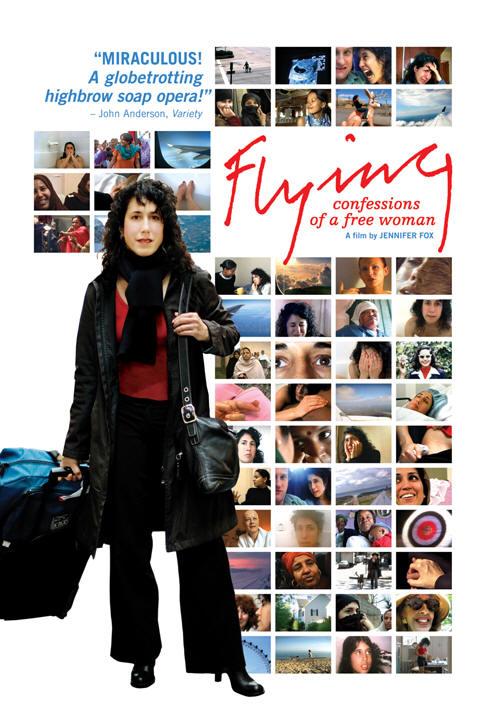
FLYING: CONFESSIONS OF A FREE WOMAN ***

DIRECTED AND WRITTEN BY JENNIFER FOX

There’s something nervy about the way Jennifer Fox, in her new autobiographical six-part, six-hour miniseries, showing this week at the Gene Siskel Film Center, tries to combine her life, her art, and her politics. Made with funding from the Danish Film Institute over a four-year period ending in late 2006, Flying: Confessions of a Free Woman recounts the privileges, confusions, and self-examinations of Fox, a Manhattan-based filmmaker in her mid-40s who grew up associating her freedom with being like a boy, feeling much closer to her permissive father than to her disapproving mother, and never having the slightest interest in getting married or (until recently) having kids.

Known for such PBS documentaries as Beirut: The Last Home Movie (1987) and An American Love Story (1999), a miniseries about the everyday life of an interracial couple, Fox does a fair amount of globe-trotting, and during the time frame of Flying she’s juggling two lovers on separate continents who know about each other. The less serious relationship is with Patrick, a Swiss-German cinematographer she sees more often, mainly in New York (he’s credited as the film’s “technical supervisor”). Read more