Gilda

From the Chicago Reader (January 2, 2004). — J.R.

Gilda-ad

GMRHGE

André Bazin reportedly once hypothesized that if Hollywood were the court of Versailles, Gilda (1946) would have been its Phedre — which may just be a fancy way of pointing out the enduring greatness of a campy melodrama that, from certain points of view, isn’t even very good. Directed by Charles Vidor, memorably shot by Rudolph Maté, and written by Marion Parsonnet, it’s set in a highly fanciful Buenos Aires (with mountains), where a professional gambler (Glenn Ford) goes to work for a casino owner (George Macready) who then marries the gambler’s old flame (Rita Hayworth), thereby setting off the sickest and weirdest bout of repressed love and hatred (both hetero- and bisexual) you ever saw. And Hayworth, whether she’s performing “Put the Blame on Mame” (dubbed by Anita Ellis) or just being her glamorous self, was never more magnificent. With Joseph Calleia and Steve Geray. 110 min. (JR)

large_gilda_02X_blu-ray_

cronenweth-hayworth-ford-gilda-temptress Read more

Theme and Variations [THE LOVERS OF THE ARCTIC CIRCLE]

From the Chicago Reader, May 14, 1999. —J.R.

The Lovers of the Arctic Circle

Rating *** A must see

Directed and written by Julio Medem

With Fele Martinez, Najwa Nimri, Nancho Novo, Maru Valdivielso, Peru Medem, Sara Valiente, Victor Hugo Oliveira, and Kristel Diaz.

Julio Medem’s fourth feature is a love story spanning 17 years — from the time Otto and Ana first meet, as children in a Spanish school yard, to their improbable reunion in the wilds of northern Finland when they’re 25. But the film starts at the end rather than the beginning, and like the names of the two characters, the story can be read backward as well as forward. That story is told by Otto and Ana in alternate bursts, inflected mainly by how Otto views Ana and vice versa, skipping back and forth in time. To make things trickier, the two versions of what happens are sometimes at variance.

When The Lovers of the Arctic Circle joined Open Your Eyes at the Fine Arts last week, it became possible to conclude, with a sigh of relief, that the age of Pedro Almodovar was finally over. I don’t mean that Almodovar won’t continue to make movies or get American distribution, but that his brand of smart-aleck entertainment will no longer have to stand for the whole of Spanish cinema. Read more

Echoes of Old Hollywood [DESTINY & THE ADOPTED SON]

From the Chicago Reader, April 2, 1999. —J.R.

Destiny

Rating *** A must see

Directed by Youssef Chahine

Written by Chahine and Khaled Youssef

With Nour el-Cherif, Laila Eloui, Mahmoud Hemeida, Safia el-Emary, Mohamed Mounir, Khaled el-Nabaoui, Abdallah Mahmoud, and Ahmed Fouad-Selim.

The Adopted Son

Rating *** A must see

Directed by Aktan Abdikalikov

Written by Abdikalikov, Avtandil Adikulov, and Marat Sarulu

With Mirlan Abdikalikov, Albina Imasmeva, Adir Abilkassimov, Bakit Zilkieciev, and Mirlan Cinkozoev.

Apart from their exoticism, Youssef Chahine’s Destiny and Aktan Abdikalikov’s The Adopted Son don’t have much in common. Destiny is the 35th film by Chahine, a 73-year-old writer, director, and sometime actor who’s generally agreed to be the major figure in the history of Egyptian cinema. His subject here is Averroes (1126-1198), a dissident Spanish-Arab philosopher best known for his commentaries on Aristotle, and his film resembles a Hollywood period spectacular — exuberant, packed with action, and positively overflowing with energy. The Adopted Son is both the first independent feature ever made in Kyrgyzstan — a former Soviet republic in central Asia — and the first feature of 42-year-old writer-director Abdikalikov, who cast his own teenage son in the title role. It’s shot mainly in an exquisitely modulated black and white, though it periodically shifts to color, always with great dramatic effect. Read more

Movies: The Big Shill [on trailers & product plugs]

From the Chicago Reader (December 21, 1990). — J.R.

If my paranoid suspicions are correct, Hollywood has embarked on a 12-year plan regarding the public consumption of trailers. The plan, which has become fully apparent to me over the past year, will come to fruition in the year 2000, and its basic goal, as I see it, is to turn movies themselves into full-fledged commercials that people will pay money to see.

When Back to the Future II ended with a trailer for Back to the Future III, it was a harbinger of what’s to come. The ever-increasing proliferation of sequels has already accustomed the public to the notion that any hit movie eventually becomes, at least retroactively, an advertisement for its inevitable successor. Now, through a three-point program that might be termed standardization-infiltration-expansion, Hollywood is force-feeding us a diet of trailers in an apparent effort to alter our modes of perception. Most movie trailers are now designed to resemble one another as closely as possible, from the discontinuous, scattershot cutting to the near-subliminal card of credits flashed at the end. They appear in a variety of fresh contexts — at the beginning and end of videotapes, on “commercial-free” cable channels, and as integral parts of some features, like the aforementioned Back to the Future II — and they crop up so repeatedly in their more traditional venues, in movie theaters and on network TV, that we may come to know certain trailers as intimately as we know certain family members. Read more

Princess Theatre, Florence, Alabama (an “early” photo and news story)

I’m terrible when it comes to dating cars from any period, especially during the early part of the 20th century. According to my memoir Moving Places: A Life at the Movies (1980), which I researched pretty thoroughly back in the late 1970s, “The Florence Princess, an $85,000 Opera House, [opened] triumphantly on Labor Day, September 1, 1919” (see pp. 180-181 in the book for more details). But according to this newspaper photo — which I don’t recall ever having seen before, posted by Betty Terry on “Remembering Florence” (a Facebook page) last November — it cost $40,000 more than that; and according to a news clipping that went with it (see below), which she posted about a week later, it opened, apparently in some other form, in 1925. An abiding mystery…but of course we can never get very far by believing what’s printed in newspapers, then or now, even when that’s all we have left. Because newspapers are largely generated and sustained by advertising, and it’s typically the job of advertising to make things sound brand-new even when they’re simply or merely upgraded.  [1/16/2012]

Read more

Short films, program one

From the Chicago Reader, May 18, 2001. — J.R.

camera

Normally, viewing 16 shorts in a row is a bit like following ice cream with pickles, cheese dip, key lime pie, lima beans, bread pudding, and spinach. But this lineup is relatively homogeneous in its strangeness — evident in the actor’s monologue filmed by children that constitutes David Cronenberg’s 35-millimeter Camera (2000, 6 min.), Joshua Pritzker’s weird animation Small Car (7 min.), Jim Finn’s Communista (a compilation of three songs), and most of all, Todd Rohal’s wildly surrealist Knuckleface Jones (1999, 13 min.), which offers the most peculiar and dreamlike cross-gendered sex I can recall seeing. There are more surrealist high jinks in the other animated shorts, some featuring puppets and clay animation, plus an experimental black-and-white documentary (Trevor Arnholt’s 13-minute digital video The Composer) and a parodic trailer starring Eric Stoltz and Tate Donovan (Paul Harrison’s Jesus and Hutch). The program runs about 95 minutes, and overall it’s not a bad lineup. Biograph, Friday, May 18, 8:00, and Sunday, May 20, 1:00.

— Jonathan Rosenbaum

knucklkeface Read more

Frankie & Johnny Are Married

From the Chicago Reader (December 10, 2004). — J.R.

F&JAM

A fascinating blend of fiction and documentary, this feature by Michael Pressman chronicles his emotionally complicated LA production of Terrence McNally’s play Frankie and Johnny in the Clair de Lune. Pressman’s wife, Lisa Chess, costarred in the show with his old friend Alan Rosenberg, until difficulties with Rosenberg convinced Pressman to take over the part himself. These three and many other people (including Kathy Baker and Hector Elizondo) play themselves in the movie, which only begins to suggest the ambiguities Pressman exploits to the utmost. Emerging from all this is a fascinating look at the nuts and bolts of theater work and an often hilarious depiction of how personal neuroses help and hinder it. R, 95 min. (JR) Read more

Tommy

From Monthly Film Bulletin, April 1975 (Vol. 42, No. 495). — J.R.

Tommy


Great Britain, 1975                                        Director: Ken Russell

Cert-AA. dist-Hemdale. p.c—The Robert Stigwood Organisation.

exec. p-Beryl Vertue, Christopher Stamp. /;Robert Stigwood, Ken

Russefl. assoc. p-Harcy Benn. p. manager-John Comfort. asst. d-

Jonathan Benson. sc-Ken Russell. Based on the rock opera by Pete

Townshend and the Who. addit. Material–John Entwistle, Keith Moon.

ph–Dick Bush, Ronnie Taylor. In colour. sp. ph. effects–Robin Lehman.

ed—Stuart Baird. a.d–John Clark. set dec–Paul Dufficey, Ian Whittaker.

sp. Effects–Effects Associates, Nobby Clarke,_Carygra Effects. m/songs–

“Captain Walker Didn’t Come Home”. “It’s a Bov !” “’51 is Going to be a

a Good Year”, “What About the Boy ?”, “See Me, Feel Me”, “The

Amazing Journey”, “Christmas”, “The Acid Queen”, “Do You Think

It’s All Right?”, “Cousin Kevin”, “Fiddle About”, “Sparks”, “Pinball

Wizard”, ‘Today It Rained Champagne” ,”‘There’s a_Doctor” , “Go to the

Mirror”, “Tommy Can You Hear Me !’” “Smash the Mirror”, “I’m Free”,

“Miracle Cure”, “Sensation”, “Sally Simpson”, “Welcome”, “Deceived”,

“Tommy’s Holiday Camp”, “We’re Not Gonna Take It”, “Listening to

You” by Pete Townshend and The Who [Roger Daltrey,John Entwistle,

Keith Moon, “Eyesight to the Blind” by Sonny Boy Williamson. m.d–

Pete Townshend. musicians-Elton John, Eric Clapton, Keith Moon,

John Entwistle, Ronnie Wood, Kenny Jones, Nicky Hopkins, Chris

Stainton , Fuzzy Samuels, Caleb Quayle, Mick Ralphs, GRaham Deakin,

Phil Chen, Alan Ross, Richard Bailey, Dave Clinton, Tony_Newman,

Mike Kelly, Dee Murray, Nigel Ollson, Ray Cooper, Davey_Johnstone,

Geoff Daley, Bob Efford, Ronnie Ross, Howie Casey. Read more

Rivette’s Rupture (DUELLE and NORÔIT)

From the Chicago Reader (February 28, 1992). For earlier reflections on both films, go here and here. — J.R.

TWHYLIGHT (DUELLE)

**** (Masterpiece)

Directed by Jacques Rivette

Written by Eduardo de Gregorio, Marilu Parolini, and Rivette

With Juliet Berto, Bulle Ogier, Hermine Karagheuz, Jean Babilee, Nicole Garcia, and Jean Wiener.

NOR’WESTER (NORÔIT)

**** (Masterpiece)

Directed by Jacques Rivette

Written by Eduardo de Gregorio, Marilu Parolini, and Rivette

With Geraldine Chaplin, Bernadette Lafont, Kika Markham, Larrio Ekson, Jean Cohen-Solal, Robert Cohen-Solal, and Daniel Ponsard.

Dagger in hand, I scaled the heights of raw power, thanks to the male role that Rivette gave me. . . . This kind of sexual metamorphosis, this strange androgyny, never appeared in the French cinema before Rivette. After I performed the role of Giulia in Norôit I felt that I was capable of anything. Rivette changed my ideas about acting; for me, he is a kind of Mao and his films are a Cultural Revolution. — Bernadette Lafont in an interview, 1977

Though no one would ever think to call Jacques Rivette a realist, the fact remains that all of his first six features take place in a sharply perceived environment that can arguably be called the “real world.” Read more

DVD Beaver Poll (2020)

Top 4K UHD Releases of 2020

1. Sudden Fear Cohen Film Collection (my mistake–this was released in 2017)
2. Showboat Criterion
3. A Bread Factory Grasshopper Films (includes 1 DVD, 1 Blu-Ray)


Top Box sets of 2020 

1. Ida Lupino: Filmmaker Kino Lorber
2. The Complete Films of Agnes Varda Criterion
3. Crazy Ex-Girlfriend: The Complete Fourth Season (Warner Archive)

FAVORITE LABEL: Arrow Academy

FAVORITE Commentary of 2020 (or commentaries): Jeremy Arnold, Sudden Fear, Cohen Film Collectiomn


Best Cover Design Nominations: The Complete Films of Agnes Varda, Criterion

Favorite DVD of the Year: Beau travail, Criterion Read more

Visions Of Europe

Commissioning a director from each of the 25 European Union countries to make a five-minute work displaying a vision of Europe sounds like a swell idea, but the result is more problematic: I’d hate to see these films and videos scattered to the winds as filler in state TV broadcasts, yet this 138-minute marathon (some directors went over the limit) is a bit of a glut. Still, it pinpoints what I like about Finland’s Aki Kaurismaki (facetious folklore) and Hungary’s Bela Tarr (an endless, sorrowful tracking shot) and don’t like about Peter Greenaway (a disgusted fascination with nudity) and the recently assassinated Dutch filmmaker Theo van Gogh (crude derision). Other contributors include Barbara Albert (Austria), Christoffer Boe (Denmark), Tony Gatlif (France), Sharunas Bartas (Lithuania), Teresa Villaverde (Portugal), and Jan Troell (Sweden). In English and subtitled European languages. (JR) Read more

Four Corners

From the Chicago Reader (December 1, 1997). — J.R.

four-corners

The ninth feature of experimental filmmaker James Benning (11 x 14, One Way Boogie Woogie, Landscape Suicide, Deseret) is one of his most ambitious and powerful. Four Corners takes as its jumping-off point the famous tourist spot where New Mexico, Arizona, Colorado, and Utah meet, but as a complex meditation on landscape, history, and painting, its subject is really the entire country (one of the longest passages deals with Milwaukee, where Benning grew up). The film examines four paintings by very dissimilar artists (Monet, Jasper Johns, a black man from Alabama, and a first-century Native American); presents biographical sketches of each painter; explores migration history, ethnic displacement, and conflicts in particular areas of Milwaukee or Four Corners; includes 13 fixed (and beautifully composed) shots of each area; and records two pieces of ethnic music (by a Navajo band and a prerap Harlem group). But Benning convinces us that nearly all these things are part of the same story, a politically potent one that brims with a sense of everyday life. (JR)

FourCorners Read more

Fight Club

This exercise in mainstream masochism, macho posturing, and designer-grunge fascism (1999) is borderline ridiculous. But it also happens to be David Fincher’s richest movie — not only because it combines the others (Alien3, Seven, The Game) with chunks of Performance, but also because it keeps topping its own giddy excesses. Adapted by Jim Uhls from Chuck Palahniuk’s novel, this has something  — but only something — to do with a bored Edward Norton encountering a nihilistic doppelganger (Brad Pitt) who teaches him that getting your brains bashed out is fun. Though you’re barely allowed to disagree with him, your jaw is supposed to drop with admiring disbelief at the provocation, and the overall impression of complexity might easily be mistaken for the genuine article. In other words, this is American self-absorption at its finest. With Helena Bonham Carter, Meat Loaf, and Jared Leto. 139 min. (JR) Read more

HARRY AND TONTO (1975 review)

From Monthly Film Bulletin, January 1975 (Vol. 42, No. 492). -– J.R.

Harry and Tonto

U.S.A., 1974
Director: Paul Mazursky

Harry Coombs, an elderly widower who lives with his cat Tonto, is evicted from his West Side Manhattan apartment when the building is slated for demolition. After spending some time in the suburban home of his son Burt, where he tends To sympathize with the vow of silence taken by his grandson Norman over the objections of the latter’s parents and more conventional brother, he decides to visit his daughter Shirley in Chicago. Quarrelling with security officials at the airport about his carrying case for Tonto, he decides to go to Chicago by bus, but leaves the vehicle en route when Tonto refuses to relieve himself in the bus toilet. He buys a used car and picks up Ginger, a runaway- teenager, who decides to accompany him and persuades him to look up an old flame, Jessie, in Fort Wayne, Indiana, where she is residing in an old folks, home. In Chicago he re-encounters Norman, dispatched by Burt to bring him back to New York; but after a short stay with Shirley, he decides to drive West with Norman and Ginger. He leaves the car with the youngsters in Arizona so that he can drive to a commune, and hitch-hikes from there to California — encountering on the way a health food salesman named Wade, a prostitute offering free fornication, and an Indian named Sam Two Feathers with whom he shares a jail cell after urinating on a sidewalk plant in Las Vegas. In Read more

U-turn

From the Chicago Reader (September 30, 1997). — J.R.

U-Turn

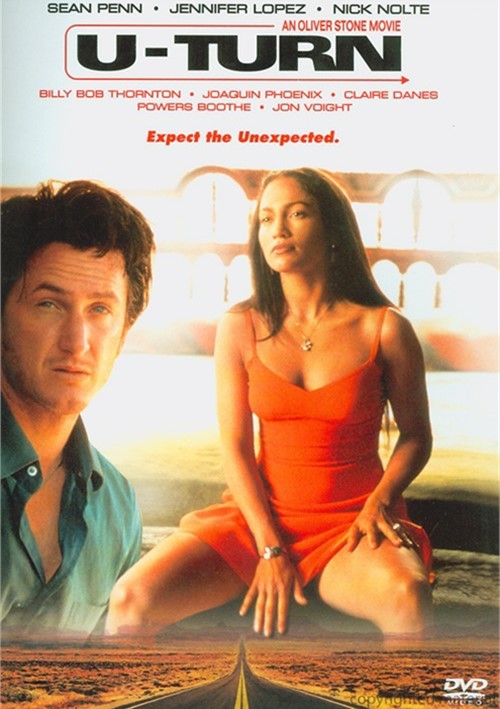
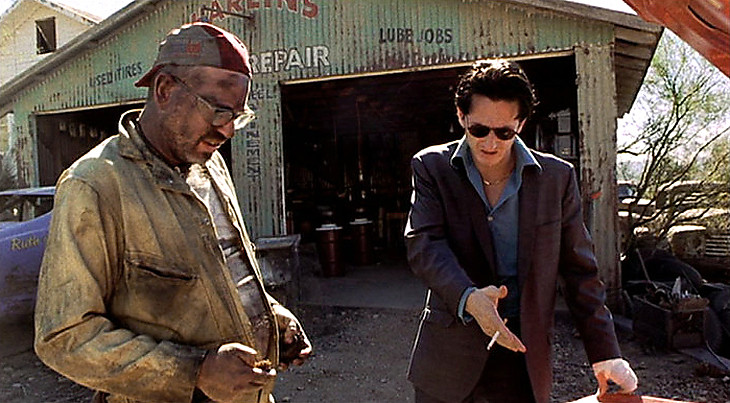
A fairly enjoyable piece of junk from Oliver Stone (1997) that occasionally recalls Dennis Hopper’s The Hot Spot — sleazy southwest burg seething with creeps, sexpots, and protracted grudge matches — and is limited only by its occasional pseudoexperimental tics (a carryover from Natural Born Killers) and by its determination to extend its hyperbolic noir plot beyond two hours. Sean Penn plays a con man whose car breaks down en route to Las Vegas, where he’s supposed to settle a debt; Billy Bob Thornton, as the ornery mechanic who extends his stay, is the first in a string of overblown caricatures that for better or worse define the movie — others are offered by Jennifer Lopez, Nick Nolte, Julie Hagerty, Powers Boothe, Joaquin Phoenix, Jon Voight, Claire Danes, Bo Hopkins, Laurie Metcalf, and Liv Tyler. The tricky and tricked-up script is by John Ridley. (JR)

1997  Billy Bob Thornton and Sean Penn in "U Turn"  TriStar Pictures Read more