EYES WIDE SHUT

This comes from the top of my 1999 ten-best column for the Chicago Reader in January 2000. — J.R.
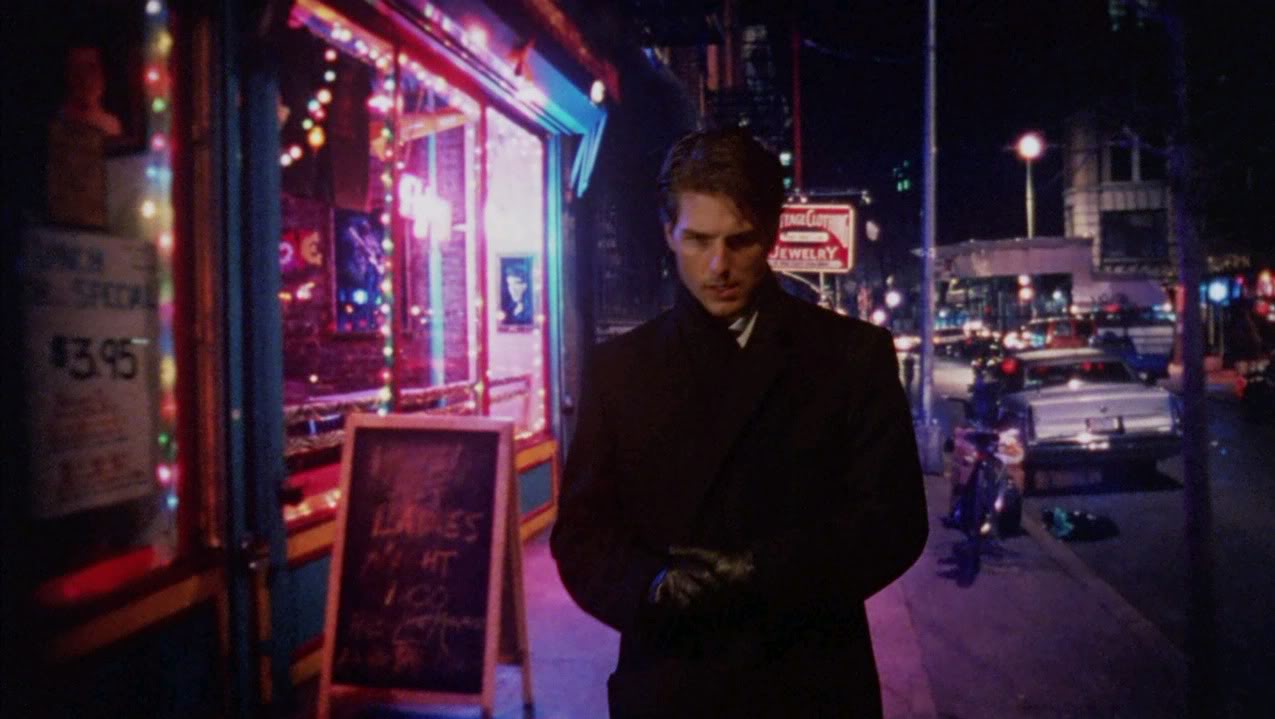
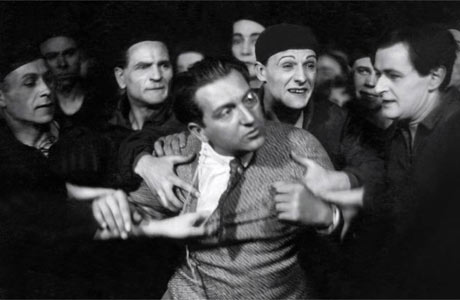
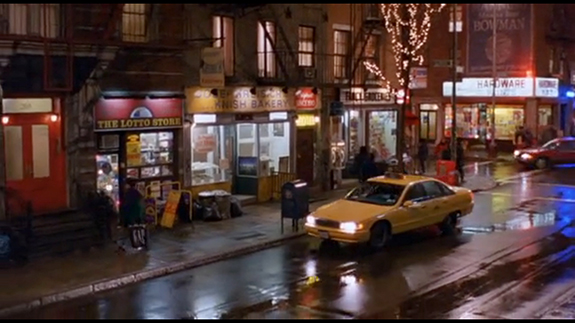
Eyes Wide Shut. Part of what irked some reviewers about Kubrick’s eccentric masterpiece is one of the things I treasure about it -– its distance from its own period. This quality is shared by at least two sublime testament films released in the 60s to similar amounts of scorn, Carl Dreyer’s Gertrud (1964) and John Ford’s 7 Women (1966). Both of them are clearly set in earlier periods; Kubrick’s is purportedly set in present-day New York but was adapted from “Traumnovelle,” a 1926 novella by Arthur Schnitzler set in prewar Vienna. All three depend on highly stylized and subjective renderings of time and place that become an essential part of their memory-laden textures. (To correct two factual errors in my original review: the prewar setting of Schnitzler’s novella can be gleaned from a reference to Bohemia, not Czechoslovakia, and Schnitzler wasn’t a friend of Freud’s but an ambivalent contemporary reader of his work, though Freud did once refer to Schnitzler as his “doppelganger,” apparently because they held some similar notions about psychology.)
Like many an artist before him, Kubrick went from being part of his own time — for better and for worse, Dr. Read more

A Dozen Undervalued Movie Satires

 Posted by DVD Beaver in January 2007 (http://www.dvdbeaver.com/film/articles/dozen_undervalued_movie_satires.htm) .  — J.R.


One reason why I haven’t gone earlier than 1940 in this chronological list is that satire depends on a certain amount of currency in order to be effective, and the further off we are in time from a given movie, the less likely it is to affect us directly. This isn’t invariably true, and it certainly doesn’t apply to literature: think of Voltaire’s Candide, first published in 1759, which probably seems more “up to date” today than Terry Southern and Mason Hoffenberg’s Candy, first published in 1958. But it’s also important to realize that one of the best ways to understand a historical period is to discover how it was ridiculed by its contemporaries.


With some significant exceptions—-Stanley Kubrick’s Dr. Strangelove is one of the most striking—-satire, as playwright and Algonquin wit George S. Kaufman once put it, is what closes in New Haven, and this is especially true of most movie satires. Apart from the studio fodder (the first two items here), and discounting the arthouse features of Buñuel and Kiarostami, all these movies were either flops or at most modest successes, and some were resounding flops.

Read more

Cassavetes’ Prelude and Postscript

This article was commissioned by the Torino Film Festival to accompany a John Cassavetes retrospective in November 2007, and was published there in a substantial catalogue/collection in Italian translation. I’m sorry I can’t do a better job of illustrating this: apart from some pictures of Cassavetes, Rowlands, and Carol Kane, there are no appropriate images available to me. I’m grateful, in any case, to Jim Healy and Emanuela Martini for asking me to write this. — J.R.

——————————————————-

Cassavetes’ Prelude and Postscript: The Original Shadows and A Woman of Mystery

by Jonathan Rosenbaum

——————————————————-

I consider myself unusually fortunate in having been able to see the original version of Shadows in January 2004. Shot in the spring of 1957 and screened publicly only four or five times, the first completed version of the first film of John Cassavetes had been considered irretrievably lost for almost half a century.

More specifically, I saw the first of two public projections at the Rotterdam International Film Festival of a good video transfer of the rediscovered 16-millimeter print, presented by Ray Carney, the man who rediscovered the print. After these two screenings, objections were raised by Cassavetes’ widow, Gena Rowlands, with the result that subsequent public screenings have been forbidden by her. Read more

Unified Theory [METROPOLIS]

This appeared in the August 16, 2002 issue of the Chicago Reader. I more recently had occasion to return to this film and some of my thoughts about it when I joined David Kalat to do an audio commentary on the expanded (and now nearly complete) version of Metropolis for the English DVD of Masters of Cinema. In fact, the essay below was used by Masters of Cinema in the accompanying booklet of their previous edition of  the film, and an updated version of this piece appeared in the next one. — J.R.

Metropolis

**** (Masterpiece)

Directed by Fritz Lang

Written by Lang and Thea von Harbou

With Gustav Frohlich, Brigitte Helm, Alfred Abel, Rudolf Klein-Rogge, Fritz Rasp, Theodor Loos, and Heinrich George.

The internationalism of filmic language will become the strongest instrument available for the mutual understanding of peoples, who otherwise have such difficulty understanding each other in all too many languages. To bestow upon film the double gift of ideas and soul is the task that lies before us.

We will realize it! — Fritz Lang, in an article published in 1926

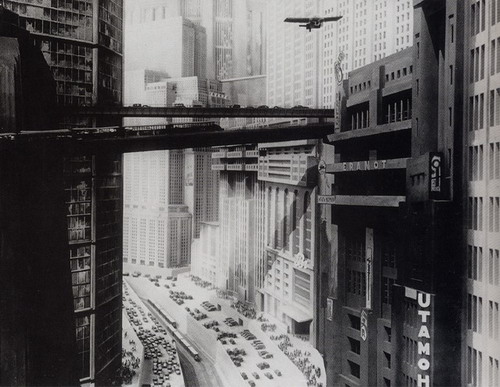
Lang’s utopian rallying cry, written in Germany during the editing of Metropolis, is well worth recalling today. Read more

PLACING MOVIES, Part 1: The Critical Apparatus (Introduction)

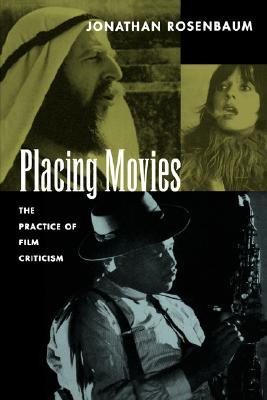
This is the Introduction to the first section of my first collection, Placing Movies: The Practice of Film Criticism (University of California Press, 1993). I’ve taking the liberty of adding a few links to some of the pieces of mine mentioned here which appear on this web site. — J.R.


PlacingMovies


Introduction


Although this entire book is devoted to film criticism as a practice, this section emphasizes this fact by dealing with film criticism directly as a subject. This includes both specific examinations of the work of other critics and polemical forays into questions about how critics and reviewers operate on a day-to-day basis. A broader look at the same topic might question whether film criticism as it’s presently constituted is a worthy activity in the first place — if in fact the public would be better off without it.


I should add that it’s the institutional glibness of film criticism in both its academic and mainstream branches — above all in the United States, where it seems most widespread and least justifiable — that has led me on occasion to raise this latter question. Speaking as someone who set out to become a professional writer but not a professional film critic, I’ve never felt that movie reviewing was an especially exalted activity, but I didn’t start out with any contempt or disdain for the profession either. Read more

Under the Chador

From the Chicago Reader (April 6, 2001). This is also reprinted in my collection Essential Cinema.— J.R.

The Day I Became a Woman

***

Directed by Marzieh Meshkini

Written by Mohsen Makhmalbaf

With Fatemeh Cheragh Akhtar, Hassan Nabehan, Shabnam Toloui, Cyrus Kahouri Nejad, Azizeh Seddighi, and Badr Irouni Nejad.

“Aren’t you afraid?” some of my stateside friends asked before I visited Iran for the first time last February. “Only of American bombs,” I replied. Notwithstanding all of the things that are currently illegal there — such as men and women shaking hands or riding in the same sections of buses — I’m not sure I’ve ever been    anyplace where people display more social sophistication in terms of hospitality, everyday courtesy, or sheer enterprise in the use of charm and persistence to get what they want. Some of this character came through in Divorce Iranian Style, a fascinating documentary that turned up at the Film Center a couple of years ago showing the aggressive resourcefulness of Iranian women in divorce court, despite the repressive laws they have to work with.

The locals I spoke to tended to be pessimistic about the reformist movement — regarding Mohammad Khatami about as skeptically as American liberals regarded Bill Clinton during his last year in office — but it also quickly became clear that some aspects of Iranian life are not defined by Islamic fundamentalism and that what might seem hopeless in one context might be possible in another. Read more

Patience Pays Off [I’M GOING HOME]

From the Chicago Reader (September 13, 2002). — J.R.

I’m Going Home

**** (Masterpiece)

Directed and written by Manoel de Oliveira

With Michel Piccoli, Antoine Chappey, Catherine Deneuve, John Malkovich, Leonor Baldaque, and Sylvie Testud.

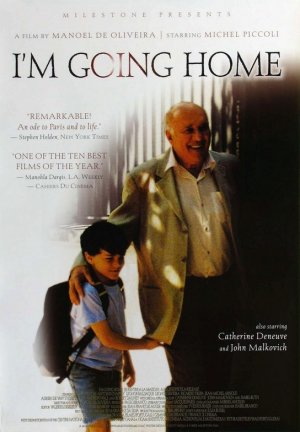
It seems entirely fitting that I’m Going Home — a beautiful feature by Manoel de Oliveira, who turns 94 this December and is still going strong — should open in Chicago, at the Music Box, just after September 11. This 2001 French film by a Portuguese master who occasionally makes films in France is the kind of quiet masterpiece that fully registers only after you’ve seen it — a profound meditation on bereavement and other kinds of loss (including losing one’s way) as well as on everyday life and things right under our noses that we accept as “other,” including old age and art and different cultures.

The French DVD of this film has an interview with Oliveira in Portuguese, subtitled in French, in which he explains what this movie means to him. He speaks alternately about the film’s plot, which he calls a tragedy, the real incident that inspired it (a famous actor in his 70s forgot his lines while shooting a film), and what he calls the “tragedy of our civilization.” Read more

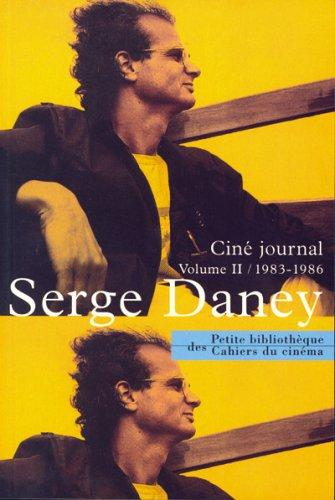
Daney in English: A Letter to Trafic

Written for and originally published (in French translation) in Trafic no. 37 (printemps 2001); also reprinted in my 2010 collection Goodbye Cinema, Hello Cinephilia. — J.R.

Chicago, November 13, 2000

Dear Jean-Claude, Patrice, Raymond, and Sylvie,

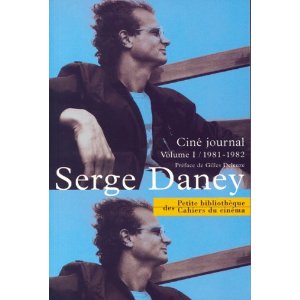
Trying to find a useful way to discuss Serge Daney in an Anglo-American context, it’s hard not to feel a little demoralized. I recently looked up the letter I wrote to a university press editor in early 1995, not very much shorter than this one, enumerating -– to no avail -– all the reasons why bringing out a collection of Serge’s film criticism in English was an urgent matter and a first priority, almost comparable in some ways to what making Bazin available in English had been in the ’60s.

I believe this might have been the longest “reader’s report” I’ve ever written for a publisher. I was trying to persuade the editor to publish a translation of Daney texts that in fact had already been commissioned and completed in England, but, for diverse reasons, had never appeared in print. All the texts chosen came from Ciné journal and Devant la recrudescence des vols de sacs à main. I thought this translation needed some revision to make it more graceful and user-friendly, and I would have preferred a broader selection. Read more

An American in Paris [ROUND MIDNIGHT]

2021 note: In part because I had unkind things to say about his first feature in 1974, writing at the time from Paris, my relations with Bertrand Tavernier (1941-2021) tended to be strained, even though both of us periodically tried to overcome this rift — and, to his credit, he was the one who made the first friendly gesture, inviting me to join him for a meal in Chicago many years later.. Round Midnight is probably the film of his that has affected me the most, which is why I’m reposting this piece now.

Part of my 1987 application for the job of film reviewer at the Chicago Reader consisted of writing three long sample reviews for them in March and/or April — only one of which was published by them (Radio Days), although, as I recall, they paid me for all three. (Writing these pieces in Santa Barbara, I was limited in my choices of what I could write about.) I only recently came across the two unpublished reviews, of Platoon and Round Midnight, in manuscript, although I recall that I did appropriate certain portions of them in subsequent reviews. Otherwise, the first publications of these pieces are on this site. Read more

List-o-Mania, or, How I Learned to Stop Worrying and Love American Movies

Based on feedback, I would guess that this article, which first appeared on June 25, 1998, is the most popular piece I ever published in the Chicago Reader. Although it’s been featured as a separate item for several years on their site, I noticed that, thanks to some of their recent user-unfriendly retoolings of that site — which makes it much harder to access anything and everything, including this article — my own list of my 100 favorite films at the end of this piece and the AFI’s list of the supposedly greatest 100 films somehow got scrambled together. [Update, 7/25/09:  Checking back a day later, this now appears unscrambled.] This is mainly why I’ve decided to reprint the original piece here in Notes, with only a few minor modifications. I revised and expanded this piece still further in my book Movie Wars: How Hollywood and the Media Limit What Films We Can See, where it forms the sixth chapter. (I’m sorry that the English edition of this, which has a much better jacket, has become more scarce.) One of the main additions, on page 93, is a list of the 25 titles on the AFI list that I probably would have included on my own if I hadn’t wanted to create an all-new list for polemical purposes; six of these titles are illustrated at the tail-end of this piece. Read more

The Hot Spot

From the Chicago Reader (May 1, 1991). — J.R.

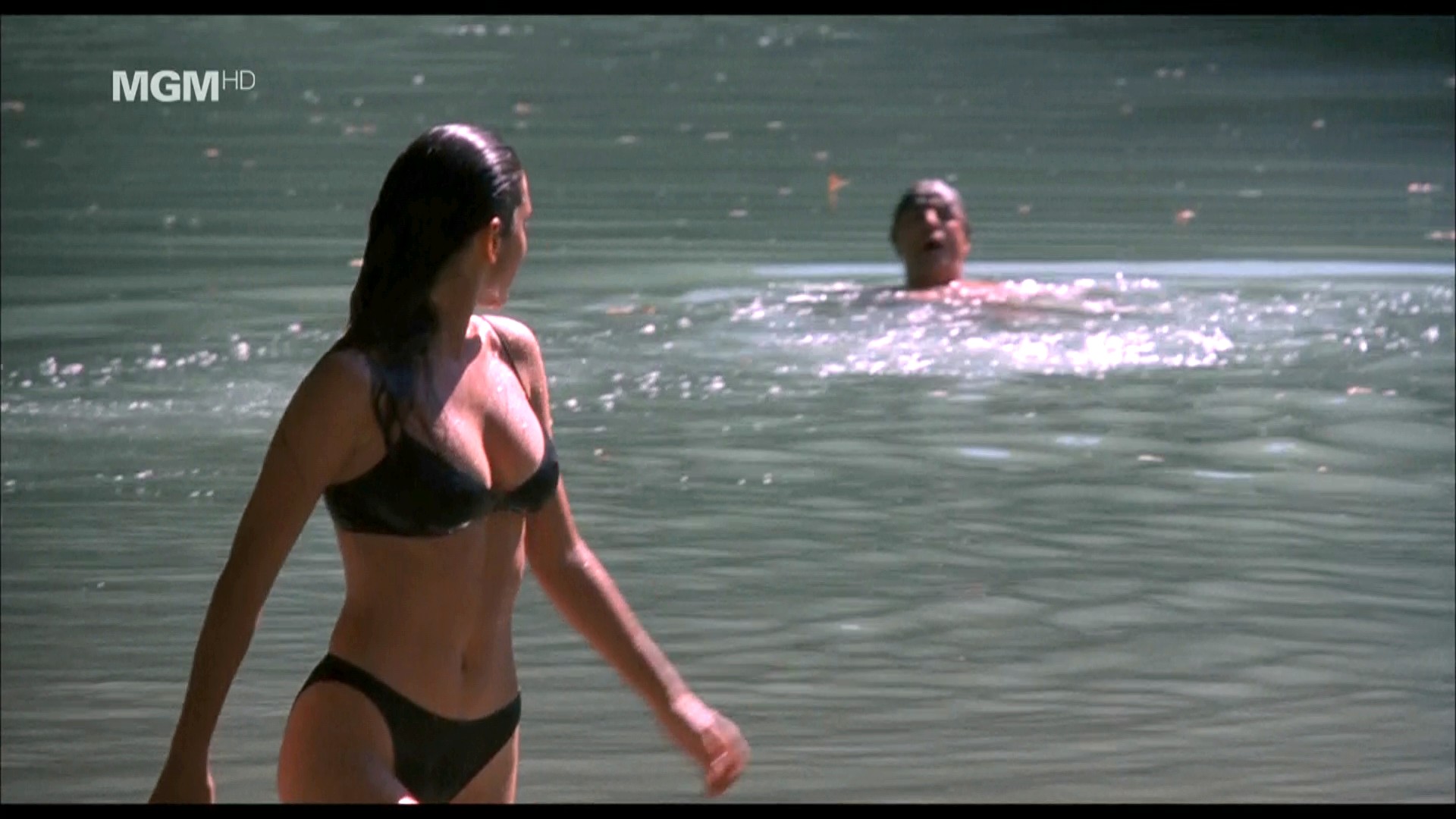
fhd990THS_Jennifer_Connelly_038

Considering that the script for this 1990 movie (by the late Charles Williams and his wife Nora Tyson, adapted from Williams’s novel Hell Hath No Fury) was in development for about 30 years and that the film is Dennis Hopper’s worst as a director, this is still pretty enjoyable as a piece of campy sleaze — especially for the first half hour, before the storytelling starts to dawdle. There’s a score by John Lee Hooker and Miles Davis, who pursue waspy duets, and Hopper’s eye for color and composition is as sharp as ever. But even if one overlooks the noirish misogyny (no easy matter), the story is still an overheated hoot. Just when one hopes that the scumbag characters — including a footloose hustler (Don Johnson) who sidles into a job as a car salesman in a sleepy Texas town, his boss’s sexpot wife (Virginia Madsen), and a seedy, bemused banker (Jack Nance) — will develop beyond their cliches, they become even sillier. And the apparently innocent accountant (Jennifer Connelly) who becomes entangled in the morass isn’t any more believable. Some may view the film’s liabilities (e.g. the inexpressive Johnson filling the foreground like a block of wood) as assets and coast along with the steamy sex, but it’s still pretty slim pickings from the man who once made Out of the Blue. Read more

Don’t Worry, Be Unhappy [SEVEN, aka SE7EN]

From the October 6, 1995 Chicago Reader. — J.R.

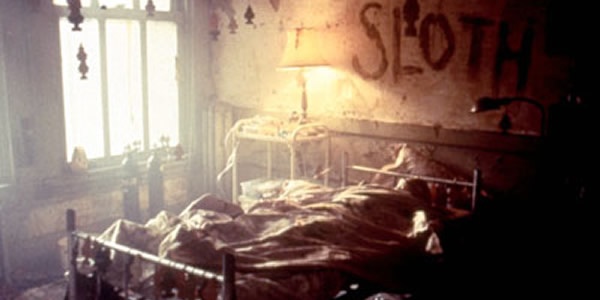
Se7en-1995-Seven-MSS-23

se7en-1995-crop-1

Seven

*** (A must-see)

Directed by David Fincher

Written by Andrew Kevin Walker

With Morgan Freeman, Brad Pitt, Gwyneth Paltrow, Richard Roundtree, R. Lee Ermey, John McGinley, Julie Araskog, Mark Boone Junior, and Kevin Spacey.

http://gothamist.com/attachments/nyc_arts_john/012309se7enpic.jpg

Since when have designer vomit, mannerist rot, and other chic signifiers of gloom, doom, and decline become such comforting mainstays of movies? I’m thinking not only about Hollywood but about Western cinema generally. What brings on all the driving, dirty rain in Satantango (Bela Tarr’s seven-hour Hungarian black comedy, which showed at last year’s Chicago International Film Festival) as well as in Seven, a stylish and affecting (albeit gory) metaphysical serial-killer movie? The facile solution would be to trace the gloom back to Blade Runner, film noir, maybe even to Prague school surrealism, though this would omit the Calvinist/expressionist vision of urban filth and the post-Vietnam psychopathology of Taxi Driver. In point of fact, it’s much more important to figure out the reasons for the strange allure of this grim sensibility than to worry pedantically about where it came from.

I’d ascribe at least part of this taste to the current inability to believe in or try to effect political change — a form of paralysis that in America is related to an incapacity to accept that we’re no longer number one. Read more

Global Discoveries on DVD: Lessons in Oppression

From Cinema Scope no. 91, Summer 2022.

Apart from those few who managed to escape from totalitarian regimes and occupied countries, most North Americans know as little about living under a dictatorship and/or in an occupied territory and what that entails as I do. For the past two decades, I’ve been periodically arguing that progressively minded Yank cinephiles missed the boat in the ’60s and ’70s by focusing too exclusively on Godard, Bertolucci, and similarly oriented Western leftists while ignoring the far more politically and formally radical inventions of Eastern European cinema by Chytilová, Jancsó, and Makevejev, among others — an avoidance that largely came about because we didn’t know more about what was happening in those parts of the world. A comparable limitation in the 1930s and 1940s led critics such as Dwight Macdonald to focus far more on Eisenstein and Pudovkin than on Dovzhenko, and as I’ve argued elsewhere, even a passionate Dovzhenko fan such as James Agee was fairly clueless about the political difficulties this Ukrainian filmmaker was having with the Russians.

Bearing this shared ignorance in mind, all of the most striking releases I’ve encountered this spring —Serge Loznitsa’s Donbass (2018), on DVD from Salzgeber & Co. Read more

3 Days at the Kitchen: Notes of a Videophobe

From The Soho News (October 29, 1980). — J.R.

What attracted me to sign up in advance for a symposium called “Television/Society/Art,” put on at the Kitchen and NYU last weekend, was the opportunity to see and hear some old friends, encounter some new people, and maybe even get some new ideas (about what I should be reading and seeing, if nothing else): a bargain for the $10 registration fee.

Presented by the Kitchen and the American Film Institute and organized by Ron Clark, a senior instructor at the Whitney Museum’s Independent Study Program, the three-day event inevitably threatened a few dead spots — particularly to a virtual videophobe like me, who largely regards the medium as a kind of wicker basket holding a few magazines that I’m neither interested in reading nor quite ready to throw away. On the other hand, the fact that some of the invited panelists seemed to share the same bias made me suspect that I’d feel right at home.

The symposium got off to a somewhat inauspicious start with the presentation of a lumbering keynote paper entitled “Television Images, Codes and Messages” by Douglas Kellner, a teacher of philosophy at the University of Texas’s Austin campus. Read more

En movimiento: The Unfinished Dance of Meaning

An “En movimiento” column for Caimán Cuadernos de Cine. This is the original, longer version, before I had to trim it down to suit the magazine’s new design and format — J.R.

meg-merlin-margaret-obrien-suffering-terribly-in-the-unfinished-dance-19471

It’s logical and inevitable that the meanings of films change over time. After all, we’re the ones who determine, discover, and/or describe those meanings, and it’s obvious that we and our understandings change over time.  At some point during my first decade, I saw a film in which poisoned biscuits played some role in the plot, and during a trip with my parents soon afterwards, I refused to eat biscuits in a hotel restaurant. I’ve subsequently been unable to remember or otherwise pinpoint the title of this film, even after several Google searches, but I’m sure that if I could resee it today, I wouldn’t take it as a practical warning about consuming biscuits.

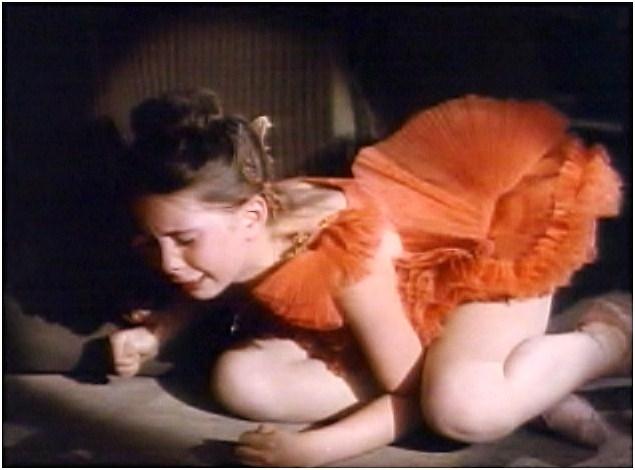
I’ve had better luck in finding and revisiting another film that upset me during my early childhood. A protracted search in this case eventually yielded The Unfinished Dance (Henry Koster, 1947), which I most likely saw at a revival in my hometown in Alabama circa 1949 or 1950, when I was six or seven, and didn’t see again until over six decades later, after ordering a DVD. Read more