Wim Wenders’s ambitious and audacious feature (1988) focuses mainly on what’s seen and heard by two angels (Bruno Ganz and Otto Sander) as they fly over and walk through contemporary Berlin. These are the angels of the poet Rilke rather than the usual blessed or fallen angels of Christianity, and Wenders and coscreenwriter Peter Handke use them partially to present an astonishing poetic documentary about the life of this city, concentrating on an American movie star on location (Peter Falk playing himself), a French trapeze artist (Solveig Dommartin), and a retired German professor who remembers what Berlin used to be like (Curt Bois). The conceit gets a little out of hand after one of the angels falls in love with the trapeze artist and decides to become human; but prior to this, Wings of Desire is one of Wenders’s most stunning achievements, certainly in no way replaceable by City of Angels, the ludicrous 1998 Hollywood remake. In English and subtitled French and German. PG-13, 128 min. (JR) Read more
Weighing in at 173 minutes, this visually expansive but intellectually and formally simplified adaptation of Milan Kundera’s fine novel holds one’s interestthanks in large part to the talented and attractive leads (Daniel Day-Lewis, Juliette Binoche, and Lena Olin) and the polish that cinematographer Sven Nykvist and coscreenwriter Jean-Claude Carriere bring to the occasion. But Philip Kaufman’s effort to create a romantic epic around a Czech menage a trois before, during, and after the Russian invasion of 1968 shortchanges the original by making virtually all of the action strictly linear and eliminating most of the essayistic material that is essential to the story’s meaning. Arguably, most of the participants make the best of a bad bargainDay-Lewis does what he can with an underscripted character, and he and the two female stars cope honorably with the unenviable task of speaking English with Czech accents, while Kaufman does a good job of matching his own re-creation of the Russian invasion with newsreel footage. But these achievements and othersincluding an undeniable erotic charge to some of the scenesadd up to less than the sum of their parts without a strong enough overall vision to shape them. When Kaufman reaches beyond the novel to flesh things outwith the old-fashioned musical taste of Russian officials, the sexual exploits of the hero, or the expanded part of a pet pighe usually flattens rather than enhances what’s left of the material (1988). Read more
If you thought you might be spared yet another replay of Bambi Meets Godzilla in this international assortment of nearly two dozen irreverent cartoons, collectively R-rated, think again (1988). By rough estimate, eight of these shorts are concerned with sex and eight more with extreme violence (including torture and dismemberment), leaving five devoted to bathroom jokes, and a couple more that might be described as eastern European variations of Saul Steinberg concepts. Nearly half of them coast along on their determination to be scuzzy and/or nasty, but my own favorites in the bunch are good simply because they’re inventive and funny: Bruno Bozzetto’s Strip Tease and Guido Manuli’s Erection (both Italian and raunchy), Wes Archer’s punky Jac Mac and Rad Boy . . . Go! and Bill Plympton’s original and oddball One of These Days (both American and violent), and Michel Ocelot’s French, pithy, and scabrous religious parable Four Wishes. (JR) Read more
Despite a hokey prologue and ending (the latter imposed by producer Charles Evans), this 1988 feature is one of George Romero’s most effective and interesting horror thrillersnot as profound as his remarkable Living Dead trilogy, but unusually gripping and provocative. Based on Michael Stewart’s novel of the same title, the plot concerns Allan (Jason Beghe), a law student who becomes a quadriplegic. His best friend (John Pankow), a scientist who has been experimentally injecting human brain tissue into a monkey named Ella, decides to have the monkey trained by a professional (Kate McNeil) to take care of Allan. But Allan, who becomes involved with the monkey trainer, gradually discovers that Ella is both tapping into and acting upon his repressed ragewith dire consequences for his overbearing mother, shrewish nurse, and former fiancee among others, climaxing in a highly suspenseful confrontation. Like other Romero films, this is both crude and powerful on the level of genre and sophisticated and subtle in its social and psychological implications (which, in this case, mainly have to do with sexual undertonesthe competition of various females, including the monkey, for the hero’s care and affection). Certain characters, like the nurse and the mother, are crudely drawn, but their functions in the overall scheme are shrewdly orchestrated, and what emerges represents an interesting variation on themes from Val Lewton (mainly Cat People) and Alfred Hitchcock (mainly Rear Window). Read more
Yet another comedy about a boy occupying a man’s body, this one produced by James L. Brooks and Robert Greenhut, written by Anne Spielberg (sister of Steven) and Gary Ross, and directed by Penny Marshall (1988). A teenager attends a carnival, makes a wish about growing up to a fortune-telling machine, and promptly turns into Tom Hanks. While this is marginally better and more serious than most of the other movies in the cycle, the psychological ramifications of the change still aren’t very convincing. The hero in this case becomes an ace executive at a toy company and wins the heart of Elizabeth Perkins (acquitting herself rather well here), but ultimately decides to become a Norman Rockwell teenager again. Once again, the overall premise is milked for some mild titillation involving the hero’s sexual innocence, making one wonder if the genre’s popularity might involve some deeply sublimated form of kiddie pornarguably the distilled ideological essence of squeaky-clean Reaganism. In keeping with the overall Spielbergian metaphysics, even skid row has a scrubbed look here; but as far as the movie’s message is consideredif only grown-ups could be more like kidsJerry Lewis did an infinitely better job of plugging it in the 50s. Read more
Set in Paris in 1926 among American expatriates, this Alan Rudoph feature (1988) isn’t everything one might hope for; Rudolph had wanted to film his and Jon Bradshaw’s script since the mid-70s, and it probably stewed in his consciousness too long. But for the first hour it’s very nearly as good as Choose Me and Remember My Name, and even when it isn’t working it remains fascinating. Set in a claustrophobic world of cafes, studios, and other cluttered interiors, with a great many smoky close-ups and drifting camera movements, the film is about the public profile of modernism more than its inner workings. Rudolph treats all his characters as contemporaries rather than historical figures, and as usual in his work the cover stories of the characters count for more than anything else, even when slipping away. The cast is by and large superb: Keith Carradine, Geraldine Chaplin, Linda Fiorentino, Genevieve Bujold, Kevin J. O’Connor (as Ernest Hemingway), Wallace Shawn, and John Lone. 128 min. (JR) Read more
An unexpected triumph. Writer-director Ramon Menendez’s 1988 account (based on a true story) of how a math teacher at the mainly Hispanic Garfield High School in East LA (Edward James Olmos) turns a group of students into whizzes at calculus makes for a lively and rousing show. Working with a talented cast (including Lou Diamond Phillips, Rosana DeSoto, and Andy Garcia) and cowriter Tom Musca, Menendez reworks the theme of Blackboard Jungle without the sensationalism or the sexism, and proves that they aren’t needed to give his material a jolt. It’s virtually impossible to dramatize the actual teaching of mathRichard Brooks had even less success in showing the work of an English teacher in Blackboard Junglebut Menendez tells the rest of the story with verve and apparent authenticity, and Olmos is especially effective in focusing the story with a minimum of liberal homilies and a great deal of unglamorous charisma. 105 min. (JR) Read more
A peculiar SF allegory about a mental patient in Buenos Aires who claims to be from another planet, this probably has the second best use of the climax from Beethoven’s Ninth in a film (after Tarkovsky’s Stalker). Not for every taste, and perhaps a bit deja vu for spectators who’ve encountered too many versions of this visionary Christian parable elsewhere, but otherwise odd enough to warrant a look. Directed by Eliseo Subiela, with Lorenzo Quinteros, Hugo Soto, and Ines Vernego (1988). (JR) Read more
From the Chicago Reader (March 1, 1988). — J.R.
Luis Buñuel’s 1959 El fievre monte a El Pao follows a Latin American country’s attempts at political reform after its dictator is assassinated. Buñuel described this as the worst of his French films (it was a French-Mexican coproduction), yet it has its ardent defenders, among them Jean-Marie Straub and Daniele Huillet. As Buñuel’s most directly political work, it certainly warrants a look. With Gerard Philipe, in his last screen appearance, and Maria Felix. Read more
An unusually ambitious effort from horror movie specialist Wes Craven (A Nightmare on Elm Street), filmed on location in Haiti (as well as the Dominican Republic). This genuinely frightening 1988 thriller follows the efforts of an anthropologist (Bill Pullman) sent by a U.S. pharmaceutical company to find the chemical mixture used in zombificationthe voodoo practice that simulates death while leaving the victim alive and conscious. Depending largely on hallucinations and psychological terror (a la Altered States), and working from a Richard Maxwell and A.R. Simoun screenplay inspired by Wade Davis’s nonfiction book of the same title, Craven provides more atmosphere and creepy ideas than fluid storytelling. But it’s nice for a change to see some of the virtues of old-fashioned horror filmsmoody dream sequences, unsettling poetic images, and passages that suggest more than they showrather than the usual splatter shocks and special effects (far from absent, but employed with relative economy). Cathy Tyson plays the hero’s Haitian guidea psychiatrist alert to some of the cultural ramifications of voodooand Zakes Mokae, Paul Winfield, and Brent Jennings, as other agents of the hero’s dark education in prerevolutionary Haiti, are effective as well. (JR) Read more
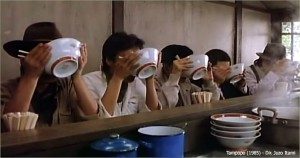
Juzo Itami’s second comedy (1987) represents a quantum leap beyond his first (The Funeral): without abandoning his flair for social satire, he expands his scope to encompass the kind of narrative free play we associate with late Buñuel. His subjects are food, sex, and death, roughly in that order, his ostensible focal point the opening of a noodle restaurant. Working with a venerable cast that includes veterans of Kurosawa, Ozu, Shinoda, and Terayama, he takes us on a wild spree through an obsession, winding his way through various digressions with a dark, philosophical wit that is both hilarious and disturbing. Not to be missed. In Japanese with subtitles. Read more
John Waters’s 1988 musical comedy set in 1962 Baltimore represented a good many firsts for the celebrated underground bad taste writer-director-producer: his biggest budget, his first period foray, his first PG-rated movie, and his first real brush with politicsthe issue of integrating a local TV dance show in Baltimore during the height of the civil rights movement. The cast includes Debbie Harry, Sonny Bono, Divine (in a dual role), Jerry Stiller, Ruth Brown, and cameo appearances by Ric Ocasek and Pia Zadora as beatniks. Not only Waters’s best movie, but a crossover gesture that expands his appeal without compromising his vision one iota; Ricki Lake as the hefty young heroine is especially delightful. With many arcane dance steps and hit singles from the period. 96 min. (JR) Read more
It’s a pity that producer and onetime actor (Come Blow Your Horn) Tony Bill doesn’t have a better sense of history in his direction of this nostalgic piece of exploitation (1988) about a lower-middle-class Bronx neighborhood in 1964, although screenwriter John Patrick Shanleywhose script for Moonstruck exhibits a related sense of New York cozinessis also partially responsible. An Irish working-class kid, the son of a recently deceased cop, believes in the nonviolent principles of Martin Luther King until some disillusioning brushes with the black world and some violent skirmishes with an old pal just out of prison show him the error of his ways. For all I know, some of the local and period details about the Bronx may be deadly accurate, but the exploitative cynicism of the plot and the complacencies about race relations smack more of contemporary mythology, particularly as it’s strained through TV sitcom misreadings of the 60s and more bad thrillers than you can shake a stick at. Cinematographer Fred Murphy does his usual fine work, and some of the cute domestic details make this intermittently watchable, but the ideological platitudes are repulsive and false, and the plot manipulations for the sake of effectsculminating in an all-stops-out violent finaleare no less tacky. Read more
This appeared originally in Senses of Cinema, issue 17, November 2001. The book it appears in has subsequently reappeared in an expanded second edition. — J.R.

The following is an extract from Abbas Kiarostami by Mehrnaz Saeed-Vafa and Jonathan Rosenbaum (University of Illinois Press, 2003) – one of the initial books in a series edited by James Naremore that is devoted to neglected contemporary filmmakers. Abbas Kiarostami contains separate essays by Rosenbaum and Saeed-Vafa followed first by this dialogue, then by an extended interview with Kiarostami conducted by both authors.
***
September 3, 2001, Chicago
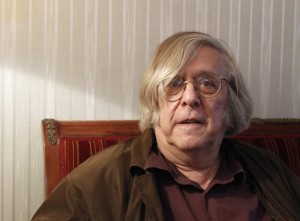
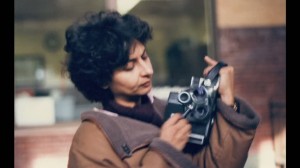
JONATHAN ROSENBAUM: You were the one who originally had the idea of proposing that we do this book together. And maybe we should both consider why we thought it was a good idea.
MEHRNAZ SAEED-VAFA: Basically, as far as I remember, we had a lot of interesting dialogues about Iranian cinema and Kiarostami, and I thought it would be a great idea to put our effort into a book. We started our dialogue in 1992, at a time when Kiarostami was still was getting discovered in France, but unknown in the United States. And I respected you highly as a critic and I knew that you were respected among other readers outside the United States as well as inside. Read more
This is the 13th one-page column I published in Cahiers du Cinéma España; it ran in their July-August 2009 issue. — J.R.

Writing from Chicago in May, during the Cannes film festival, I’ve been reflecting lately how much this festival remains a spectator sport even for those who don’t attend it. I’ve attended it nine times in all, 1970-1973 and 1994-1998, and my most enduring impression about it is how quickly everything that happens there gets turned into some form of business — a process that is both hilarious and somewhat horrifying.
Two immediate examples come to mind which occurred during my first and most recent visits there. In 1970, I attended the world premiere of Woodstock, only five days after four students were shot and killed by National Guardsmen at Kent State University in Ohio. Michael Wadleigh, the hippie director — a tall, commanding figure dressed in suede — dedicated the film to those four students and to “the many deaths to come” in the ongoing political struggles of the period. When the screening was over, he stood by the exit and calmly handed out black arm bands to anyone who wanted to wear one. I wore one myself for a day or two. Read more