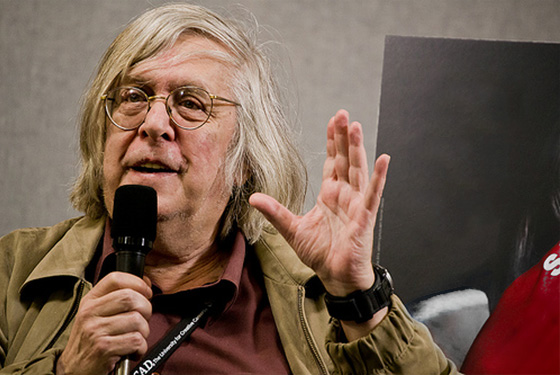
Jonathan Rosenbaum
This essay was commissioned by the Indian arts journal The Riveraine Muse (based in West Bengal) and published in their Spring 2026 issue (vol. 3, no. 1). I’ve added a few parenthetical notes to identify the photos. –J.R.
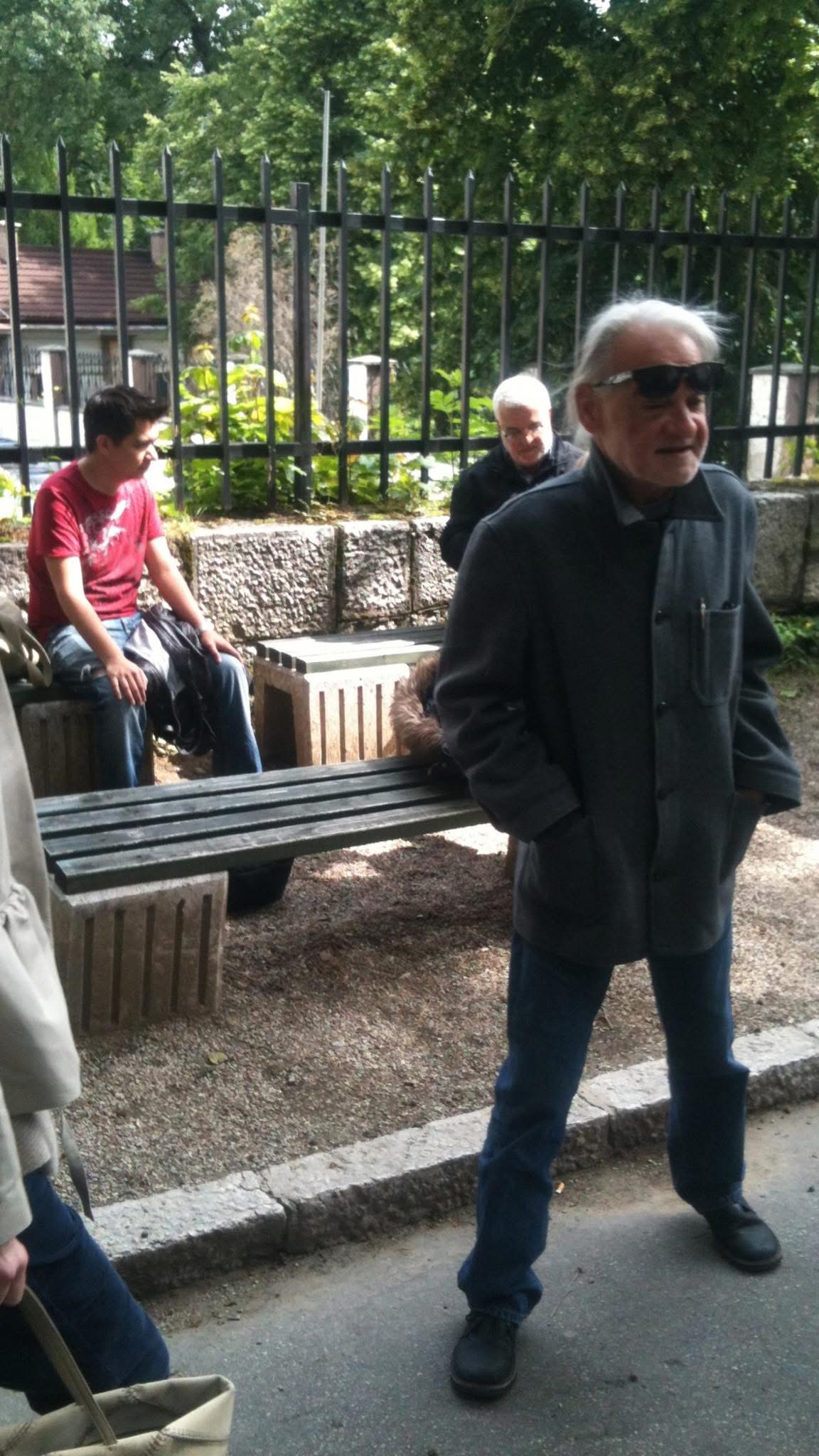
I’ve spent most of my life in search of communities I can join without compunction — decidedly not the small town in Alabama where I grew up, and at most only two of the schools I chose to attend as a student: Highlander Folk School in Tennessee (summer 1961), cradle of the civil rights movement in the U.S., and Bard College in New York (1962-66), where my professional and vocational involvements in film and literature took shape. But the only such community that I was invited to join, as a teacher, was film.factory in Sarajevo, over four two-week periods, 2013-2015, and this was entirely due to Béla Tarr (1955-2026), a filmmaker I discovered in Chicago via Almanac of Fall (1984) and Damnation (1988) in 1990, who became a friend around the time of the international premiere of Sátántangó (1994). I had been on the New York Film Festival’s selection committee that had chosen the film, had arranged for its showing at the Chicago International Film Festivalas as a “critic’s choice” of mine, and had found its first American distributor. (I copied my own video of the film and sent this copy to my friend Rob Tregenza, a remarkable filmmaker and cinematographer who ran Cinema Parallel — a small company that distributed films by Godard and Haneke, among others — correctly guessing that he would want to distribute Sátántangó.)
I haven’t liked all of Béla’s films — broadly speaking, only about half of them belong in my pantheon — but one didn’t have to be an unqualified fan in order to earn his loyal friendship. One also didn’t have to like one’s favorites — in my case, Macbeth (1982), Almanac of Fall (1984), Damnation (1988), The Last Boat (1990), Sátántangó (1994), and The Turin Horse (2011) — for the “right” reasons. My enthusiasm for the seven-hour Sátántangó, which has already lasted through at least half a dozen screenings, is very much bound up in some of its literary and political aspects — especially its relation to Joseph Conrad and William Faulkner (particularly Nostromo and Light in August), focusing on the events of a single day through multiple and diverging viewpoints, a topic I’ve explored at length elsewhere
(https://jonathanrosenbaum.net/2024/06/33546), and its anarchistic view of what life is like under a totalitarian regime, neither of which had any relevance to Béla’s view of the film. He insisted he couldn’t read Faulkner because the Hungarian translations of him were all “shit” — unlike László Krasznahorkai, author of the source novel and coauthor with Béla of the screenplay (as well as the screenplays of five other Tarr films), who has said he was deeply marked by reading Faulkner in his youth. He also insisted that Sátántangó’s meaning was metaphysical and not at all political.
Even though film.factory lasted for only four years, its first graduating class, all selected by Béla from the applicants—a truly international group, like the other classes succeeding it, with members from Austria, the Czech Republic, France, the Faroe Islands, Iceland, Iran, Japan, Mexico, Poland, Portugal, Serbia, Spain, the U.K., and the U.S., describing itself as a family and generously including me among its members, posted a lengthy statement shortly after Béla’s death that begins as follows:
  We are a family. A crazy, fucked-up, utopian filmmaking family. And, now, dad is gone.
We were called to film.factory, and to Béla, by a belief in the transformative power of cinema.
That the creation of cinema could be a radical act of love and defiance in a world that so clearly needs more of both.
[And towards the end:]
Never losing sight of the freedom in the act. The laughter and joy in the creation. The tenderness in the world. You were our North Star. But, more than that, you were family.As a lifelong internationalist, I should add that finding common cause with such a family was far easier than it may sound, especially because of Béla‘s astuteness in selecting them. And the fact that he wasn’t a film buff didn’t really matter in the long run. I gather that he was similarly skilled when he produced films in Budapest that he knew he wouldn’t like as a spectator.
I should add that I’ve always considered Béla older than me — even though he was physically a dozen years younger — but never as a father, always as a brother, friend, and accomplice. That we were members of the same family as our students was irrefutable. And he was the individual, assisted by the wonderfully energetic Sunčica Fradelić, who made film.factory not just an idea but a community and a family I was privileged to belong to. (That’s Sunčica next to me with Béla and some of the students in the photo below.)
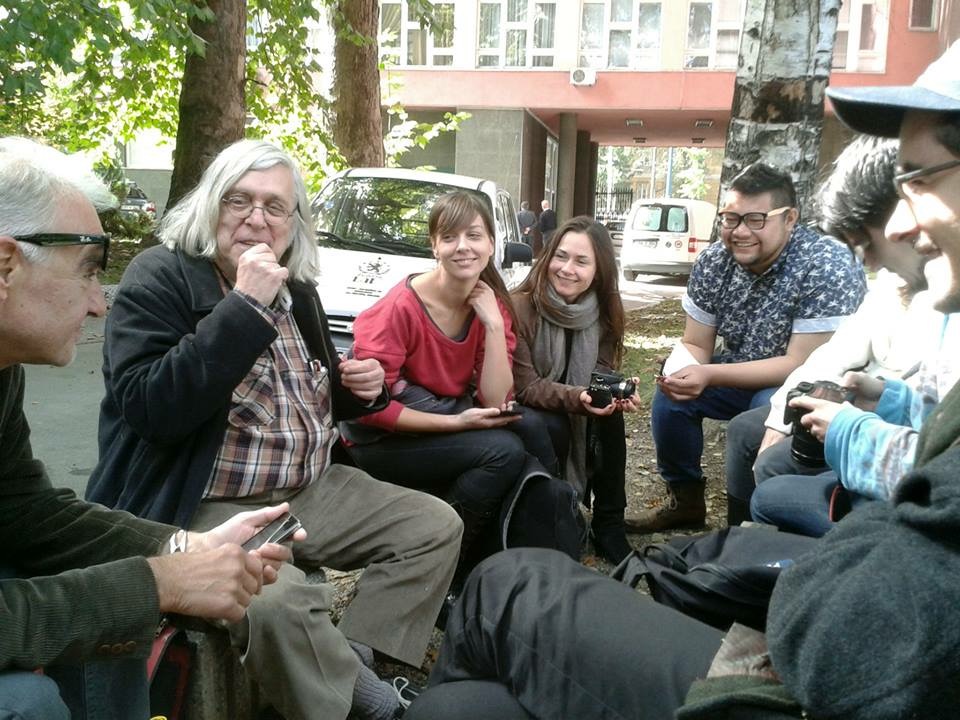
Prior to that, our friendship (Bela’s and mine) developed in and around many film festivals — Toronto, Chicago, New York, Fajr in Tehran (where we were on the same jury), Rotterdam, Buenos Aires, and New Horizons in Wrocław, Poland, where he premiered The Turin Horse, identified by him at that time as his final feature, and invited me to teach at his new school, which he originally thought would be in Split, Croatia.
But it was in Sarajevo, Bosnia and Herzegovina that film.factory eventually took shape, housed at the Sarajevo Film Academy that was just over the bridge from where Archduke Franz Ferdinand was assassinated by Bosnian activist Gavrilo Princep, sparking World War 1.
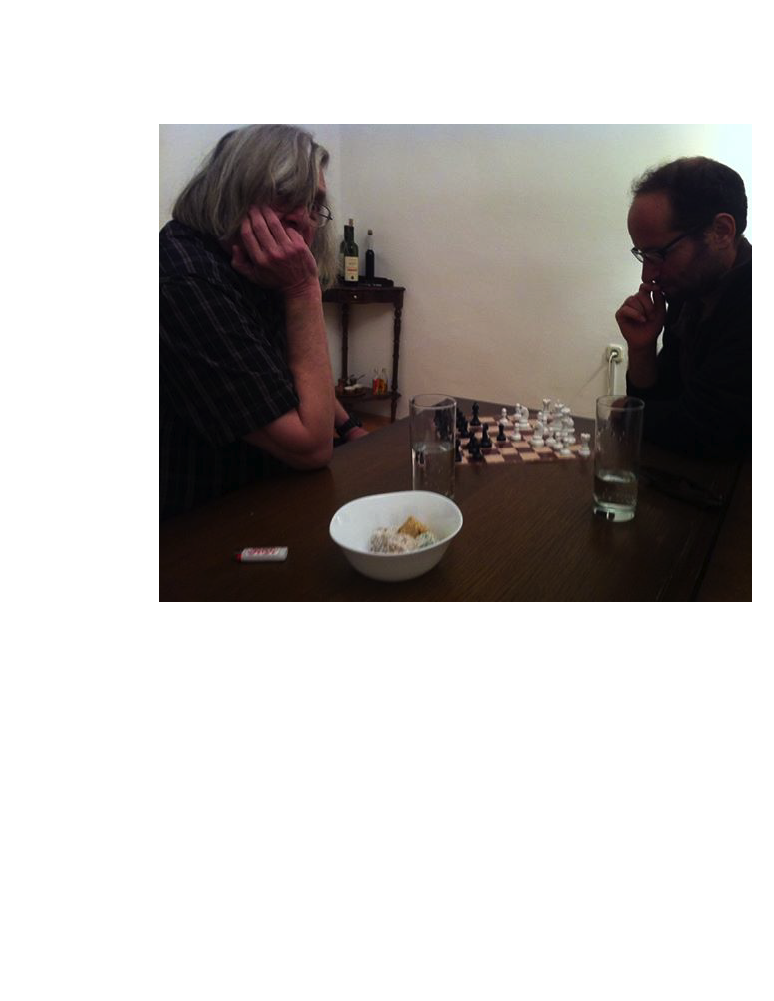
As a factory-school, we managed to be both relaxed and intense. During my first Sarajevo stint, we usually met in the mornings to watch “American independent” films (on the videos that I chose and brought — which included, among many others, films by Stan Brakhage, Charlie Chaplin, Larry Clark, Pal Fejos, Erich von Stroheim, and Peter Thompson, as well as Richard Pryor Live in Concert, Mikey and Nicky, The Seventh Victim, the Hawks Scarface, Wise Blood, and You Are Not I, and then discussed them, a process that we continued over lunch. Carlos Reygadas met with them to discuss their own films in the afternoons, and then he and I usually had dinner with Béla, sometimes with others, on one of the narrow streets of the market, not far from the local mosque, synagogue, and cathedral. (The photo below, taken by Béla, is of Carlos and I playing chess in Béla’s flat after one of those dinners.)
Our original plan had been to show the American independent films on film in the evenings at our auditorium, and to make these screenings free and open to the Sarajevo public. But to acquire prints, we needed help from the local U.S. embassy, who never even replied to our letter. It was probably naïve of us to ask for their collaboration in that period, but we figured it wouldn’t hurt to try.
To better understand how marginal and “off the map” Béla was regarded in the fashionable American mainstream circa 1994 (when Sátántangó premiered) and almost a decade later, when I joined film.factory. It’s worth comparing the public festival screening in Toronto (well-attended, with few walkouts, which was also the case in Chicago) with the earlier press screening, which was practically deserted. When I tried to convince John Powers, the sophisticated film critic at Vogue, to attend the latter, he actually said, “I’d rather see three or four bad films.” And it’s even more historically instructive to compare Susan Sontag’s “The Decay of Cinema” (a retitled and edited version of her sad and nostalgic “A Century of Cinema”) in the February 25, 1996 issue of the Sunday New York Times Magazine, with Alexandra Kleeman’s “Everyone’s a Critic,” a celebratory look at the film-buff web site Letterboxd in its February 15, 2026 issue. The former pruned Sontag’s original list of major filmmakers, including Béla, who were deemed so esoteric that readers couldn’t be expected to know them (or even tolerate the names or titles they both didn’t already know). The latter article cites Tarr and Sátántangó more than once and reproduces the following Letterboxd blurb: “I just watched a 7 hour movie with the love of my life. I really am the luckiest girl in the world. –- Hillary”).
To backtrack a little, how can one be relaxed and intense at the same time? Sometimes this meant being open to last-minute improvisations, such as the day at film.factory when Béla decided to cancel our classes and send us off on an impromptu field trip to Bunker Konjic — a fascinating Cold War relic and history lesson about an hour’s drive away, comprising a massive underground bomb shelter built by Tito, housing an international art exhibition overseen by the Bosnian army when we visited. Another changed schedule occurred after Béla got me to cancel a second after-hours weekend screening in a flat shared by several students because he felt these extra sessions were causing some of them to neglect their own films-in-progress. Best of all was a Saturday screening of Sátántangó that Béla got me to introduce, followed a day later by him delivering a fascinating four-and-a-half-hour lecture (with two intermissions, like the film) about how it was filmed, shot by shot and take by take, using a kind of post-it storyboard on a blackboard as a narrative thread. Typically, he was explicit and precise about the film’s technique and had almost nothing to say about its meaning — although he agreed with me when I described it as a comedy. Curiously, contradicting the film’s very Eastern European pessimism and comic sarcasm, he often said that a primary meaning of his films in general was the dignity of human beings. As weird as this sounds, it makes perfect sense once one realizes that his experience of making films was obviously, for him, part of their meaning. Similarly, the fictional torture and poisoning of a cat by a mentally challenged girl (Erika Bók) in Sátántangó convinced some of my friends that Béla must have been a cruel sadist rather than a very skilled illusionist who would have found any abuse of pets unthinkable and used only a sedative with the cat. (In fact, he once canceled appearing on a Chicago panel just after learning via a long-distance phone call that his pet dog in Budapest had died.) Paradoxically, he shared with the equally anti-Hollywood Abbas Kiarostami an illusionist talent that could fool even some Hollywood professionals.
His inability or refusal to compromise about anything was vividly illustrated to me by his behavior as a festival juror in Tehran. Mehrnaz Saeed-Vafa, with whom I was coauthoring a book on Abbas Kiarostami at the time, was also visiting the Fajr film festival from Chicago, and it turned out that we both had only one chance to see his latest, not-quite-completed film, ABC Africa, at his home, along with a few others, around 6 pm, soon after my jury was expected to complete all its deliberations. But Béla hadn’t liked any of the films we saw and objected to every film proposed for a prize. Even though our meeting started around 10, about six hours later, at 4, it was beginning to seem that I couldn’t make the Kiarostami screening unless I could think up some radical scheme for ending Béla’s filibusters. So when he left the room for the toilet, I seized the opportunity by proposing a full slate of prizes to all the other jurors -– a list including the favorite film of each one apart from Béla -– and my motion passed before he returned from the bathroom. The fascinating result of this was that he was relieved rather than angry, suggesting that he’d been every bit as trapped by his own intransigence as the rest of us were.
At such times his intransigence seemed unnecessary. When he came to the Toronto film festival in 1995 with his video documentary Journey on the Plain, he insisted on going to a local university library soon after he arrived to xerox and give me an acceptable English translation of a poem cited in the film, which struck me as both flattering and somewhat embarrassing. I experienced the same two emotions in Rotterdam when he insisted on me watching a 45-minute segment of the not-quite-finished Werckmeister Harmonies with German subtitles that Andi Engels, one of his producers, translated into English for me — an experience I found so disorienting that it effectively ruined the film for me when I finally saw it in finished form with English subtitles. (Béla also had the grace to say to me afterwards that he wouldn’t make the same sort of mistake with me again.)
It was the same intransigence, I suspect, that ultimately led to film.factory closing. He wanted the school (or factory, as he preferred to call it) to be accredited, yet he refused to take attendance, or give tests, or assign grades. This made perfect sense to me as well as everyone else at the school, but it obviously posed problems in the wider world, possibly exacerbated by certain prolonged absences from Sarajevo occasioned by his back troubles and surgeries in Budapest. I have to proceed cautiously here, because my sessions at the school were sporadic, and if memory serves, he wasn’t even present during my last two-week stint in Sarajevo. The last time I saw him was in Zagreb, at a special event with many students and staff members held after the school’s closing was set but there was still discussion about whether students would stay there long enough to graduate after he left. (At his request, I and other faculty members were asked not to attend this difficult and awkward meeting.) He was taking a lot of painkillers then for his back, and conversations at meals (we were staying at the same hotel) were terse and difficult because of his medication. I know that he attended many film festivals afterwards as a juror, but I have no idea how easy or difficult this was for him.
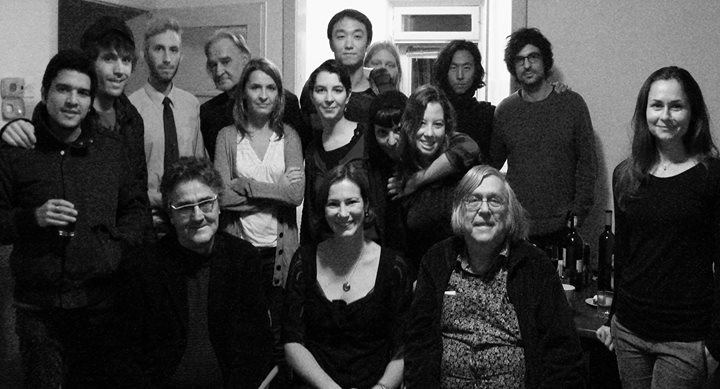
Relaxed intensity best describes my memories of Sarajevo, which in most cases correspond to my memories of Béla because even when he was absent, his example and his lessons remained. (He’s present in the above photo — as is Thierry Garrel, one of the other teachers.) This was especially the case when Tilda Swinton, who had appeared in The Man from London (2007), was visiting and he was around also, maybe because they both tended to be Socratic as well as practical rather than theoretical as teachers. Apart from his Sátántangó lecture, I never attended any of his classroom sessions, but the two lectures of Tilda at film.factory about acting that I was lucky to be present at had the same sort of intuitive and practical insights I associated with Béla.
She used as her main point of reference Robert Bresson’s Notes on Cinematography, and initially I took this to be a joke or provocation due to Bresson’s rejection of film acting. But in fact, it was a practical way of illustrating how acting wasn’t self-expression but a form of notation designed to advance a narrative — a fact that she explicated by filming each member of her audience in close-ups, starting with me, and then showing how small facial inflections could convey exhaustion, thoughtfulness, sadness, happiness, and so on. A simple how-to explanation, in short, like Béla’s lecture on how he filmed his own shots. (The photo below of Tilda filming me was taken by Pilar Palomero, one of the students.)
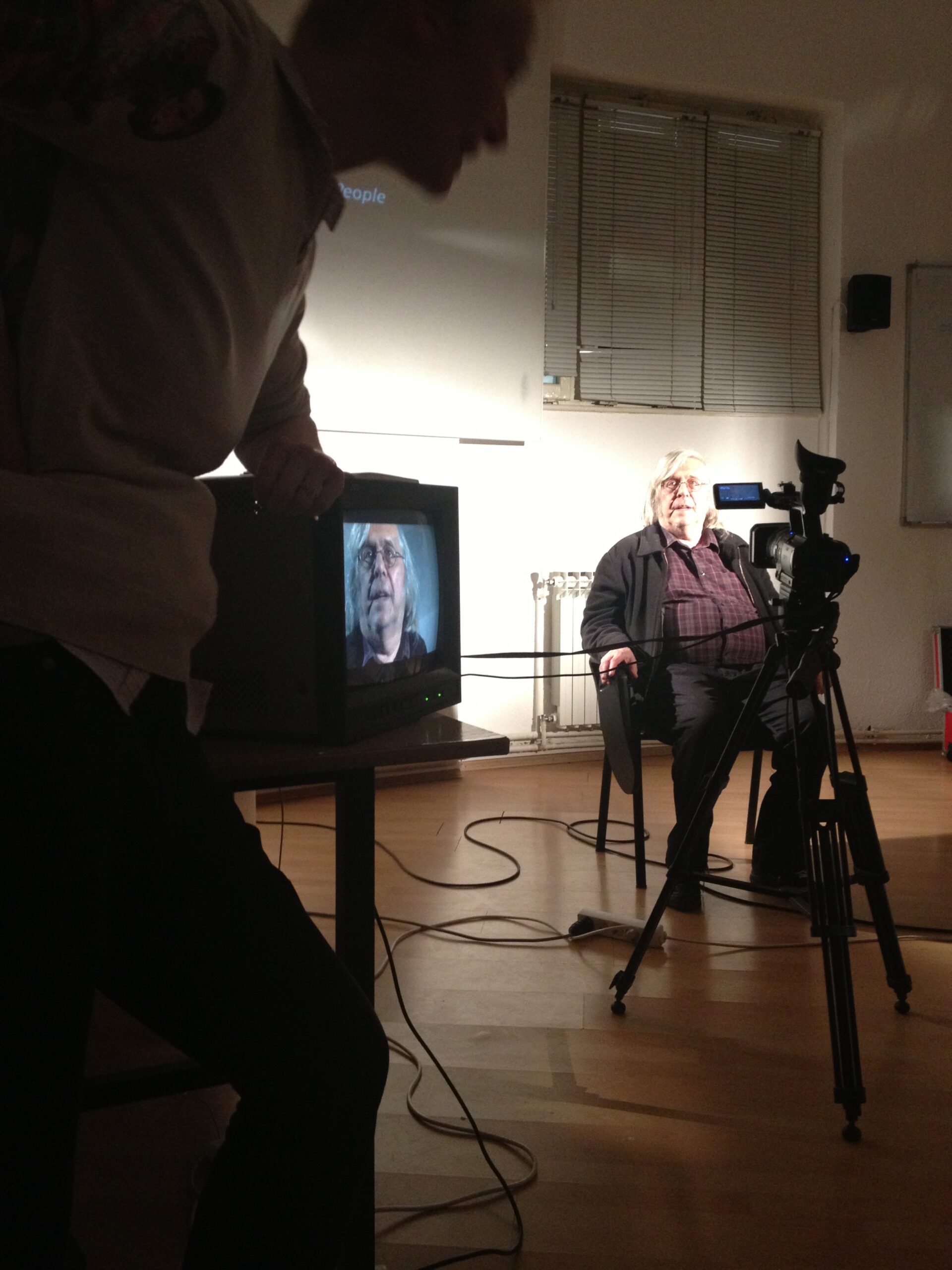
To tell the truth, I think that Béla is still with us, thanks to his films and simple lessons — as present in my own home as the bottle of Slivovitz that he once gave me, the same potent Hungarian plum brandy that his characters often like to guzzle. I still have only a few swigs left, yet I feel that with any luck, their aftertaste may last as long as I do.