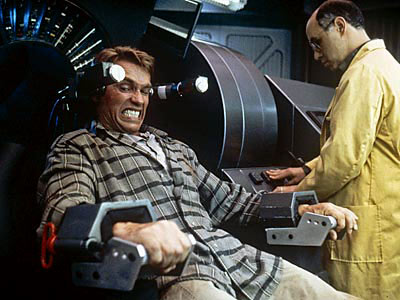
Written by Ronald Shusett, Dan O’Bannon, Jon Povill, and Gary Goldman
With Arnold Schwarzenegger, Rachel Ticotin, Sharon Stone, Ronny Cox, Michael Ironside, Mel Johnson Jr., and Marshall Bell.
The most influential SF movies of the past two decades are still very much with us, not only as landmarks but as continuing influences on newer release. 2001: A Space Odyssey (1968) gave us a whole slew of standbys, from the use of familiar brand names in outer space to a sense of visual design that, as critic Annette Michelson once put it, dissolved the very notion of the “special effect” as it was previously understood. In 1977 Star Wars popularized the notion of SF adventure as continuous action; and Close Encounters of the Third Kind the same year brought a certain pop religiosity (or perhaps one should say pseudoreligiosity) back to the genre, a combination of De Mille and Disney that sanctified Spielberg lighting as a means of bestowing halos on deserving characters, creatures, or locations.
Alien (1979) revitalized the claustrophobic horror-film dynamics of The Thing (1951), internalizing the monstrous and echoing David Cronenberg’s feature of 1975, They Came From Within. Read more
This essay was commissioned by the Indian arts journal The Riveraine Muse (based in West Bengal) and published in their Spring 2026 issue (vol. 3, no. 1). I’ve added a few parenthetical notes to identify the photos. –J.R.
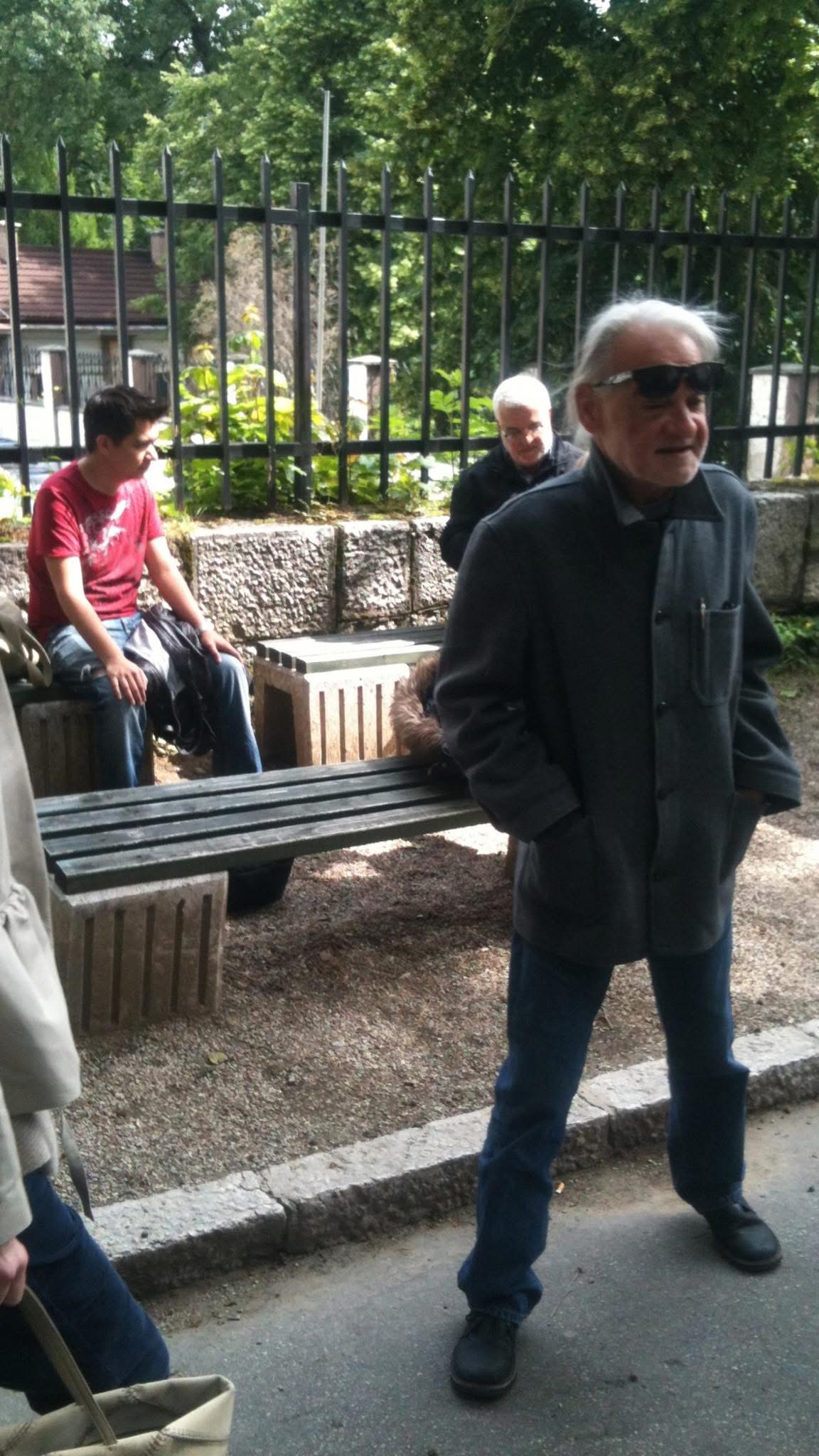
I’ve spent most of my life in search of communities I can join without compunction — decidedly not the small town in Alabama where I grew up, and at most only two of the schools I chose to attend as a student: Highlander Folk School in Tennessee (summer 1961), cradle of the civil rights movement in the U.S., and Bard College in New York (1962-66), where my professional and vocational involvements in film and literature took shape. But the only such community that I was invited to join, as a teacher, was film.factory in Sarajevo, over four two-week periods, 2013-2015, and this was entirely due to Béla Tarr (1955-2026), a filmmaker I discovered in Chicago via Almanac of Fall (1984) and Damnation (1988) in 1990, who became a friend around the time of the international premiere of Sátántangó (1994). I had been on the New York Film Festival’s selection committee that had chosen the film, had arranged for its showing at the Chicago International Film Festivalas as a “critic’s choice” of mine, and had found its first American distributor. Read more
From Monthly Film Bulletin, September 1975, Vol. 42, No. 500.
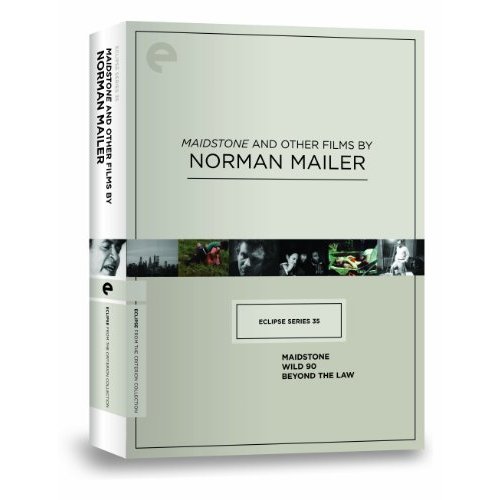
It’s good to see Norman Mailer’s first three features just out in a two-disc DVD set from Eclipse (it would be great if Criterion could eventually do the same for Susan Sontag’s three fiction features), even though I regret that my two favorite Mailer films — his untitled, ten-minute experimental short from 1947 (recently discovered by archivist Michael Chaiken, who wrote the excellent and provocative notes for the Eclipse set, and which I saw last July at Il Cinema Ritrovato) and Tough Guys Don’t Dance (1987) — aren’t included. (Admittedly, I haven’t yet seen all of Maidstone, which Chaiken makes the most claims for, so these rankings on my part are still subject to revision.)…In his Eclipse notes, Chaiken describes Will the Real Norman Mailer Please Stand Up? [sic] as “a filmed counterpart to The Armies of the Night“, which parallels my own observation here.Read more
Posted on Indiewire on January 6, 2012, with different illustrations. — J.R.
Critical Consensus: Kent Jones and Jonathan Rosenbaum Discuss Robert Bresson and Jean-Luc Godard
By Kent Jones, Eric Kohn and Jonathan Rosenbaum | Indiewire January 6, 2012 at 11:20AM
Editor’s note: Critical Consensus is a biweekly feature in which two critics from Indiewire’s Criticwire network discuss new releases with Indiewire’s chief film critic, Eric Kohn. Here, Jonathan Rosenbaum (formerly of the Chicago Reader) and Kent Jones (executive director of the World Cinema Foundation and editor-at-large at Film Comment) discuss two legendary filmmakers: Robert Bresson, the subject of a retrospective beginning at New York’s Film Forum today, and Jean-Luc Godard, whose “Film Socialisme” comes out on DVD and Blu-ray on January 10. More details on films opening this week follow after the discussion.
ERIC KOHN: There’s no easy way to have a short conversation about Robert Bresson without shortchanging a career spanning 13 films and widely considered paramount to 20th-century film history. Bresson’s Catholicism, his narrative precision, use of non-actors and painterly formalism have been analyzed many times over.
However, the Bresson retrospective that begins at Film Forum today ahead of a national tour, and includes 35mm prints of 11 films, is the first one in 14 years.Read more
This appeared in the Chicago Reader (July 30, 1993). –J.R.
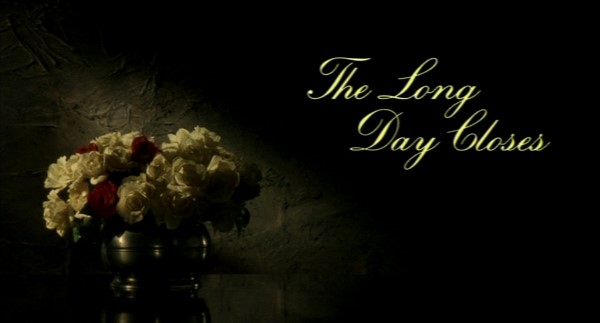
THE LONG DAY CLOSES
**** (Masterpiece)
Directed and written by Terence Davies
With Leigh McCormack, Marjorie Yates, Ayse Owens, Nicholas Lamont, Anthony Watson, Tina Malone, and Jimmy Wilde.
I began making films [out of] a deep need . . . to come to terms with my family’s history and suffering, to make sense of the past and to explore my own personal terrors, both mental and spiritual, and to examine the destructive nature of Catholicism. Film as an expression of guilt, film as confession (psychotherapy would be much cheaper but a lot less fun). — Terence Davies
With The Long Day Closes English filmmaker Terence Davies completes his second autobiographical trilogy. (Faber and Faber has conveniently published the screenplays of the six films — all his films to date — with an introduction by Davies, under the title A Modest Pageant.) I haven’t seen the first trilogy — Children (1976), Madonna and Child (1980), and Death and Transfiguration (1983) — but the first two parts of the second, shot in 1985 and 1987 and distributed as a single feature, Distant Voices, Still Lives (1988), still strikes me as one of the greatest of all English films. Read more
From the Chicago Reader (October 23, 1987). — J.R.
Genre specialist John Carpenter returns to the principle of confined space that he used as a disciplinary structure in Assault on Precinct 13 and The Thing in this horror thriller set in an abandoned church. The main difference here from earlier Carpenter films is the heavy metaphysical baggage: a team of graduate students and teachers (including Lisa Blount, Victor Wong, and Jameson Parker) in physics and science is summoned by a Catholic priest (Donald Pleasence) to study an ancient religious manuscript that proves to contain differential equations (long before such equations were developed), and a canister containing a green liquid that proves to be seven million years old. Mathematics combines with demonology to produce a variant on Night of the Living Dead, and while the church is playfully called Saint Godard’s, the pivotal use and significance of mirrors spawned by the canister liquid might make Saint Cocteau’s a more appropriate appellation. While the dense significations of the script (credited to one “Martin Quatermass”) may get a bit thick in spots, Carpenter’s handsome ‘Scope images generally make the most of them, and some haunting poetic notions — such as video images from the future that appear as recurring dreams dreamt by the church’s inhabitants — figure effectively in the plot. Read more
The Rotterdam Festival is gradually expanding in scope and attendance, while its survival seems to become increasingly polemical and precarious. Now in its 16th edition, the festival continues to honor its director Hubert Bals’ stubborn, utopian precept that, ‘An audience should be found for a film, not a film for an audience.’
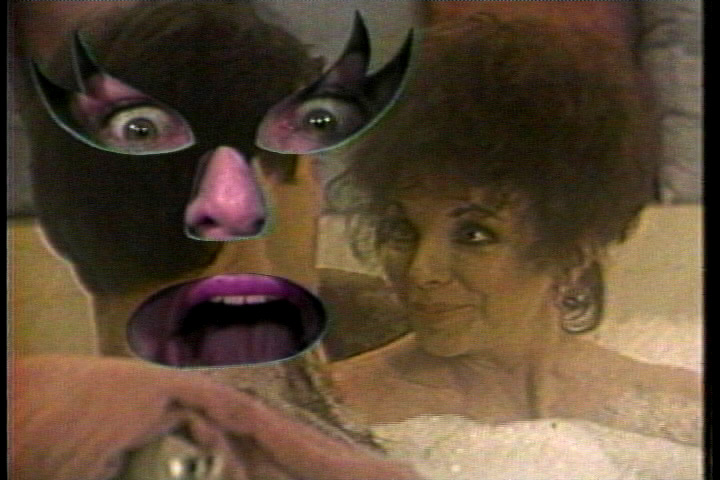
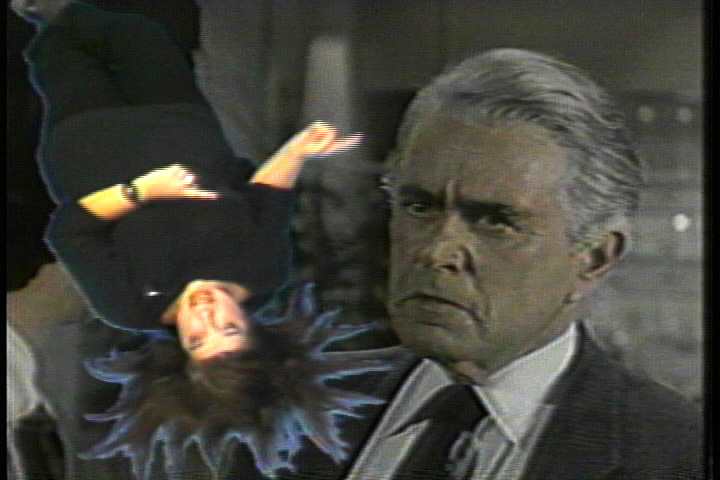
Thus, while Libération critic Serge Daney was lecturing persuasively on the growing impossibility of critics mediating between films and audiences, it was possible to watch a videotape, Joan Does Dynasty, in which New York critic Joan Braderman, with the aid of Manuel De Landa’s computer graphics, does precisely that for the TV series.She appears in front of Dynasty in different sizes, shapes and positions, from diverse angles and with varying degrees of transparency, and delivers an exuberant, madcap critique of the show. Part of a cycle of low-budget, leftist media critiques known as Paper Tiger Television which appears on us public access cable and boasts more than a hundred titles in its catalogue, Braderman’s pungent intellectual stand-up is the likely formal masterpiece of a variable, slapdash series ranging from the unfocused and obvious (Peter Wollen on the U.S. Read more
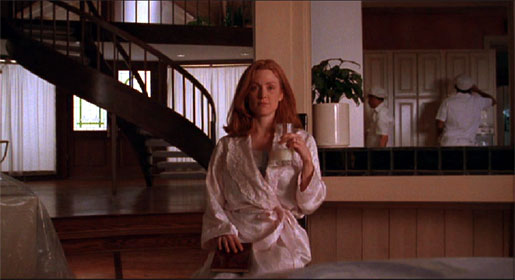
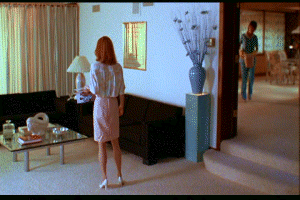
With Julianne Moore, Xander Berkeley, Ronnie Farer, Martha Velez-Johnson, Chauncy Leopardi, and James LeGros.
I know that Americans are supposed to hate whatever they can’t understand, and certainly current Hollywood filmmaking is predicated to the point of tedium on this truism. But part of what makes Todd Haynes’s Safe the most provocative American art film of the year so far — fascinating, troubling, scary, indelible — is that it can’t be entirely understood. The mystery and ambiguity missing from mainstream movies are all the more precious, magical, even sexy here, in a 35-millimeter feature employing professional actors set partly in the plusher suburban reaches of the San Fernando Valley.
By chance the star of Safe, Julianne Moore, also plays the female lead in the least mysterious Hollywood feature of the moment, the unspeakable Nine Months — a movie that essentially celebrates the world that Safe attacks. This makes Haynes’s film even more dangerous: seeing both films might be like combining chemicals that produce lethal explosives. One suspects that anyone who sees both in swift succession will be flirting with social or political revolution or some sort of madness. Read more
Written for and published in Outsider Films on India, 1950-1990, edited by Shanay Jhaveri, Mumbai: The Shoestring Publisher, 2009 — a very handsomely produced book that I can highly recommend. — J.R.
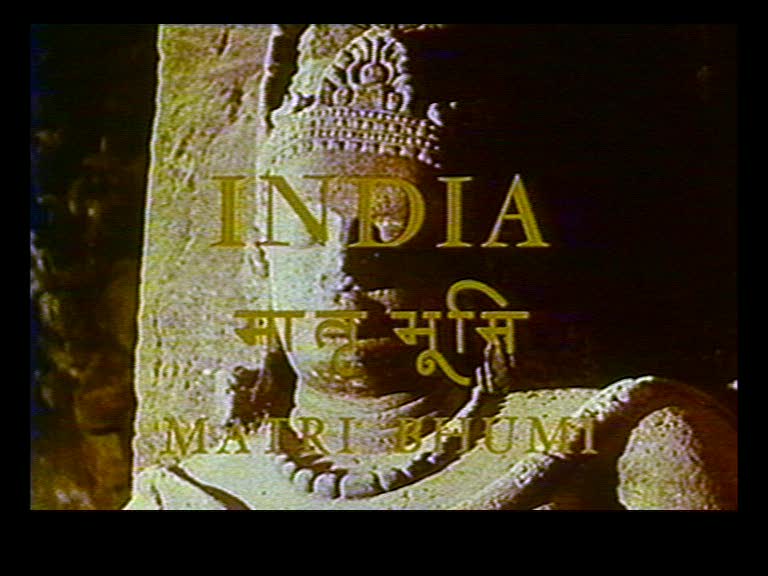
The Creation of the World: Rossellini’s India Matri Buhmi
In my mind, there isn’t as much distinction between documentary and fiction as there is between a good movie and a bad one. — Abbas Kiarostami
From the beginning, film has owed an important part of its fascination to ambiguous overlaps between documentary and fiction —- sometimes experienced as conflicts between the separate aims of showing the world and telling a story, and frequently associated with incorporating both unforeseeable and carefully planned elements in a given film. It’s a tendency that can already be seen in the contrived gags of the Lumière brothers films, the re-enactment of recent famous events in some films of Georges Méliès, and the coexistence of fantasy and on-location actuality in Louis Feuillade serials. Later, of course, the same mix becomes re-animated in Italian neorealism and in work by French New Wave directors (perhaps most notably Jean-Luc Godard and Jacques Rivette and some of their immediate successors, such as Luc Moullet and Jean Eustache), in the improvisational strategies of Robert Altman, in some of the ambiguities found in the films of Abbas Kiarostami, Mohsen Makhmalbaf, and Jafar Panahi, and in practically all the films of Pedro Costa and Pere Portabella. Read more
From Cinema Comparat/ive Cinema, Volume 1, No. 1, 2012 (a Spanish academic online journal, available at http://www.ocec.eu/cinemacomparative/pdf/ccc01.pdf). I’m reposting this after fixing a broken link. The Introduction to this long out-of-print book can be found here.– J.R.
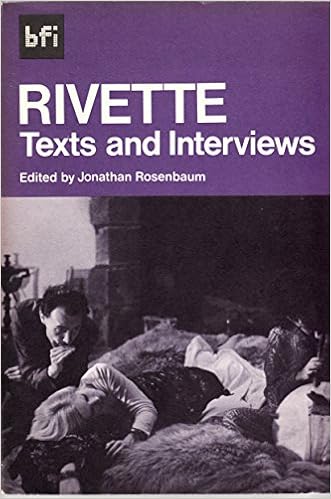
“Rivette in Context” had two separate incarnations, occurring a year and a half apart. The first consisted of 28 programs presented at London’s National Film Theatre in August 1977, to accompany the publication of Rivette: Texts and Interviews — a 101-page book I had edited for the British Film Institute while still working on the staffs of two of its magazines, Monthly Film Bulletin and Sight and Sound, in 1976.
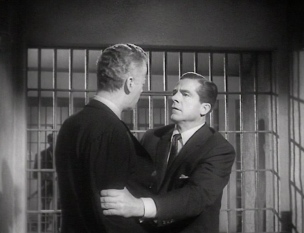
This book included a polemical Introduction by me and translations — most of them by my London flat mate, Tom Milne — of two lengthy interviews with Rivette (one in 1968 that was centered on L’amour fou, the other in 1973 that was centered on the two separate versions of Out 1), three key critical texts by him (“Letter on Rossellini,” 1955; “The Hand” [on Lang’s Beyond a Reasonable Doubt], 1957, and “Montage” [with Jean Narboni and Sylvie Pierre], 1969), and a brief, undated proposal of his from the mid-1970s (“For the Shooting of Les Filles du Feu” — the latter was the working title for a projected series of four features, never completed, that was subsequently retitled Scènes de la Vie Parallèle). Read more
In late 2002 or early 2003, I was approached by an editor at Oxford University Press about the possibility of editing a new Oxford Companion to Film. Despite some initial reluctance on my part—being rather frightened of the dimensions and demands of such a project—the editor was persistent, and eventually I signed a contract to carry out this work, after drawing up a proposal, enlisting the late Robert Tashman, a Chicago friend (and former Granta editor) to serve as line editor, and compiling several lists of entries (1099 of them covering A through L, as far as I ever got) and contributors (an ideal list of 43). But the project fell aground after the editor who had enlisted me got downsized. A meeting of Tashman and myself with other Oxford editors in New York made it clear that they weren’t interested in following through on the project, and frankly, I wound up feeling relief about this (although I’m sorry to say that Bob was disappointed—even though both of us were able to keep our advances).
What follows are two sample entries that I wrote for this abortive project; if memory serves, both benefited from Bob’s line-editing. I haven’t updated either of them.Read more
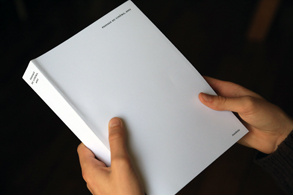
165 x 240 mm. PlanoPak Weiß 50 gr. (Papyrus). 992 pages.
ISBN 978-2-9544708-0-1. 35 euros. Septembre 2013.
Composition, choix des fragments et montage : Annick Bouleau
Conception graphique : Le Théâtre des Opérations
Édition : Ansedonia, association Loi 1901
Not simply a book, but an interactive, multimedia art project by French experimental filmmakerand teacherAnnick Bouleau (you can go here for her extensive filmography), the centerpiece of which is a book in French, a copy of which Bouleau was kind enough to send to me. (For the many other aspects of this project and her work, one could easily spend days navigating Bouleau’s web site.) It took her a decade to assemble it. [2019: In July 2019, while I was visiting Paris, she recognized me on the street and introduced herself.]
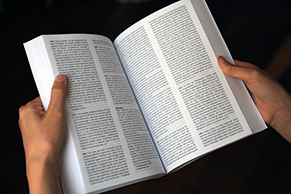
What are the contents of this book (seen below in manuscript form)?
A title page, dedication, acknowledgements, Introduction (“Mode d’emploi”), Table of Contents (an alphabetical listing of hundreds of topics, from “abandon” to “zoom,” with corresponding page numbers), and a one-page reader’s manual (“Vade-mecum du lecteur”), followed by 967 double-column pages of 4992 entries. Read more
The following was commissioned by and published in Frank Tashlin, edited by Roger Garcia and Bernard Eisenschitz, Éditions du festival international du film de Locarno, 1994. — J.R.
“According to Georges Sadoul, Frank Tashlin is a second-rank director because he has never done a remake of You Can’t Take It With You or The Awful Truth. According to me, my colleague errs in mistaking a closed door for an open one. In fifteen years’ time, people will realize that The Girl Can’t Help It served then — that is, today — as a fountain of youth from which the cinema now — that is, in the future — has drawn fresh inspiration ….To sum up, Frank Tashlin has not renovated the Hollywood comedy. He has done better. There is not a difference in degree between Hollywood or Bust and It Happened One Night, between The Girl Can’t Help It and Design For Living, but a difference in kind. Tashlin, in other words, has not renewed but created. And henceforth, when you talk about a comedy, don’t say ‘It’s Chaplinesque’; say, loud and clear, ‘‘It’s Tashlinesque’.“
Jean-Luc Godard’s review of Hollywood or Bust in the 73rd issue of Cahiers du cinéma (July 1957) is founded on a frank prophecy, only a small part of which has come true. Read more
This essay was written in late November 2010 for The Common Review, whose editor commissioned it, but was subsequently and recently withdrawn from that magazine once it became clear that the editor wasn’t giving me any straight or candid answers about whether or when he would publish it. Which is why I’m publishing it here. I’ve only updated it slightly to incorporate the recent distressing news about the government’s sentencing of Jafar Panahi. And more recently, thanks to Danny Postel, this article has been reposted here, at Tehran Bureau. P.S.: This essay is included in the much-expanded second editition of Abbas Kiarostami (2019), a book I coauthored with Mehrnaz Saeed-Vafa.– J.R.
To what extent does Abbas Kiarostami, Iran’s best known and most celebrated filmmaker, still belong to Iran, and to what extent does he now belong to the world? Insofar as the first sixteen of his seventeen features have been shot in Iran –- only Certified Copy, filmed in Italy, which premiered in Cannes last May, qualifies as a feature shot in exile –- he might be said to “belong” in some fashion to his native country. But the last of his features to date to have opened commercially in Iran was his tenth, Taste of Cherry (1997), and one wouldn’t expect this situation to change anytime in the near future. Read more
Written in October 2012 for what was supposed to have been the first (and, so far, only) translated edition of my most recent collection, although it has never come out. There is, however, a Korean translation of my earlier collection Essential Cinema (with a new Afterword, available here).
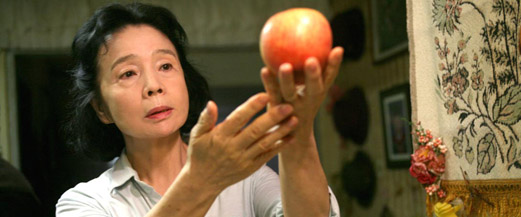
In retrospect, I’m sorry that I didn’t find some way of mentioning Lee Chang-dong’s extraordinary Poetry (2010), my favorite Korean film [see all the stills below] — and one that, incidentally, helps to explain the reason for my alienation from most of the other South Korean films I’ve seen and their excessive reliance on rape and serial killers as subjects (something that I was embarrassed to bring up in this Preface, written at the request of the publisher). This film in fact addresses the theme of rape and its role in Korean society quite directly. — J.R.
My acquaintance with cinephilia in South Korea is limited. My only first- hand knowledge comes from my experience as a juror on Indie Vision at the Jeonju International Film Festival in the Spring of 2006 and my acquaintance over a longer period with the brilliant and discerning critic and programmer Un-Seong Yoo, who worked for that festival for many years and, more recently, was my fellow juror on the New Directors jury at the San Sebastian Film Festival in the Fall of 2011.Read more