No Way Out

From the Chicago Reader (August 1, 1987). — J.R.

Kevin Costner, suffering as nobly here as in The Untouchables, plays a naval officer hired by the secretary of defense (Gene Hackman), whose mistress he has been unwittingly sharing. While credited as an adaptation of Kenneth Fearing’s novel The Big Clock (which was already made into a movie in 1948, directed by John Farrow), this taut thriller adds so many twists of its own it might be more appropriately cross-referenced with The Manchurian Candidate, even though it isn’t nearly as daffy or as mercurial. Cornball Dolby effects aside, it’s the kind of intricately plotted suspense film with juicy secondary parts (Sean Young, Will Patton, George Dzundza, Iman, Howard Duff) that used to be churned out in the 1940s; Roger Donaldson, the New Zealand director of Smash Palace, The Bounty, and Marie, delivers coproducer Robert Garland’s efficient script with more bombast than brilliance, but at least it keeps you in your seat (1987). (JR)

Read more

House of Games

From the Chicago Reader (October 16, 1987). Mamet’s first feature and still his best.– J.R.

Hitchcock lives! David Mamet’s first time out as a director is a thriller about compulsive behavior and con games, done with a sureness of touch and taste that shows a better understanding of Hitchcockian obsessions than the complete works of Brian De Palma. The viewer has to adjust to Mamet’s theatrical reflexes, which impart a certain strangeness to both the performances and the staging — such as confidential conversations held within earshot of characters who don’t hear them, because the conventions of theater space are employed rather than the usual conventions of filmic space. But once past this barrier, one is easily seduced by Mamet’s storytelling gifts, which deliver a shapely script (developed with Jonathan Katz), full of its own con games and compulsions, with an adroit grasp of emphasis and pacing. Lindsay Crouse (Mamet’s wife) plays a successful upper-crust psychiatrist and author whose feelings of frustration in treating her criminally involved patients goad her into a walk on the wild side, beginning with the eponymous gambling den, with Joe Mantegna as her guide. Apart from uniformly fine performances — with Mike Nussbaum, Lilia Skala, and J.T. Read more

Go Fish

From the Chicago Reader (July 1, 1994). — J.R.

gofish1

One of the delightful things about Rose Troche’s stylish, low-budget, filmed-in-Chicago black-and-white lesbian comedy is that its characters all register as real people, even when bits of the dialogue are stiff or some of the lip sync is off; this isn’t a movie about lesbians, it’s a movie about these lesbians, and we’re likely to think of them afterward as if they were people we knew. As in the better American underground movies of the 60s, which this sometimes resembles, the youthfulness and the footloose free spirit — evident in everything from the performances and Ann T. Rossetti’s shooting style to Brendan Dolan and Jennifer Sharpe’s jazz score and the breezy rhythmic stretches bridging narrative sequences — keep things bouncing along like a clear spring day. (And though the characters themselves vary in age, there’s a clear note of shared adolescent braggadocio in the way that sex and romance here become real only after they’re talked about and described.) Written as well as produced by Troche in collaboration with Guinevere Turner, the younger of the two romantic leads (the other is V.S. Brodie), this movie dives into fantasy and stylized internal monologues with the same aplomb it brings to the buildup to a hot date. Read more

Recommended Reading: Sadeq Hedayat’s THREE DROPS OF BLOOD

I find it curious that the great Iranian prose writer Sadeq Hedayat (1903-1951) should remind me so much of Edgar Allan Poe, because their backgrounds couldn’t be more dissimilar. Poe (1809-1849) was poor his entire life and Hedayat came from a very wealthy and privileged background; Poe lived in several American cities but never left the U.S. whereas Hedayat lived for extended periods in Belgium, France, and India as well as Iran.

Before the recent publication of Three Drops of Blood, a collection of Hedayat stories, I’d read only his novella The Blind Owl (1936), one of the most terrifying and unsettling horror stories I know, as well as a few of his other stories in French. It seems that most of his work is (or at least has been) available in French, but until the appearance of this slim anthology, The Blind Owl–freely if brilliantly adapted by Raul Ruiz in one of his craziest features, La Chouette Aveugle (1987)–has been virtually the only thing of his available in English. (12/25 postscript: Adrian Martin has just informed me that one can access many Hedayat stories in English translation, including The Blind Owl, for free here. Read more

Dallas Doll

From the November 7, 1997 Chicago Reader. — J.R.

Dallas-Doll

This 1994 feature is much too goofy to qualify as an absolute success, but it’s so unpredictable, irreverent, and provocative that you may not care. Australian writer-director Ann Turner has a lot on her mind, and it’s unlikely you’ll be able to plot out many of her quirky moves in advance. Imagine Pier Paolo Pasolini’s Teorema (with Sandra Bernhard in the Terence Stamp part, seducing most of a bourgeois Australian family and enough other country-club notables to wind up as mayor) crossed with Repo Man and you’ll get some notion of the cascading audacity. This is a satire about foreign invasion in which America (in the form of Bernhard, a spiritual “golf guru”), then Japan, and finally extraterrestrials in a spaceship all turn up to claim the land down under as their own. Along the way Turner gives us delightfully incoherent dream sequences, bouts of strip miniature golf, some hilarious lampooning of the new-age mentality, and one of my favorite performances by a dog. Incidentally, Bernhard despises this movie and trashes it whenever she gets a chance, but I liked it as well as or better than many of her routines. Read more

The Power of Belief

This appeared in the April 6, 1990 issue of the Chicago Reader. Although my favorite Cecil B. De Mille film is the talkie version of Dynamite (1929) — I still haven’t seen the silent version, released around the same time — The Ten Commandments (1956) is probably the film of his that I’m most familiar with, along with the somewhat underrated Samson and Delilah (1949).

Dynamite

Part of what’s so remarkable about the scandalously underrated and neglected Dynamite [see still, above] is how real and serious it contrives to make the marital pairing of a coal miner (Charles Bickford) and a spoiled city heiress (Kay Johnson), even though brought about through preposterous plot contrivances, and how, in spite of De Mille’s conservative social and political biases, it assigns equal amounts of dignity and vulnerability to both classes. It’s also one of the most suspenseful and charged melodramas to have ever come out of Hollywood. — J.R.

The Power of Belief

THE TEN COMMANDMENTS

*** (A must-see)

Directed by Cecil B. De Mille

Written by Aeneas Mackenzie, Jessie L. Lasky Jr., Jack Gariss, and Frederic M. Frank

With Charlton Heston, Yul Brynner, Anne Baxter, Edward G. Robinson, Yvonne De Carlo, Debra Paget, John Derek, Cedric Hardwicke, and Vincent Price. Read more

Back To The Future Part Ii

The further adventures of Marty McFly (Michael J. Fox) and Doc Emmett Brown (Christopher Lloyd) take them from 1985 to 2015 and back, and then back to 1955 after a mishap in the future involving the villain (Thomas F. Wilson) creates a universe parallel to the one they left. The problem with all the time-travel high jinks, involving multiple versions of the major characters (a gimmick that Robert Heinlein handled much better in stories like By His Bootstraps and All You Zombies), is that in order to make the plot even semiintelligible, writer Bob Gale and director-cowriter Robert Zemeckis have to turn all these characters into strident geeks and make the frenetic action strictly formulaic. (Significantly, the principal romantic interest, Elisabeth Shue, is knocked unconscious early on so she won’t interfere with the little-boy games, and Fox briefly playing his own sister in drag only adds to the rampant misogyny.) There’s a bit of fun in the 2015 section (although this notion of the future is more nostalgic and Disneyfied than genuinely speculative), but the shrill simplicities that follow become increasingly mechanical. By the end, you may feel that you’ve just sat through a feature-length commercial for both part one (which has to be seen to make this sequel comprehensible) and part three (a trailer for it literally ends part two), along with a host of other consumables (from Pepsi to other Spielberg productions), and have been turned into a first-class geek along with the charactersan airhead consumer designed to wolf these products down. Read more

Unpublished letter to Sight and Sound (9/19/15)

living-together

I’m very glad that Anna Karina’s neglected first feature, Vivre ensemble (1973), wasn’t overlooked in “The Female Gaze” (S&S, October), but I should also point out that the film isn’t quite as inaccessible as James Blackford, who couldn’t find a way of seeing it, assumes. Having been at the film’s premiere at Cannes and then having reseen it shortly afterwards in Paris, I still remembered it almost 40 years later when I selected and presented it on January 21, 2012, at Toronto’s Lightbox, as part of a series celebrating the Cannes’ La Semaine de la Critique. Seeing it again on that occasion, I found it fascinating — very brave, very personal, and also very, very 1973, in quite illuminating ways. The occasional autobiographical echoes reflecting Karina’s earlier relation to Godard only added to the fascination, and Karina herself suggested to me in a brief phone conversation that the film was badly received by the French film industry in part because the decision of a local actress to write and direct her own feature was virtually unprecedented at the time. I should add that she has written and directed a second feature, Victoria (2008), made in French Canada, that is even more obscure and inaccessible than Living Together has been; I haven’t been able to see it myself, and information about it on the Internet is extremely scarce, but I’m still hoping this situation will change. Read more

The Saddest Music In The World

From the Chicago Reader (May 14, 2004). This is probably my favorite Maddin feature to date. — J.R.

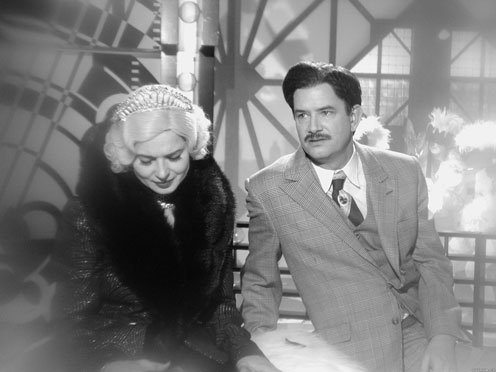
thesaddestmusic-canada

thesaddestmusic-cello

Mannerist film antiquarian Guy Maddin takes a bold step forward with this 2003 feature, a comic/melodramatic musical enhanced by his flair for expressionist studio shooting (in grainy black and white, with selected scenes in two-strip Technicolor). The project originated as a script by novelist Kazuo Ishiguro; revising extensively, Maddin and George Toles, his usual collaborator, turn it into an allegory about Canada’s colonial relationship with the U.S. In the depths of the Depression, a Winnipeg beer baroness (Isabella Rossellini) launches an international contest to come up with the saddest music in the world. Competing for the U.S. is her former lover (Mark McKinney), a brassy Broadway producer; for Serbia the producer’s older brother (Ross McMillan), who grieves for his dead son and vanished amnesiac wife (Maria de Madeiros); and for Canada both men’s father (David Fox), a surgeon who’s drunkenly amputated Rossellini’s legs. Not to be missed. 99 min. (JR)

thesaddestmusic-halo

thesaddestmusic-leg Read more

Ishtar

From the Chicago Reader (January 16, 2004). — J.R.

ishtar-withagent

Treated as a debacle upon release, partially as payback for producer-star Warren Beatty’s high-handed treatment of the press, this Elaine May comedy was the most underappreciated commercial movie of 1987. It may not be quite as good as May’s previous features, but it’s still a very funny work by one of this country’s greatest comic talents. Beatty and Dustin Hoffman, both cast against type, play inept songwriters who score a club date in North Africa and accidentally get caught up in various international intrigues. Misleadingly pegged as an imitation Road to Morocco, the film is better read as a light comic variation on May’s masterpiece Mikey and Nicky as well as a send-up of American idiocy in the Third World. Among the highlights: Charles Grodin’s impersonation of a CIA operative, a blind camel, Isabelle Adjani, Jack Weston, Vittorio Storaro’s cinematography, and a delightful series of deliberately awful songs, most of them by Paul Williams. 107 min. A 35-millimeter print will be shown. Univ. of Chicago Doc Films.

ishtar-camel Read more

The Corporation

From the April 23, 2004 Chicago Reader. — J.R.

Absorbing and instructive, this 2003 Canadian documentary tackles no less a subject than the geopolitical impact of the corporation, forcing us to reexamine an institution that may regulate our lives more than any other. Directors Mark Achbar (Manufacturing Consent) and Jennifer Abbott and writer Joel Bakan cogently summarize the history of the chartered corporation, showing how it accumulated the legal privileges of a person even as it shed the responsibilities. This conceit allows the filmmakers to catalog all manner of corporate malfeasance as they argue, wittily and persuasively, that corporations are clinically psychotic. The talking heads include not only political commentators like Noam Chomsky, Milton Friedman, Naomi Klein, Michael Moore, and Howard Zinn, but CEOs such as Ray Anderson, Sam Gibara, Robert Keyes, Jonathon Ressler, and Clay Timon, whose insights vary enormously. This runs 145 minutes, but it’s so packed with ideas I wasn’t bored for a second. (JR)

Read more

Twisted

From the Chicago Reader (February 27, 2004). — J.R.

A newly appointed homicide detective in San Francisco (Ashley Judd) tracks a serial killer whose victims are all men she has slept with. Director Philip Kaufman, who usually writes his own scripts, works with a cliche-ridden screenplay by Sarah Thorp, and his personal touches mainly seem to consist of selecting fashionable North Beach bars as locations. His usual flair for erotic detail largely deserts him here, and this thriller seems most interested in lingering over battered and bloodied male faces. Samuel L. Jackson and Andy Garcia costar. R, 97 min.

Read more

Cecil Taylor All The Notes

From the May 14, 2004 Chicago Reader. P.S. I once went to hear Cecil Taylor at a San Francisco club in the 1980s with Nathaniel Mackey (as well as Trinh T. Minh-ha and the late Bell Hooks).- J. R.

Any musician of Cecil Taylor’s caliber deserves sustained attention, but the jazz great doesn’t get it in this rambling assortment of alternating sound and music bites. Taylor is a nonstop pontificator of varying interest as well as a brilliant and virtuosic avant-garde pianist, but director Christopher Felver treats his music and his remarks as equally relevant, cutting between them — or away to still photographs — as if determined not to focus too long on any one thing. On piano Taylor employs an idiosyncratic technique, sometimes using his elbows as well as his fingers, and I’d hoped the camera angles would reveal this; apart from a brief shot behind the final credits, however, Felver shows almost everything except the keyboard. At least the other talking heads have things to say, including Elvin Jones, Amiri Baraka, Nathaniel Mackey, and Al Young. 71 min. (JR)

Read more

What’s up, Doc?

From The Movie, Chapter 33 (1980). -– J.R.

It was in 1940 that a brisk, buck-toothed city rabbit first sank teeth into carrot. briefly paused, gazed with indifferent aplomb at a lisping country rabbit-hunter with a shotgun and coolly inquired: ‘What’s up, Doc?’ This official debut of Bugs Bunny occurred at the beginning of A Wild Hare, one of nine cartoons that were supervised that year by Fred (known as ‘Tex’) Avery, a brilliant animator from Dallas who was working for Warner Brothers. The cartoon won an Academy Award nomination and the durable comedy team of Bugs Bunny and Elmer Fudd promptly went into business.


‘That darn wabbit!’

Bugs Bunny, first seen in Porky’s Hare Hunt (1938), had a complicated cross-bred genealogy. Remembering the ‘What’s up, Doc?’ expression from his high-school days in Texas, Avery had decided to place it in the mouth of a sharp Brooklynese rabbit who knew everything. Avery later recalled in an interview:

‘So when we hit on the rabbit we decided he was going to be a smart-aleck rabbit, but casual about it, and I think the opening line in the first one was, “Eh, what’s up, Doc?,’ And gee, it floored ’em! Read more

DAISY MILLER

From Sight and Sound (Autumn 1974). — J.R.
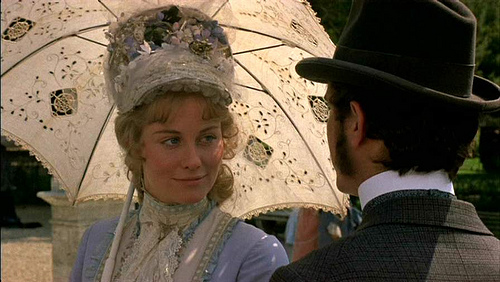
The first and perhaps the final question to be asked about Peter Bogdanovich’s adaptation of Henry James’ novella is simply why he chose to embark on it. A revealing interview with the director by Jan Dawson which appeared in Sight and Sound last winter affirms that he is anything but a Jamesophile (‘The social aspects of it don’t really concern me’), and one would imagine that taking up an admittedly minor — if commercially celebrated — work by the grey eminence would at least be dictated by an interest in the tale as ‘raw material’, an expedient for arriving at his own creation. But the confounding thing about his Daisy Miller is that it comes across as neither fish nor fowl: too indifferent to Jamesian nuance to qualify as appreciation, too faithful (in terms of the overall plotting and dialogue in Frederic Raphael ‘s script) to gain credence as an attack on the original — and yet too amorphous and uncertain in its own terms to register as an independent and autonomous work.
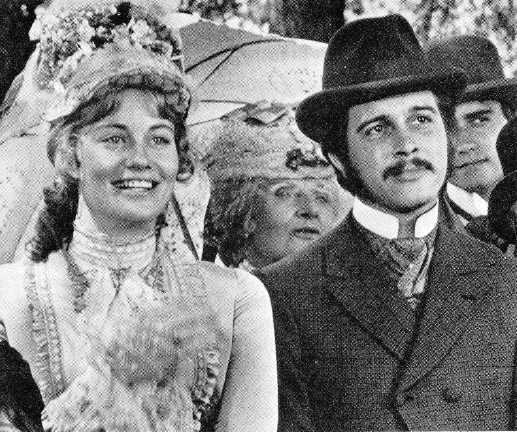
One suspects that the attractions of the project were the mythic elements: American innocence and charm in confrontation with European decadence. Read more