GHOST STORY (1975 review)

From Monthly Film Bulletin, July 1975 (vol. 42, no. 498). –- J.R.

ghoststory3

Ghost Story

Great Britain, 1974

Director: Stephen Weeks

ghoststory2

England; 1930. Talbot and Duller, former schoolmates of

McFayden, are summoned by the latter to a country house

supposedly belonging to a friend of his father for a weekend

of grouse hunting. Ragged and isolated by the other two for

his callow enthusiasm, Talbot is puzzled to find a warm

teacup and an odd-looking doll in his bedroom. In the

morning, he witnesses a scene in the parlor enacted by

people living forty years ago: Robert Quickworth signing

his sister Sophy over to Dr. Borden’s insane asylum, despite

the protests of her maid. At first Talbot assumes this to be

an elaborate practical joke, but after seeing people who

resemble these characters in the village pub and

dreaming or half-dreaming further episodes — in which

the doll leads him to Borden’s asylum -– he becomes

increasingly obsessed with the intrigue. Meanwhile

Duller, who has come to the house to seek ghosts with

‘scientific’ equipment, is disgruntled when all his

experiments fail and he insists on leaving. McFayden

confesses to Talbot that he has recently inherited the

house and invited him and Duller there to ‘test’ it

for ghosts, mentioning a cousin of his father’s who

went mad there. Read more

Hot Blood

From the March 15, 2002 Chicago Reader. — J.R.

Hot-Blood

While not really a success, Nicholas Ray’s 1956 film about urban Gypsies, made between two of his near-masterpieces (Rebel Without a Cause and Bigger Than Life), has its share of interesting moments and vibrant energies, many of them tied to Ray’s abiding interest in the folkloric. In some respects this color ‘Scope feature comes closer than any of his other movies to the musical that Ray always dreamed of making: there’s a defiant dance on the street performed by Cornel Wilde, a dynamic whip dance between Wilde and Jane Russell that’s even more kinetic, and a Gypsy chorus that figures in other parts. Definitely one of the more intriguing and neglected of Ray’s second-degree efforts. 85 min. A 35-millimeter ‘Scope print will be shown. Gene Siskel Film Center, 164 N. State, Sunday, March 17, 6:00, 312-846-2800.

Read more

Demonlover

demonlover

This is radically different from Olivier Assayas’s two previous features (Late August, Early September and Les destinees), but it suggests a continuation of his Irma Vep (1996) in its narrative ambiguity and its feeling for contemporary conspiracy. The main difference is that Assayas seems more deliberate now in tapping his unconscious, making the aura of mystery somewhat more willful. This begins as a sleek paranoid thriller about a multinational conglomerate, dominated by women (Connie Nielsen, Chloe Sevigny, Gina Gershon), that traffics in 3-D manga porn, and though the backdrop shifts from Tokyo to Paris to rural Texas, the film ultimately slides into a netherworld where it’s impossible to distinguish fact from fantasy. It’s gripping and provocative, making effective use of actor Charles Berling and the music of Sonic Youth, though I wish it were a little less indebted to David Cronenberg’s Videodrome. In English and subtitled French. 128 min. Landmark’s Century Centre.

demonlover2 Read more

Kill Bill Vol. 1

From the Chicago Reader (October 10, 2003). — J.R.

Kill Bill 2003 Vol 1 poster

Quentin Tarantino’s lively and show-offy 2003 tribute to the Asian martial-arts flicks, bloody anime, and spaghetti westerns he soaked up as a teenager is even more gory and adolescent than its models, which explains both the fun and the unpleasantness of this globe-trotting romp. It’s split into two parts, and I assume the idea of volumes reflects the mind-set of a former video-store clerk who thinks in terms of shelf life. This is essentially 111 minutes of mayhem, with hyperbolic revenge plots and phallic Amazonian women behaving like nine-year-old boys; the dialogue, less spiky than usual, uses bitch as often as his earlier films used nigger, and most of the stereotypes are now Asian rather than black. If Jim Jarmusch’s Ghost Dog was a response of sorts to Tarantino, then Tarantino returns the compliment here with RZA’s music and the mixture of Japanese and Italian genre elements. With Uma Thurman, Lucy Liu, Sonny Chiba, Daryl Hannah, Julie Dreyfuss, and Chiaki Kuriyama. R. (JR)

KILL-BILL-Volume-1-720x380 Read more

Power Surge

Chicago International Film Festival coverage, from the Chicago Reader (October 10, 2003). — J.R.

CoffeeandCigarettesBlanchett

Among the films screened at the Toronto film festival last month that will turn up here eventually was Jim Jarmusch’s Coffee & Cigarettes, which taught me something about the complex ethics of celebrity — including the resentment fame can foster in noncelebrities and the defensiveness this resentment can provoke in turn. It also showed me how a cycle of comic black-and-white shorts can become a thematically and formally coherent feature. Other festival films were equally edifying, in their own ways. Ann Marie Fleming’s The Magical Life of Long Tack Sam — a playful, speculative documentary about Fleming’s once-famous great-grandfather, a Chinese stage magician who toured around the world — tells the story of his life by telling the history of the 20th century.

themagicallife-movieposter

thesaddestmusic

In The Saddest Music in the World Guy Maddin applies his hallucinatory, pretalkie visual style to a characteristically deranged script, which has hilarious things to say about how the colonialist chutzpah of big business in the U.S. looks to a cowering Canadian artist. Errol Morris’s documentary about Robert McNamara, The Fog of War, suggests, among other things, that in terms of power relations Morris is ultimately as subservient to McNamara as McNamara once was to Lyndon Johnson. Read more

See the World

From the Chicago Reader (October 3, 2003). — J.R.

Elephant

A friend of a friend recently visited an uncle who’d just come back from fighting in Iraq. He conceded that the invasion hadn’t reduced the threat of terrorism or uncovered any weapons of mass destruction or exposed any links between September 11 and Saddam Hussein. “Just the same,” he said, “September 11 happened almost two years ago — and somebody’s got to pay.”

I was reminded of his words a couple days later at the Toronto film festival, when I saw Gus Van Sant’s Elephant — a fiction film about the 1999 killings at Columbine High School. No one has been able to adequately explain that massacre, and Van Sant doesn’t even try. Yet one of the teenagers’ motives may well have been “somebody’s got to pay.”

Elephant is Van Sant’s first decent film in years, but it made Variety‘s Todd McCarthy so indignant when it premiered at Cannes this past spring that his anger may have been the biggest news at that festival. This is less peculiar than it sounds, since the Cannes festival is held mainly for the press — unlike the Chicago festival, which is held for the public, or the Toronto festival, which is held for the press, the industry, and the public — and that creates an overheated critical climate where all the competing films are commonly declared either wonderful or terrible. Read more

Backwaters [SHOWER]

From the Chicago Reader (July 28, 2000). — J.R.

Shower

Rating ** Worth seeing

Directed by Zhang Yang

Written by Liu Fen Dou, Yang, Huo Xin, Diao Yi Nan, and Cai Xiang Jun

With Zhu Xu, Pu Cun Xin, Jiang Wu, He Zheng, Zhang Jin Hao, Lao Lin, and Lao Wu.

In these pages last week I wondered whether adapting Marcel Proust was the best way for the talented Raul Ruiz to spend his time. Later I heard from some colleagues who write for suburban papers that their editors had forbidden them to review Time Regained — a standard form of censorship that made me wonder whether my expressing misgivings would encourage the editors to believe they were justified. Especially stomach turning was the spurious reason they reportedly gave: that people in the burbs wouldn’t care about such a movie.

But what else would persuade a suburbanite to travel all the way to Chicago to see a film if not something like Time Regained? Surely not a chance to see The Patriot on a slightly bigger screen (democracy at work: we can choose where to see bad summer movies). I suspect that the contempt these suburban editors have for their readers is a form of fear: if they admitted that better fare was available elsewhere, the studios might get annoyed and withhold some of their advertising dollars. Read more

En movimiento: Two Nonauteurist Films, New and Old (PASOLINI & ON THE BEACH)

My column for the April 2016 issue of Caimán Cuadenos de Cine. — J.R.

PASOLINI

1. I can easily understand why some of Abel Ferrara’s biggest fans have certain reservations about his Pasolini, available now on a splendid region-B Blu-Ray from the BFI.  Even if it’s a solid step forward from the stultifying silliness of Welcome to New York, it lacks the crazed, demonic poetry of Bad Lieutenant, The Addiction, and New Rose Hotel; most disconcertingly, it’s a responsible, apparently well-researched treatment of one of the most irresponsible of film artists, made by another film artist generally cherished for his own irresponsibility. And stylistically, it’s almost as if Ferrara has moved from being the great-grandson of F.W. Murnau to being the grandson of Vincente Minnelli — although one could argue, more precisely, that this isn’t really an auteur film at all. Yet as a portrait of the great and uncontainable Pier Paolo Pasolini, filtered through the last day of his life –- a day focused on new creative work (a novel in progress and a film in preproduction) as well various other activities, at home and on the street -– it carries an undeniable conviction and emotional authenticity in which the prosaic strengths of Lust for Life may finally be more relevant to this film’s serious ambitions than the poetic flourishes of a Faust or a Tabu. Read more

Lost and Found: Susan Sontag’s UNGUIDED TOUR (1983)

I’ve been trying for years to track down and see Susan Sontag’s fourth and final film, Unguided Tour (1983), and now, quite by accident, I’ve discovered that it’s available online, here. If, like me, you can’t follow the Italian without English subtitles, perhaps the best solution would be to read Sontag’s original story, the final one included in her 1978 collection I, etcetera. [3/6/2016]

unguided-tour

unguidedtour

A lengthy postscript: Thanks to the generosity of David Heslin and the wonders of the Internet, there are the complete English subtitles:

1
00:00:39,362 –> 00:00:44,104
<b>UNGUIDED TOUR</b>
2
00:00:44,400 –> 00:00:47,558
by Susan Sontag
3
00:01:49,488 –> 00:01:52,357
A tourist city different from
any other.
4
00:01:54,195 –> 00:01:56,284
Different from Florence.
5
00:01:57,995 –> 00:01:59,883
Different from Siena.
6
00:02:01,316 –> 00:02:03,003
Different from Rome.
7
00:02:04,664 –> 00:02:06,476
Different from Athens.
8
00:02:08,036 –> 00:02:09,697
Or Dubrovnik.
9
00:02:11,711 –> 00:02:13,699
Because there’s an imaginary kingdom
10
00:02:13,850 –> 00:02:16,241
of which this city is the capital.
11
00:02:17,310 –> 00:02:19,550
of which this city is the centre.
12
00:02:24,559 –> 00:02:28,711
There was a very dear friend of mine,
an Argentinian film-maker in exile
13
00:02:29,139 –> 00:02:31,165
who fled to save his skin.
Read more

En Movimiento: Docudrama as News

My column for the June 2016 issue of Caimán Cuadenos de Cine. — J.R.

EWcover

anita-hill-confirmation-hbo-oj-simpson-kerry-washington-wendell-pierece

One of the frustrations about living in the U.S. these days is the virtual absence of TV news, replaced by a media circus built around the omnipresence of single events — the deaths of Frank Sinatra and Michael Jackson, or, this year, the U.S. Presidential primary elections.  As with most Hollywood blockbusters, these circuses are designed to screen out the rest of the world, assuming that Americans are interested in sensation more than thought and can only focus on one momentous event at a time (which means that the delighted TV pundits can ignore the rest of the world with impunity). So it’s logical that everything Donald Trump utters or tweets gets more coverage than anything said by Barack Obama and that the same sound bites from Trump and the other candidates get endlessly recycled, thumbed over, and analyzed.

Consequently, it’s at once ironic and appropriate that the two most relevant and contemporary cinematic events that I’ve seen lately are both cable TV docudramas about media circuses of the 1990s, both of which offer certain insights into how a Frankenstein monster such as Trump was created thanks to the unholy marriage of celebrity culture and what subsequently became known as “reality TV”: a ten-part miniseries called American Crime Story: The People vs. Read more

A Great Day In Harlem

From the Chicago Reader (May 1, 1995). — J.R.

New York Stories: Great Day In Harlem

There are only a few great jazz documentaries, and each has a style all its own. This one-hour 1994 dissection of a 1958 group photograph of 57 key jazz musicians is special both as oral history and as a survey of the art. If you wanted to introduce someone to what jazz is all about, this would be an ideal place to start, a labor of love by jazz enthusiast and former Chicago journalist Jean Bach, who did an awesome job of tracking down the surviving participants in and witnesses to the picture taking, even locating some silent home-movie footage by bassist Milt Hinton and his wife. Included are elegant thumbnail profiles of such musicians as Lester Young, Jo Jones, Count Basie, Charles Mingus, Pee Wee Russell, Red Allen, Roy Eldridge, Horace Silver, Jimmy Rushing, Coleman Hawkins, Dicky Wells, and Stuff Smith, most of them offered by fellow musicians, along with samples of their music and comments on their placement in the photograph. (JR)

New York Stories: Great Day In Harlem Read more

The Underneath

From the Chicago Reader (May 1, 1995). — J.R.

underneath1

theunderneath_scope

Steven Soderbergh’s remake of the classic noir thriller Criss Cross tells substantially the same story (a divorced couple who can’t let go of each other, an armored car heist that grows out of their deceptions after the avaricious woman marries a hood) but gives it such a different emphasis that it functions only fitfully as a thriller (chiefly in a dazzling hospital sequence near the end). What it unmistakably has is a feeling for the insecurity of contemporary relationships, an often ravishing visual style, some very funny crusty dialogue, and subtle and sensitive direction of actors (Peter Gallagher, newcomer Alison Elliott, William Fichtner, Anjanette Comer, Elisabeth Shue, Adam Trese, Joe Don Baker, and Paul Dooley, among others). This is a quirky personal effort with much of the humor and pain of Soderbergh’s earlier Sex, Lies, and Videotape and King of the Hill, though filtered through material that sometimes seems to engage the writer-director less fully; as partial compensation, the ‘Scope cinematography is stunning. (JR)

the-underneath-movie-poster Read more

Babe

From the Chicago Reader (September 1, 1995). — J.R.

Babe #1

This 1995 live-action film about a piglet that behaves like a sheepdog is impressive, though I do think it’s creepy to be so entertained by a movie in which I can’t tell from one moment to the next whether I’m watching a real animal or a fake. Writer-producer George Miller is the Australian wonder responsible for both the antihumanist brilliance of the Mad Max movies and the humanist brilliance of Lorenzo’s Oil, and that same paradox animates this movie. Directed and coscripted by Chris Noonan from a novel by Dick King-Smith, the film succeeds because its talking animals are more than just ersatz humans. In addition the lip sync is more skillful than in Forrest Gump, the characters (both animal and human) are solidly conceived, and the storytelling and visuals are expertly fashioned. With James Cromwell and Magda Szubanski. G, 92 min. (JR)

Babe Read more

Low Budget, Real Life [MY LIFE’S IN TURNAROUND]

From the Chicago Reader (September 2, 1994). — J.R.

** MY LIFE’S IN TURNAROUND

(Worth seeing)

Directed and written by Eric Schaeffer and Donal Lardner Ward

With Schaeffer, Ward, Lisa Gerstein, Dana Wheeler Nicholson, Debra Clein, Sheila Jaffe, John Sayles, Martha Plimpton, Phoebe Cates, and Casey Siemaszko.

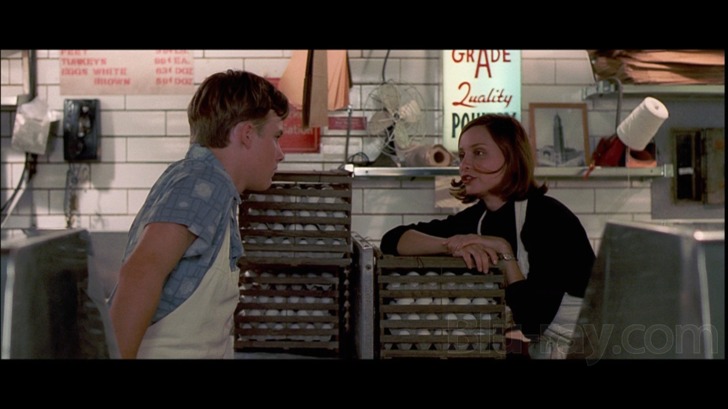
As a member of the New York film festival’s selection committee, I’ve seen or sampled close to 150 films (shorts and features) this summer that haven’t yet opened in the United States, about a quarter of them American. And I’ve come to a few rough conclusions about the differences between new American movies and those recently made elsewhere, and had a few thoughts about trends in American studio and independent pictures. All of them are fairly depressing.

One major difference between foreign and American fiction features stands out: those made in other countries tend to be about how people live today, and those made here tend to be anything but. The few American movies that spring to mind as exceptions are already being regarded within the business as uncommercial — difficult, marginal works earmarked for “special” audiences.

This state of affairs is partly the result of new definitions of “universality” developed by the studios over the past several years, which generally suppose that the ideal movie viewer has the taste and sensibility of a ten-year-old boy: think of the well-received Speed, Forrest Gump, and True Lies, for instance, none of which betrays a view of the adult world any more developed than those in The Lion King and The Mask. Read more

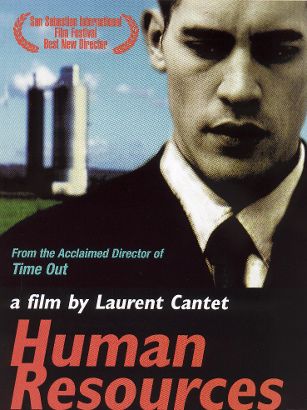
Human Resources

From the Chicago Reader (March 1, 2002). — J.R.
HumanResources

In Laurent Cantet’s 1999 French feature, written with Gilles Marchand, a student at a Paris business school returns home to Normandy to intern at the factory where his father has worked for 30 years. When the son and other workers go on strike and the antiunion father is let go, the son finds himself and his father on opposite sides of the fence. This sharp, convincing, and utterly contemporary political film calls to mind some of Ken Loach’s work, full of passion as well as precision. Cantet’s subsequent film, L’Emploi des Temps (Time Out), a prizewinner in Venice, shows an even more masterful grasp of the business world and all that it entails. This filmmaker is definitely someone to get acquainted with. In French with subtitles. 100 min. (JR)

Recursos-humanos-2-e1404070642715 Read more