The Ten Best Jazz Films (1999 list)

Joseph McBride, a friend, asked me to contribute a list of some sort to The Book of Movie Lists (Chicago: Contemporary Books, 1999), which he put together, and here’s what we came up with. -– J.R.

The 10 Best Jazz Films

by Jonathan Rosenbaum

What follows is a personal list of neither the best films on jazz (e.g., Jazz on A Summer’s Day) nor the best examples of jazz on film (such as the Fats Waller soundies or the 1981 Johnny Griffin at the Village Vanguard), but something more special and rarified: films in which the aesthetics of jazz and the aesthetics of film find some happy and mutually supportive meeting ground.
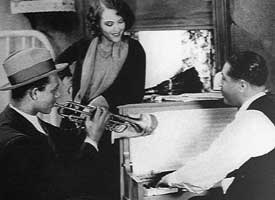
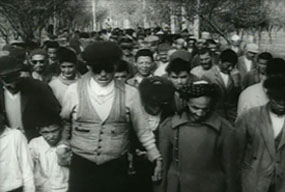
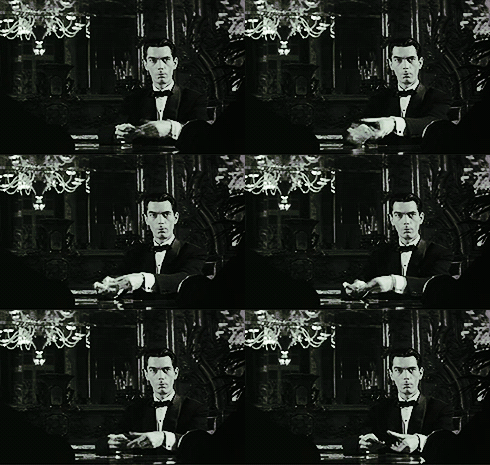
1.Black & Tan (DUDLEY MURPHY, 1929). Remarkable not only as an experimental narrative by the (often uncredited) main author of Ballet mécanique and as a radical political statement about to whom jazz belongs, but also as a ravishing, poetic marriage between the music of Duke Ellington and the poetics of death and orgasm. Only twenty-one minutes long, but the aesthetics of jazz and film start here.
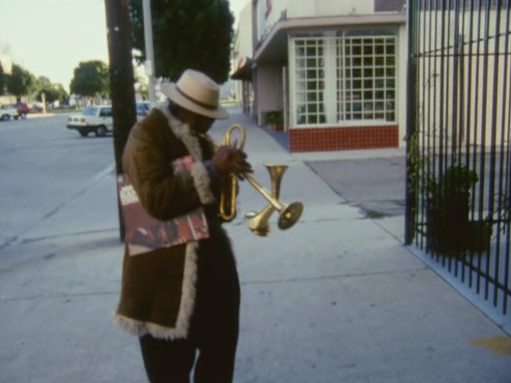
2.When it Rains (CHARLES BURNETT, 1995). A twelve-minute miracle, and, alas, the only film on this list by a black filmmaker, this is a jazz parable about the discovery of common ‘6os roots via a John Handy album in contemporary L.A., Read more
Ten & Twenty Best Lists, 1995-1999

This is third in an ongoing series of five lists of lists. –J.R.

Chicago Reader, 1995:
Latcho Drom (Tony Gatlif)
Crumb (Terry Zwigoff)
A Great Day in Harlem (Jean Bach) + When It Rains (Charles Burnett)
Lamerica (Gianni Amelio)
Good Men, Good Women (Hou Hsiao-hsien)
Safe (Todd Haynes)
Germany Year 90 Nine Zero (Jean-Luc Godard)
Exotica (Atom Egoyan)
Hyenas (Djibril Diop Mambety)
Up Down Fragile (Jacques Rivette)

Chicago Reader, 1996:
Dead Man (Jim Jarmusch)
The Asthenic Syndrome (Mira Kuratova)
The Decalogue (Krzysztof Kieslowski)
Nightjohn (Charles Burnett)
The Neon Bible (Terence Davies)
Regularly or Irregularly (Abbas Kiarostami) + From the Jounals of Jean Seberg (Mark Rappaport)
Thieves (André Téchiné) + My Favorite Season (André Téchiné)
The White Balloon (Jafar Panahi) + Goodbye South, Goodbye (Hou Hsaio-hsien)
Blush (Li Shaohong) + Red Hollywood (Thom Anderson & Noël Burch)
Flirt (Hal Hartley) + Deseret (James Benning)
Sling Blade (Billy Bob Thornton) + Joan the Maid (Jacques Rivette)
Secrets & Lies (Mike Leigh) + Basquiat (Julian Schnabel)
Get on the Bus (Spike Lee) + Chungking Express (Wong Kar-wai)
Mars Attacks! (Tim Burton) + The Cable Guy (Ben Stiller)
When Pigs Fly (Sara Driver) + Desolation Angels (Tim McCann)
Stealing Beauty (Bernardo Bertolucci) + My Life and Times With Antonin Artaud (Gérard Mordillat)
Ectasy (Mariano Barroso) + Vive l’Amour (Tsai Ming-liang)
Cyclo (Tran Anh Hung) + Breaking the Waves (Lars von Trier)
2 X 50 Years of French Cinema (Anne-Marie Mièville & Jean-Luc Godard) + The Crucible (Nicholas Hytner)
A Family Thing (Richard Pearce) + Nelly and Monsieur Arnaud (Claude Sautet)
Yang and Yin: Gender in Chinese Cinema (Stanley Kwan) + Red Lotus Society (Stan Lai)
Foxfire (Annette Haywood-Carter) + Bottle Rocket (Wes Anderson) + Trainspotting (Danny Boyle)

Chicago Reader, 1997:
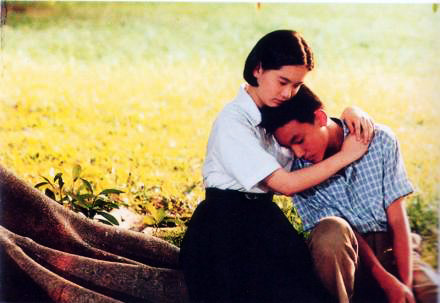
A Brighter Summer Day (Edward Yang)
The House Is Black (Forugh Farrokhzad)
Irma Vep (Olivier Assayas)
The Ceremony (Claude Chabrol)
4 Little Girls (Spike Lee) + Fast, Cheap & Out of Control (Errol Morris)
La promesse (Luc and Jean-Pierre Dardenne)
In the Company of Men (Neil LaBute)
The Sweet Hereafter (Atom Egoyan)
As Good As It Gets (James L. Read more

Remembering Ron

From the Chicago Reader, February 10, 1995. — J.R.

TheLastTimeISawRon

Ron Vawter (1948-1994), who died of AIDS, was one of those rare actors who, like Tilda Swinton in England and the late Delphine Seyrig in France, remained equally active in commercial and experimental productions. He played the psychiatrist in sex, lies, and videotape and appeared in such Hollywood features as The Silence of the Lambs and Philadelphia. But Vawter also played the male lead in Mark Rappaport’s ground-breaking and visually stunning Postcards and in Bruce and Norman Yonemoto’s Made in Hollywood (both from 1990) and appeared with Willem Dafoe and other members of the Wooster Group in Ken Kobland’s elegantly creepy and cadaverous video Flaubert Dreams of Travel but the Illness of His Mother Prevents It (1986), a series of surrealist tableaux presented with diverse sound elements. Remembering Ron includes the Rappaport and Kobland tapes, a ten-minute excerpt from Made in Hollywood (unfortunately too fragmented to give much sense of the whole), and Leslie Thornton’s brand-new The Last Time I Saw Ron. This powerful memoir combines glimpses of Vawter in a Belgian stage production, Philoktetes Variations, with diverse kinds of found and new footage and uncanny sound effects. Read more

The Glass Shield

The fourth feature (1995) by this country’s most gifted black filmmaker, Charles Burnett (Killer of Sheep), is his first with a directly political edgea heartfelt and persuasive look at the racism and corruption of the Los Angeles police force, based on a true story and calculated to burn its hard lessons straight into your skull. The plot concerns the adjustments made by a sincere black rookie cop (Michael Boatman) who joins an all-white precinct and wants to be accepted by his fellow officers; his only real ally turns out to be the one woman in the precinct (Lori Petty, in a singular performance), a Jew who gets plenty of abuse herself. When a murder case arises involving a black suspect (Ice Cube), the hero’s decision to perjure himself in order to support his white partner opens a Pandora’s box of ironies and ambiguities that the movie squarely faces. The distributor forced him to tone down the anger and despair of his original ending, but this still packs a mighty punch. With Elliott Gould and M. Emmet Walsh. 108 min. (JR) Read more

Jefferson In Paris

For many of its historical details, I found this James Ivory-Ruth Prawer Jhabvala account of Thomas Jefferson’s five-year stint as ambassador to France (1784-’89) a lot more absorbing and interesting than their usual brand of Classics Illustratedeven if the Gourmet-style consumerist spreads remain pretty much the same. But by the time they get around to articulating a story, the inhibitions imposed by their good taste begin to seem more like gutlessness, and what initially promises to be an exposure of American liberal doublethink about slavery winds up as a querulous wimp out on a subject that the underrated Mandingo is better equipped to deal with. I don’t feel qualified to comment on the accuracy of this portrait of Jefferson, but Nick Nolte does what he can to suggest unplumbed depths, and the other actorsincluding Greta Scacchi, Gwyneth Paltrow, Thandie Newton, Seth Gilliam, Simon Callow, Nancy Marchand, Charlotte de Turckheim, Jean-Pierre Aumont, Michael Lonsdale, and James Earl Jonesvie with the varied decor in holding one’s respectful attention (1995). (JR) Read more

The Bridges Of Madison County

Clint Eastwood resurrects the star system, the Hollywood love story, and middle-aged romance, but despite all his craft and sincerity, he and screenwriter Richard LaGravenese can’t quite turn Robert James Waller’s cardboard best-seller into flesh and bone. The one big exception is Meryl Streep’s beautiful and fresh performance as an Iowa housewife resigned to a disappointing life. Eastwood plays a National Geographic photographer who happens along while her family is gone, a fantasy figure who seldom adds up to anything more than his sketchy profile. As long as these two are on-screen one can forget the treacle that brought them theretheir first moment of physical contact is exquisite and unforgettableand the film makes a plausible conservative argument for adultery as a preserver of marriage. This self-styled relic (1995) only fitfully transcends the Reader’s Digest aura it seems so eager to honor and justify, but it’s earnest and it has the unfashionable courage to be slow. With Annie Corley, Victor Slezak, Jim Haynie, and a wonderful jazz sound track featuring singer Johnny Hartman. 135 min. (JR) Read more

Beyond Rangoon

This 1995 film works so well as storytelling and action adventure that you may want to overlook the dubious if well-intentioned premise: the slaughter of the Burmese populace becomes significant only to the degree that an American tourist (Patricia Arquette), seeking to overcome a tragedy in her own life, becomes personally involved with it. Ace director John Boorman took over this project from other hands, and he shows his customary flair with ‘Scope compositions, gorgeous sunsets, and suspenseful, exotic spectacle. What left me a little uneasy is epitomized by Hans Zimmer’s hack score, which aims at sounding vaguely Southeast Asian (wooden-sounding flutes and the like) rather than specifically Burmese to get us all in the right paternalistic frame of mind. But if you don’t mind such casual insults, you’re likely to be glued to your seat. Alex Lasker and Bill Rubenstein wrote the script; with Frances McDormand, Spalding Gray, and U Aung Ko. 99 min. (JR) Read more

On F FOR FAKE (1995 essay)

Commissioned and published for the Voyager laserdisc of F for Fake in 1995.  My thanks to Marcio Sattin in São Paulo for giving me a printout of this untitled “lost” essay in Spring 2015, which I’ve slightly re-edited.-– J.R.

f-for-fake2

Orson Welles’ two major documentary forays stand roughly at opposite ends of his film career: It’s All True (1942) and F for Fake (1973), and together the two projects’ very titles express a dialectical relationship to the documentary. Both belong to a form of documentary known as the essay film that interested Welles throughout his career. Notwithstanding some Wellesian hyperbole, it seems safe to say that both titles accurately convey the overall essence of their respectiive projects: Most of the never-completed It’s All True, as Welles conceived and shot it, was true; most of F for Fake is fake -– a fake documentary about fakery, with particular attention devoted to art forger Elmyr de Hory, to author Clifford Irving, and to Welles himself. As Welles put it in a 1983 interview, “In F for Fake I said I was a charlatan and didn’t mean it . . . because I didn’t want to sound superior to Elmyr, so I emphasized that I was a magician and called it a charlatan, which isn’t the same thing. Read more

Hollywood Strikes Out (The Best Movies of 1995)

From the Chicago Reader (January 5, 1996). — J.R.

I can’t recall a worse year for Hollywood than 1995. This suggests that either my memory or the studio system is disintegrating. My guess is it’s the latter. I don’t mean to say the business is coming apart; sadly, Hollywood has often found it easy to make money with junk, especially if the public is willing — as it still apparently is — to go along with the film industry’s manipulations. (However, given the scant means available to most people to make themselves heard on such matters in this “free” society, I don’t want to jump to too many conclusions about this.) Rather I believe that what’s coming apart is the social contract between the industry and filmgoers, which allows some form of customer satisfaction that isn’t predicated on deception and a fundamental contempt for the audience.

A symptom of the problem could be found in an article by Peter Bart in Variety late last October bemoaning the poor box-office returns for “such pricy projects” as Jade, The Scarlet Letter, Strange Days, and Assassins. “Rubbing salt into the wound,” added Bart, “is a new Yankelovich opinion survey…which indicates that 43 percent of filmgoers interviewed say they would attend more films all year round if a ‘better selection’ of movies were available. Read more

Cannes, 1995

Adapted from “Journal de Cannes,” translated by Jean-Luc Mengus, Trafic, no. 15, été [summer] 1995. — .J.R.

From 1970 to 1973, when I was living in Paris, it was still possible to write Cannes coverage for two magazines, stay in a cheap hotel, and not lose too much money, and last year I was able to start attending again thanks to being on the selection committee of the New York Film Festival. Despite the opening of a new Palais des Festivals in 1983 and the closing or remodeling of various cinemas, the most significant changes to be found here after two decades could arguably be summed up in a single phrase: what we mean when we say “contemporary cinema,” entailing not only what we include but what we leave out. In theory, all the beauty and horrors, the contradictions and paradoxes of world cinema are crammed in two weeks over a few city blocks. But in practice, how can we say with any confidence that Cannes is an accurate précis of anything except the international film business (which includes the press)?

Perhaps the biggest difference between the seventies and nineties in Cannes is the matter of whose opinions count the most. Read more

The Aesthetics and Politics of Fear

Commissioned by the Portuguese quarterly Electra for its fall 2025 issue, devoted to Fear.

In their original forms as novels, Mary Shelley’s sophisticated novel of ideas, Frankenstein (1818) and Bram Stoker’s simpler and pulpier Dracula (1897) were published almost eighty years apart. Although only the second of these appeared during the Victorian era (1837-1901), it doesn’t seem like a stretch to associate both novels with the repressions and displacements of what we regard today as Victorian.

By contrast, the releases of the movie adaptations of these novels made at Universal studios in 1931 were only a little over eight months apart. An earlier, unauthorized film adaptation of Dracula called Nosferatu (1922) is also worth mentioning, as are other early silent German features that belong to the horror genre (e.g., The Golem in 1915 and The Cabinet of Dr. Caligari in 1920). But the commercial successes of Dracula and Frankenstein, both of which drew on elements from silent German films, were arguably what established horror as an ongoing international genre, working with both repression and its subsequent unleashing and/or explosive consequences. At least since the 1950s in the U.S., when teenagers were first identified as a social class and a market, horror movies have been commonly viewed as the ideal “date” movies for teenagers, largely because the fear they provoke can draw couples closer together for mutual comfort and assurance. Read more

Robert Frank’s ONE HOUR (1990)

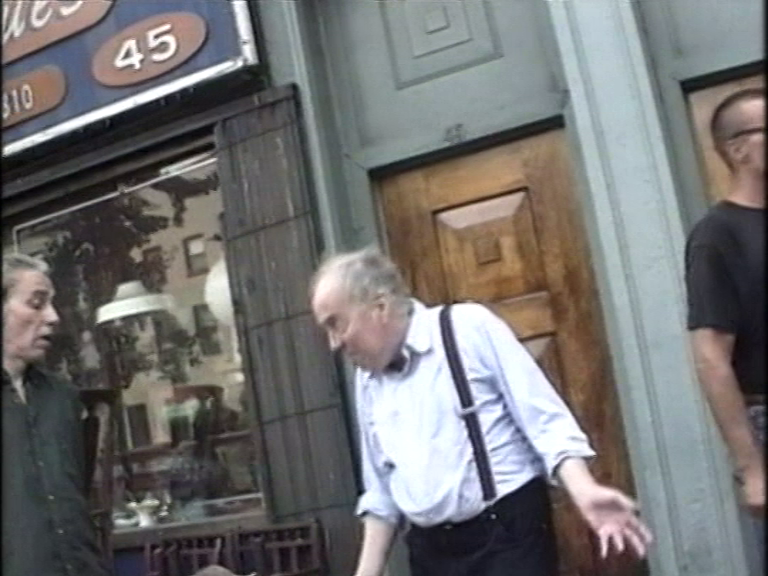
Commissioned by and published in Frank Films: The Film and Video Work of Robert Frank, a 2009 German retrospective catalogue published in English. You can see a few brief glimpses of the video in the fascinating recent documentary Don’t Blink — Robert Frank. It was produced by Philippe Grandrieux for French television. — J.R.

“I’ve seen La chouette aveugle seven times,” Luc Moullet once wrote of Raúl Ruiz’s intractable masterpiece, “and I know a little less about the film with each viewing.” Apart from being both intractable and a masterpiece, I can’t say Robert Frank’s One Hour [also sometimes known as Sixty Minutes)  has anything in common with the Ruiz film, yet what makes it a masterpiece and intractable is the same paradox: the closer I come to understanding it, the more mysterious it gets.

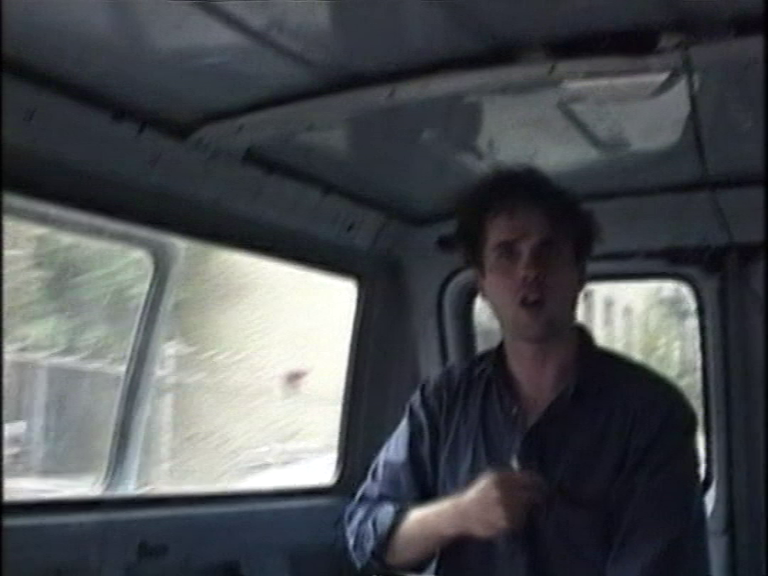
My first look at this single-take account of Frank and actor Kevin O’Connor either walking or riding in the back of a mini-van through a few blocks of Manhattan”s Lower East Side — shot between 3:45 and 4:45 pm on July 26, 1990 — led me to interpret it as a spatial event capturing the somewhat uncanny coziness and intimacy of New York street life, the curious experience of eavesdropping involuntarily on strangers that seems an essential part of being in Manhattan, an island where so many people are crammed together that the existential challenge of everyday coexistence between them seems central to the city’s energy and excitement. Read more

Werner Herzog Takes Us All On the Bad Faith Express: Reflections on FAMILY ROMANCE, LLC

Commissioned by The Chiseler, and posted there on July 4, 2020. — J.R.

aguirre2

aguirre

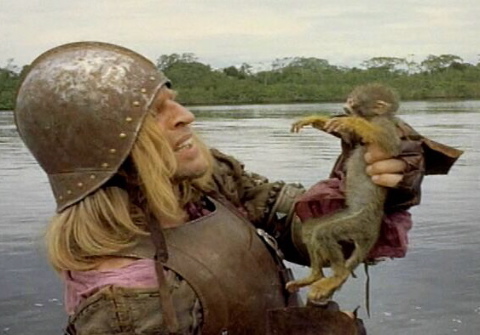
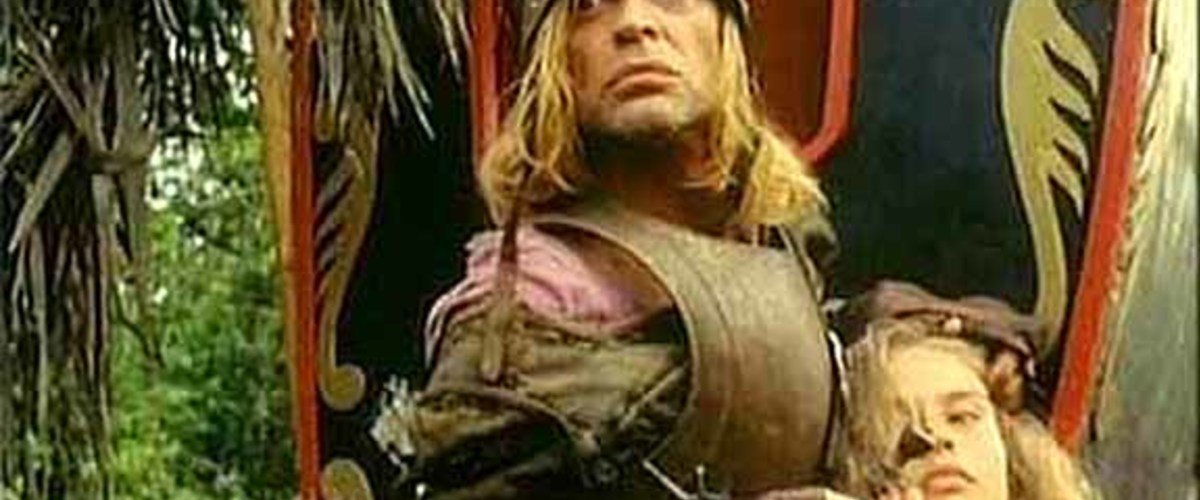
My first encounter with Werner Herzog was at the Directors’ Fortnight at Cannes in 1973, where I first saw Aguirre, the Wrath of God in an English-dubbed version that included, if memory serves, a few Brooklyn accents in 16th century Peru. (This is why it took some rethinking and retooling before the film could be successfully exhibited in the U.S., in German with subtitles.) But what flummoxed me the most  — in spite of the film’s awesome visual splendor and its crazed poetic conceits — was what Herzog revealed about the opening intertitle when I asked him about it during the Q & A.

Aguirre

The intertitle: “After the conquest and sack of the Incan empire by Spain, the Indians invented the legend of El Dorado, a land of gold, located in the swamps of the Amazon tributaries. A large expedition of Spanish adventurers led by Pizarro sets off from the Peruvian sierras in late 1560. The only document to survive from this lost expedition is the diary of the monk Gaspar de Carvajal.” Herzog’s cheerful admission: the bit about the document and the diary was a total lie, invented by him because he reasoned that people wouldn’t accept the film’s premises otherwise. Read more

Blade Runner: The Director’s Cut

Far and away the best SF movie of the 80s, Ridley Scott’s visionary look at Los Angeles in the year 2019a singular blend of grime and glitter that captures both the horror and the allure of Reagan-era capitalism with the claustrophobic textures of a Sternberg filmwas a critical and commercial flop when it first appeared (1982). Loosely adapted from Philip K. Dick’s Do Androids Dream of Electric Sheep?, the film follows the hero (Harrison Ford) as he tracks down and kills replicants, or androids. Much of the film’s erotic charge and moral and ideological ambiguity stems from the fact that these characters are very nearly the only ones we care about. (We never know for sure whether the hero is a replicant himself; in the director’s cut version that uncertainty is even greater.) The grafting of 40s hard-boiled detective story with SF thriller creates some dysfunctional overlaps, and the movie loses some force whenever violence takes over, yet this remains a truly extraordinary, densely imagined version of both the future and the present, with a look and taste all its own. With Rutger Hauer, Edward James Olmos, Joe Turkel, and William J. Sanderson. R, 112 min. (JR) Read more