This 1995 film works so well as storytelling and action adventure that you may want to overlook the dubious if well-intentioned premise: the slaughter of the Burmese populace becomes significant only to the degree that an American tourist (Patricia Arquette), seeking to overcome a tragedy in her own life, becomes personally involved with it. Ace director John Boorman took over this project from other hands, and he shows his customary flair with ‘Scope compositions, gorgeous sunsets, and suspenseful, exotic spectacle. What left me a little uneasy is epitomized by Hans Zimmer’s hack score, which aims at sounding vaguely Southeast Asian (wooden-sounding flutes and the like) rather than specifically Burmese to get us all in the right paternalistic frame of mind. But if you don’t mind such casual insults, you’re likely to be glued to your seat. Alex Lasker and Bill Rubenstein wrote the script; with Frances McDormand, Spalding Gray, and U Aung Ko. 99 min. (JR) Read more
Commissioned and published for the Voyager laserdisc of F for Fake in 1995. My thanks to Marcio Sattin in São Paulo for giving me a printout of this untitled “lost” essay in Spring 2015, which I’ve slightly re-edited.-– J.R.
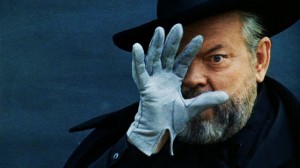
Orson Welles’ two major documentary forays stand roughly at opposite ends of his film career: It’s All True (1942) and F for Fake (1973), and together the two projects’ very titles express a dialectical relationship to the documentary. Both belong to a form of documentary known as the essay film that interested Welles throughout his career. Notwithstanding some Wellesian hyperbole, it seems safe to say that both titles accurately convey the overall essence of their respectiive projects: Most of the never-completed It’s All True, as Welles conceived and shot it, was true; most of F for Fake is fake -– a fake documentary about fakery, with particular attention devoted to art forger Elmyr de Hory, to author Clifford Irving, and to Welles himself. As Welles put it in a 1983 interview, “In F for Fake I said I was a charlatan and didn’t mean it . . . because I didn’t want to sound superior to Elmyr, so I emphasized that I was a magician and called it a charlatan, which isn’t the same thing. Read more