Written for Volume 34, Number 3, Issue No 135 of the Winnipeg-based Canadian arts journal Border Crossings in Fall 2015 (see below). — J.R.
I’m frequently troubled these days by the growing absence of global perspectives in what passes for news and other forms of mainstream discourse in the U.S. — the perpetually shrinking definitions of what we mean by ‘we’. A good many of the congealed stereotypes of foreign cultures that crop up in both Hollywood blockbusters and Internet chatter — ranging from the notion that ‘the French’ are crazy about Jerry Lewis to the pop images we still have of Latinos, Italians, Russians, Arabs, and Asians in SF blockbusters whenever ‘the world’ has to be represented — can paradoxically be traced back to the 50s and 60s, when the Cold War and all of its most rigid either/or assumptions were still in force. One might suppose that the combined resources of the Internet and digital viewing would widen our cinematic and other cultural reference points rather than shrink them. But the tendency of even respectable, adult media pundits to speak about ‘good guys’ and ‘bad guys’ in the world at large suggests a metaphysics tailored to the dimensions of a Star Wars saga or a video game, where the cultural givens plunge back even further into the mythical past: Flash Gordon serials and Triumph of the Will from the mid-1930s, Roy Rogers Westerns and airborne World War 2 epics of the mid-1940s. Read more
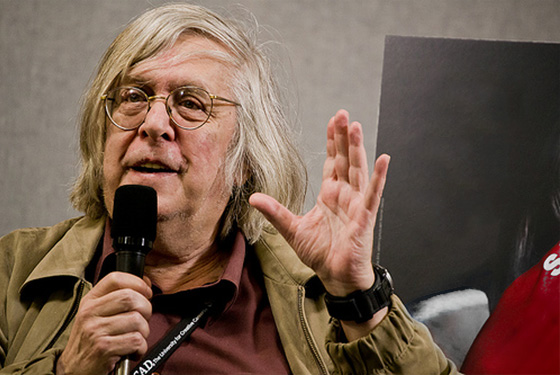
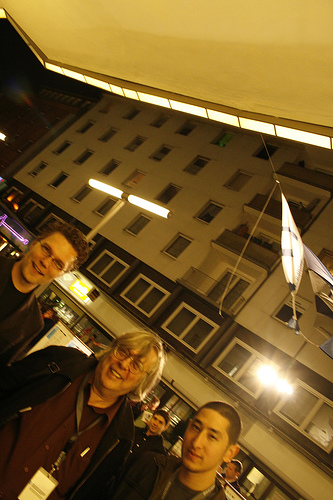
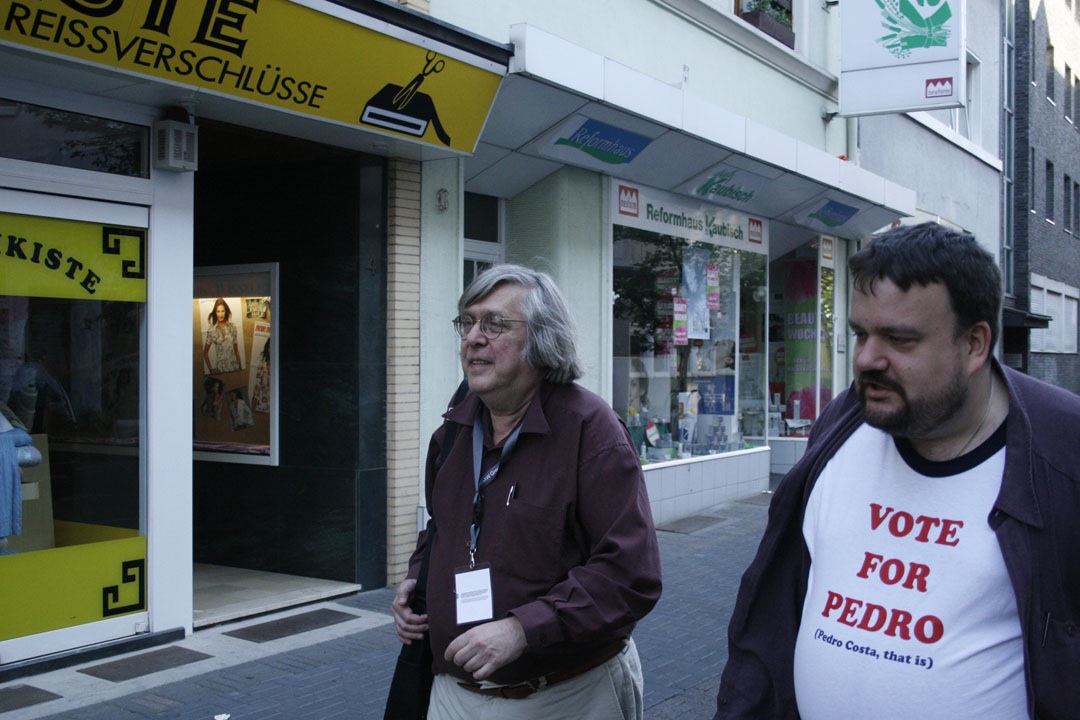
This is the second of my bimonthly columns written for Cahiers du Cinéma España, which ran in their third (July-August 2007) issue. It seems fitting to post it three years later because I’m back at the same festival again, serving again on the FIPRESCI jury. It’s hard not to feel an immense sadness about the intervening death (by murder, in Manila, along with his Slovenian partner Nika Bohinc) of Alexis Tioseco, my fellow juror, who can be seen here in the first photo, on the far right. This was most likely taken by Olaf Möller, one of the festival’s programmers, who can be seen in the second photo below, taken by Alexis.
Amit Dutta, incidentally, whose Kramasha won our FIPRESCI prize three years ago, will be attending the festival for the first time this year, and presenting a program tomorrow night. (Update, a day later: Unfortunately, Dutta had to cancel his visit due to health reasons, but two programs of his films will still be presented.) — J.R.
The prospect of attending a festival of short films has always seemed difficult to me because of the number of aesthetic gear changes involved in moving from one film to the next. Read more
A Chicago Reader blog post, dated Saturday, December 1, 2007, 1:46 PM. — J.R.
Two of the more interesting programs that I saw at the just-concluded Torino Film Festival consisted of films by LA filmmaker and Cal Arts alumnus Anna Biller, who writes, directs, stars in, designs the costumes and sets for, and sometimes helps to perform the music in her films, none of which has a distributor at this point. Her first feature, Viva(2006), is a pastiche of 1970s soft-core porn, theoretically reconfigured to support a woman’s viewpoint — an interesting curiosity, but a bit long for my taste (at 120 minutes, longer than any ’70s soft-core flick that I’m aware of), and perhaps not sufficiently aware of its own grotesqueness to qualify as either a critical commentary on its elected genre or as a wholly convincing entry in that genre.
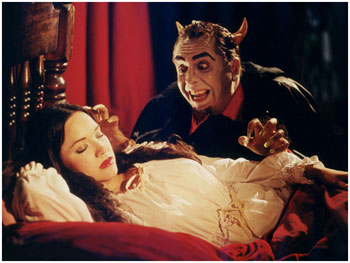
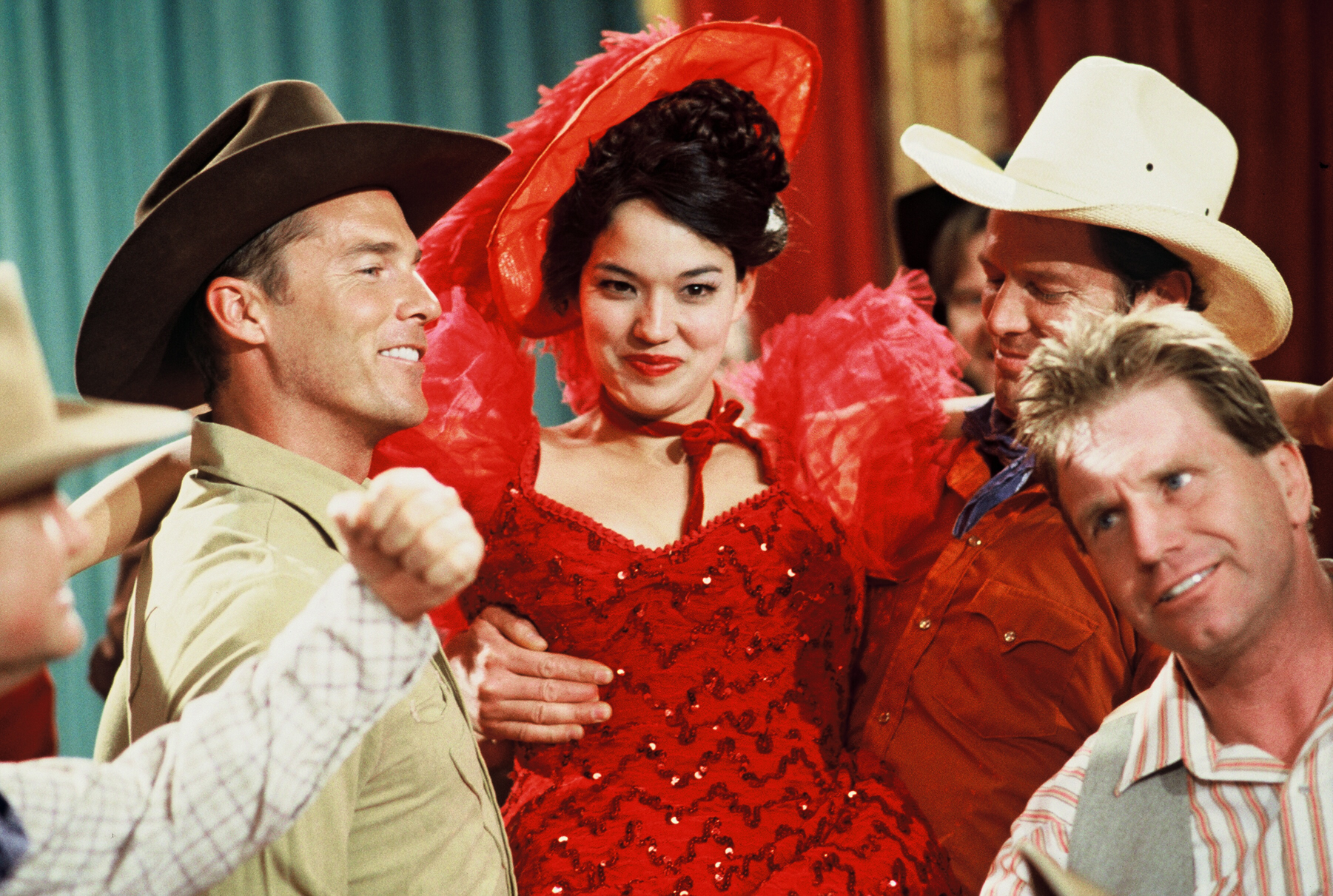
I found her program of earlier 16mm shorts more interesting: Three Examples of Myself as Queen (1994), The Hypnotist (2001 — her only film in which she doesn’t act and which she didn’t write herself, written instead by her partner and frequent collaborator Jared Sanford), and, above all, A Visit from the Incubus (2001, see photos above), a 27-minute horror-western-musical that I regard as her masterpiece.
Commissioned by Sight and Sound, and written for their August 2006 issue. — J.R.
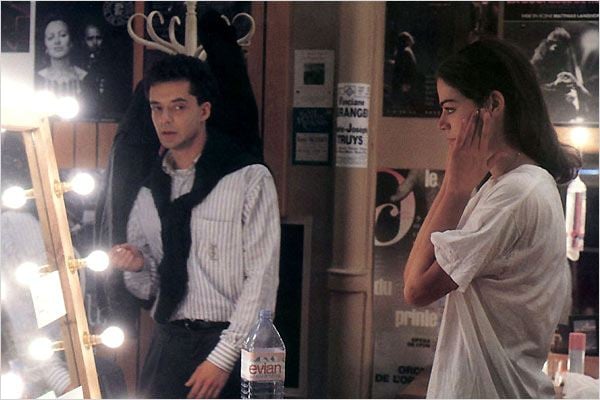
Considering how much admiration I have for the films of Philippe Garrel, it’s hard to avoid some feelings of guilt and consternation for not liking them more — especially when I consider how much they mean to others whose tastes I admire. Why do I find myself preferring the work of his best-known disciple, Leos Carax?
This is a problem I’ve been wrestling with for a quarter of a century. For the past decade, I’ve been trying to theorize my disaffection by ascribing the passion of my younger friends for this melancholy star of the French underground to a generational taste I can’t share. In some respects, I even like the way they like Garrel’s films more than I like the films themselves. They generate a kind of awe that few other filmmakers inspire, and the fact that he’s a minority taste in no way disqualifies him from being a major talent.
These far-flung cinéphiles, all born around 1960, include Nicole Brenez, based in Paris; Alexander Horwath, based in Vienna; Kent Jones, based in New York; and Adrian Martin, based in Melbourne —- all of whom share similarly acute feelings for John Cassavetes, Abel Ferrara, Monte Hellman, and Maurice Pialat. Read more
From the Chicago Reader (September 1, 1993). — J.R.
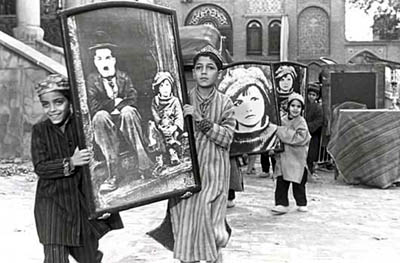
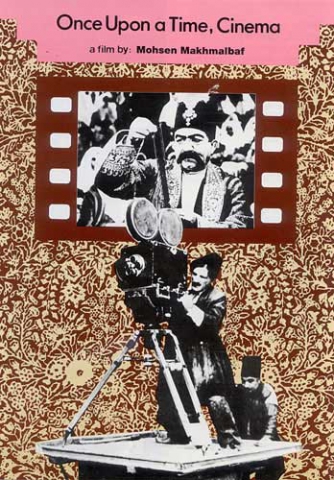
An entertaining if somewhat uneven departure by Mohsen Makhmalbaf, this 1992 film can be regarded in part as a kind of peace offering to the Iranian government after the banning of his two previous features. A fantasy about the birth of Iranian cinema, full of whimsical special effects and wacky magical-realism conceits, it’s centered on an early cinematographer (Mehdi Hashemi) — modeled loosely and rather awkwardly on Chaplin’s tramp figure — who introduces movies to the Persian court, gradually winning over the shah (Ezatollah Entezami) after the ruler falls for an actress (Fatemeh Motamed Aria, literally dropping from the screen into the palace). Quirkily inventive and unpredictable, the film concludes with a sentimental anthology of clips celebrating the history of Iranian cinema that calls to mind Oscar night; before this, much more interesting use is made of a silent film identified by Makhmalbaf as the first Iranian movie, Ebrahim Khan’s Hajagha, the Film Actor. In Farsi with subtitles. 90 min. (JR)
From the Chicago Reader (September 1, 1992). — J.R.
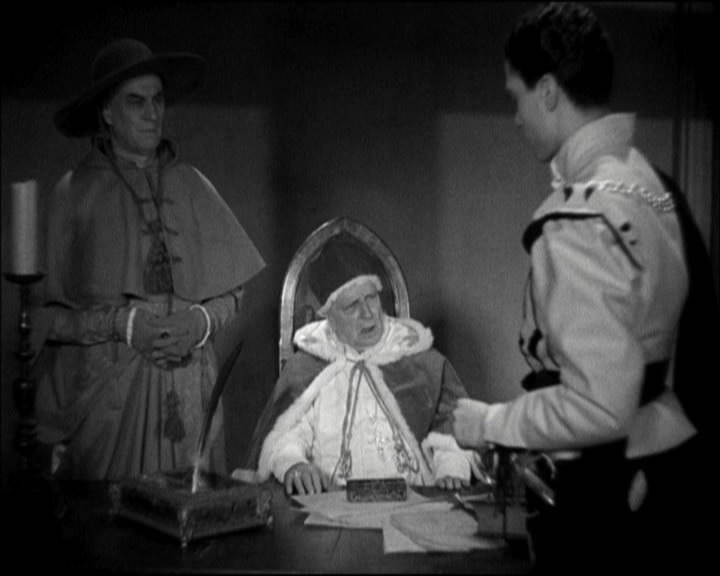
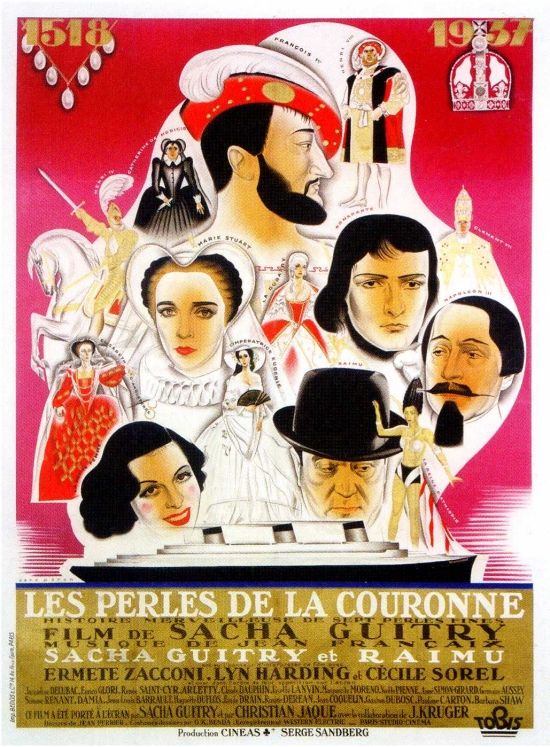
Henry II dies in a quizzical jump cut, Arletty’s voice is run backward to suggest the speech of an Abyssinian snake princess, and writer-director Sacha Guitry plays several parts (including Francis I, Napoleon III, and himself telling the film’s story to his wife). It’s often been said that you have to know French to fully appreciate Guitry’s cleverness and genius. But even if only those who speak French will catch a pun capping Jacqueline Delubac’s attempt to resist Raimu’s advances by speaking exclusively in adverbs, the sheer personality and energy of this 1937 film transcends linguistic barriers. A tale about the fate of seven perfect pearls, four of them in the English crown, it starts in the 16th century and proceeds by leaps and bounds into the 20th, periodically shifting to English or Italian to give its wit and formal play more international cachet. If you’ve never encountered Guitry, this is a plausible place to start. The all-star cast also includes Marcel Dalio, Claude Dauphin, and Jean-Louis Barrault. In English and subtitled French and Italian. 100 min. (JR)
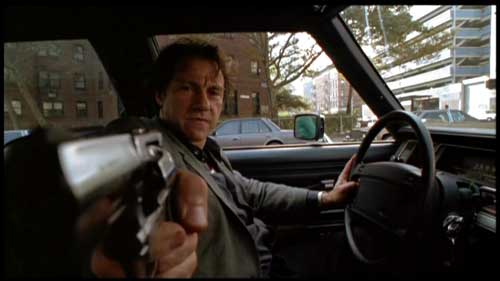
The able Abel Ferrara (Ms. 45, King of New York) goes arty, which means that a corrupt cop and guilty Catholic (Harvey Keitel) cries and apologizes personally to Jesus Christ after swiping, smoking, and snorting every drug in sight, compulsively betting on ball games and losing, ripping off thieves and the grocer they hold up, shooting his car radio with his pistol, jerking off in front of teenage girls, and lots of other fun activities. What transports him even more, it seems, is his outrage that a nun raped in a church decides to forgive her two rapists and refuses to identify them. There’s an undeniable formal elegance in the way Ferrara, who coauthored the script with Zoe Lund, frames and holds certain shots, and Keitel certainly gives his all in this 1992 entry in the Raging Bull redemptive sweepstakes. But I must confess I kept thinking of a friend’s response to this movie — that it made him feel glad, even proud, not to be straight. With Victor Argo, Paul Calderone, Leonard Thomas, Robin Burrows, Frankie Thorn, Victoria Bastel, and Paul Hipp. 98 min. (JR)
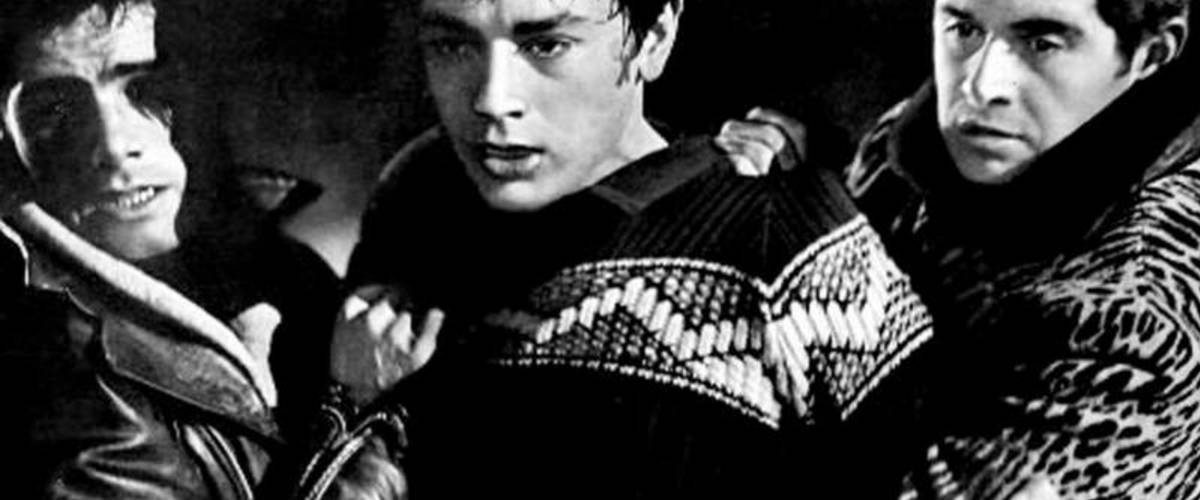
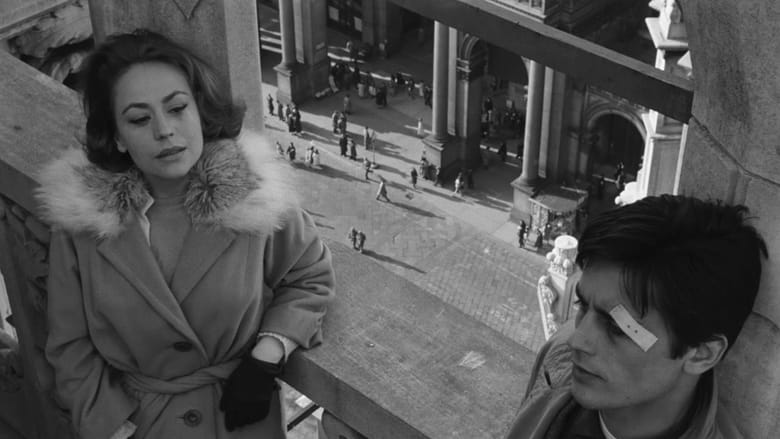
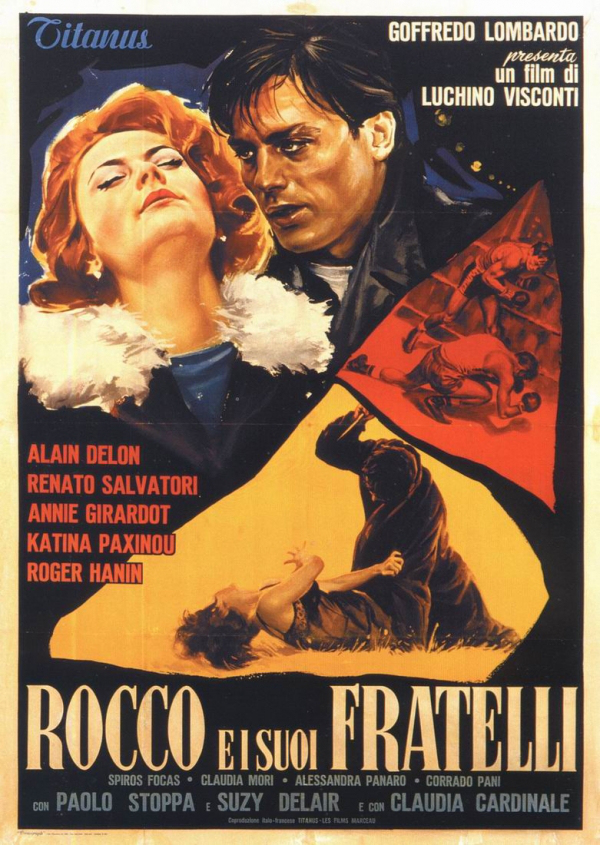
An epic (1960) from Luchino Visconti about five brothers (Alain Delon, Renato Salvatori, Spiros Focas, Rocco Vidolazzi, Max Cartier) who, with their widowed mother (Katina Paxinou), leave their impoverished farm in southern Italy for the corruptions of Milan. This looks like a primary sourcebook for the overheated operatic styles, homoerotic intensity, quasi-incestuous delirium, and casual conceptual misogyny of Scorsese, Coppola, and Cimino — and you may have to value the ranker elements of those filmmakers more highly than I do to consider this precursor more than a mannerist touchstone. Visconti is an incontestable master in films as diverse as La Terra Trema, Senso, The Leopard, and The Innocent, but those films don’t employ women as unconvincingly or as insultingly as this one does. Still, you may be swept along by the sheer grace and stamina of the mise en scene and Nino Rota’s music. With Annie Girardot, Roger Hanin, Suzy Delair, Claudia Cardinale, and, in a smaller role, Adriana Asti. In Italian with subtitles. 180 min. (JR)
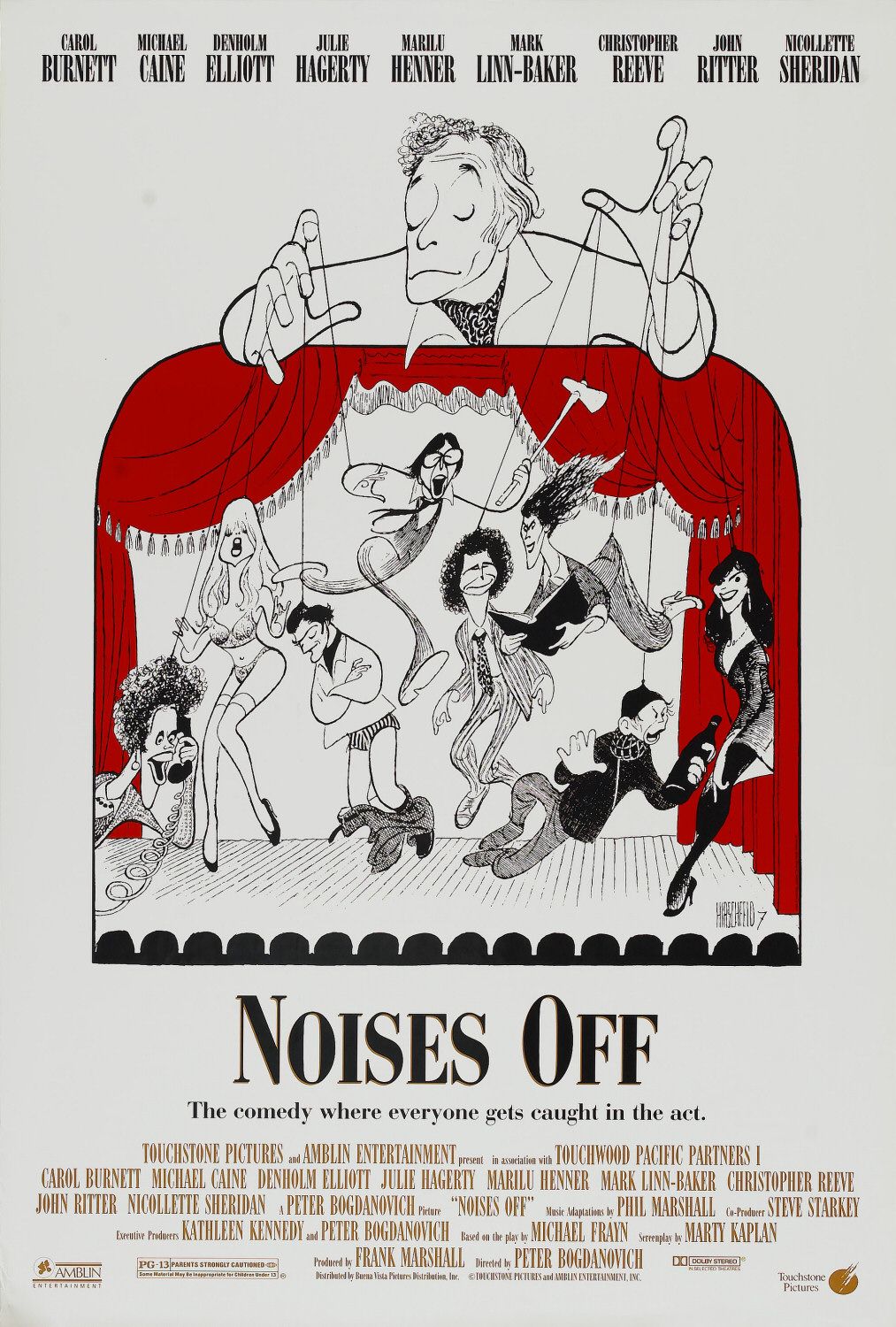
Peter Bogdanovich directs Marty Kaplan’s adaptation of Michael Frayn’s highly successful stage farce about a director (Michael Caine) and a cast of hapless actors trying to whip a sex farce into shape. The transition from stage to screen may be bumpy in spots, but this movie made me laugh more and much harder than What’s Up, Doc? ever did, and the long-take shooting style is executed with fluidity and precision. The basic idea is to hurtle us through three increasingly disastrous tryouts of the same first act, which might be loosely termed “Desperate Dress Rehearsal in Des Moines,” “Actors in Personal Disarray Backstage in Miami Beach,” and “Props in Revolt in Cleveland”; the fleetness of this raucous theme-and-variations form makes it easier to slide past the confusion of all the onstage and offstage intrigues. I can’t comment on the changes undergone by Frayn’s material, except to note that I find it hard to buy the closing artificial uplift, which seems to have been papered over the original’s very English sense of pathos and defeat. Ironically, after the warm and dense ensemble work of Texasville, Bogdanovich reverts here to the cold-blooded mechanics of choreographing one-trait characters, though the chilly class biases of his early urban comedies once again give way to something more egalitarian and balanced. Read more
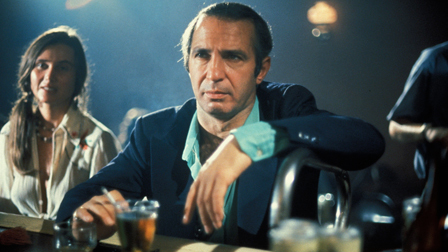
John Cassavetes’s first crime thriller, a postnoir masterpiece, failed miserably at the box office when first released in 1976, and a recut, shorter version released two years later didn’t fare much better. This is the first, longer, and in some ways better of the two versions; it’s easier to follow, despite reports that — or maybe because — Cassavetes had less to do with the editing (though he certainly approved it). A personal, deeply felt character study rather than a routine action picture, it follows Cosmo Vitelli (Ben Gazzara at his very best), the charismatic owner of an LA strip joint — simultaneously an asshole and a saint — who recklessly gambles his way into debt and has to bump off a Chinese bookie to settle his accounts. In many respects the film serves as a personal testament; what makes the tragicomic character of Cosmo so moving is its alter-ego relation to the filmmaker — the proud impresario and father figure of a tattered showbiz collective (read Cassavetes’s actors and filmmaking crew) who must compromise his ethics to keep his little family afloat (read Cassavetes’s career as a Hollywood actor). Peter Bogdanovich used Gazzara in a similar part in Saint Jack (1979), but as good as that film is, it doesn’t catch the exquisite warmth and delicacy of feeling of Cassavetes’s doom-ridden comedy-drama. Read more
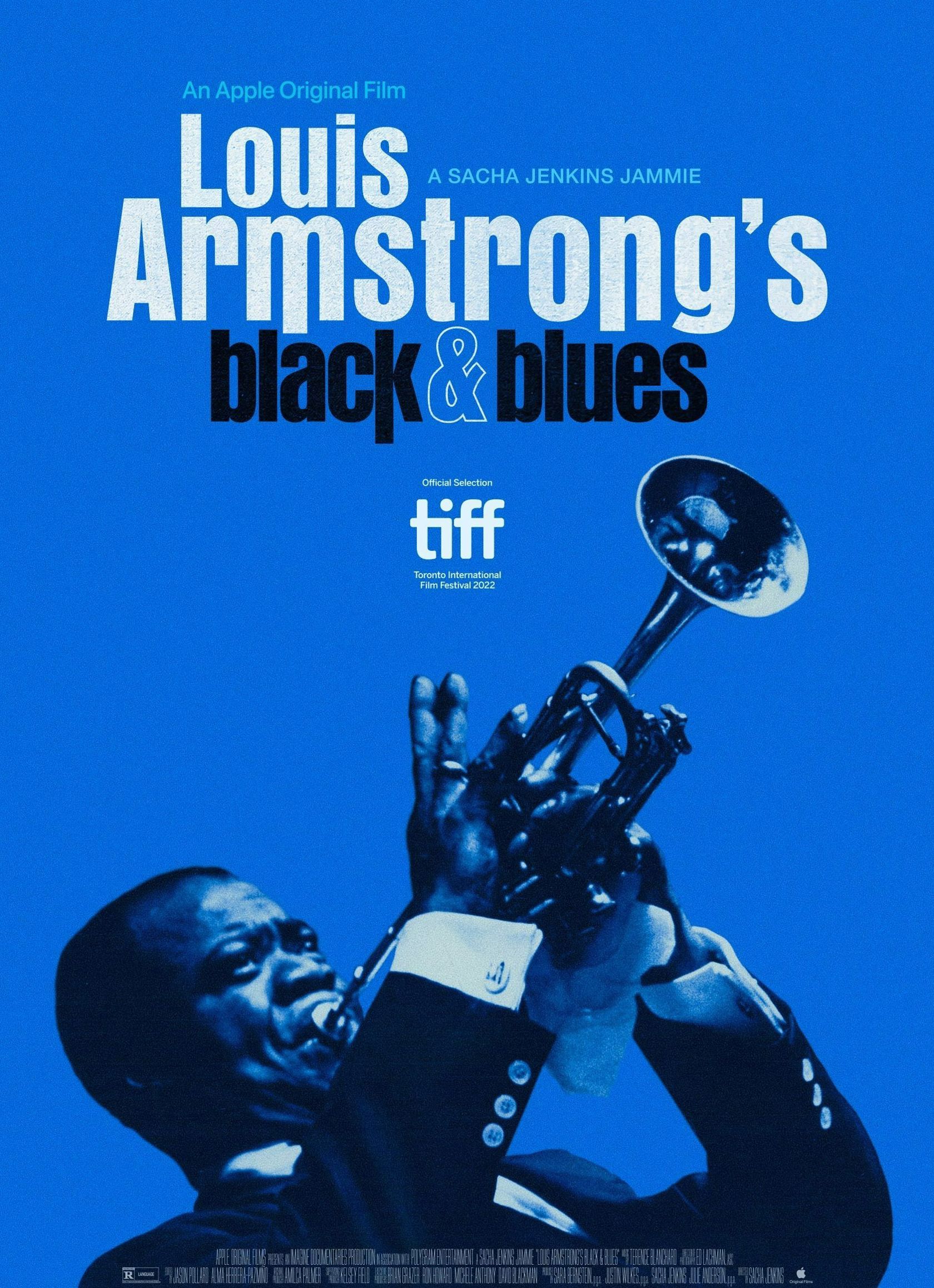
For me, the two best talking heads in Sacha Jenkins’ recent documentary, Louis Armstrong’s Black & Blues, are those of Orson Welles and Ossie Davis, both of whom significantly started out as performers and theater people. Welles — whom we hear as the film begins, warmly introducing Armstrong as a friend on a TV talk show, explaining that he once planned to make a film that would recount the history of jazz through Armstrong’s life — insists on his preeminence as a performer “not on the principle of escapism but on the principle of affirmation.” Given that the entire career of Armstrong as a blazing maestro of the cornet and trumpet can be summed up by the word “affirmation”, Welles’s introduction couldn’t have been more apt.
Written for the first paper issue of New Lines Magazine, January 15, 2023.(Note: The version posted here is somewhat different.)
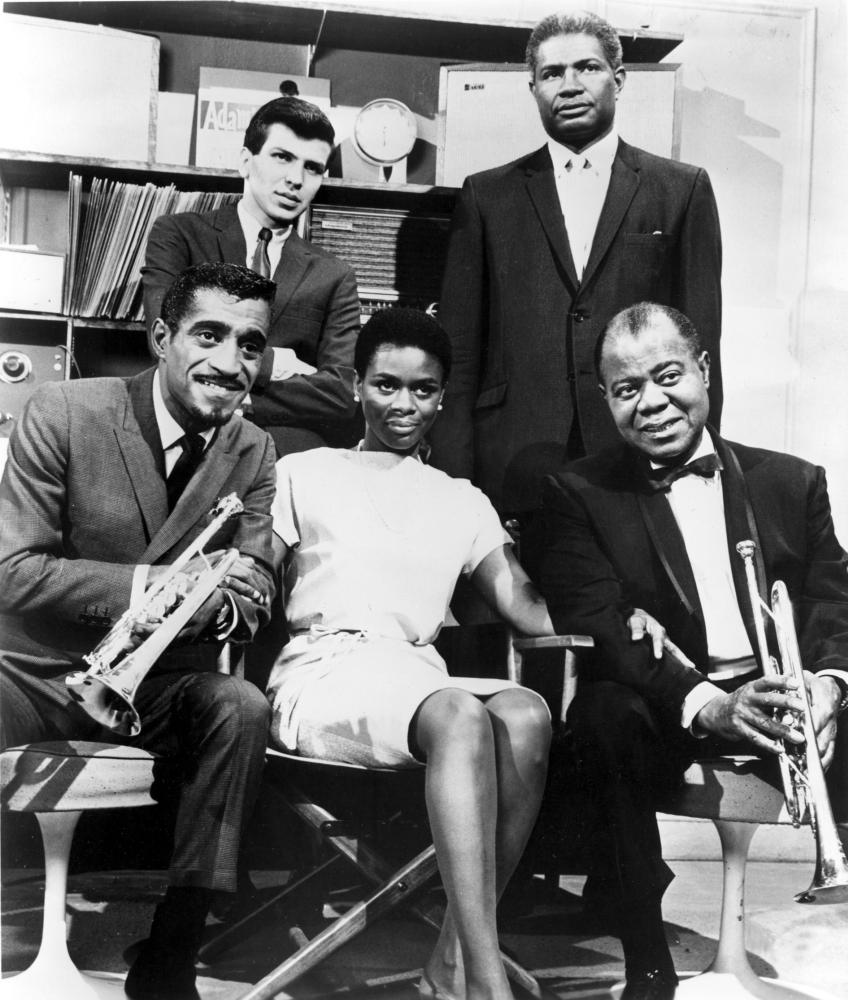
A MAN CALLED ADAM, Sammy Davis, Jr., Frank Sinatra, Jr., Cicely Tyson, Ossie Davis, Louis Armstrong, 1966
Ossie Davis, who once had a character in his play Purlie Victorious say to someone, “You’re a disgrace to the Negro profession,” recalls that he and his friends used to laugh derisively at Satchmo’s performing antics and clowning as a creepy form of Uncle Tomism until the two of them worked together on a movie, A Man Called Adam (1956). Read more
From the Chicago Reader (September 1, 1992). — J.R.
The underrated James Foley (After Dark, My Sweet) shows an excellent feeling for the driven and haunted jive rhythms of David Mamet, macho invective and all, in a superb 1992 delivery of his tour de force theater piece about desperate real estate salesmen, adapted for the screen by Mamet himself. Practically all the action occurs in an office and a Chinese restaurant across the street, and Foley’s mise en scene is so energetic and purposeful (he’s especially adept in using semicircular pans) that the ‘Scope format seems fully justified, even in a drama where lives are resurrected and destroyed according to the value of offscreen pieces of paper. The all-expert cast consists of Al Pacino, Jack Lemmon, Alan Arkin, and Ed Harris (labor), Alec Baldwin and Kevin Spacey (management), and Jonathan Pryce (a customer); the wholly appropriate jazz score, with fine saxophone solos by Wayne Shorter, is by James Newton Howard. 100 min. (JR)
From the Chicago Reader (January 19, 1996). — J.R.
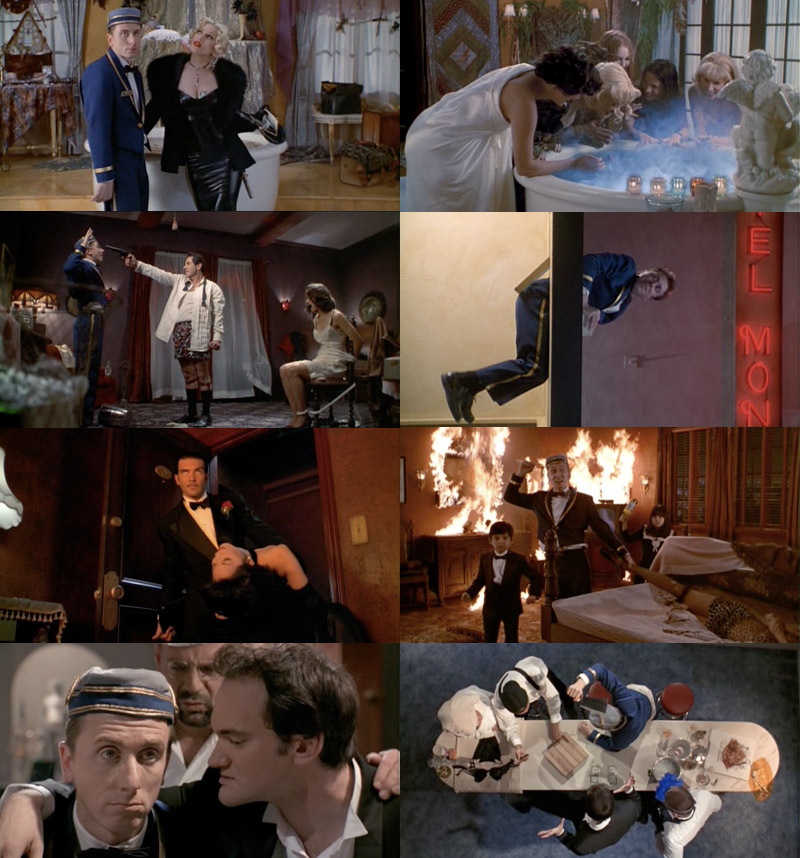
Four Rooms
no stars
Directed and written by Allison Anders, Alexandre Rockwell, Robert Rodriguez, and Quentin Tarantino
With Tim Roth, Sammi Davis, Lili Taylor, Valeria Golino, Madonna, Ione Skye, Jennifer Beals, David Proval, Antonio Banderas, Lana McKissack, Danny Verduzco, Bruce Willis, Paul Calderon, and Tarantino.
Fair is fair. Though I’m calling Four Rooms worthless — an opinion that’s uncontroversial — it’s a better picture than, for example, To Wong Foo, Thanks for Everything! Julie Newmar. In fact Four Rooms is rather interesting in spite of — or perhaps because of — its disturbing awfulness. Declaring a movie worthless usually means something beyond a strictly aesthetic evaluation; there’s something punitive and moralistic, even tribal about our disapproval and rejection. (The same sort of thing often happens when we call a movie “great”: the longtime absence of any movie for and about black women obviously has influenced the recent success of Waiting to Exhale.)
Maybe calling a movie worthless is a way of getting even. Many reviewers, myself included, were excessively dismissive of Twin Peaks: Fire Walk With Me — backlash against the media hype around David Lynch (including an appearance on the cover of Time) that built up expectations and could only lead to his immolation as a sacrificial victim. Read more
From the Chicago Reader (December 4, 1998). — J.R.
The Sentinel
Rating ** Worth seeing
Directed by Arnaud Desplechin
Written by Desplechin, Pascale Ferran, Noemie Lvovsky, and Emmanuel Salinger
With Salinger, Thibault de Montalembert, Jean-Louis Richard, Valerie Dreville, Marianne Denicourt, Bruno Todeschini, and Laszlo Szabo.
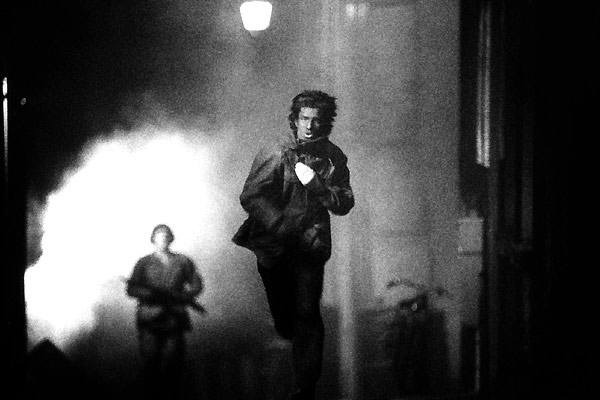
Anyone who saw the three-hour My Sex Life…or How I Got Into an Argument (1997) when it showed at the Film Center last year knows that, for better and for worse, writer-director Arnaud Desplechin, born in 1960, has a generational voice, speaking for and about French yuppies in their late 20s and early 30s. The same is true of his only previous feature, The Sentinel (1992), an eerie 139-minute espionage thriller that has been accruing a cult reputation here and abroad (it’s playing this week as part of Facets Multimedia’s New French Cinema Film Festival). My Sex Life, for all its virtues, was a bit conventional and bland, but The Sentinel is genuinely crazy and a lot more interesting, mainly because it has a meatier subject: the end of the cold war and what this means to French yuppies.
“French yuppies” sounds condescending, but a lot more than the Atlantic Ocean separates Americans from the worldview of the French. Read more
I was lucky enough to see John Coltrane’s classic quartet several times in the 60s and was always amazed by his total relaxation amid the cascading wails and yodeling fast runs that came out of his saxophone. He, pianist McCoy Tyner, bassist Jimmy Garrison, and drummer Elvin Jones were completely absorbed, listening to one another so intently that one couldn’t help but join them, even in a noisy nightclub. This 1992 documentary by writer-director Robert Palmer, codirected by Toby Byron, starts off with familiar talk about family and church, some of it voiced over scratchy and blotchy TV performance footage, so I was prepared for the worst. Then comes a lively sequence that cuts between still photographs in sync with “Giant Steps,” and from then on this is pure pleasure. Byron and Palmer are among the few jazz documentarians with the good sense to let us listen to the music for reasonably long stretches without interruption; they present an entire fine Coltrane solo on “So What” with Miles Davis, a relatively stiff rendition of “My Favorite Things” on TV followed by a much better version in concert, a complete performance of “Impressions” with Eric Dolphy on alto sax and a fleet solo by Tyner, an equally full version of “Alabama” punctuated by talking heads, and two healthy chunks of “Naima” that exemplify Coltrane’s later and freer style. Read more