Feast From the East [Oshima’s GOHATTO]

This originally appeared in the January 10, 2001 issue of the Chicago Reader. It seems worth reprinting as a kind of adjunct to my overview piece about Oshima, written for Artforum in 2008 and also available on this site. –J.R.

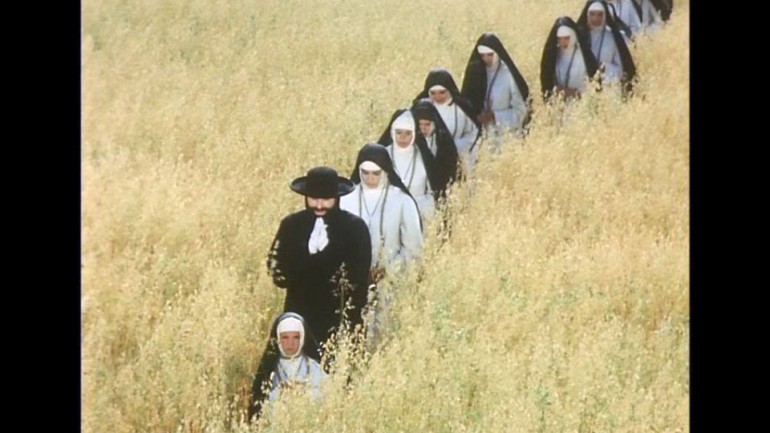
Taboo

****

Directed and written by Nagisa Oshima

With Beat Takeshi (Takeshi Kitano), Ryuhei Matsuda, Shinji Takeda, Tadanobu Asano, and Yoichi Sai.

By Jonathan Rosenbaum

Mark your calendars. Over the next six weeks, the Music Box is offering three eye-popping masterpieces from Asia. This is a welcome sign–-as is the popularity of the breezy Crouching Tiger, Hidden Dragon in the multiplexes–-that American theaters and audiences are finally recognizing that a lot of the best movies come from the other side of the planet and that there’s as much diversity among them as there is among ours.

Yi Yi, which opens March 2, is a three-hour feature set in contemporary Taiwan. It was just voted best picture of the year by the National Society of Film Critics, the first foreign-language picture to receive this honor since Akira Kurosawa’s Ran 15 years ago. Its writer-director, Edward Yang, is one of the two or three undisputed masters of Taiwanese cinema, and the Film Center gave us a full retrospective of his work in 1997. Read more

Made in Hoboken

I am reprinting the entirety of my first and most ambitious book (Moving Places: A Life at the Movies, New York: Harper & Row, 1980) in its second edition (Berkeley: University of California Press, 1995) on this site in eleven installments. This is the tenth.

Note: The book can be purchased on Amazon here, and accessed online in its entirety here. — J.R.

5—

Made in Hoboken

Douglas, Wyoming, 1914—three states away from where our old friend Gordon MacRae is still only a radical freshman or a freethinking sophomore at the University of Indiana—Bo is operating his very first movie theater, at the age of twenty-seven. Think of it: when Jonathan’s the same age, in 1970, he’s working fitfully on his second yet-to-be unpublished novel, completing his first yet-to-be unpublished book as an editor (a collection of film criticism he was commissioned to do), still living on the dregs of Bo’s inheritance, and dividing the first three months of the year among three countries: pursuing a heavy love affair in New York, having his appendix removed in London (and smoking hash with his brother Michael’s friends in a room called the Box), and taking acid all alone one beautiful spring afternoon in Paris, where he moved last fall, acid that suddenly prompts him to buy red paint, a roller, and brushes, and to go to work on his bedroom closets—a conversation with the wood, red saying one thing, grain saying another—and later sends him out the door and up rue Mazarine to the Odéon métro stop, a little after 6:30, to take the Porte de Clignancourt train as far as Châtelet and then the Mairie des Lilas train to République. Read more
Morality Movies (BROADCAST NEWS & WALL STREET)

This was published at the end of my first year at the Reader, in their Christmas issue. –J.R.

BROADCAST NEWS *** (A must-see)

Directed and written by James L. Brooks

With Holly Hunter, Albert Brooks, William Hurt, Robert Prosky, Lois Chiles, Joan Cusack, and Jack Nicholson.

WALL STREET ** (Worth seeing)

Directed by Oliver Stone

Written by Stone and Stanley Weiser

With Charlie Sheen, Michael Douglas, Martin Sheen, Daryl Hannah, Terence Stamp, Hal Holbrook, and Sylvia Miles.


Both Broadcast News and Wall Street score as punchy, energetic movies that are designed to feel as contemporary as possible without taking place in the literal present, and both pivot around a moral reckoning that accompanies economic cutbacks -– as if to remind us that this country’s Reagan-inspired spending spree, which tripled our trillion-dollar national debt, seems to be drawing to a fearful close. Apart from offering behind-the-scenes glimpses of their all-encompassing, hothouse professional turfs, both movies are built around the mise en scene of a moral crisis that splits the major characters apart –- each one charting a mutual seduction that leads to recriminations and the characters isolated in opposing moral camps. Yet the undisputed effectiveness of these films as entertainment seems at least partially predicated on fudging or at least mystifying the moral issues that they are bold enough to raise. Read more

Babette’s Feast

From the Chicago Reader (March 1, 1989). — J.R.

babette1

Gabriel Axel’s Danish feature, the 1987 Oscar winner for best foreign film, is based on an Isak Dinesen tale. On the whole, the adaptation is faithful but some of the qualities of Dinesen’s language are lost in translation or through abridgment, and the politics have been needlessly simplified. The plot concerns a French servant in a strict Lutheran household in Denmark — Norway in the original — whose family has perished in the French Commune uprising. The acting is impeccable and the ambience suffused with delicate charm, but overall this doesn’t aim at anything higher than Masterpiece Theatre or a Merchant-Ivory film. Aside from the elaborate serving of the eponymous meal, which expands greatly on the original, few of the additions constitute improvements. With Stephane Audran, Jean-Philippe Lafont, Jarl Kulle, Bodil Kjer, and Birgitte Federspiel (Ordet). In Danish with subtitles. 102 min. (JR)

babette's-feast Read more

Ghost World

From the August 1, 2001 Chicago Reader. — J.R.

38Ghost-World-32 GW108030301AR

If, like me, you’ve been wondering how Terry Zwigoff, the brilliant documentary filmmaker who made Crumb, would negotiate his shift to fiction filmmaking, here’s your answer: brilliantly. Ghost World, a very personal adaptation of the Daniel Clowes comic book that Zwigoff wrote with Clowes, either captures with uncanny precision what it’s like to be a teenage girl in this country at this moment or fooled me utterly into thinking it does. Thora Birch (American Beauty) plays Enid, a comic book artist (her notebook was actually drawn by Sophie Crumb, Robert’s daughter) who plans to share an apartment with her best friend Rebecca (Scarlett Johansson). Enid befriends Seymour (Steve Buscemi), a lonely, much older collector of rare blues and jazz 78s, shortly after she almost graduates from high school. To get a diploma, she has to take an art course over the summer, and our glimpses of this add up to the funniest portrait of American “art appreciation” I’ve ever seen, with Illeana Douglas, as the teacher, rivaling Elaine May as a satirist. Never predictable, this movie is often hilarious as well as touching, subtly adapting the mise en scene of Clowes’s original without being fancy or obtrusive about it. Read more

The Good, the Bad, and the Future

From the Chicago Reader (October 29, 1987). — J.R.

I. Good Things About the Chicago Film Festival

1. Quite apart from aesthetic considerations, any film festival that can boast films from 35 countries and encompass 70 years of filmmaking is performing an invaluable cultural service. The xenophobic and antihistorical cast of most pop culture in this country is such that the more the media expand, the narrower our sense of reality generally becomes, and any institution that can allow us glimpses of cultures and eras other than our own is bound to teach us something more than the average TV news broadcast. (The sharp moral distinction that we usually make between news and fiction–designating the first as “serious” and the second as “entertainment”–overlooks the fact that both are usually designed as narrative entertainment, offering consumable, hence disposable, stories with larger-than-life characters.)

2. Out of the 20 films in the festival that I’ve so far managed to see, more than half are eminently worth seeing, and roughly a third qualify as first-rate. If that’s a somewhat lower batting average than either Facets or the Film Center, it’s still a much higher one than what is achieved by the usual run of commercial mainstream releases. Read more

American Pimp

From the July 11, 2000 Chicago Reader. — J.R.

What’s so disturbing yet provocative about this documentary by Allen and Albert Hughes (Menace II Society, Dead Presidents) is that it essentially celebrates as well as interrogates its chosen subject. More precisely, it allows the pimps in interviews to celebrate themselves, offering them the equivalent of their own music videos in which to strut their stuff. Even if one disapproves of the results — it’s hard not to, given the countless obfuscations and omissions ensured by such an approach — there’s also more understanding of a certain kind than would come from a holier-than-thou polemic. One has to weigh the lift against the mystifications. There isn’t the sort of analysis one would hope to find (the Hugheses even sidestep the issue of whether pimps are as important to prostitution as they once were), but at least one gets a pungent look at what makes being a pimp look attractive to some people in certain circumstances. Check it out for yourself; I’ve felt at least as conflicted about the Hughes brothers’ other movies, but this one arguably accomplishes and says the most. 87 min. (JR)

Read more

Menace II Society

From the June 4, 1993 Chicago Reader. — J.R.

Don’t let the silly styling of the title put you off, this is a powerful, convincing, and terrifying look at teenage crime in contemporary Watts. Directed by 20-year-old twin brothers Allen and Albert Hughes from a script they wrote with coproducer Tyger Williams, this shocking, violent, and unsentimental (albeit sensationalized) drama about a second-generation drug dealer (Tyrin Turner) and the callous world he lives in, produced by To Sleep With Anger’s Darin Scott, is terrifically acted, as much by the newcomers (Jada Pinkett, Larenz Tate, Erin Leshawn Wiley, Vonte Sweet, MC Eiht, and Too $hort) as by the old pros (Samuel L. Jackson, Bill Duke, Charles S. Dutton), who are around for cameos. Bel-Air Drive-In, Double Drive-In, Hyde Park, Norridge, Pipers Alley, Ford City.

Read more

My 25 Favorite Films of the 21st Century (so far, four years ago)

Not so long ago, A.O. Scott and Manohla Dargis decided to name their 25 favorite films of this millennium so far. More recently, J. Hoberman decided to play the same game.

I’ve decided to play as well. My only rule in this game, not followed by Hoberman, was to restrict my favorite filmmakers on the list to only one film each –- not always easy, and sometimes downright agonizing. (How, for instance, could I have left out Costa’s Where Lies Your Hidden Smile?, Jarmusch’s Coffee and Cigarettes, Jia’s Platform and Still Life, Linklater’s Waking Life?)

I haven’t provided links here to my writing about these films, but using this site’s search engine should turn up texts about practically all of them. (The only exception that comes to mind is The Clock.)


The order below is alphabetical.


A.I. Artificial Intelligence (Spielberg/Kubrick)

Bernie (Linklater)

Certified Copy (Kiarostami)

The Circle (Panahi)

The Clock (Marclay)

*Corpus Callosum (Snow)

The Day I Became a Woman (Meshkini)

Down There (Akerman)

Down with Love (Reed)

Farewell to Language (Godard)

Horse Money (Costa)

Howl’s Moving Castle (Miyazaki)

Inland Empire (Lynch)

Los Angeles Plays Itself (Andersen)

The Mad Songs of Fernanda Hussein (Gianvito)

Operai, Contadini (Straub-Huillet)

Paterson (Jarmusch)

Pistol Opera (Suzuki)

RR (Benning)

The Silence Before Bach (Portabella)

Son of Saul (Nemes)

The Trap (Curtis)

The Turin Horse (Tarr)

The World (Jia)

You Ain’t Seen Nothin’ Yet (Resnais) [6/21/17] Read more

Notes on a Conversation with Welles (1972)

The following notes appeared in the same issue of Film Comment (November–December 1972) as “The Voice and the Eye,” at the end of my regular column, titled “Paris Journal,” which typically dealt with several different topics. Though these notes largely replicate things said elsewhere by Welles, two details for me stand out as significant additions to the record: that Welles regarded his Don Quixote as nearly completed in 1972 -— which corresponds fairly closely to the conclusions of “Don Quixote: Orson Welles’s Secret” by Audrey Stainton (who worked “on and off” as Welles’s secretary in the late 1950s) in the Autumn 1988 Sight and Sound — and that he remained convinced that the deleted footage of Ambersons was destroyed by RKO (a belief I regretfully share, though legends continue to circulate about another copy of the longer cut that may survive somewhere in Brazil).

2014 footnote: The information that The Deep was “completed” by 1972 seems contradicted by the apparent fact that Jeanne Moreau never dubbed her part. -– J.R.

In the course of a conversation with Orson Welles about his Heart of  Darkness script, which is detailed elsewhere in this issue, I asked Welles about his more recent projects. Read more

Orson Welles’ TOO MUCH JOHNSON is downloadable now, for free!

http://www.filmpreservation.org/preserved-films/screening-room/too-much-johnson-work-print

My only (minor) quarrel with Scott Simmon’s excellent accompanying essay is his speculation about the reason or reasons why the film wasn’t screened at the Connecticut stage preview. According to the late Richard Wilson, who worked on the editing of the film, the summer theater had an inadequate throw for film projection. (See This is Orson Welles, p. 344 — which also includes the erroneous information that the only copy of the work print was destroyed in a fire at Welles’ Madrid villa in 1970). [8/21/14]

TooMuchJohnson

too-much-johnson-1938

tmj_09 Read more

Global Discoveries on DVD: Niche Market Refugees (Spring 2016)

My column for the Spring 2016 issue of Cinema Scope. — J.R.

Let me start with a correction and adjustment to the final entry in my last column, furnished by Chris Fujiwara and relating to the appearance of Joseph L. Mankiewicz’s 131-minute The Honey Pot (1967) on a Kino Lober Blu-ray:

the-honey-pot

“When I did my stint at the Frieda Grafe favorite films series at Arsenal in Berlin two or three years ago, they showed a good 35mm print of The Honey Pot that ran about 150 minutes. It had a BBFC [British Board of Film Censors] card on it and it came from Park Circus. (By the way I took detailed notes of the differences from the DVD version, which I had recently watched several times.)….The cutting that was done to the film to get it down to 131 minutes was quite extensive and elaborate. In a few cases whole scenes were cut out (including scenes with the three ex-lovers, and a scene showing Cliff Robertson at work as a male escort). But a good deal of the shortening was done by cutting out individual shots or parts of shots from scenes that are otherwise kept in. Not only the rhythm but also the tone and the thematic content of these scenes are changed, sometimes drastically….It’s Read more

Working-Class America in American Cinema of the Depression and New Deal

Written in May 2014 for De Lumière a Kaurismäki: La clase obrera en el cine, coedited by Carlos F. Heredero and Joxean Fernández and published by Colección Nosferatu in 2014. — J.R.

blondecrazy

Writing about the reception of Brecht’s Threepenny Opera in pre-Hitler [1928] Germany, Hannah Arendt noted (in The Origins of Totalitarianism) that “The play presented gangsters as respectable businessmen and respectable businessmen as gangsters.  The irony was somewhat lost when respectable businessmen in the audience considered this a deep insight into the ways of the world and when the mob welcomed it as an artistic sanction of gangsterism. The theme song in the play, “Erst kommt das Fressen, dann kommt die Moral  [First comes food, then comes morals],” was greeted with frantic applause by exactly everybody, though for different reasons. The mob applauded because it took the statement literally; the bourgeoisie applauded because it had been fooled by its own hypocrisy for so long that it had grown tired of the tension and found deep wisdom in the expression of the banality by which it lived; the elite applauded because the unveiling of hypocrisy was such superior and wonderful fun. The effect of the work was exactly the opposite of what Brecht had sought by it.” Read more

Brightness (Yeleen)

From the Chicago Reader (January 4, 2002). — J.R.

Souleymane Cissé’s extraordinarily beautiful and mesmerizing fantasy is set in the ancient Bambara culture of Mali (formerly French Sudan) long before it was invaded by Morocco in the 16th century. A young man (Issiaka Kane) sets out to discover the mysteries of nature (or komo, the science of the gods) with the help of his mother and uncle, but his jealous and spiteful father contrives to prevent him from deciphering the elements of the Bambara sacred rites and tries to kill him. Apart from creating a dense and exciting universe that should make George Lucas green with envy, Cissé has shot breathtaking images in Fujicolor and has accompanied his story with a spare, hypnotic, percussive score. Conceivably the greatest African film ever made, sublimely mixing the matter-of-fact with the uncanny, this wondrous work won the jury prize at the 1987 Cannes festival, and it provides an ideal introduction to a filmmaker who is, next to Ousmane Sembène, probably Africa’s greatest director. Not to be missed. 105 min. A new 35-millimeter print will be shown. Gene Siskel Film Center, 164 N. State, Friday, January 4, 6:15 and 8:15; Saturday, January 5, 4:15, 6:15, and 8:15; Sunday, January 6, 4:15 and 6:15; and Monday through Thursday, January 7 through 10, 6:15 and 8:15; 312-846-2800. Read more

Films by Michaelangelo Antonioni

The Film Center’s ongoing retrospective of the work of Italy’s greatest living filmmaker, Michelangelo Antonioni, offers two noteworthy programs this Friday night. First is perhaps the most unjustly neglected of Antonioni’s early features, Lady Without Camelias (La signora senza camelie, 1953), a caustic Cinderella story about a Milanese shop clerk (Lucia Bose) who briefly becomes a glamorous movie star. One of the cruelest and most accurate portraits of studio moviemaking and the Italian movie world that we have, it’s informed by a visually and emotionally complex mise en scene that juggles background with foreground elements in a choreographic style recalling Welles at times. Though it’s only Antonioni’s third feature, and it’s episodic structure necessitates a somewhat awkward expositional method, this is mature filmmaking that leaves an indelible aftertaste.

Then comes a program of shorts made between 1947 and 1953, mainly “apprentice” works, though no less impressive and commanding for all that; the only conventional and fairly forgettable one is the last in the program, The Villa of Monsters (1950)–to be shown, unlike the others, only with French and German subtitles. Perhaps the most significant stylistic trait to be found in most of the work here is the pan suddenly linking foreground with background, the animate with the inanimate. Read more