Please go to kickstarter.com/projects/1209470946/a-fuller-life/posts for details. — J.R. [8/20/12]


Please go to kickstarter.com/projects/1209470946/a-fuller-life/posts for details. — J.R. [8/20/12]

I was delighted to discover just now that the Raymond Durgnat web site — relaunched about half a year ago, and one of my favorite movie-related web sites (which, even better, includes a lot of material about things other than movies, including some rare poems), has been growing and expanding lately; see, especially, Articles, Poems, and Additional Resources and Links for some of the new additions. It’s also worth recalling that Ray’s pioneering A Mirror for England came out in a second edition late last year, with a new Introduction by Kevin Gough-Yates, his literary executor, and this was about a year after the publication of a second edition of A Long Hard Look at ‘Psycho’, with a new Introduction by Henry Miller. (May 21 update, wonderful news: Miller has also edited a superb Durgnat collection of previously uncollected pieces that the British Film Institute plans to bring out in December 2012.)…On the web site, I haven’t found any activity yet on the Forum, but I’m hoping that this will start to grow soon as well. [3/11/12]


…belonging to Yvette Biro and J. Hoberman. Let’s hope that both of these resources will grow and grow.

And meanwhile, here is a link to my review of Jim’s next-to-most-recent book. [10/02/11] Read more
Through a gross blunder on my part, I’ve just deleted all my posts in this section and under Notes over the past six weeks and all the future posts I had set up to go out over the next few weeks! Until or unless I can find a way of recovering some or all of these, the usual “new” content on this site will have to be held in abeyance. If anyone who works with WordPress and knows anything about recovering lost content can help me out with this, I’ll be immensely grateful; please email me at jonathanrosenbaum2002 at yahoo.com. Update, a few hours later: thanks to cached posts on Google, I’ve recovered most or all of the older posts by now, as users of this site can see. But I haven’t yet found a way to recover any of the future, not-yet-posted texts. I also no longer recall which long reviews from the Reader I had scheduled (which are easily recoverable, but only if I can identify which ones they are), so if any readers happen to notice any of these missing texts from this site, I’d welcome hearing about them. — J.R., 10/1/11 Read more
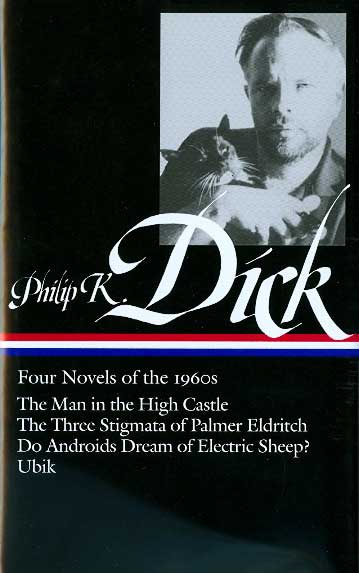

Until recently, it has appeared that the Library of America has completely embraced the contemporary gentrification of “trashy” crime fiction to the highest ranks of literary canonization while it has almost as completely rejected the premise of according this same treatment, or anything that even distantly approaches it, to science fiction or western fiction. (I’ve already posted a little bit about this issue, last month.) But now that Philip K. Dick and Kurt Vonnegut, Jr. have recently entered LOA’s Hall of Fame, I wonder how unreasonable it might be to hope that, say, Ray Bradbury (see below), Fredric Brown, Robert Heinlein, Henry Kuttner and/or C.L. Moore (see below), and Theodore Sturgeon (see below), among others, might be among the next in line for consideration. (I wouldn’t presume to list any candidates for canonizing western fiction.)



There will always be differences and disputes regarding LOA’s choices, of course. And the fact that I prefer Philip K. Dick’s Pi in the Sky to most of the 13 other Dick novels selected by Jonathan Letham for LOA, or that I value Charles Willeford’s four Hoke Moseley novels of the 1980s as literature far more than his second novel, Pick-up (1955), doesn’t factor in various other considerations, such as editor Robert Polito selecting Pick-up as one of the five novels included in LOA’s American Noir of the 1950s volume, whereas there isn’t an American Noir of the 1980s volume edited by anyone. Read more


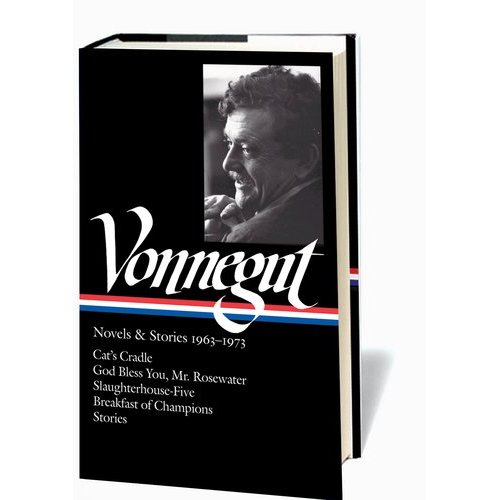
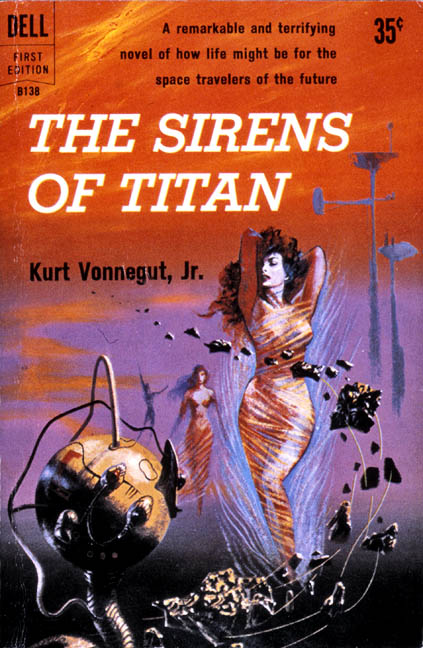

It’s more than a little unnerving to discover that the “canonized” Kurt Vonnegut, Jr. collection that Library of America is bringing out on June 11 excludes my favorite work of his — his mind-boggling second novel (1959), The Sirens of Titan, by all counts his wittiest and most profound — as well as Mother Night (his third, 1961), another major work.
Of course, it’s entirely possible that Library of America is planing one or more other Vonnegut volumes, thus theoretically making room for the first three novels (Piano Player in 1952 was his debut effort) as well as more of the late and relatively weak ones, along with his play, Happy Birthday, Wanda June, and other stories. But the weird thing about LOA’s canonizing is that it creates contestable and uncomfortable groupings, even when they’re simply chronological; for me, Cat’s Cradle (1963) belongs squarely with the two novels preceding it, not with the three that came afterwards. This isn’t quite as grotesque as collecting William Faulkner’s The Sound and the Fury in the same volume as his Soldier’s Pay, Mosquitoes, and Flags in the Dust (the longer version of Sartoris), which the Library of America also did, but it’s still bothersome. Read more
I recently discovered this photograph, for the first time, on a Facebook page called Remembering Florence that has lately been growing to astronomical proportions. I estimate that I must have been somewhere between eight and nine months old when it was taken. I don’t even remember the tree in the right foreground, but I love the way the glass doors visible on the left reflect another part of the house’s exterior. According to normal terminology, this is the “back” of the house, but I believe that Frank Lloyd Wright, who designed it in the late 1930s, would have called it the “front”. Below is a photo taken (I think) on the same occasion, which we would call the “front” of the house and Wright would have called the “back”. (The house’s extension, built after my two younger brothers were born, in 1948, changed the overall shape. For more details, go here, or check the more contemporary color photos I’ve just added, shot from different angles.) (2/1/11)
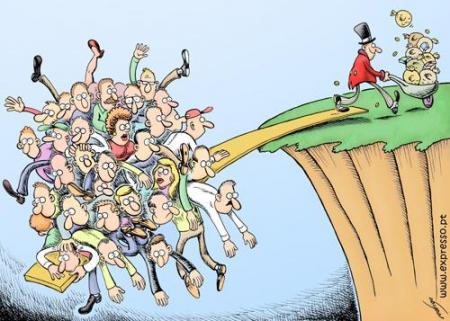
“The government fails the people of New Orleans when they are hit by a hurricane, fails to notice the cadmium paint in the marketplace, does a lousy job educating our kids, can’t keep the libraries open or the park lawns mowed, overlooks the catastrophic shortcuts taken by its pals in the oil-drilling industry — and all we can do to express sour frustration is elect candidates who promise to hack it down even more.”
–“Servile Disobedience,” Harper’s magazine, February 2011, p. 7 [1/23/2011] Read more

They call it their “Self-Improvement” issue, and while flying today from Richmond to Chicago, I read three especially good articles about the sorry state of our nation, each one a pretty good substitute for the sort of news and editorials that we’re no longer getting. Here are teasers from each one:
From “Revolt of the Elites” (unsigned) in The Intellectual Situation (p. 15):
“Who…is guility of elitism, if not the elitely educated in general? The main culprits turn out to be people for whom a monied and therefore educated background lies behind the adoption of aesthetic, intellectual, or political values that demur from the money-making mandate that otherwise dominates society.”
From “Caucasian Nation” by Marco Roth in Politics (p. 14):
“The robust case for dominating other people sounds awful to most American ears today. So the contemporary idea of ethnocracy relies instead on an opposite rhetoric of victimization. The simple-minded mantra we’re taught in grade school goes like this: blacks good because oppressed, whites bad because oppressors. So if whites suddenly became oppressed, even while remaining the majority, they would magically become good again. Many Americans are now being taught to think this way.”
From “The Two Cultures of Life” by Kristin Dombek in Essays (p. Read more

Why did I book a ticket to this solo concert long in advance, even though I have yet to shell out for Paris/ London: Testament, the three-disc album he released last October, which the concert was meant to promote? I guess it’s basically a matter of not getting too many chances lately to see Jarrett live — meaning that I’m even willing to put up with an evening of his playing that’s mainly devoted to his relatively dull and uninspiring impromptu originals.
There’s always been a certain solipsistic side to some of Jarrett’s predilections as a performer. If memory serves, the last time I saw him live was at a Left Bank cave in Paris called La caméléon circa the early 70s, less than a block from my flat, and I can still remember how infuriated I was when he insisted on playing the flute — not especially well — during a large portion of his set. His stabs at performing classical music, no matter how “competent,” often seem comparably misguided. Similarly, when he chooses to go “free-form” nowadays and play some version of what used to be regarded as avant-garde jazz, I’d much rather hear Cecil Taylor than Jarrett’s much inferior version of that style. Read more

Just because it isn’t available online doesn’t mean that Dudley Andrews’ interview with the great Jia Zhangke in the Summer 2009 issue of Film Quarterly isn’t the most aesthetically and politically eye-opening piece I’ve read so far anywhere about this filmmaker. And the fact that 24 City is on the cover, also illustrating James Naremore’s second annual ten-best piece for this magazine (which isn’t online either), should serve as a further incentive. [7/05/09] Read more
A wealthy young Englishman (Ben Barnes) marries an American widow he meets in France (Jessica Biel) and brings her back to his family estate, causing various kinds of havoc. Noel Coward’s drawing-room comedy was loosely adapted by Alfred Hitchcock in 1928 but is seldom revived these days; assigning it to Australian cult filmmaker Stephan Elliott (The Adventures of Priscilla, Queen of the Desert) seems perverse, but if you’re looking for a simple-minded farce with campy overtones, this 2008 feature might be your dish. Elliott retains the 20s setting, improbably makes the widow a sports-car racer from Detroit, drastically changes the plot in other ways, adds lots of tunes by Coward and Cole Porter (along with more recent hits like “Car Wash”), and awkwardly introduces a few gags involving a dead dog. The only characters who seem anchored in some form of reality are the hero’s parents (Kristin Scott Thomas, Colin Firth) and former fiancee (Charlotte Riley); all the others, from siblings to servants, are standard-issue eccentrics or the subjects of running gags. PG-13, 96 min. –Jonathan Rosenbaum Read more

Recommended Reading: “Long Shot” by Evan Osnos. in the May 11, 2009 issue of The New Yorker. Not so much for critical insights into the films as for biographical information that one wouldn’t likely come across elsewhere, at least in English. [5/11/09]