Edward Yang has died at 59 [Chicago Reader blog post, 2007]

Edward Yang has died at 59

Posted By on 07.02.07 at 02:49 PM

 abrightersummerday-singer
a-brighter-summer-day

First Ousmane Sembene, the father of African cinema, who passed away at age 84 on June 9, and now the Taiwanese master Edward Yang. We’re losing our giants.

Many of Sembene’s major literary works are out of print (including Tribal Scars, a wonderful collection of stories that includes “The Promised Land,” which his first feature, Black Girl, was based on; purchasing this essential paperback on Amazon now costs about $49). Only four of his ten features are available on English-subtitled DVDs, all of them recent releases. Even Black Girl, the one that still moves me the most, is available only in an imperfect copy. (The film’s color sequence, which I’ve never seen in color, is printed in black and white.)

The situation regarding Edward Yang’s films is even worse: only the last of his seven features, albeit one of the best, Yi Yi, is available on Amazon. The one I consider his greatest, A Brighter Summer Day (pictured) can be found extralegally or semilegally from at least a couple of different sources, as I explain in my current DVD column in the summer issue of Cinema Scope.

Read more

Goodbye, Dragon Inn

From the Chicago Reader (January 7, 2005.) — J.R.

Goodbye Dragon Inn

goodbye_dragon_inn1

For all its minimalism, Tsai Ming-liang’s 2003 masterpiece manages to be many things at once: a Taiwanese Last Picture Show, a failed heterosexual love story, a gay cruising saga, a melancholy tone poem, a mordant comedy, a creepy ghost tale. A cavernous Taipei movie palace on its last legs is (improbably) showing King Hu’s groundbreaking 1966 hit Dragon Inn to a sparse audience (which includes a couple of that film’s stars) while a rainstorm rages outside. As the martial-arts classic unfolds on the screen, so do various elliptical intrigues in the theater — the limping cashier, for instance, pines after the projectionist, even though she never sees him. Tsai has a flair for skewed compositions and imparts commanding presence to seemingly empty pockets of space and time. In Mandarin, Cantonese, and Taiwanese with subtitles. 81 min. Music Box.

goodbyedragoninn3

GOOD-BYE-DRAGON-INN-05 Read more

8 Mile

8MileThis energetic and often exciting feature from Curtis Hanson (L.A. Confidential, Wonder Boys), set in Detroit in 1995, aims to be the kind of showcase for Eminem and hip-hop that Saturday Night Fever was for John Travolta and disco, and in most respects it succeeds. Hanson depicts a far grungier world, brimming with aggression and homophobia, and one might argue that his version of the working-class “success” story is a lot more honest about the racial and sexual undercurrents of its music and milieu and at least as frank about the desperate need for some kind of transcendence. The movie has some of the braggadocio of its white-trash hero, building to its competitive climax as if it were a gladiatorial sporting event. With Kim Basinger, Mekhi Phifer, and Brittany Murphy; Scott Silver wrote the well-honed script. 118 min. Burnham Plaza, Century 12 and CineArts 6, Crown Village 18, Ford City, Gardens 1-6, Golf Glen, Lincoln Village, Norridge, North Riverside, River East 21, Village North, Webster Place. Read more

Recommended Reading: Repertory Movie Theaters of New York City

Jonathan Rosenbaum writer at the 59th International Film Festival of San Sebastian

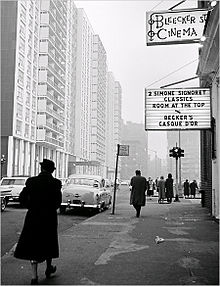
Labors of love can be executed well or badly, and one of the many pleasures of this new book from McFarland — quite apart from the fact that its author, Ben Davis, interviewed me at some length for it (full disclosure), and quotes me accurately — is that it’s done so well. This is above all a work of social history, and because the 34 years that it covers includes all of my own extended sojourns in Manhattan and environs (in particular, 1961-1963, 1966-1969, 1978-1983), I can vouch for its accuracy as well as its success in evoking a now-vanished film culture without ever succumbing to the distortions of nostalgia. (I was interviewed mainly about my adventures in programming at the Carnegie Hall Cinema and the Bleecker Street Cinema, thanks to the support and assistance of Jackie Raynal and Sid Geffen.) The fine selection of photographs also helps a lot — although, thanks to the vagaries of the Internet, only one of these (the first) is posted below. [5/25/17]

NewYorkerTheater

filmmakers-cinematheque-charles-8feb62

Thalia

FF

CHC

Washington_Square_Village_Bleecker_Street_Cinema Read more

LE SECRET (1976 review)

From Monthly Film Bulletin, September 1976 (vol. 43, no. 512). — J.R.

LeSecret-poster

Secret, Le (The Secret)

France/ltaly, 1974

Director: Robert Enrico

LeSecretStrangling a guard, David Daguerre escapes from his cell in an unidentified building, and thumbs a ride to Paris. He borrows money from a former lover and takes a train to the country, where he meets Thomas Berthelot while looking for a place to hide. Thomas and his lover Julia Vandal invite David to stay over at their house and he accepts. But he refuses to specify who is pursuing him and why, intimating only that he witnessed something he wasn’t supposed to, was confined and tortured as a result, and that he (and now the couple) will be killed if ‘they’ find him again. Although Julia is reluctant to keep him on as a guest, Thomas insists on protecting him as a kind of antidote to his uneventful life. even when David steals their revolver. After deciding to leave, David is held back by the arrival of several soldiers, although they later prove to be on maneuvers. Thomas then suggests driving David to Marmizan and taking him in his boat to Spain, and over Julia’s protests they all set out in the couple’s camper. Read more

Film Music: An Interview with Jerry Fielding and Dan Carlin (conducted with Peter Lehman)

From Wide Angle, vol. 4, no. 3 (1980).  I hope that Peter Lehman, who wrote the introduction to our interview and whom I haven’t seen in decades, doesn’t mind me posting this piece now.

I retain a very warm memory of Jerry Fielding; we were staying in Athens, Ohio at the same hotel during the Workshop on Sound and Music in the Cinema, which we were both attending, and we had breakfast together once or twice. I recall his conversation as both literate and dynamic, and especially compelling when he spoke about Sam Peckinpah, one of his favorite collaborators. Dan Carlin (1927-2001), whom I got to know less well, is also, alas, no longer alive. -– J.R.


Film Music: An Interview with Jerry Fielding and Dan Carlin

By Peter Lehman and Jonathan Rosenbaum

THEOUTLAWJOSEYWALES,jpg

Jerry Fielding, Dan Carlin and Chris Newman were guests of a Workshop on Sound and Music in the Cinema presented by the Appalachian Regional Media Center in Athens, Ohio, October 5-7, 1979. The well-known Hollywood composer, Jerry Fielding, began studying music in his late teens with Max Atkins. Atkins was the music director and arranger at the Stanley Theater in Pittsburgh, Fielding’s hometown.  Fielding moved to Los Angeles where he worked with some of the most famous big band leaders. Read more

Burn, Witch, Burn

From the December 10, 2004 Chicago Reader. — J.R.

Atmospheric and underplayed in the tradition of Val Lewton (I Walked With a Zombie, Cat People, The Seventh Victim), this British horror feature (1961) operates from the premise that witchcraft survives as an open secret among some women, in both benign and malevolent forms. A small-town academic (Peter Wyngarde) convinces his wife (Janet Blair) to stop casting spells to advance his career; he doesn’t believe in the occult, so he’s taken aback by the various disasters that ensue. Charles Beaumont and Richard Matheson are credited with the intelligent and efficient script, which adapts Fritz Leiber’s American novel Conjure Wife to an English setting. Director Sidney Hayes can be needlessly rhetorical at times, relying on a campus statue of an eagle to create a sense of menace (the UK title was Night of the Eagle), but this is still eerily effective. 90 min. (JR)

Read more

Antz

From the Chicago Reader (September 1, 1998). — J.R.

If one can accept the revolting notion that ants are just like people — rather than the more demonstrable premise that some film workers, film publicists, and filmgoers are a little like ants — then one might easily find this 1998 computer-animation effort from Dreamworks as cute as its title. The real premise is that ants are just like superstars — people like Woody Allen, Sharon Stone, Sylvester Stallone, Dan Aykroyd, Danny Glover, Gene Hackman, Christopher Walken, and Jennifer Lopez, all of whom have lent their voices and screen personalities to ant characters. For example, Allen, in truth an emblem of herd instinct, inevitably is employed to represent individuality — in the form of an ant named Z who resembles E.T. and kvetches a lot. Disneyfied anthropomorphism is the name of the game here, and I was left wondering whether Pepsi paid for the use of Give Peace a Chance (rendered here as Give Z a Chance). I suspect an account of all the complex business transactions would be more fun than anything in the movie, where you can’t see a blue sky that doesn’t resemble the Dreamworks logo. PG, 83 min. Read more

Three Routine Short Reviews from 1976

Three short reviews for the Monthly Film Bulletin in 1976, the first two for their April issue (vol. 43, no. 507), and third for their November issue (vol. 43, no. 514).  –- J.R.

TheBattleofBillysPondBattle of Billy’s Pond, The

Great Britain, 1976

Director: Harley Cokliss


TheBattleofBillysPond2


Finding a dead fish in a pond where he frequently goes fishing, Billy Bateson takes it home, where his cat makes off with it and becomes ill. Informed by a vet that the cat’s illness was caused by chemicals, Billy investigates the pond further with his friend Gobby, discovers more dead fish and eventually learns the cause: industrial waste is being emptied into an underground stream, originating from an abandoned quarry, which feeds the pond. After secretly witnessing two lorry drivers in the quarry and then seeing green fluid enter the pond, the boys report their findings to the police and learn from Billy’s father about “Breeze”, a detergent manufactured at Con-Chem nearby. Getting into the factory by subterfuge, they videotape the tanker drivers with Gobby’s father’s camera and sneak out to the quarry that night to trap them in the act, rigging up speakers and lights and then letting air out of the tanker’s tires. Read more

A Preview

From the seventh issue of one of my favorite magazines as both a reader and a contributor, published in Spain and available at https://foundfootagemagazine.com for 20 Euros. By prior agreement, Found Footage pays me for my essays but asks me in return not to post them on my web site until years later. This is my latest contribution for them, just out. [4/13/21]

Read more

Godard: Anarchy or Order? (Letter to THE NEW YORK TIMES, 1968)

From the Sunday, March 24, 1968 New York Times (“Movie Mailbag”). Coincidentally, I had just taken a bus in Manhattan with a friend the previous night to see Godard’s La Chinoise at an avant-premiere screening in Philadelphia, and before boarding the bus back, I bought the Sunday Times and found my letter published there prominently. — J.R.

 Le-Petit-Soldat

Godard: Anarchy or Order?


TO THE EDITOR:

I SUPPOSE one should be grateful for The Times’s belated “recognition” of Jean-Luc Godard, particularly after a record of disapproval that has helped to keep much of his work unseen and misunderstood in this country for nearly a decade. But Eugene Archer’s slick comments are painfully inadequate for anyone who knows and cares about Godard’s films. and misleading for anyone who doesn’t. Adhering to a hallowed Times tradition, Archer is informative and interesting whenever he sticks to objective facts about Godard’s career; it is only when he turns to the films themselves that he shows his naivité.

Essential to his understanding of Godard are three questionable assumptions:

l) In order to be an artist, a filmmaker has to be a “dramatist,” not an “essayist.”

2) Godard’s films are composed of arbitrary and unstructured selections of material (“Godard…shoots anything that strikes his fancy and edits it into his film”). Read more

Celebrating southern cinema

[Chicago Reader blog post, 4/23/07] (I’ve eliminated all the now-out-of-date links, making this even more esoteric.) — J.R.

1386.jpg

Five years ago the Oxford American, a quarterly publication that dubs itself the “southern magazine of good writing,” published a special issue on southern movies. It did so well that they’ve just brought out a sequel. Though I contributed to the previous issue I didn’t propose anything this time round, but now that I have the follow-up in front of me I find I can recommend it for a couple of things. There’s a good interview with Charles Burnett by Dennis Lim and a thoughtful essay by Joseph McBride about John Huston, his Wise Blood in particular. Maybe it’s not always reliable: Jack Pendarvis claims that “if you Google ‘commedia dell’arte’ + ‘baby doll’ you’ll get over a thousand hits,” but when I tried I got only 368. All the same, it’s interesting to see Elia Kazan’s Baby Doll, a 1956 feature scripted by Tennessee Williams, and commedia dell’arte connected .

What I mainly value in the package, though, is the free DVD that’s been appended to it–an eclectic collection of 16 items consisting of 13 clips (from films ranging from Roger Corman’s overlooked The Intruder to Joey Lauren’s Come Early Morning to Ross McElwee’s Bright Leaves, plus the overexposed Black Snake Moan) and three full-length shorts, all three pretty arcane: animator Leon Searl’s 1916 Krazy Kat Goes A-Wooing (download required), Mary Ellen Bute and Ted Nemeth’s 1938 animation Synchromy No. Read more

Moving (July-August 1978)

From the July-August 1978 Film Comment, only slightly tweaked in March 2014. In retrospect, it must have been an act of sheer defiance and perversity for me to have structured the order of the films discussed here in alphabetical order, perhaps as a way of further brandishing all my globetrotting at the time. Thirty-six years later, I regret some of the swagger here, including the facile wisecrack-putdown of Jean-Pierre Gorin. I was still under the excessive influence of Manny Farber at the time -– a great writer whose style one imitates, consciously or unconsciously, at one’s peril –- combined with some of the early stirrings that led to my 1980 memoir Moving Places. — J.R.

 BackandForth

Back And Forth (London, 1/10/78), in Pam Cook and Simon Field’s avant-garde film course. Each time I encounter Michael Snow’s crisscrossed classroom, I learn a little bit more about how to watch it. Following those relentless, oscillating pans with the eyes — equating one’s head and ego with the camera or vice versa in some sort of anthropomorphic/illusionist perversion conditioned by Hollywood — turns out to be about as useful as climbing into a Mix Master and throwing the switch. Sitting still, in your head as well as in your seat, affords a smoother, subtler, and more contemplative experience.

Read more

Sound Thinking (1978, with Carrie Rickey)

From The Thousand Eyes, Fall 1978. Carrie Rickey and I embarked on this film series and article shortly after we became flat mates, but lamentably it didn’t pan out as we hoped it would; our program notes, for starters, never got distributed. — J.R.

Sound Thinking

By Carrie Rickey and Jonathan Rosenbaum

One of the consequences of describing the world around us is that language separates into different senses what we often experience as a unified whole. Language, an instrument — perhaps the instrument — of’ culture, overvalues the visual at the expense of the other four senses. Our language for the way we see is more precise: looks are eminently describable, we discuss color, dimensions, surface.

Our language for the way we hear is a jumble, less precise. Ambient sound consists of so many simultaneous events: acoustics of a space., buzz of appliances, rhythm of a clock, crowd voices, footfall. We “focus” on a visual event; we “concentrate” on sound, which is more difficult to pinpoint. We screen out the rumble of the subway train to concentrate on a movie.

If movies themselves are a selective screening process, the ways we experience them often censor out other elements. The way we talk about films — referring to “viewers” and “spectators”, talking about “seeing” a movie, asking, “How does it look?” Read more

ZULU (and KHARTOUM) on Blu-Ray

zulu-zulus

khartoum2

In a double whammy, Twilight Time has recently brought out splendid new Blu-Rays of two exceptional widescreen colonialist epics, Cy Endfield’s Zulu (1964, set in 1879) and Basil Dearden’s Khartoum (1966, set in 1883-1885). Both come equipped with extensive and informed audio commentaries by screenwriter Lem Dobbs and film historian Nick Redman, who are joined on Khartoum by film historian Julie Kirgo, a writer who also contributes essays on all of the Twilight Time releases, including these two.  The first of these movies now strikes me as one of the very greatest of all war films (a genre that I’m not generally partial to), even when it presents combat as potentially noble, succeeding equally in intimate details and in spectacular overviews, whereas the second is at most an intriguing star vehicle for Charlton Heston (as British officer Charles Gordon) and Laurence Olivier (as Sudanese Arab leader Muhammad Ahmad, who dubbed himself the Mahdi), both playing egomaniacal religious fanatics whose two scenes together are the best in the film (although Ralph Richardson as Prime Minister Gladstone also gets in a  few choice bits). The audio commentary in this case is notable for how critical and even disdainful it often is — something that I suspect Criterion would never tolerate on any of its own releases. Read more