This fascinating personal essay (2003) by Canadian filmmaker Ann Marie Fleming investigates the life of her great-grandfather, the Chinese vaudeville performer Long Tack Sam (1895-1961) — one of the greatest magicians in the world (and one of the key mentors of Orson Welles), who was also an acrobat, though he’s mainly forgotten today. In fact, he circled the globe so many times and experienced so much that recounting his life in many ways means recounting the 20th century. Fleming, an animator and storyteller as well as a documentarian, draws extensively on her own varied talents to approach this elusive topic from many different angles, and her speculations are often as interesting as her findings. Indeed, the way Long Tack Sam keeps sliding out of her and our grasp, even though we wind up feeling that we know him in some fashion, is part of this film’s magic. 90 min. (JR) Read more
Les Modeles De “Pickpocket”
In this personal and poetic 2003 video documentary, Babette Mangolte—possibly the best cinematographer now working in experimental cinema (she’s also shot major films by Chantal Akerman, Richard Foreman, Jean-Pierre Gorin, Marcel Hanoun, Sally Potter, Jackie Raynal, Yvonne Rainer, and Michael Snow)—interviews the three leading performers from Robert Bresson’s wondrous 1959 Pickpocket. Bresson wanted to convey directly, without acting, the spiritual essence of individuals, which is why he called his performers interpreters or models. These three were clearly marked by the experience of working for him, and as Mangolte moves from France to Austria to Mexico meeting them she seems as responsive to their self-aware vibrancy and as respectful of their mysteries as Bresson was. 89 min. (JR) Read more
ROME OPEN CITY: History as Adventure
Commissioned by BFI Video for an April 2015 release. — J.R.
Charlie Chaplin, the late Gilbert Adair liked to assert, doesn’t simply belong to film history; he belongs to history. And the same might be said for Roberto Rossellini’s first major feature, Roma città aperta. Even though it’s routinely regarded as a landmark in film history — the film that decisively put Italian Neorealism on the global map — one could argue that its lasting importance owes far more to the major role it played in humanizing the Italian population for the rest of the world after it emerged from over two decades of Fascist rule under Benito Mussolini.
We don’t hear much about that Fascist rule in Rome Open City, an omission that entails a historical simplification, albeit an understandable as well as an expedient one — not so much an expression of “first things first” as an expression of “second things first,” viewed by most audiences around the world from the vantage point of the war’s end. A project that was first conceived in August 1944, only two months after the Allies had forced the Nazis out of Rome, the film was driven primarily by a desire to expose the brutalities and indignities suffered by Romans under the German occupation as well as the discovery of a common purpose between the Communist and Catholic partisans who had opposed it. Read more
Mind Wide Open
I can’t recall when this was written or what occasioned it (apart from the initial reviews of Eyes Wide Shut when it opened in 1999). — J.R.
Much of the negative critical response to Eyes Wide Shut came from indignant New Yorkers who felt their city had been misrepresented — worst of all, by a native of the Bronx and onetime Manhattan resident who had dared to expatriate himself. “It’s difficult to make a movie about a city you last set foot in 35 years ago,” J. Hoberman wrote in the Village Voice, sidestepping the hypothesis that Kubrick’s last film might be about something else — some elusive, shifting city of the mind, perhaps, as shared by the fearful dreams and imaginations of a married couple. Similarly, Stuart Klawans’ complaint in The Nation that he couldn’t buy “a Village jazz club with a tuxedoed headwaiter and a last set ending at midnight” overlooks the possibility that Kubrick couldn’t either, any more than he could believe in an intersection in that same Village of Miller and Wren — two nonexistent streets even when he lived in the city.
The film is full of such “off” details, and not simply because all of it was shot in an English studio. Read more
Seeing Right Through Us [HOLLOW MAN]
From the August 11, 2000 Chicago Reader. — J.R.
Hollow Man
Rating *** A must see
Directed by Paul Verhoeven
Written by Andrew Marlowe
With Elisabeth Shue, Kevin Bacon, Josh Brolin, Kim Dickens, Greg Grunberg, Joey Slotnick, Mary Randle, and William Devane.
Apart from Space Cowboys, Clint Eastwood’s enjoyably auteurist swan song, Paul Verhoeven’s latest feature, Hollow Man, was the only summer Hollywood release I’d been looking forward to. For one thing, I’d hoped it would give me an opportunity to reassess his previous works, most of which I now think I underestimated when they were released.
I was pretty hospitable to Total Recall (1990), but I awarded a black dot to Basic Instinct (1992), mainly because I was incensed about the calculations of Joe Eszterhas’s $3 million script (I’m leaving aside Verhoeven’s Dutch movies because the only one I’ve seen is The 4th Man). I declined to review Showgirls (1995) at length, noting somewhat puritanically toward the end of my capsule: “I suppose the overall theory is that male spectators will tolerate any amount of stupidity and unpleasantness for the sake of acres of tits and ass, but you’ve got to hand it to the filmmakers for putting such a theory to the ultimate test: if anyone emerges from this with a smile on his face he must hate women as much as this movie does.” Read more
Diaries, Notes & Sketches — Volume 1, Reels 1-6: Lost Lost Lost
From Monthly Film Bulletin, January 1977, Vol. 44, No. 516. Both this film and Mekas’s earlier diary film Walden (1969) have been released together on a Blu-Ray from Kino Lorber. –- J.R.
Diaries, Notes & Sketches — Volume 1, Reels 1-6: Lost Lost Lost
U.S.A. ,1975
Director: Jonas Mekas
Dist–Artificial Eye. p.c /p/sc/ph–Jonas Mekas. addit. ph–Charles Levine, David Brooks, Peter Beard, Ken Jacobs. Part in colour. ed–Jonas Mekas. m/songs–including piano music by Chopin, “Abschied” by Schubert, traditional Lithuanian music, “Kiss of Fire” by Lester Allen, Robert Hill, excerpts from Wagner’s “Parsifal”,“How Deep Is the Ocean” by Irving Berlin, music by Lucia Dlugoszewski. sd/narrator–Jonas Mekas. with–(Reels 1-6) Jonas Mekas, Adolfas Mekas; (Reel 2) Prof. Pakstas, Juozas Tysliava, Stepas Kairys, Zadeikis, George Maciunas and family, Faustas Kirsa, Aleksandra Kasuba, Vytautas Kasuba, Vladas Jakubenas, Jeronimas Kacinskas; (Reel 3) Gideon Bachmann, Dorothy Brown, Sidney Grief, Lily Bennett, Storm De Hirsch, Louis Brigante, George Fenin and son, Arlene Croce, Edouard de Laurot, Ben Carruthers, Leo Adams, Sheldon Rochlin, Frances Starr, Robert Frank, Peter Bogdanovich, LeRoi Jones, Frank O’Hara, Allen Ginsberg, Bremser, Ged Berliner, Dick Bellamy; (Reel 4) Gretchen Weinberg, Herman Weinberg, Dick Preston, Dwight Macdonald, Shirley Clarke, Julian Beck, Judith Malina, Robert Hughes, Nat Hentoff, Norman Mailer, David Stone, Jules Feiffer, Naomi Levine, David Reynolds, Paul Goodman; (Reet 5) Peggy Stefans, Herman Weinberg, Gretchen Weinberg, Marty Greenbaum, Peter Beard, Ed Emshwiller, David Stone, Taylor Mead, Sheila Finn, P. Read more
Bullet Ballet [PISTOL OPERA]
This appeared in the August 22, 2003 Chicago Reader, and has more recently been reprinted in the excellent Camera Lucida. On the afternoon of September 17, 2014, in Sarajevo at the Film.Factory, I screened this for the MA students and assigned them to create five-minute remakes. We screened most of the results nine days later at a party, and they were really dazzling — and all quite different from one another. — J.R.
Pistol Opera
**** (Masterpiece)
Directed by Seijun Suzuki
Written by Kazunori Ito and Takeo Kimura
With Makiko Esumi, Sayoko Yamaguchi, Masatoshi Nagase, Kan Hanae, Mikijiro Hira, Kirin Kiki, Haruko Kato, Yeong-he-Han, and Jan Woudstra.
Can I call a film a masterpiece without being sure that I understand it? I think so, since understanding is always relative and less than clear-cut. Look long enough at the apparent meaning of any conventional work — past the illusion of narrative continuity that persuades us to overlook anomalies, breaks, fissures, and other distractions we can’t process — and it usually becomes elusive. Yet it’s also true that we have different ways of comprehending meaning. I once watched some children listen to passages from James Joyce’s Finnegans Wake, possibly the most impenetrable book in the English language, and saw them burst into giggles, plainly understanding better than the adults that this was exactly the way grown-ups talked, only funnier. Read more
POETRY
The following was commissioned by and written for Asia’s 100 Films, a volume edited for the 20th Busan International Film Festival (1-10 October 2015). — J.R.
To explain why Lee Chang-dong’s extraordinary Poetry (2010) is my favorite Korean film, I first need to confess to a feeling of alienation from a good many other South Korean films and what I regard as their excessive reliance on rape and serial killers as subjects. Admittedly, these themes are by no means restricted to South Korean cinema or even more generally to Asian cinema, but they also help to account to my resistance to such highly praised European touchstones involving rape as Ingmar Bergman’s The Virgin Spring and Luchino Visconti’s Rocco and His Brothers (both 1960), and such American films regarding serial killers as Jonathan Demme’s The Silence of the Lambs (1991) and Ethan and Joel Coen’s No Country for Old Men (2007). The tendency of all these films to exploit and/or sentimentalize these subjects is scrupulously avoided by Lee and handled throughout with tact, delicacy, and a finely nuanced sense of development in its heroine’s ethical and aesthetic consciousness. Consequently, Poetry offers a profound social critique by addressing the theme of rape and its role in Korean society quite directly,
The film centers on the suicide by drowning of a suburban, small-town schoolgirl who had been raped by several of her teenage classmates. Read more
How film history gets rewritten [Chicago Reader blog post, 2007]
How film history gets rewritten
Posted By Jonathan Rosenbaum on 06.13.07 at 05:48 PM
I realize it must sound crazy for people who haven’t seen Jacques Rivette’s 750-minute Out 1 (1971) or his 255-minute Out 1: Spectre (1972) to keep reading blog posts about them — even though I keep hearing almost every day from various others who have seen either or both films recently, in Chicago or New York or Vancouver or Berkeley, and are still recovering from the experience.
What I’d like to focus on here is how these films wind up getting misrepresented due to the circulation of incomplete data. For instance, everyone who’s seen any stills from the two films and hasn’t seen the films probably concludes that they’re both in black and white. They’re wrong; the problem is that the only photos available from the films on the Internet and in film magazines are in black and white, undoubtedly because color stills would cost too much money to process. In fact, the beautiful restoration of Spectre that showed at the Gene Siskel Film Center last Saturday, blown up from 16-millimeter to 35, had far more luscious and luminous colors than any other print I’ve ever seen — finally justifying Rivette’s supposedly extravagant claim in a 1975 interview that “you might almost say that I am trying to bring back the old MGM Technicolor!
Global Discoveries on DVD: From Dreyer and Welles to Rappaport and Kastle (my 3rd column, 2003)
From Cinema Scope #16 (Fall 2003). — J.R.
One of the more fascinating things about the linguistic options of DVDs in relation to their nationality is how often they confound expectations. It would appear that few countries show more indifference to other countries and their languages than the U.S., yet the DVDs with the greatest number of subtitling and dubbing options are often those on American labels. Conversely, when I visited Japan twice in the late 1990s, I was impressed by the cottage industries devoted to teaching foreign languages, which ranged from prime-time TV shows teaching conversational “business” English and Spanish to bilingual movie scripts sold in bookstores, some of them packaged with videos of the same films. But my recent efforts to hunt for Japanese DVDs with English or French subtitles have been in vain -— which is all the more frustrating when I come across listings for box sets devoted to Kiarostami and Godard’s Histoire(s) du Cinéma.
Attending Cinema Ritrovato, an archival film festival, in Bologna last summer, I went hunting for Italian DVDs and quickly discovered that those with Italian movies almost never come equipped with English subtitles (the restoration of The Leopard, which I noted in my last column, is a rare exception). Read more
Into Barbarism
Into Barbarism
The following is an edited transcript of remarks delivered by Jonathan Rosenbaum at High Concept Laboratories in Chicago on June 5, 2014. Mr. Rosenbaum and the other two panelists were asked to respond to The Point’s issue 8 editorial on the new humanities.
●
I’m the odd person out in this gathering because I’m not an academic, although I teach periodically in various, most often relatively unacademic, situations. And plus, I could be described as a failed academic. Before I came to Chicago I was teaching for four years at the University of California, Santa Barbara, but prior to that I actually began my failed academic career in the U.S. where Robert Pippin had his background, at UC San Diego. And in between I was an adjunct at NYU, at the School of Visual Arts, etc.
My academic background, actually, was in English. I was an English major as an undergraduate and in graduate school I did everything but a dissertation in English and American literature. But then I went to Europe and ended up being a journalist. And the reason why is that I had reached the point of alienation in graduate school where I was actually making a point of reading college outlines rather than the literary texts because I didn’t want them ruined — I wanted to read them in my own time, whereas what they needed in terms of my papers could better be fulfilled by reading the college outlines than by actually reading the texts. Read more
PARADE
Written for Criterion’s laserdisc release of Parade and apparently posted on its web site (criterion.com) — at least if it had a web site that early — on March 31, 1991. — J.R.
It seems incredible that it’s taken seventeen years for a film as truly great as Parade — Jacques Tati’s final work — to become available in the U.S., and that it’s reaching the public, for the first time, on laserdisc. But old habits die hard, including our biases about technology as well as spectacle. Tati was the first major filmmaker to shoot a feature in video, and he brought to this challenge the same sort of innovative craft that he brought to the movie — although the technical options available in video in 1973 were far from what they are today. He began by shooting with an audience at a circus in Sweden for three days, using four video cameras. Then, he spent 12 days in a studio reshooting portions of the stage acts on film.
The first “gag” in Parade takes place in front of a theater and is so subtle it hardly qualifies as a gag at all. A teenager in line picks up a striped, cone-shaped road marker on the pavement and dons it like a dunce cap; his date laughs, finds another road marker, and does the same thing.
Groundhog Day
From the Chicago Reader (February 1, 1993). — J.R.
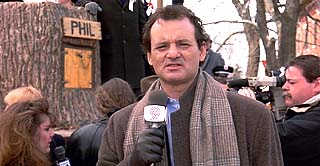
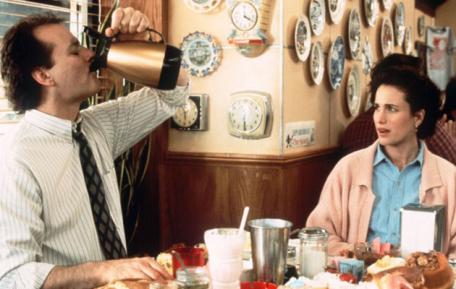
Bill Murray plays an obnoxious TV weatherman from Pittsburgh forced to relive the same wintry day in a small Pennsylvania town over and over again until he gets it right, in an unexpectedly graceful and well-organized comedy (1993) directed and cowritten by Harold Ramis. While the movie’s underlying message is basically A Christmas Carol strained through It’s a Wonderful Life — hardly a recommendation in my book — the filmmakers mercifully spare us the speeches and simply demonstrate their thesis; as they do they reveal their true virtue: a fluid sense of narrative that works the story’s theme-and-variations idea with a glancing and gliding touch. Considering that none of the characters is fresh or interesting, it’s a commendable achievement that the quality of the storytelling alone keeps the movie watchable and likable. With Andie MacDowell and Chris Elliott. PG, 103 min. (JR)
Brand New Angles [2/DUO]
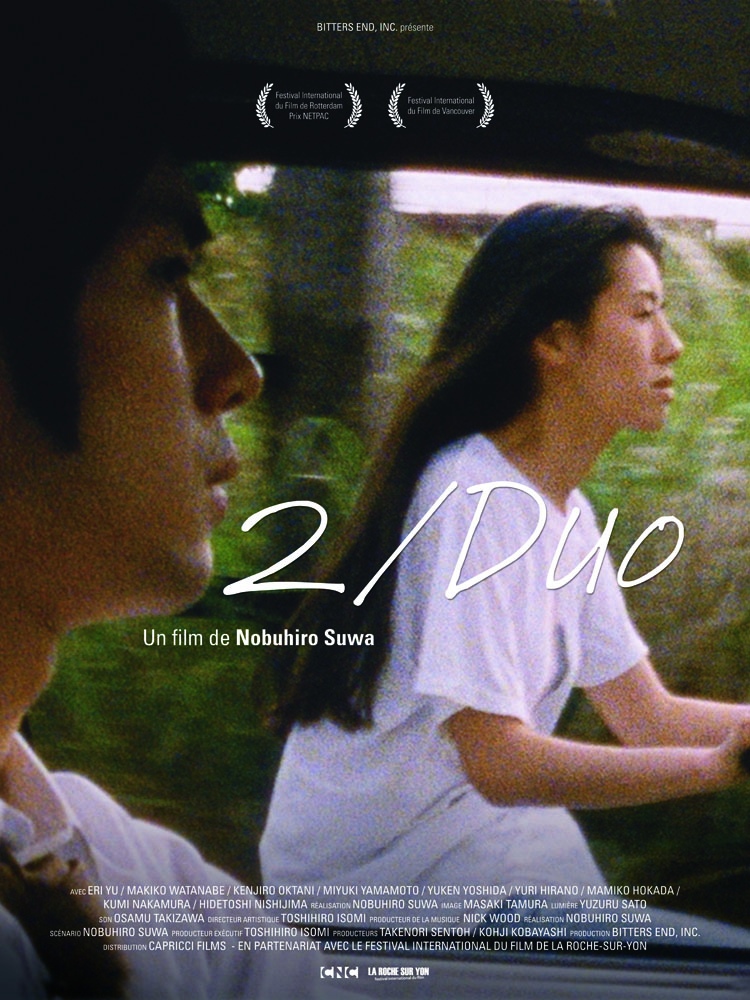
From the February 26, 1999 Chicago Reader. July 2014 postscript: This fascinating and neglected film, still my favorite among the Nobuhiro Suwa features that I’ve seen, has become available on a French DVD released by Capricci — see the first image below — albeit with (optional) French subtitles only. — J.R.
2/Duo
Rating *** A must see
Directed by Nobuhiro Suwa
Written by Suwa, Eri Yu, and Hidetoshi Nishijima
With Yu, Nishijima, and Makiko Watanabe.
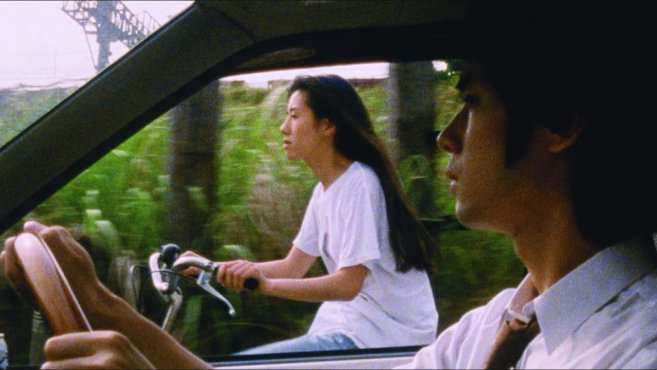
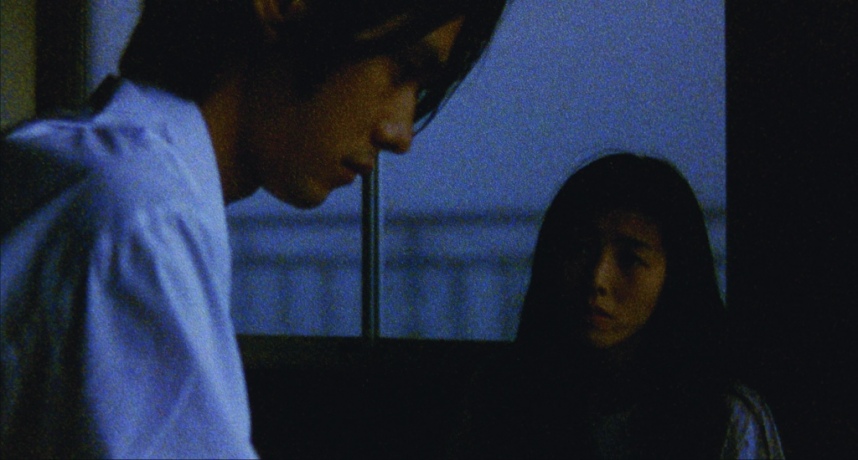
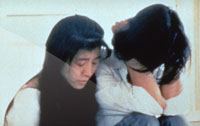
The first feature of Nobuhiro Suwa, a director of TV documentaries in his mid-30s, 2/Duo (1996) is the penultimate work in the Doc Films series “Japanese Cinema After the Economic Miracle: Masaki Tamura, Cinematographer.” Having seen only one other film in the series — Shinsuke Ogawa’s remarkable two-and-a-half-hour documentary about the lives of farmers protesting the construction of Japan’s biggest airport, Narita: Heta Village (1973) — I can’t give a comprehensive account of Tamura’s work. But judging from these two very different features, I suspect I might recognize his shooting style without seeing his name in the credits. Though Narita: Heta Village is a documentary and 2/Duo a fictional narrative, the style of both displays a highly intuitive engagement with the characters, expressed most clearly in the way Tamura places and moves his camera in relation to them, neither anticipating their actions nor dogging them, but navigating the spaces they occupy with an intelligence that manages to project empathy as well as independence — a rare combination. Read more
Park Row
From the Chicago Reader (February 5, 1999). — J.R.
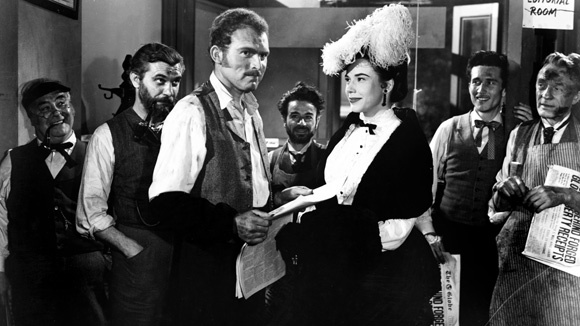
This neglected feature is one of Samuel Fuller’s most energetic — his own personal favorite, in part because he financed it out of his own pocket and lost every penny (1952). It’s a giddy look at New York journalism in the 1880s that crams together a good many of Fuller’s favorite newspaper stories, legends, and conceits and places them in socko headline type. A principled cigar smoker (Gene Evans) becomes the hard-hitting editor of a new Manhattan daily, where he competes with his former employer (Mary Welch) in a grudge match full of sexual undertones; a man jumps off the Brooklyn Bridge trying to become famous; the Statue of Liberty is given to the U.S. by France, and a newspaper drive raises money for its pedestal. Enthusiasm flows into every nook and cranny of this exceptionally cozy movie; when violence breaks out in the cramped-looking set of the title street, the camera weaves in and out of the buildings as through a sports arena, in a single take. The phrase “Park Row” is repeated incessantly like a crazy mantra, and the overall fervor of this vest-pocket Citizen Kane makes journalism sound like the most exciting activity in the world, even as it turns all its practitioners into members of a Fuller-esque military squad. Read more