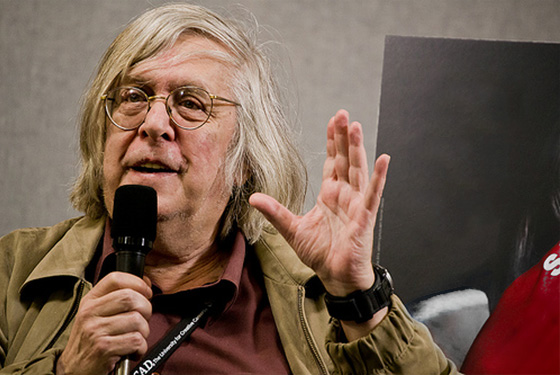
James Naremore, Cinema Then and Now: Conversations with Craig S. Simpson, New York: Sticking Place Books, 2025, 254 pp., $20 cloth, $16 paper.
JONATHAN ROSENBAUM
Many book-length interviews with film critics have been appearing in vertically-shaped volumes from the highly energetic Sticking Place Books over the past couple of years, starting with Michel Ciment and already including Joseph McBride, Patrick McGilligan, Leonard Maltin, James Naremore, Gerald Peary, Pierre Rissient, myself, and David Sterritt so far — even more by the time this review reaches print. Thanks to an inclusive policy that allows Maltin, Naremore, and Rissient to rub shoulders, there’s also a variety of lengths ranging from Rissient’s (167 pages) to McBride’s (730 pages), suggesting a welcome freedom from standardized formats and a willingness to let each volume establish its own rules and priorities. It appears that the critics have been invited to
pick their own interviewers. Naremore selected Craig S. Simpson, a former colleague and former manuscript archivist at Indiana University’s Lilly Library, and part of what makes this book an enjoyable page-turner in spite of its boilerplate title are the relaxed and sometimes playful discussions between these friends, even when they disagree (Simpson, for instance, likes both Robert Altman and Pauline Kael, unlike Naremore).
To begin with a full disclosure, Naremore and I have been good friends for almost half a century and have collaborated on many projects and written on many occasions about each other’s work. One particular bonus of Cinema Then and Now is that it concludes with a selective nine-page bibliography of Naremore’s oeuvre, enabling even wizened fans of his such as myself to discover many stray items that we hadn’t previously known about. (For others, Naremore’s web site at jamesnaremore.net is also useful.) Consequently, even though only two of his books —a 1973 Filmguide to Psycho and a 1993 edited volume about North by Northwest — are obviously devoted to Alfred Hitchcock, casual looks at the indexes of Acting in the Cinema (1973), Naremore’s two books about film noir (1998/2008 and 2019) , An Invention Without a Future: Essays on Cinema (2014), and Some Versions of Cary Grant (2022) reveal multiple and often extended discussions of Hitchcock, who is clearly one of Naremore’s two specialties along with Orson Welles.
Among the many ways that Naremore’s criticism differs from
most academic discussions of film are the attention given to
politics, history, and diverse technical matters, a graceful and mostly jargon-free writing style, and a commitment to pleasure with no desire to hide the fact that Naremore approaches cinema like an opinionated fan was well as a scholar, with debts to both Andrew Sarris’s auteurism and the formalism of Noel Burch’s early writing, (Apart from his skill with technical aspects of film, which I flagrantly lack, these are attributes and biases that I tend to share, which helps to explain how we became friends after meeting at the first American academic conference devoted to Welles, held in the late 1980s.)
Characteristically, Naremore noted in his ironically titled An Invention Without a Future (2014) that “we had reached the point where the name of the theorist was more important than the name of the artist” — one of his many welcome critiques of the anti-pleasure reflexes of what might be termed Screenthink. His indifference to academic and American fashion is no less apparent in his defense of Jerry Lewis as both a film director and an actor. And Naremore’s skill in summarizing his own positions makes this interview an invaluable introduction to all his books, including his first (a study of Virginia Woolf) and his most recent (a study of Pedro Costa, coauthored with his wife Darlene Sadlier, a specialist in Portuguese cinema and literature with a comparable skill in
moving between cinematic and literary values). And Hitchcock
specialists will encounter plenty of insights along the way.