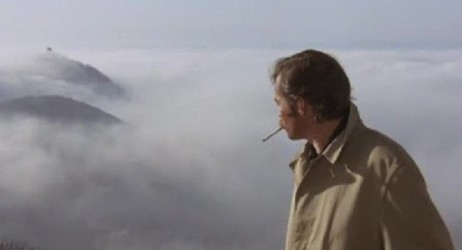
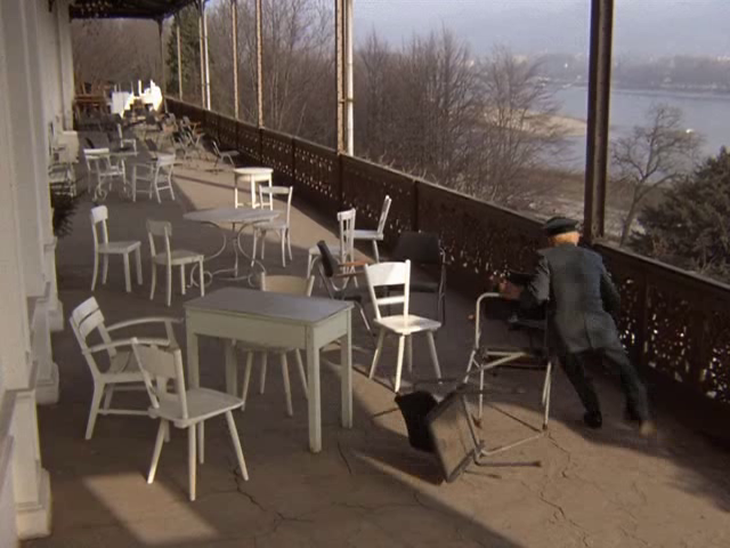
A peculiar SF allegory about a mental patient in Buenos Aires who claims to be from another planet, this probably has the second best use of the climax from Beethoven’s Ninth in a film (after Tarkovsky’s Stalker). Not for every taste, and perhaps a bit deja vu for spectators who’ve encountered too many versions of this visionary Christian parable elsewhere, but otherwise odd enough to warrant a look. Directed by Eliseo Subiela, with Lorenzo Quinteros, Hugo Soto, and Ines Vernego (1988). (JR) Read more
From the Chicago Reader (March 1, 1988). — J.R.
Luis Buñuel’s 1959 El fievre monte a El Pao follows a Latin American country’s attempts at political reform after its dictator is assassinated. Buñuel described this as the worst of his French films (it was a French-Mexican coproduction), yet it has its ardent defenders, among them Jean-Marie Straub and Daniele Huillet. As Buñuel’s most directly political work, it certainly warrants a look. With Gerard Philipe, in his last screen appearance, and Maria Felix. Read more
An unusually ambitious effort from horror movie specialist Wes Craven (A Nightmare on Elm Street), filmed on location in Haiti (as well as the Dominican Republic). This genuinely frightening 1988 thriller follows the efforts of an anthropologist (Bill Pullman) sent by a U.S. pharmaceutical company to find the chemical mixture used in zombificationthe voodoo practice that simulates death while leaving the victim alive and conscious. Depending largely on hallucinations and psychological terror (a la Altered States), and working from a Richard Maxwell and A.R. Simoun screenplay inspired by Wade Davis’s nonfiction book of the same title, Craven provides more atmosphere and creepy ideas than fluid storytelling. But it’s nice for a change to see some of the virtues of old-fashioned horror filmsmoody dream sequences, unsettling poetic images, and passages that suggest more than they showrather than the usual splatter shocks and special effects (far from absent, but employed with relative economy). Cathy Tyson plays the hero’s Haitian guidea psychiatrist alert to some of the cultural ramifications of voodooand Zakes Mokae, Paul Winfield, and Brent Jennings, as other agents of the hero’s dark education in prerevolutionary Haiti, are effective as well. (JR) Read more
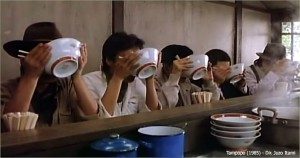
Juzo Itami’s second comedy (1987) represents a quantum leap beyond his first (The Funeral): without abandoning his flair for social satire, he expands his scope to encompass the kind of narrative free play we associate with late Buñuel. His subjects are food, sex, and death, roughly in that order, his ostensible focal point the opening of a noodle restaurant. Working with a venerable cast that includes veterans of Kurosawa, Ozu, Shinoda, and Terayama, he takes us on a wild spree through an obsession, winding his way through various digressions with a dark, philosophical wit that is both hilarious and disturbing. Not to be missed. In Japanese with subtitles. Read more
John Waters’s 1988 musical comedy set in 1962 Baltimore represented a good many firsts for the celebrated underground bad taste writer-director-producer: his biggest budget, his first period foray, his first PG-rated movie, and his first real brush with politicsthe issue of integrating a local TV dance show in Baltimore during the height of the civil rights movement. The cast includes Debbie Harry, Sonny Bono, Divine (in a dual role), Jerry Stiller, Ruth Brown, and cameo appearances by Ric Ocasek and Pia Zadora as beatniks. Not only Waters’s best movie, but a crossover gesture that expands his appeal without compromising his vision one iota; Ricki Lake as the hefty young heroine is especially delightful. With many arcane dance steps and hit singles from the period. 96 min. (JR) Read more
It’s a pity that producer and onetime actor (Come Blow Your Horn) Tony Bill doesn’t have a better sense of history in his direction of this nostalgic piece of exploitation (1988) about a lower-middle-class Bronx neighborhood in 1964, although screenwriter John Patrick Shanleywhose script for Moonstruck exhibits a related sense of New York cozinessis also partially responsible. An Irish working-class kid, the son of a recently deceased cop, believes in the nonviolent principles of Martin Luther King until some disillusioning brushes with the black world and some violent skirmishes with an old pal just out of prison show him the error of his ways. For all I know, some of the local and period details about the Bronx may be deadly accurate, but the exploitative cynicism of the plot and the complacencies about race relations smack more of contemporary mythology, particularly as it’s strained through TV sitcom misreadings of the 60s and more bad thrillers than you can shake a stick at. Cinematographer Fred Murphy does his usual fine work, and some of the cute domestic details make this intermittently watchable, but the ideological platitudes are repulsive and false, and the plot manipulations for the sake of effectsculminating in an all-stops-out violent finaleare no less tacky. Read more
This appeared originally in Senses of Cinema, issue 17, November 2001. The book it appears in has subsequently reappeared in an expanded second edition. — J.R.

The following is an extract from Abbas Kiarostami by Mehrnaz Saeed-Vafa and Jonathan Rosenbaum (University of Illinois Press, 2003) – one of the initial books in a series edited by James Naremore that is devoted to neglected contemporary filmmakers. Abbas Kiarostami contains separate essays by Rosenbaum and Saeed-Vafa followed first by this dialogue, then by an extended interview with Kiarostami conducted by both authors.
***
September 3, 2001, Chicago

JONATHAN ROSENBAUM: You were the one who originally had the idea of proposing that we do this book together. And maybe we should both consider why we thought it was a good idea.
MEHRNAZ SAEED-VAFA: Basically, as far as I remember, we had a lot of interesting dialogues about Iranian cinema and Kiarostami, and I thought it would be a great idea to put our effort into a book. We started our dialogue in 1992, at a time when Kiarostami was still was getting discovered in France, but unknown in the United States. And I respected you highly as a critic and I knew that you were respected among other readers outside the United States as well as inside. Read more
This is the 13th one-page column I published in Cahiers du Cinéma España; it ran in their July-August 2009 issue. — J.R.

Writing from Chicago in May, during the Cannes film festival, I’ve been reflecting lately how much this festival remains a spectator sport even for those who don’t attend it. I’ve attended it nine times in all, 1970-1973 and 1994-1998, and my most enduring impression about it is how quickly everything that happens there gets turned into some form of business — a process that is both hilarious and somewhat horrifying.
Two immediate examples come to mind which occurred during my first and most recent visits there. In 1970, I attended the world premiere of Woodstock, only five days after four students were shot and killed by National Guardsmen at Kent State University in Ohio. Michael Wadleigh, the hippie director — a tall, commanding figure dressed in suede — dedicated the film to those four students and to “the many deaths to come” in the ongoing political struggles of the period. When the screening was over, he stood by the exit and calmly handed out black arm bands to anyone who wanted to wear one. I wore one myself for a day or two. Read more
The following is taken from my “Cannes Journal” in the September-October 1973 issue of Film Comment and corrected in a few particulars in April 2016, after seeing the restored 128-minute director’s cut on a wonderful new Blu-Ray from Olive Films. — J.R.
In theory, the Marché du Film is merely one division of the festival out of many (official selections, Directors’ Fortnight, Critics’ Week, etc.); in practice, every film and every person attending is on the marketplace, to purchase or to be purchased, and all the rest is journalistic euphemism. It was there, at any rate, that I came across Samuel Fuller’s latest film.
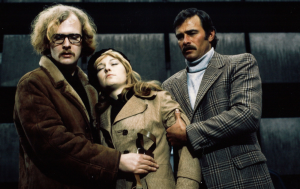
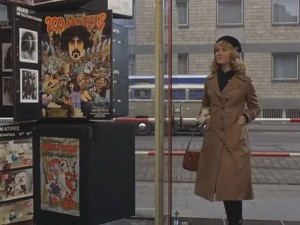
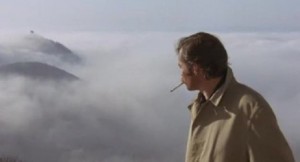
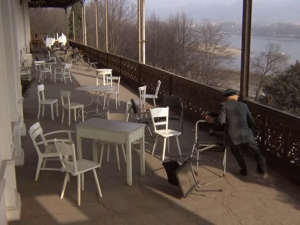
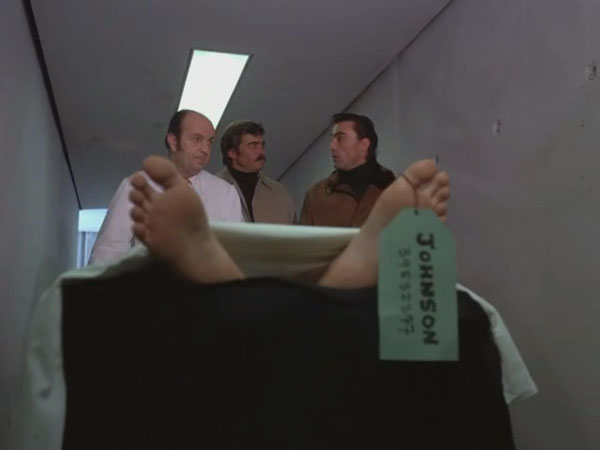
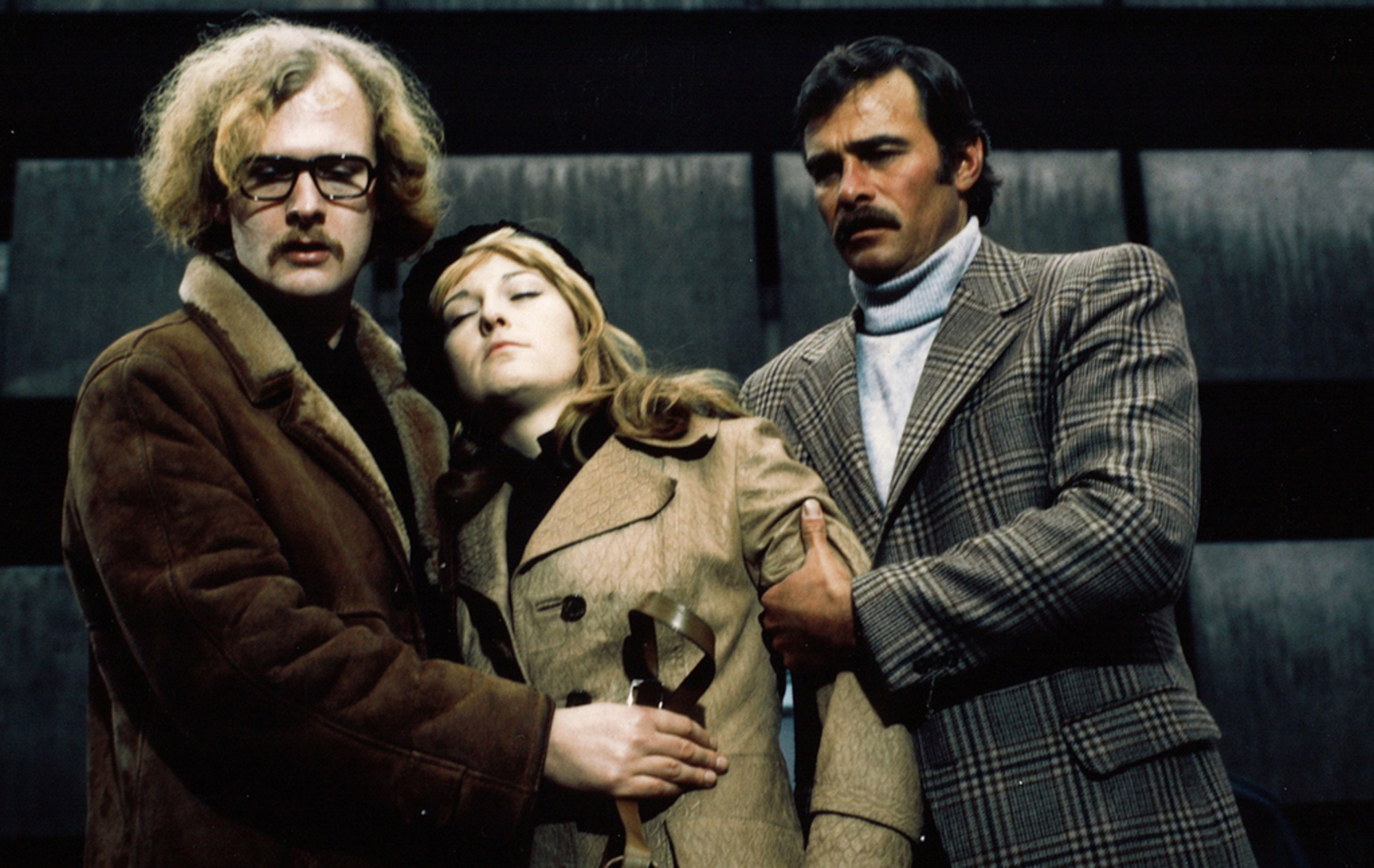
Not all of DEAD PIGEON ON BEETHOVEN STREET is peaches and cream, but the beginning is extraordinary — a brilliant burst of action that illustrates the title in lightning flashes — and the mad finale in a weapons room is not far behind. Fuller’s habitual obeisance to the title composer reaches an apogee of sorts in a scene set in the Beethoven Museum, where the head of one of the leads (Glenn Corbett) is cut off by the top of the frame in order to give one of the Master’s pianos a privileged place in the composition. Read more
A soporific road movie about a runaway girl (Greer Robson) and a rebellious worker in flight from the law (Peter Phelps) who team up during the Depression, this New Zealand film, despite some picturesque locations, is essentially defeated by colorless acting and a mediocre script. Directed by Sam Pillsbury, with a screenplay by Grant Hinden Miller which adapts his owen novel, The Dream Monger. (JR) Read more
These liner notes were written for Home Vision Entertainment circa 1997. —J.R.
Drôle de drame

The English release title of Drôle de drame (1937) —- set in London circa 1900, and based on J. Storer Cloutson’s English novel His First Offense — is Bizarre Bizarre. This curious label derives from a conversation between Irwin Molyneux (Michel Simon) — a horticulturist who’s been writing crime novels on the sly, under the pen name of Félix Chapel, at the insistence of his wife Margaret (Françoise Rosay), to raise money to keep up their social appearances —- and Archibald Soper, the Bishop of Bedford (Louis Jouvet), Margaret’s hypocritically prudish cousin, who’s been publicly denouncing Chapel’s novels, and has just invited himself over for dinner due to his partiality for Margaret’s orange duck.

Unfortunately, Margaret’s cook and butler have just quit, leaving Margaret in a state of a panic—-because her servants are as necessary to her public image as the money brought in by Irwin’s moonlighting. So she prepares the duck herself while hiding in the kitchen, gets Irwin’s assistant Eva (Nadine Vogel) to serve it, and asks Irwin to come up with a story explaining Margaret’s absence.

In response to the Bishop’s prying questions, Irwin impulsively comes up with two explanations — that Margaret left for the country to visit friends and that she had to leave suddenly due to the measles —- and then tries to reconcile them by adding that it’s her friends who have the measles. Read more
From the June 5, 2002 issue of the Chicago Reader. — J.R.
The Naked Spur
**** (Masterpiece)
Directed by Anthony Mann
Written by Sam Rolfe, Harold Jack Bloom
With James Stewart, Janet Leigh, Robert Ryan, Ralph Meeker, and Millard Mitchell.
Man of the West
**** (Masterpiece)
Directed by Anthony Mann
Written by Reginald Rose
With Gary Cooper, Julie London, Lee J. Cobb, Arthur O’Connell, Jack Lord, John Dehmer, Royal Dano, and Robert Wilke.

Q: What is the starting point for The Naked Spur?
A: We were in magnificent countryside — in Durango — and everything lent itself to improvisation. I never understood why almost all westerns are shot in desert landscapes! John Ford, for example, adores Monument Valley, but I know Monument Valley very well and it’s not the whole west. In fact, the desert represents only one part of the American west. I wanted to show the mountains, the waterfalls, the forested areas, the snowy summits — in short to rediscover the whole Daniel Boone atmosphere: the characters emerge more fully from such an environment. In that sense the shooting of The Naked Spur gave me some genuine satisfaction. –Anthony Mann in a 1967 interview

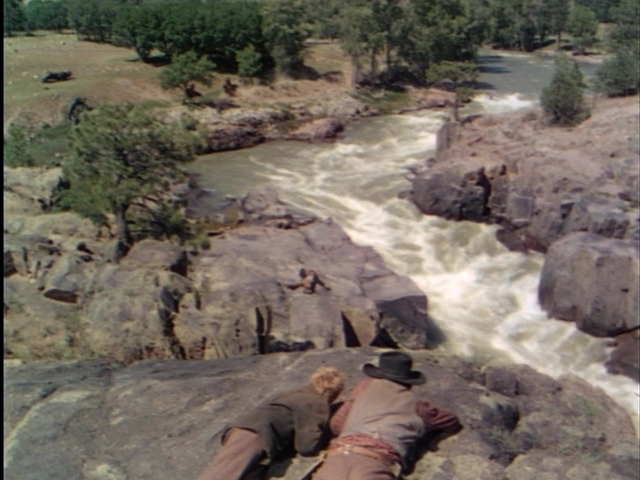
This seems to be landscape week at the Gene Siskel Film Center, with Abbas Kiarostami’s sublime Where Is the Friend’s House? Read more
From Monthly Film Bulletin, October 1984 (Vol. 51, No. 609). This was published long after I left the MFB staff in early 1977, and by this time, over seven years later, the magazine had finally abandoned its highly dubious practice of restricting all its reviews to single paragraphs. –- J.R.
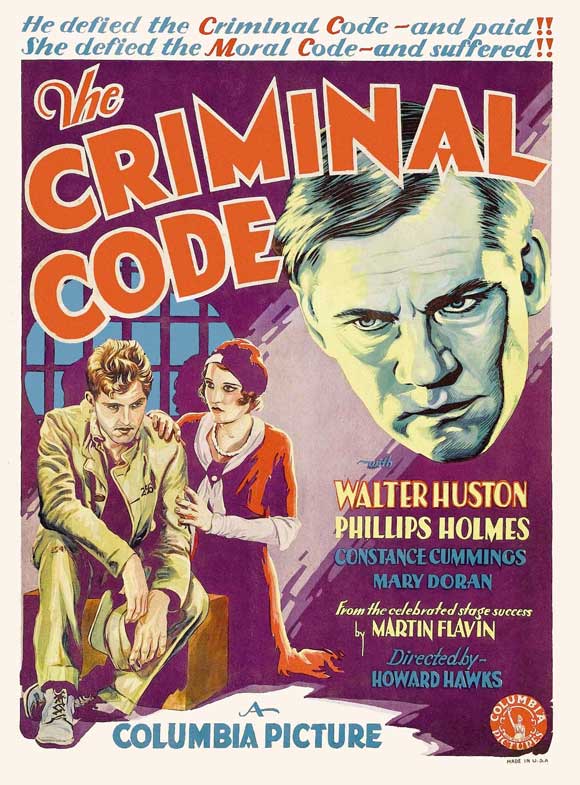
The Criminal Code
U.S.A.,1930
Director: Howard Hawks
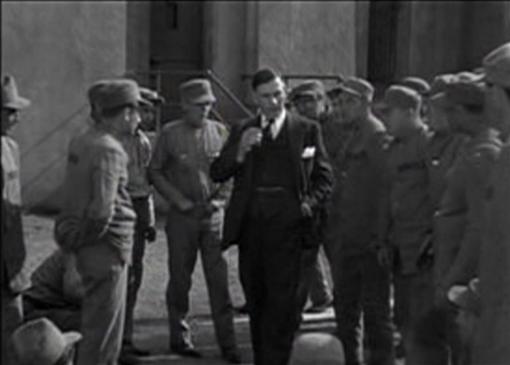
Cert–A.dist—Filmfinders. p.c–Columbia. A Howard Hawk production. p–Harry Cohn. sc–Seton I. Miller, Fred Niblo Jnr. Based on the play by Martin Flavin. ph–Teddy Tezlaff, James [Wong] Howe, (uncredited) William O’Connell. ed–Edward Curtiss. a.d–Edward Jewell. m–(not credited). sd. rec–Glenn Rominger. l.p–Walter Huston (Warden Martin Brady), Phillips Holmes (Robert Graham), Constance Cummings (Mary Brady), Mary Doran (Gertrude Williams), De Witt Jennings (Gleason), John Sheehan (MacManus), Boris Karloff (Galloway), Otto Hoffman (Jim Fales), Clark Marshall (Runch), Ethel Wales (Katie), lohn St. Polis (Dr. Rincwulf), Paul Porcassi (Spelvin), Hugh Walker (Lew), Andy Devine (Prisoner), Jack Vance (Reporter), Arthur Hoyt (Nettleford), Nicholas Soussanin, James Guilfoyle, Lee Phelps. 3,245 ft.n90 mins. (16 mm.) Original running time–97 mins. Read more
From Film Comment, July-August 1982. — J.R.
Movies Plus One by William S. Pechter, 246 pp., index, Horizon Press, $14.95.
Ever since certain American film critics have taken to collecting their own reviews and/or commanding their own screenings, the solipsistic nature of their profession has tended to grow. It is a tendency that crosses cult boundaries, characterizing the Neros of the profession as well as the Babbitts, the scarlet empresses as well as the Sylvia Scarletts. In her celebrated and lengthy attack on Pauline Kael in the New York Review of Books two summers ago, Renata Adler indirectly broached this problem by singling out the distressing evidence of one very gifted intelligence having run amok — a charge largely made on stylistic and rhetorical grounds, and persuasively shaped around the assumption that what was really at stake was not movies at all, but prose and the relation between writers and readers. The greatest, lasting value of Adler’s remarkable piece was its illumination of this sticky problem as a general tendency — not its ostensible project of bringing the reader the head of Pauline Kael, which gave it all its publicity.
For a wider application of what Adler was talking about, one need only turn to Kael’s arch-rival Andrew Sarris — a critic so adroit at exposing his own solipsistic stances that he’s never needed an Adler to point them out. Read more
This is the very first long review I ever published in the Chicago Reader. It was published in their March 13, 1987 issue, about five months before I moved to Chicago from Santa Barbara and started working as their regular film critic, and writing this piece was part of my audition for the job. (They commissioned two other pieces from me, neither of which they ran, as part of the same audition; both of these reviews — on Oliver Stone’s Platoon and on Bertrand Tavernier’s ‘Round Midnight — are now available on this site.)
This article has never previously appeared online, on the Reader’s website or anywhere else. It ran originally with the same black and white still reproduced here. Readers familiar with my essay, “Notes Toward the Devaluation of Woody Allen,” written about three years later, may notice that I borrowed a few passages in it from this review. My original title for this review, “Woody’n You,” was rejected by the Reader editors, who didn’t catch or dig the jazz reference. — J.R.
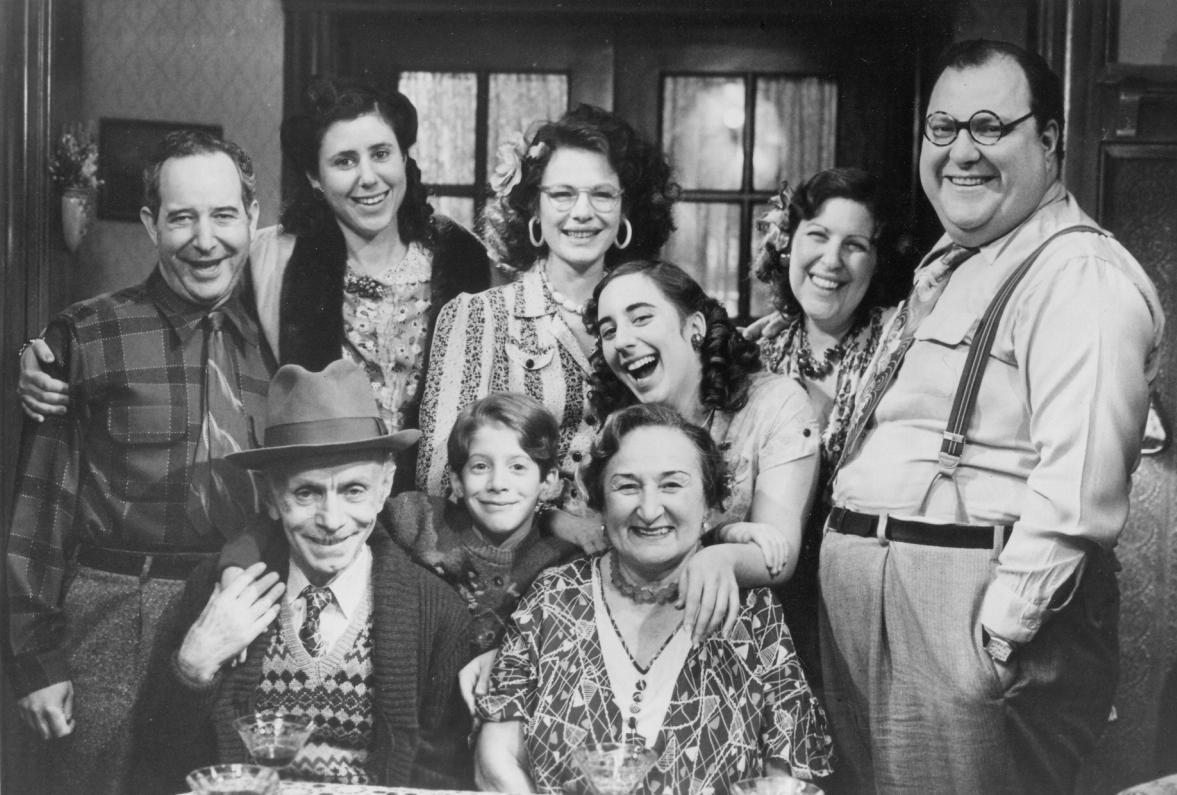
*RADIO DAYS
Directed and written by Woody Allen
With Seth Green, Julie Kavner, Michael Tucker, Mia Farrow, Dianne Wiest, and Diane Keaton.
It’s hard to think of a contemporary American filmmaker who is more universally admired than Woody Allen –- a fact that may say more about us than it says about Woody. Read more