From the August 27, 1980 issue of The Soho News — only slightly tweaked almost three decades later. –J.R.
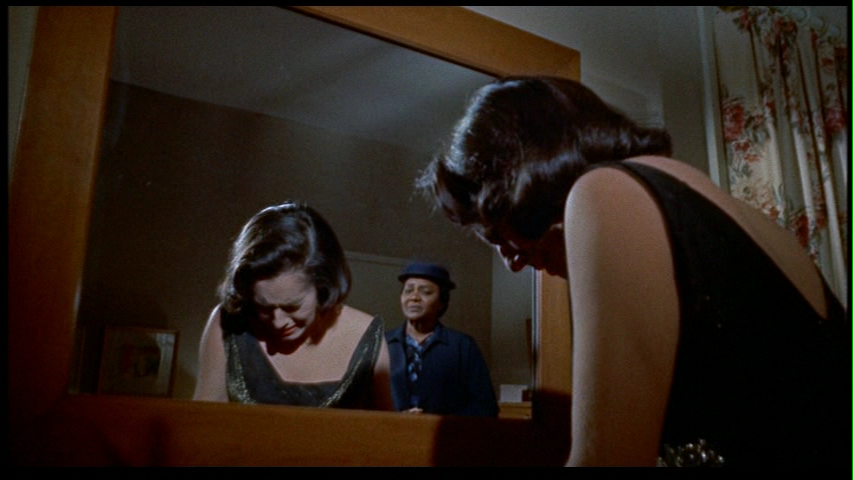

Douglas Sirk in Germany: Four Films
Museum of Modern Art, Aug. 15-18
It must have been in the late spring of 1959 — surrounded mainly be weeping matrons at a matinee of Imitation of Life in Florence, Alabama — that I first tangled with the considerable talents of major melodramatist Douglas Sirk. At the time, these were focused on the task of encouraging white middle-class segregationists and racists to weep bittersweet buckets over the sentimental death of an Aunt Jemima figure named Annie (Juanita Hall), a nas ole cullid lady (as those matrons would have put it) who — unlike her sexy and evil light-skinned, teenage daughter, Sarah Jane (Susan Kohner) — knew her place, accepted her color as a necessary cross to bear, and then died of a broken heart when Sarah Jane rejected her.
Bearing in mind this particular praxis of Sirk’s last Hollywood film, I’ve always felt just a little querulous when armchair Marxists in London have patiently explained to me that Sirk was actually a Brechtian subversive back in the ’50s, boring from within — subtly and secretly criticizing our American values. Read more
From the August 18, 1989 Chicago Reader; this piece is also reprinted in my collection Essential Cinema. — J.R.
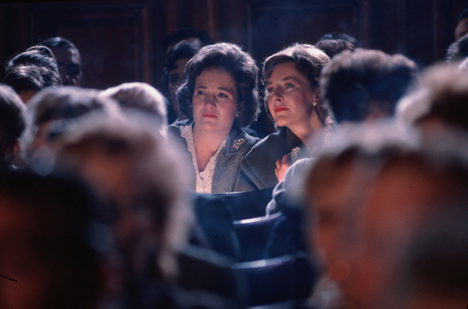
DISTANT VOICES, STILL LIVES
**** (Masterpiece)
Directed and written by Terence Davies
With Freda Dowie, Pete Postlethwaite, Angela Walsh, Dean Williams, Lorraine Ashbourne, Debi Jones, Michael Starke, and Vincent Maguire.
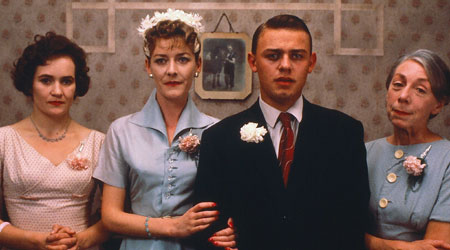
An autobiographical film about growing up in a Catholic working-class family in Liverpool in the 40s and 50s. Achronological glimpses of a traumatic family life, with particular emphasis on a funeral and two weddings. A collection of radio shows and nostalgic songs sung at parties and pub gatherings. A highly condensed, triple-distilled family album of faces and feelings organized around a few key locations. A series of emotional and visceral jolts whose brute power and intensity could not be conveyed by a conventional linear story. A seamless block of passionate memories defined by the beauty and terror of the everyday.
The problem with all these descriptions of Distant Voices, Still Lives is that though each is partially accurate, they only dance around the periphery of what is a primal experience; that they represent the shards of my attempts to describe the essence of a masterpiece that reinvents filmgoing itself. I saw it twice at the Toronto film festival last September, and twice again earlier this month, and the inadequacy of my efforts is largely due to the fact that great films have a way of imposing their own laws and definitions that ordinary descriptions can’t reach. Read more
This appeared in the July 26, 1996 issue of the Chicago Reader. — J.R.


Up Down Fragile
**** (Masterpiece)
Directed by Jacques Rivette
Written by Laurence Côte, Marianne Denicourt, Nathalie Richard, Pascal Bonitzer, Christine Laurent, and Rivette
With Côte, Denicourt, Richard, Anna Karina, André Marcon, Bruno Todeschini, Wilfre Benaiche, Enzo Enzo, and the voice of László Szabó
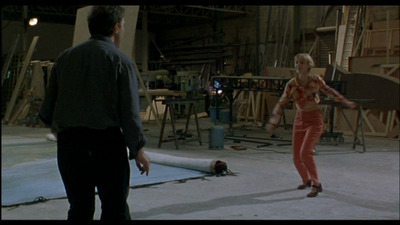

The inspiration of Up Down Fragile? The MGM low-budget films of the 50s that were shot in four or five weeks on sets left over from other films. In particular, a Stanley Donen movie, Give a Girl a Break [1953], a simple film shot in next to no time with short dance numbers. — Jacques Rivette in an interview
Entertainment does not…present models of utopian worlds, as in the classic utopias of Sir Thomas More, William Morris, et al. Rather the utopianism is contained in the feelings it embodies. It presents, head-on as it were, what utopia would feel like rather than how it would be organized. — Richard Dyer, “Entertainment and Utopia”
Out of Jacques Rivette’s 17 features to date — in which I include his 12-hour serial Out 1 (1970) as well as both parts of his Jeanne la pucelle (1994) — 9 are set in contemporary Paris. Read more
1. GREED (Stroheim, 1924)
2. SUNRISE (Murnau, 1927)
3. THE MAGNIFICENT AMBERSONS (Welles, 1942)
4. CITY LIGHTS (Chaplin, 1931)
5. LOVE ME TONIGHT (Mamoulian, 1932)
6. THE BEST YEARS OF OUR LIVES (Wyler, 1946)
7. STARS IN MY CROWN (Tourneur, 1950)
8. LOVE STREAMS (Cassavetes, 1984)
9. A.I. ARTIFICIAL INTELLIGENCE (Kubrick & Spielberg, 2001)
10. WHEN IT RAINS (Burnett, 1995) Read more
This commissioned essay was for a touring retrospective catalogue, The American New Wave, 1958-1967, published by the Walker Art Center and Media Center/Buffalo in 1982 (and slightly tweaked just now, in June 2010). It’s dated by my erroneous assumption, shared by most critics during this period, that the dialogue of Shadows was improvised, corrected years later by the research of Ray Carney — although I still stand fully behind my opening paragraph. I was also mistaken in my assumption that Charles Mingus was entirely responsible for the film’s score, especially in the second version. (Ross Lipman has written brilliantly and in detail on this subject.)
My writing of this article was both interrupted and ultimately informed by the shock of the suicide of my older brother David. Regarding the details about lapsed Catholicism apropos of The Savage Eye, I can still recall a phone conversation I had at the time with the late Veronica Geng, a former colleague at Soho News (and lapsed Catholic) and a writer and editor at The New Yorker whom I plumbed for information and advice. Perhaps I went a little overboard in my expressions of scorn for the purple prose in The Savage Eye’s commentary; today I find it rather fascinating for its kinship with Beat writing from the same period, for better and for worse. — Read more
From the September 24, 1999 issue of the Chicago Reader. — J.R.
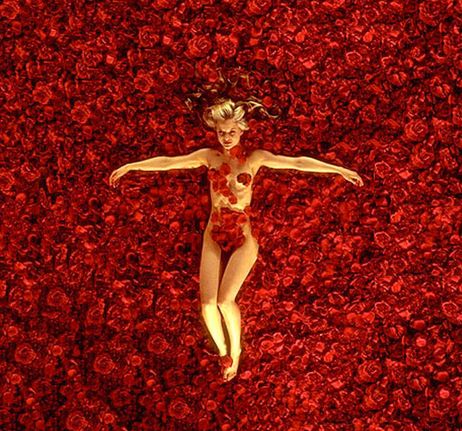
American Beauty
Rating *** A must see
Directed by Sam Mendes
Written by Alan Ball
With Kevin Spacey, Annette Bening, Thora Birch, Wes Bentley, Mena Suvari, Chris Cooper, Peter Gallagher, and Allison Janney.
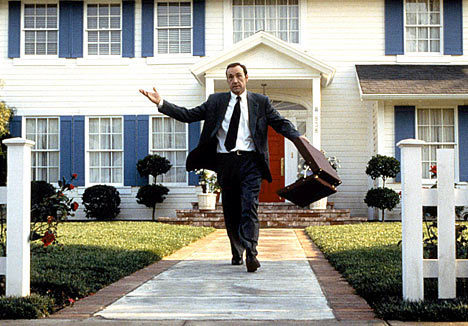
American Beauty is a brilliant satirical diagnosis of what’s most screwed up about life in this country, especially when it comes to sexual frustration and kiddie porn. Or American Beauty is a hypocritical piece of kiddie porn, brilliantly exploiting an audience’s sexual frustration and turning it into coin. Take your pick.
Paradoxical as it sounds, both of these statements may be true. American Beauty is, after all, a Hollywood movie, like The Graduate (1967) and Risky Business (1983), two somewhat comparable historical markers that gleefully conflate social criticism and fantasy wish fulfillment so you can’t tell them apart. Whether American Beauty will become a hit like those earlier movies is hard to predict, but if it doesn’t it won’t be for lack of trying. Like The Graduate, it sympathizes with rebellion and satirizes complacency, but that doesn’t stop it from taking digs at sexually deprived middle-aged women as if they were somehow the root of all evil. Read more
From the Chicago Reader (November 21, 1997). I tend to respect Verhoeven more nowadays than I did back then. — J.R.
Starship Troopers
Rating ** Worth seeing
Directed by Paul Verhoeven
Written by Ed Neumeier
With Casper Van Dien, Dina Meyer, Denise Richards, Jake Busey, Neil Patrick Harris, Clancy Brown, Seth Gilliam, and Patrick Muldoon.
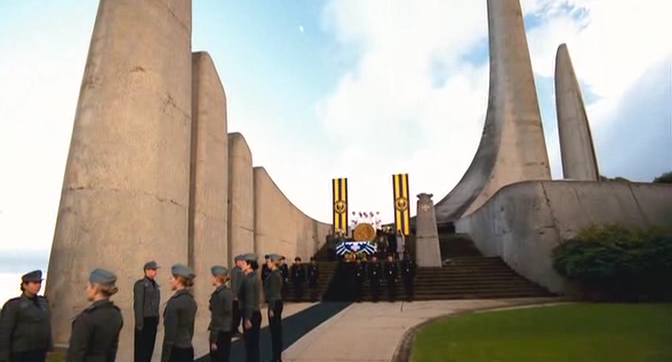
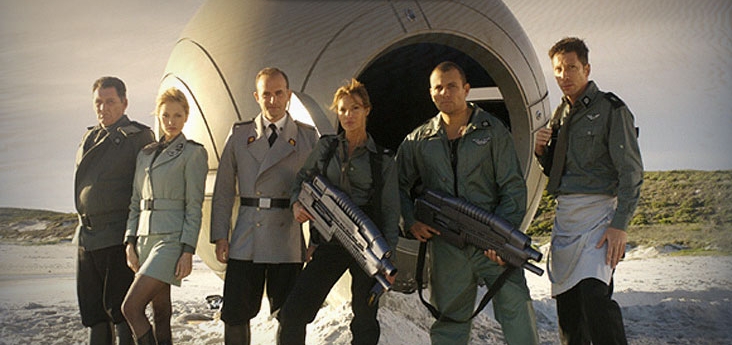
When did American action blockbusters stop being American? Sometime in the last two decades, in between the genocidal adventures of George Lucas’s Star Wars and those of Paul Verhoeven’s Starship Troopers, the national pedigree disappeared. True, Starship Troopers is a simplified, watered-down version of Robert A. Heinlein’s all-American novel, and it’s consciously modeled on Hollywood World War II features (as was much of Star Wars); it even boasts an “all-American” cast that could have sprung full-blown from a camp classic of Aryan physiognomy like Howard Hawks’s Red Line 7000. But the only state it can be said to truly reflect or honor is one of drifting statelessness. If the alien bugs that populate Verhoeven’s movie wanted to learn what American life and culture was like in 1977, Star Wars would have served as a useful and appropriate object of study; but if they wanted to know what American — or even global — life was like in 1997, Starship Troopers would tell them zip. Read more
From the Chicago Reader (March 10, 1989). It’s sad to hear that the great and irreplaceable Jackie Burroughs passed away on September 22, 2010. — J.R.
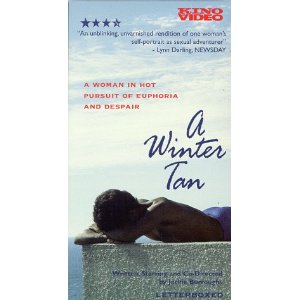
A WINTER TAN
*** (A must-see)
Directed by Jackie Burroughs, Louise Clark, John Frizzell, John Walker, and Aerlyn Weissman
Written by Burroughs
With Burroughs, Erando Gonzales, Javier Torres, and Diana d’Aquila.

A Winter Tan is startling because it mainly succeeds in its aims though they’re based on at least three dubious premises. The first is that a volume of letters can be adapted into a plausible dramatic film. The second is that the letters in question — an American woman’s descriptions of her sexual adventures in Mexico, written before she was murdered, probably as a result of a sexual escapade — can be seen as exhilarating and life-enhancing instead of just depressing. And the third dubious premise is that a film made collectively by five directors can come across with a singular voice and style, a consistent meaning and purpose.


I haven’t read Maryse Holder’s book Give Sorrow Words, which was published posthumously some years ago, first by Grove Press in hardcover and then by Avon in paperback, and is currently out of print in both editions. Read more
From the Summer 2000 issue of Cineaste, Vol. XXV, No. 3. — J.R.
Jacques Tati
by David Bellos. London: The Harvill Press, 1999. 382 pp., illus. Hardcover: £25.
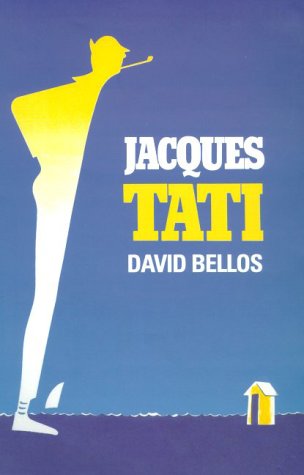
In some ways, this is a better biography of Jacques Tati than we had cause to expect from anyone — certainly a more cultivated one than the useful if relatively lowbrow efforts of James Harding in English (1984) and Marc Dondey in French (written with the assistance of Tati’s daughter Sophie Tatischeff, 1993). So it’s all the more regrettable that no American publisher or distributor to date has shown any interest in making this English book available. Even more unexpectedly, the author — who currently teaches in the departments of Comparative Literature and Romance Languages at Princeton — is best known for his work on Balzac (a survey of French criticism over the second half of the nineteenth century) and Georges Perec (a major biography and a good many translations). In fact, there are even a few unforced allusions to Balzac and Perec threaded through this text.
But why Tati? Conceding in his Preface that he isn’t a film critic, a film buff, or a filmmaker manqué, Bellos makes no claims for offering any “last word” about “one of the outstanding creators of the 20th century,” but admits to some curiosity about the sturdiness of the few films Jacques Tati made as an oeuvre — “a set of films which, taken together, is much more than the sum of its parts.” Read more

The Chicago production of the Aaron Sorkin play, The Farnsworth Invention, directed by Nick Bowling and playing through June 13, has the lively sort of staging, acting, and pacing that I’ve come to expect from the TimeLine Theatre Company, which presents “stories inspired by history that connect with today’s social and political issues” at their 615 W. Wellington headquarters. I discovered this company a little over year ago with the world premiere of Masha Obolensky’s Not Enough Air, also directed by Bowling, and have subsequently seen his production of Alan Bennett’s The History Boys as well, which was my first encounter with TimeLine’s remodeled, almost-in-the-round playing space. (In between these events, I also showed up for a reading of Sophie Treadwell’s 1920s expressionist play Machinal, done as a sort of adjunct to Not Enough Air.) Neither of these follow-ups has quite equaled the sheer Wellesian bravura of the Not Enough Air production, but I can’t say that either one has ever bored me for an instant — even if the sheer energy required in the new playing space, with the actors moving their various props onstage and off with lightning-fast cues, can occasionally (if only momentarily) overwhelm certain aspects of the stories being told. Read more
Not many recent films about heroism that one can still believe in. This is one of them. [12/11/10]

 Read more
From Video Movies (August 1984). — J.R.
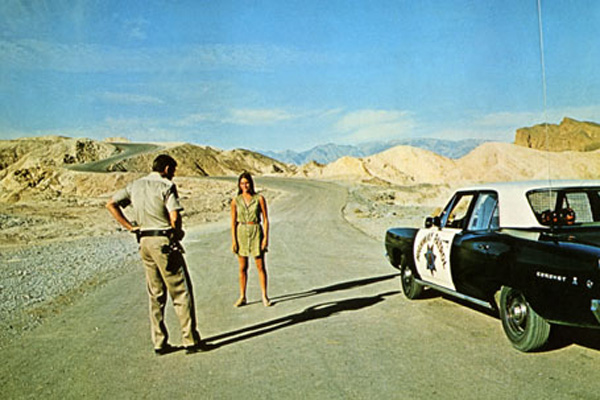

Zabriskie Point
(1969), C, Director: Michelangelo Antonioni. With Mark Frechette, Daria Halprin, Rod Taylor, and Kathleen Cleaver. 111 min. R. MGM/UA, $59.95.
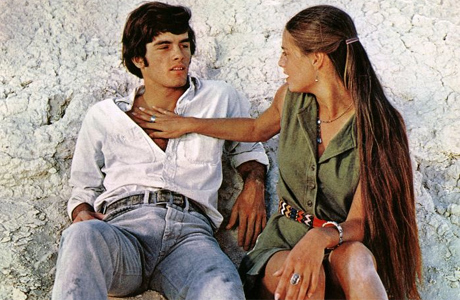
In the 1960s, he could do no wrong, especially after his hit, Blow-up. In the 1980s, Michelangelo Antonioni emerges as a shamefully neglected figure — only one of his last four films (The Passenger) has been released in this country. And Zabriskie Point, the film that virtually destroyed his American reputation, offers ample proof of both the Italian director’s brilliance and his neglect of filmmaking particulars that Americans seemingly will not stand for. To understand Antonioni’s art, we must acknowledge that he is not a storyteller but a composer/choreographer of sounds and images.
As either a plausible romance about disaffected youth or as a documentary rendering of 1969 America, Zabriskie Point is often ludicrous. But if one keeps in mind that Antonioni thinks through his camera more than through his scripts — and that realism is far from his intention — one can see this film as an astonishingly beautiful achievement. As the director noted at the time, “The story is certainly a simple one. Nonetheless, the content is actually very complex. Read more
From the April 1985 Video Times. — J.R.
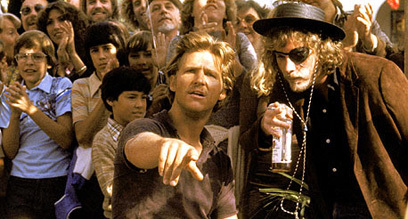

Cutter’s Way
(1981), C, Director: Ivan Passer. With Jeff Bridges, John Heard, Lisa Eichhorn, and Ann Dusenberry. 105 min. R, MGM/UA, $69.95.
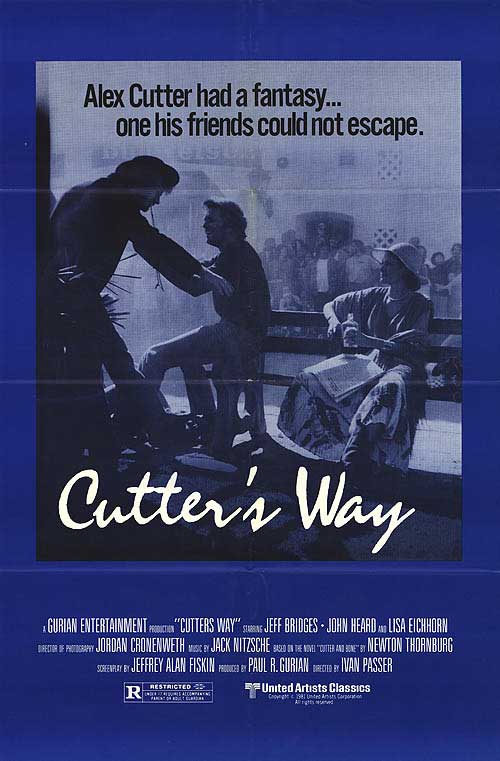

A powerful, erotic thriller with remarkable performances from all three of its leads (Jeff Bridges, John Heard, and Lisa Eichhorn), Cutter’s Way never made the impact it should have when it was released. Originally titled Cutter and Bone, after the novel by Newton Thornberg on which it is based, it quickly became a studio write-off in the immediate wake of Heaven’s Gate. Not even a brace of rave reviews and a couple of film festival prizes could save it. Rereleased a few months later as Cutter’s Way, the film went on to acquire an enthusiastic cult that continues to appreciate its sensitive, offbeat mood and its indelible portrait of disaffected America.
The film is tightly scripted by Jeffrey Alan Fiskin and directed by the Czech expatriate Ivan Passer, best known for his bittersweet Czech feature Intimate Lighting, as well as such American features as Born to Win, Law and Disorder, and Silver Bears. Cutter’s Way is an in-depth portrait of the complex relations between three disaffected people. Read more
From The Soho News (November 17, 1981). Ironically, this review was originally copyedited rather clumsily, so I’ve tried to restore some of its original logic and meaning. Incidentally, for those who might be interested, my earlier review of Nabokov’s Lectures on Literature for Soho News can be accessed here. — J.R.
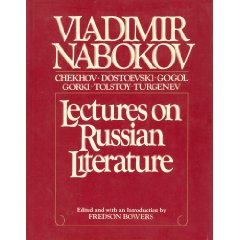
Lectures on Russian Literature
By Vladimir Nabokov
Edited and introduced by Fredson Bowers
Harcourt Brace Jovanovich, $19.95
Compare the book under examination to Nabokov’s Lectures on Literature, reviewed in these pages last November. Is Volume II a worthy successor, an arguable improvement, or a distinct letdown? Explain. (Use concrete examples.)
All three. Issued in a uniform edition at the same price, only 50-odd pages shorter -– the jacket Indian-red in contrast to last year’s sky-blue –- the book can be considered a worthy successor. Insofar as it contains meaty selections from what I take to be Nabokov’s supreme act (and work) of literary criticism (not counting his voluminous notes on his translation of Pushkin’s Eugene Onegin, which I haven’t read) –- namely, his eccentric and indelible Nikolai Gogol, first published by New Directions in 1944 -– it can arguably be deemed an improvement, even over his exhilarating and enlightening lectures on Flaubert and Kafka in the first volume. Read more
From the Chicago Reader (March 1, 1991) — J.R.
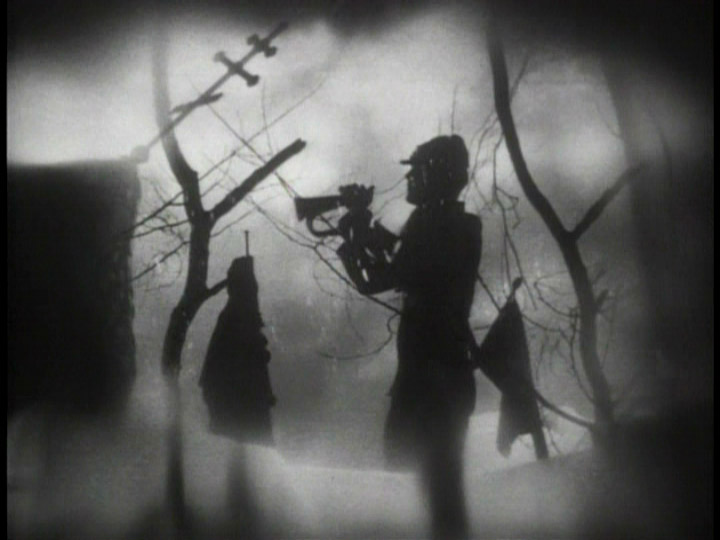
ARCHANGEL
*** (A must-see)
Directed by Guy Maddin
Written by George Toles and Maddin
With Kyle McCulloch, Kathy Marykuca, Ari Cohen, Sarah Neville, Michael Gottli, and Victor Cowie.

Amnesia is a subject we associate with film noir of the 40s and 50s, and social commentators tend to link its use in such films — with their gloomy and murky moods, their amnesiac heroes’ helplessness — to some version of postwar angst. Now it appears that amnesia — both as subject and as metaphor — is making a minor comeback as a postmodernist theme. An early instance of this trend can be found in the fate of Tyrone Slothrop, the hero of Thomas Pynchon’s 1973 novel Gravity’s Rainbow, who gradually gets phased out of the book as a visible presence once he starts shifting his attention from his inscrutable, troubling past to his immediate present. We learn that “‘personal density is directly proportional to temporal bandwidth….Temporal bandwidth’ is the width of your present, your now … [and] the narrower your sense of Now, the more tenuous you are. It may even get to where you’re having trouble remembering what you were doing five minutes ago, or even — as Slothrop now — what you’re doing here, at the base of this colossal curved embankment…”
It’s a paradoxical hallmark of postmodernist art to be preoccupied with certain aspects of the past while being closed off — whether through indifference or ignorance or (real or metaphorical) amnesia — to certain other aspects. Read more
