Tribal Trouble [CALENDAR]

From the Chicago Reader (August 19, 1994). — J.R.
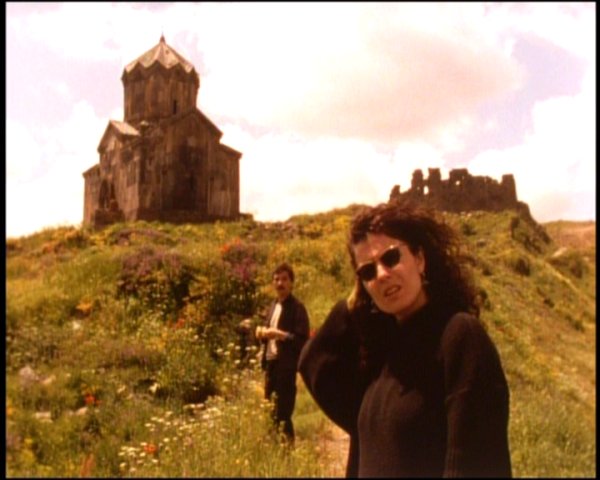
**** CALENDAR

(Masterpiece)

Directed and written by Atom Egoyan

With Arsinee Khanjian, Ashot Adamian, and Atom Egoyan.
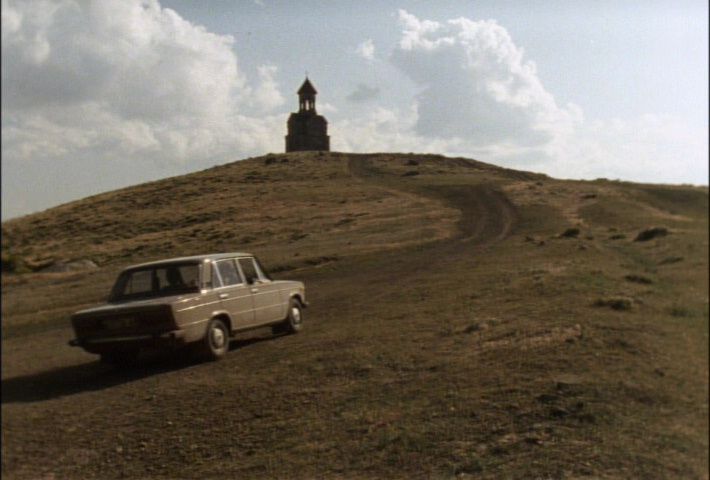
In terms of craft, originality, and intelligence, there are few young filmmakers in the world today to match Atom Egoyan — a Canadian writer-director with a bee in his bonnet about video, photography, voyeurism, sexual obsession, troubled families, and personal identity (not necessarily in that order). But of his half-dozen features to date, the only one I’m comfortable calling a flat-out masterpiece is his fifth, Calendar — in some ways the least premeditated or worked over of the bunch. (Its successor, Exotica, which showed at Cannes in May 1993, will probably surface in New York later this year, which means it probably won’t get to Chicago before next summer.)

There are various ways of categorizing Egoyan’s six features, but perhaps the most useful involves distinguishing between the relatively low-budget ones, which happen to be my favorites — Next of Kin (1984), Family Viewing (1987), and Calendar (1993) — and the slicker, more expensive ones: Speaking Parts (1989), The Adjuster (1991), and Exotica (1994). Though all these movies have similar preoccupations and many have similar formal structures, a few distinctions between them are worth noting. Read more
Pasolini’s Second Coming [on MAMMA ROMA]

From the Chicago Reader (May 19, 1995). — J.R.

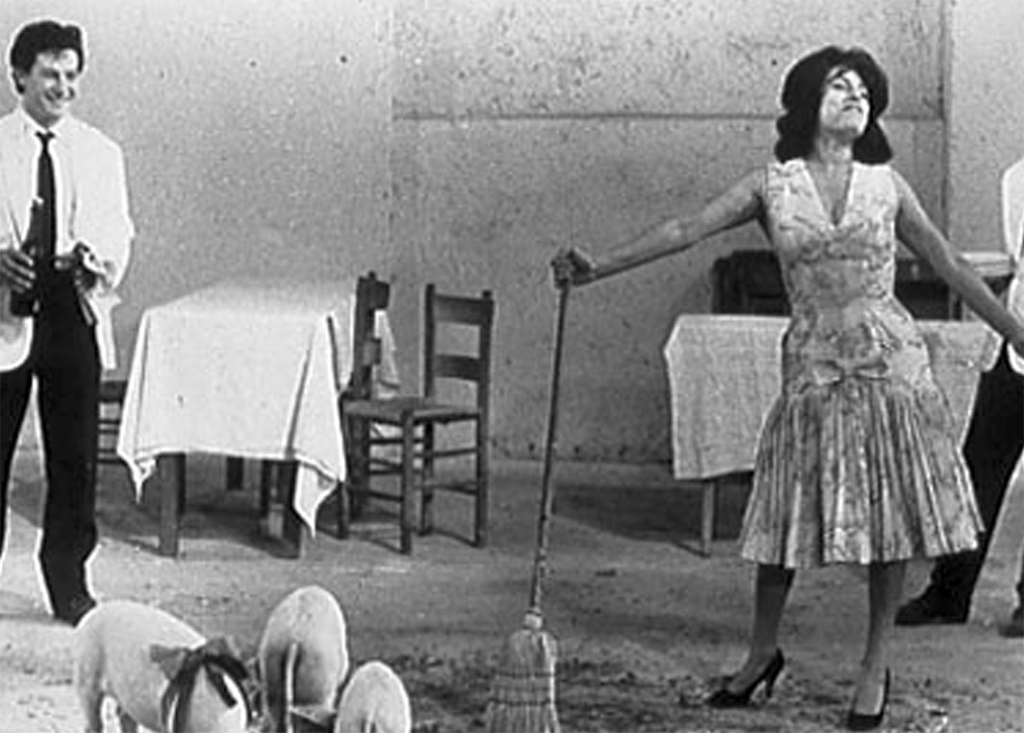
Mamma Roma

Rating *** A must see

Directed and written by Pier Paolo Pasolini

With Anna Magnani, Ettore Garofolo, Franco Citti, Silvana Corsini, Luisa Orioli, Paolo Volponi, Luciano Gonini, Vittorio La Paglia, and Piero Morgia.

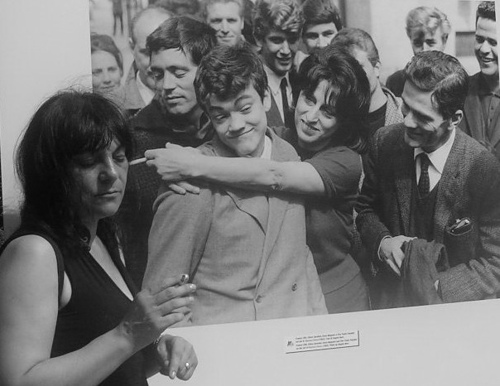
Who can predict the changes in intellectual fashion over 20 years? In 1975, when the controversial Italian writer and filmmaker Pier Paolo Pasolini was brutally murdered by a 17-year-old boy in a Roman suburb, he was no more in vogue than he had been throughout his stormy career. If any openly gay writer-director was an international star in the mid-70s, it was Rainer Werner Fassbinder, who at that point was spinning out as many as three or four features a year; he died in 1982 after an orgy of cocaine abuse.

Pasolini and Fassbinder were both maverick leftists who often alienated other leftists as well as everyone on the right, and both had a taste for rough trade, but in terms of their generations (Pasolini was born in 1922, Fassbinder in 1946) and cultural reference points they were radically different. The only reason to compare them now is to note how much their reputations and visibility have changed here over the last two decades. Read more

The Constant Compromise (GOOD NIGHT, AND GOOD LUCK & CAPOTE)

From the October 21, 2005 Chicago Reader. — J.R.

Good Night, and Good Luck

** (Worth seeing)

Directed by George Clooney

Written by Clooney and Grant Heslov

With David Straithairn, Clooney, Robert Downey Jr., Patricia Clarkson, Frank Langella, Ray Wise, Heslov, Jeff Daniels, and Dianne Reeves

Capote

*** (A must see)

Directed by Bennett Miller

Written by Dan Futterman

With Philip Seymour Hoffman, Catherine Keener, Clifton Collins Jr., Chris Cooper, Bruce Greenwood, Bob Balaban, Mark Pellegrino, and Amy Ryan

Good Night, and Good Luck and Capote view journalism as an intricate mix of principles, bravado, and negotiation. Working in a minefield, their star journalists are victims of their vocations. Good Night, and Good Luck, set in the early 50s, celebrates Edward R. Murrow’s bravery, eloquence, and sense of justice in challenging Joseph McCarthy at the height of his power — a kind of heroism that evokes John Wayne’s in a western like Rio Bravo (a movie I cherish, though its view of good and evil is similarly unshaded). Good Night, and Good Luck — named for Murrow’s sign-off line — also explores how internal politics at CBS were shaped by the network’s relations with its sponsors. The victimization of Murrow can be seen in his early death from lung cancer — his chain smoking, like James Agee’s and Albert Camus’, was somehow connected in the public mind with his moral seriousness — and in the way his weekly show, See It Now, was bumped to a Sunday-afternoon slot after he challenged McCarthy. Read more

The Comedy of Narcissus

Written for Cinema Narcissus, a collection put together for the Rotterdam International Film Festival in early 1992….One of the regular visitors to this site, Barry Scott Moore, has reminded me that in 2013, Ehsan Khoshbakht pointed out to me that Lewis’s first use of the video assist was actually in The Bellboy, his first feature. (He also drew my attention to several typos, now corrected below.) — J.R

The total film-maker is a man who gives of himself through emulsion, which in turn acts as a mirror. What he gives he gets back. — Jerry Lewis

The image “http://jr2.studioskiing.com.au/wp-content/uploads/1992/01/ladies-man-1-786182.jpg” cannot be displayed, because it contains errors.

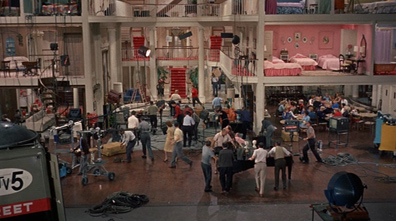
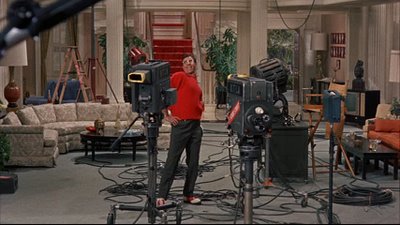
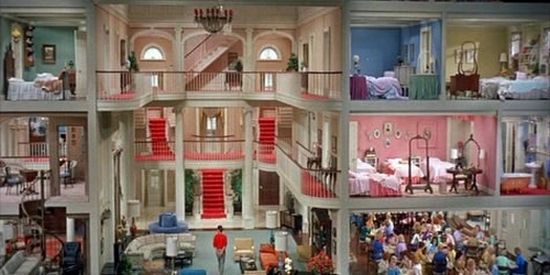
It was Jerry Lewis who first had the idea of installing a video monitor on a soundstage while shooting a picture. The feature in question was THE LADIES MAN (1961), most of which was shot on a single set, a four-storey, open-faced building that stretched across two soundstages on the Paramount lot. The reason for this video monitor? To allow Lewis to see what a particular camera setup looked like at the same time that he was acting in the shot.

Directing and acting at the same time in comedies is a practice that can be traced back at least as far as the beginning of the 20th century. Read more

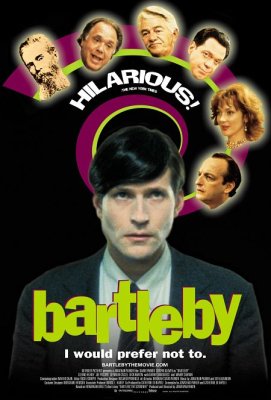
The Heart of an Enigma [BARTLEBY]

From the May 24, 2002 Chicago Reader. — J.R.

Bartleby

** (Woth seeing)

Directed by Jonathan Parker

Written by Parker and Catherine di Napoli

With David Paymer, Crispin Glover, Glenne Headly, Joe Piscopo, Maury Chaykin, and Seymour Cassel.

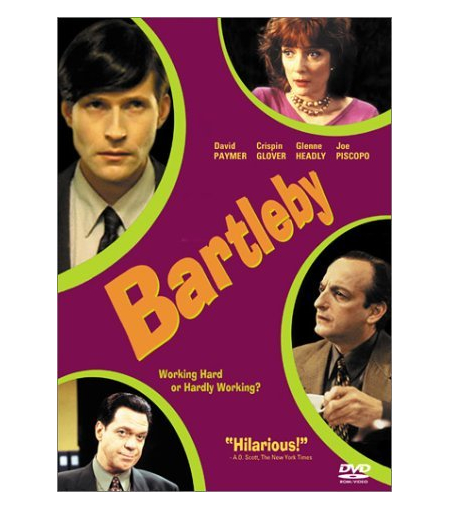
Jonathan Parker’s first feature adapts Herman Melville’s eerie 1853 novella “Bartleby” (also known as “Bartleby the Scrivener”) with the kind of fidelity to mood and feeling that’s rare among movie adaptations of literary classics. The action has been updated roughly a century and a half, the setting transferred from Wall Street to a building perched on a hilltop over a freeway in an unnamed American location. Characters have been added, significant plot details altered, and a strategic part of the exposition shifted from the end of the tale to near the beginning. Yet the story still has much of the same maddening mystery, conviction, and unsettling comedy that Melville gave it.

The added epilogue is harder to justify and much less successful, and the filmmaking throughout, starting with the early use of slow motion, is needlessly fussy and self-conscious. But these are forgivable flaws in a first feature, one that updates Melville’s story and conception without betraying it.

The nameless narrator of the original is a lawyer on the verge of retirement looking back on the events he describes from a distance of many years. Read more

Spoiler Alert [ROADS OF KIAROSTAMI]

From the June 9, 2006 Chicago Reader. I can happily report that Roads of Kiarostami has appeared as an extra on the DVD of Kiarostami’s Shirin released by Cinema Guild. — J.R.

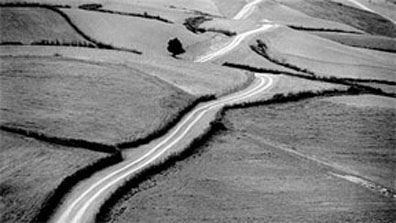
Roads of Kiarostami

*** (A must see)

Directed and written by Abbas Kiarostami

The definition of what qualifies as commercial movie fare seems to have shrunk to works that appeal to teens and preteens. Meanwhile the definition of experimental film — which traditionally has meant abstract, nonnarrative, and small-format works produced in a garret — has been expanding to address wider audiences. An ambitious DVD box set released last year, “Unseen Cinema: Early American Avant-Garde Film 1894-1941,” includes lavish Busby Berkeley production numbers and juvenilia by Orson Welles. And last year’s Onion City Experimental Film and Video Festival opened with a dazzling 35-millimeter short by Michelangelo Antonioni, Michelangelo Eye to Eye.

This year Onion City’s opening-night program reflects this tendency even more: it includes a video by cult horror director Kiyoshi Kurosawa, Peter Tscherkassky’s radical reworking of footage from The Good, the Bad, and the Ugly in 35-millimeter and ‘Scope, Andy Warhol’s two 1966 “screen tests” with Bob Dylan, and best of all Abbas Kiarostami’s half-hour Roads of Kiarostami. Read more

Life and Nothing More: Abbas Kiarostami’s African Musical

From Film Comment, September-October 2001. — J.R.

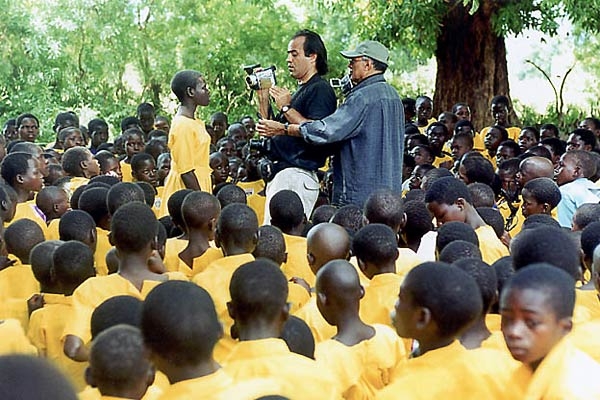
Though I haven’t yet seen a 35mm transfer of A.B.C. Africa, Abbas Kiarostami’s first digital video, I’ve had the benefit of viewing his 92-minute rough cut and his 84-minute final version. It’s obvious that this documentary is a departure for him in many ways, being his first feature made outside Iran and his first work that’s primarily in English. It’s also possibly his most accessible picture to date, confirming that Kiarostami has become as “multinational” or as transnational as he is Iranian — which may help to account for his worldwide reputation.

Shot with two cameras by Kiarostami and his assistant Seifollah Samadian, who also helped with the editing, A.B.C. Africa was made at the request of the UWESO (Uganda Women’s Efforts to Save Orphans) program, part of the International Fund for Agricultural Development. A letter of thanks from the IFAD’S Takao Shibata, dated March 23, 2000, arrives in Kiarostami’s fax machine in the opening shot, explaining how civil unrest and AIDS have left Uganda with about 1.6 million children who’ve lost one or both of their parents — and how a film by him might “sensitize people around the world [to] the devastating dimensions of this tragedy.” Read more

Before He Was Famous (Kiarostami’s Early Shorts)

From The Guardian (21 September 2002). I continue to find it frustrating that almost sixteen years later, what I regard as Kiarostami’s two best shorts, Two Solutions for One Problem (1975) and Orderly or Disorderly (1981), still aren’t available on any DVD or Blu-Ray (although Scott Perna has just emailed to remind me that the former can at least be accessed on YouTube). The principal reason was that Kiarostami himself didn’t like them. He once told me that even the second of these was made before he regarded himself as a film artist — something I continue to find baffling, and astonishing. But now that Criterion has announced that it will be restoring and releasing all his films, this lack of availability will apparently change. — J.R.

The eight short films made by Abbas Kiarostami between 1970 and 1982 offer an interesting riposte to critics who claimed during those years that they knew what was going on in world cinema. Even in Iran, where the shorts were made, none constituted much of an event. And considering how deceptively modest they are, they probably never would have attracted much notice anywhere if their director hadn’t gone on to make a string of masterful features over the past 15 years (the most recent of which, Ten, is about to open here). Read more

Female Trouble [MONKEY SHINES: AN EXPERIMENT IN FEAR]

From the July 29, 1988 Chicago Reader. — J.R.

MONKEY SHINES: AN EXPERIMENT IN FEAR

*** (A must-see)

Directed and written by George A. Romero

With Jason Beghe, John Pankow, Kate McNeil, Joyce Van Patten, Christine Forrest, Stephen Root, Stanley Tucci, and Janine Turner.

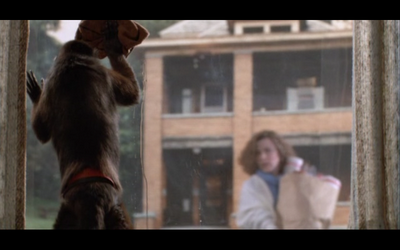
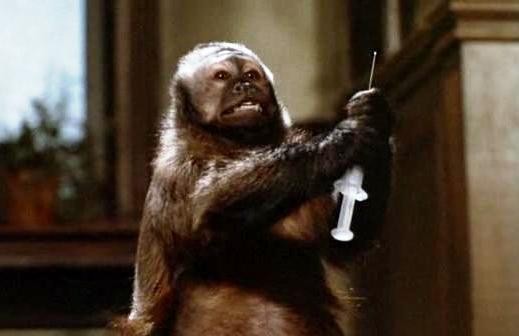
You’ve got to get through a few layers of foam rubber before you reach what’s good (or better than good) about George Romero’s new feature. There’s a series of obstacles — cultural, corporate, ideological, stylistic, aesthetic, commercial — standing in the way of what the movie is doing at its best; they may not count for much in the long run, but it’s better to be forewarned and forearmed.

First there’s the problem of the title. I appreciate that the producers did not want to suggest that the movie is a comedy — as sticking to the title of Michael Stewart’s source novel, Monkey Shines, would have done. So a subtitle is understandable as a means of labeling the contents. But An Experiment in Fear? Whose experiment and whose fear? The phrase describes nothing in the film (except for a brief undeveloped scene with a rodent and a beady-eyed behaviorist) and nothing you can say about the film (except as an easy platitude). Read more

Dark Heart [BAND OF OUTSIDERS]

From the December 7, 2001 Chicago Reader. — J.R.

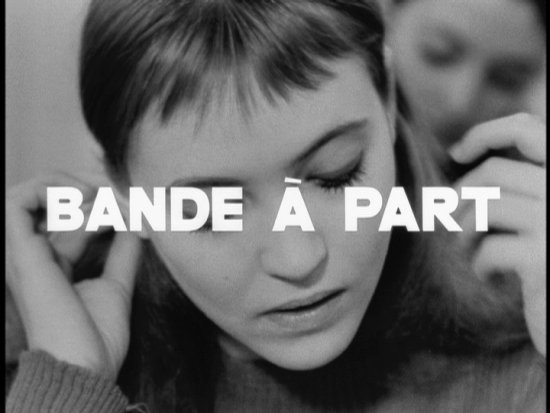
Band of Outsiders

Rating **** Masterpiece

Directed and written by Jean-Luc Godard

With Anna Karina, Claude Brasseur, Sami Frey, Daniele Girard, Louisa Colpeyn, and Ernest Menzer.

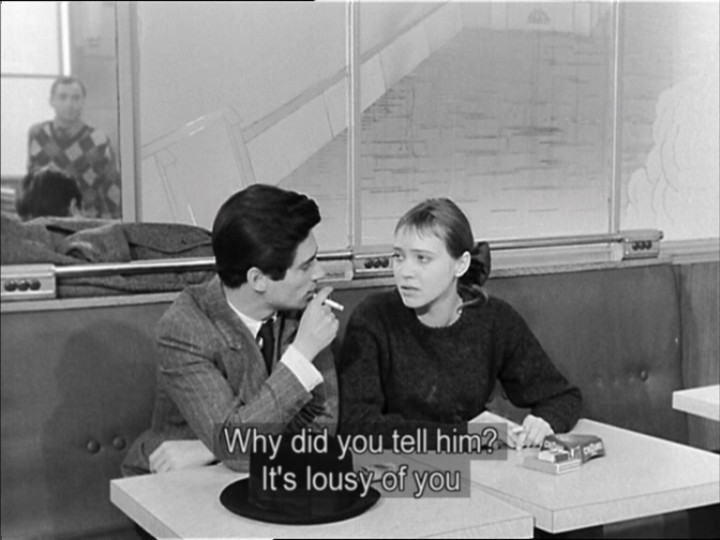
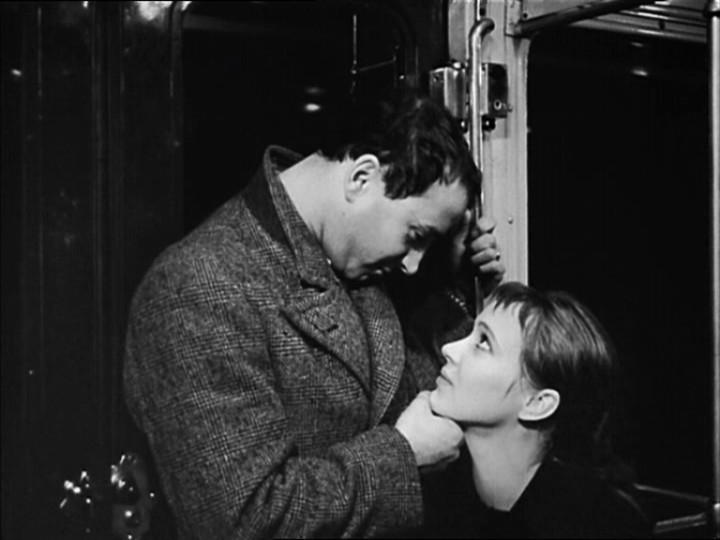
To gauge the historical significance of Jean-Luc Godard’s Band of Outsiders (1964) — getting a week’s run in a lovely new print at the Music Box  — it helps to know that it was made four years after François Truffaut’s Shoot the Piano Player and three years before Arthur Penn’s Bonnie and Clyde. Both Band of Outsiders and Shoot the Piano Player are low-budget black-and-white French thrillers adapted from American crime novels translated into French for the celebrated Serie Noire collection, and they were abject box-office flops on both sides of the Atlantic — though today they embody the glories of the French New Wave in a good many people’s minds. By contrast, Bonnie and Clyde, a Hollywood movie in color that was profoundly influenced by these two films, was a huge success, and its lyrical depictions of violence changed the direction of American cinema.

All three films are mixtures of tragedy and farce, violence and romance, with an uncertain emotional tone. When Band of Outsiders and Shoot the Piano Player were first released, audiences didn’t know what to make of this mix, but when they saw Bonnie and Clyde they were exhilarated by its ambiguities. Read more

Entries in 1001 MOVIES YOU MUST SEE BEFORE YOU DIE (the fifth dozen entries)

These are expanded Chicago Reader capsules written for a 2003 collection edited by Steven Jay Schneider. I contributed 72 of these in all; here are the fifth dozen, in alphabetical order. — J.R.

The Red and the White
This 1967 feature was one of the first by Hungarian filmmaker Miklós Jancsó to have some impact in the U.S., and the stylistic virtuosity, ritualistic power, and sheer beauty of his work are already fully apparent. In this black-and-white pageant, set during the aftermath of the Russian Revolution, the reds are the revolutionaries and the whites are the government forces ordered to crush them. Working in elaborately choreographed long takes with often spectacular vistas, Jancso invites us to study the mechanisms of power almost abstractly (as suggested by the Stendhalian ring of his title), with a cold eroticism that may glancingly suggest some of the subsequent work of Stanley Kubrick. But this shouldn’t mislead one into concluding that Jancsó is any way detached from either politics or emotions.

For one thing, the markedly nationalistic elements in The Red and the White could be —- and were —-interpreted as anti-Russian, especially if one considers that the film was made less than a decade after the Soviet repression of the Hungarian revolution, which left over 7,000 Hungarians dead. Read more

Interplanetary Postmodernism [EARTH GIRLS ARE EASY]

From the Chicago Reader (May 12, 1989). — J.R.


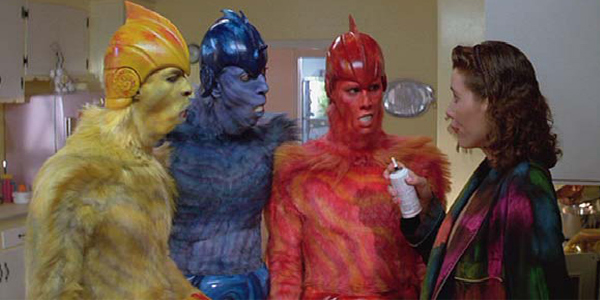
EARTH GIRLS ARE EASY

*** (A must-see)

Directed by Julien Temple

Written by Julie Brown, Charlie Coffey, and Terrence E. McNally

With Geena Davis, Jeff Goldblum, Jim Carrey, Damon Wayans, Julie Brown, Michael McKean, and Charles Rocket.

One would like to think that this delicious new pop musical will finally give the talented English director Julien Temple the reputation and the commercial cachet that he deserves. Mainly known as a director of music videos for such groups as the Rolling Stones, Iggy Pop, Boy George, Billy Idol, and Janet Jackson, Temple has also pursued a fascinating fringe career in movies throughout the 80s, starting with his celebrated film with the Sex Pistols in 1980 (The Great Rock and Roll Swindle), and culminating with his brilliant Absolute Beginners in 1985. Along the way there have also been The Secret Policeman’s Other Ball, Mantrap, Running Out of Luck, It’s All True (a 1983 TV feature), and his virtuoso Rigoletto sequence in Aria, filmed in the kitschy splendor of California’s Madonna Inn.

On the basis of what I’ve seen, Temple is pretty much at the mercy of his material — although it’s worth noting that he appears to always or almost always work with the same gifted cinematographer, Oliver Stapleton. Read more

Carpenter’s Gothic [IN THE MOUTH OF MADNESS]

From the February 3, 1995 Chicago Reader. –J.R.

In the Mouth of Madness

Rating *** A must see

Directed by John Carpenter

Written by Michael De Luca

With Sam Neill, Julie Carmen, Jurgen Prochnow, David Warner, John Glover, Bernie Casey, Peter Jason, and Charlton Heston.

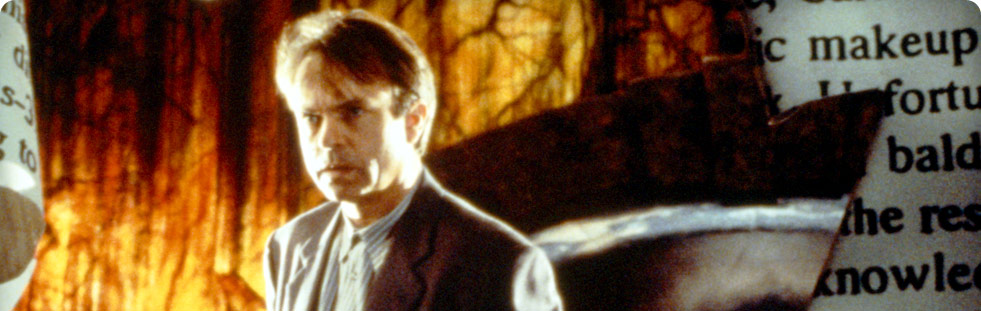
In the Mouth of Madness isn’t John Carpenter’s best horror movie to date, but it may well be his scariest. What makes it nightmarish isn’t so much its premise — a man set loose inside the mind and writings of a crazed hack novelist — as the many elliptical details that the premise occasions: things that go bump in the head, fleeting suggestions of horrors that brush the edge of our attention and perceptions, like the peripheral events in bad dreams.

In this respect, Carpenter seems to have entered David Lynch territory — an unlikely development, but then Carpenter’s career has been full of unlikely developments. In early features like Dark Star (playing this Tuesday at the University of Chicago) and Assault on Precinct 13, he was a playful auteurist making the rounds of popular genres, nodding to masters like Hawks and Hitchcock along the way. After establishing himself as a suspense and horror specialist in Halloween, his first hit, he took an abrupt right turn into gritty (and implicitly libertarian) action kicks in Escape From New York, then virtually drowned in special effects in his remake of The Thing. Read more
Entries in 1001 MOVIES YOU MUST SEE BEFORE YOU DIE (the fourth dozen)

These are expanded Chicago Reader capsules written for a 2003 collection edited by Steven Jay Schneider. I contributed 72 of these in all; here are the fourth dozen, in alphabetical order. — J.R.

Taste of Cherry
A middle-aged man who’s contemplating suicide drives around the hilly, dusty outskirts of Tehran trying to find someone who will bury him if he succeeds and retrieve him if he fails. This minimalist yet powerful and life-enhancing feature by Abbas Kiarostami (Where Is the Friend’s House?, Life and Nothing More, Through the Olive Trees) never explains why the man wants to end his life, and is even inconclusive about whether or not he succeeds, yet every moment in his daylong odyssey carries a great deal of poignancy and philosophical weight. The film has remained in many ways Kiarostami’s most controversial film ever since it shared the 1997 paume d’or at Cannes with Shohei Imamura’s The Eel, in part because it entrusts so much of its meaning and power to the audience and the nature of its own investment in what it’s watching. Like many of Kiarostami’s other films, it’s centered around the simultaneously private and public experience of a character in a car giving rides to others, and just as the experience of watching a film in a theater combines private responses with public reactions, this is a film that speaks to both of these situations. Read more
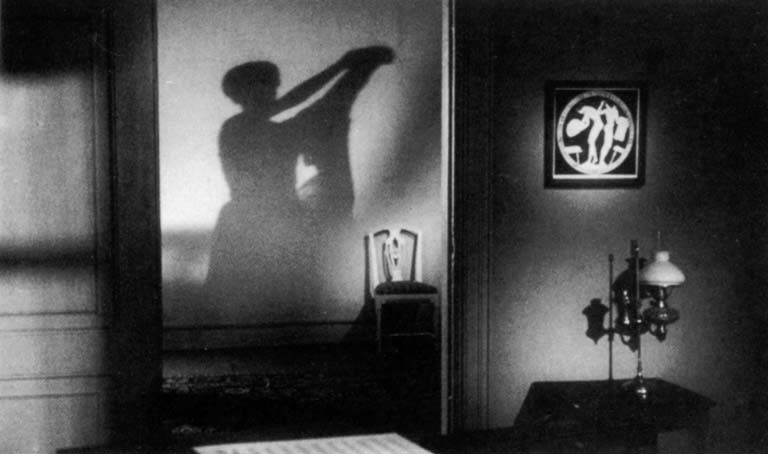
Watch with Mother [on Carl Dreyer]

From The Guardian (May 30, 2003). –J.R.

For roughly two decades, my three favourite dramatic features have all been the work of the same man — and my favourite among these depends almost entirely on which one I’ve seen most recently. I came to know and love them in reverse order: first the incandescent and subtly erotic Gertrud (1964), discovered in my early 20s shortly after it premiered; then the gut-wrenching Ordet (1955), which I initially hated when I first saw it in my teens, misconstruing its climactic miracle as a tool of religious propaganda; and finally the voluptuous and mysterious Day of Wrath (1943), which I didn’t appreciate or understand until my 40s, when I finally saw it in a decent 35mm print.

Like all the greatest artists, Carl Theodor Dreyer demands to be taken as a figure whose work continues to grow and change, quite irrespective of the fact that he died in 1968 at the age of 79, with many of his most cherished projects (most notably, a film about Jesus) unrealised. Fresh insights about his life and career keep coming to light: not only through biographical research; the emergence of new prints (such as the remarkable 1981 rediscovery of the original 1927 version of The Passion of Joan of Arc in an Oslo mental hospital); but also through the uncanny fact that his films seem to grow more multilayered, ambiguous, and complex over time. Read more