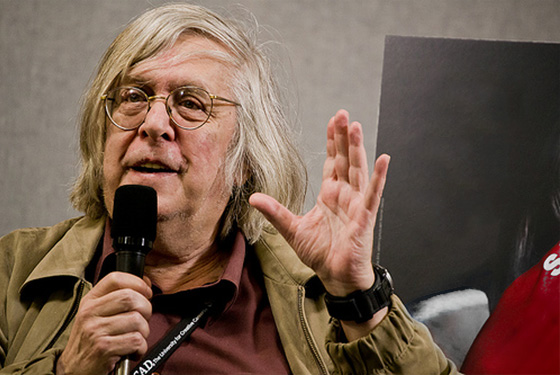
Zinn, the straight-talking Jewish leftist from working-class Brooklyn who wrote A People’s History of the United States, participated in the first use of napalm while helping to bomb a French village near the end of World War II, an experience that partly motivated his protests against the Vietnam war, and in the mid-50s he became an inspirational figure in the civil rights movement while chairing the history department at a black college in Atlanta. This video profile by Deb Ellis and Denis Mueller allows his significance to register and his charisma to shine despite a pedestrian approach that’s especially awkward in its use of archival footage. 68 min. (JR) Read more
The Party’s Over
I missed The Last Party, a 1993 documentary by Donovan Leitch and others that charts the progress of Robert Downey Jr. from apathy to active interest as he interviews other celebrities about the 1992 presidential election. This sequel by Leitch and Rebecca Chaiklin sets out to do something similar with Philip Seymour Hoffman and the 2000 election: seeking to become politically engaged, Hoffman travels across the U.S. collecting sound bites from Noam Chomsky, Newt Gingrich, Jesse Jackson, Bill Maher, Michael Moore, Willie Nelson, Rosie O’Donnell, Susan Sarandon, and many lesser-known activists; he also stands thoughtfully in front of the Jefferson Memorial for 15 seconds, accompanied by a snippet of a gospel tune. I realize this insulting film is supposed to coax young people into serious political involvement, but if they aren’t already involved, why would they want to see this in the first place? All the participants, including the audience, deserve much betterfor starters, time enough to connect three sentences. 90 min. (JR) Read more
Dopamine
This romantic comedy-drama by Mark Decena promises more than it delivers. A computer programmer (John Livingston) who’s helping to develop an artificially intelligent life form falls for a kindergarten teacher (Sabrina Lloyd). Decena intermittently suggests that relationships are programmed, but there isn’t enough to connect the increasingly conventional love story with the scientific speculation. 79 min. (JR) Read more
The School Of Rock
Broadly speaking, this is Richard Linklater’s French Cancanthat is to say, a humanist’s joyful exploration of the musical in which the actors’ personalities resonate as much as the characters they play. Or maybe it’s what Jean Renoir might have come up with if he’d remade Don’t Knock the Rock and cast fifth-graders as the musicians. Though this seems like a personal film, Linklater was hired to direct a cannily commercial script by Mike White, about a rock ‘n’ roll loser (Jack Black) who, fired from his job and his band, impersonates his wimpy substitute-teacher roommate (White) to land a teaching position at an upscale elementary school. This infantile character hasn’t got a thought in his head except for rock music, but somehow he becomes a model teacher, and through stealth and sheer perseverance he turns his class into an inspired gang of rockers. The kids, all real musicians performing, are wonderful, and so is Black; Joan Cusack is both charming and funny as the principal. PG-13, 108 min. (JR) Read more
The Homecoming
For the most part, this is a faithful transposition of Peter Hall’s London stage version of one of Harold Pinter’s best plays, done for the American Film Theatre series in 1973. Two of the cast members are different, but far more consequential are the formal losses from stage to screen: the theater curtain that signaled the play’s division into two acts and the spectator’s fixed distance from the action, which occurs in a hyperrealistically oversize living room. Both acts end with Max (Paul Rogers), a retired butcher and the presiding patriarch of a North London family, demanding a kiss from someone, and after the first act masterfully seduces an audience into accepting the characters’ behavior on a quasi-naturalistic level, the second elucidates the moral implications of that acceptance in a devastating manner. As in middle-period Ibsen, Pinter discloses facts about his characters at precise junctures so that events and identities click into place simultaneously. With Cyril Cusack, Ian Holm, Michael Jayston, Vivien Merchant, and Terence Rigby. 111 min. (JR) Read more
The Light That Failed
Brisk and polished in the best 30s Paramount manner, this mounting of Rudyard Kipling’s first novel is limited mainly by its Classics Illustrated impulse to synopsize the story even as it preserves extended chunks of literary dialogue. As an English painter and former colonial soldier in the Sudan who’s losing his eyesight, Ronald Colman is so stiffly decorous that he sometimes seems to have been painted onto William Wellman’s artfully composed frames. Ida Lupino, as Colman’s brash cockney model, and Walter Huston, as his faithful friend, are particular standouts; Robert Carson scripted this 1939 feature. 97 min. (JR) Read more
Galileo
Joseph Losey’s 1974 film of the great Bertolt Brecht play (which Losey directed onstage with Charles Laughton in 1947) isn’t everything it might have been, if only because Topol, who plays the title role, is clearly no Laughton. But this is still the best film version of a Brecht play that I’m aware of, and the secondary castEdward Fox, Michael Lonsdale, John Gielgud, Patrick Magee, Margaret Leighton, John McEnery, and Tom Contiis fine. 145 min. (JR) Read more
The Sea Is Watching
Scripted by Akira Kurosawa four years before his death in 1998, this Edo-period tale (2002) about prostitutes, adapted from Shugoro Yamamoto’s novel The Smell of an Unknown Flower Before the Dew Dries, seems more characteristic of Kenji Mizoguchi. Director Kei Kumai, best known for his socially conscious films, was recommended for this assignment by Kurosawa himself, who admired Kumai’s handling of women characters. Following the master’s own sketches for sets and costumes, Kumai makes this a real eye pleaser, impressive in its use of color and its treatment of weather (including a climactic flood). The banal score seems more appropriate for a western, and there’s a certain self-conscious theatricality in the mise en scene, yet this is both handsome and affecting. In Japanese with subtitles. 119 min. (JR) Read more
The Girl From Chicago And Broken Strings
Two race movies made for segregated black audiences. The 69-minute The Girl From Chicago (1932) was written and directed by independent black pioneer Oscar Micheaux, who’d been an able filmmaker in the silent era but became mannerist and slapdash once he turned to talkies, consistently selecting terrible camera angles, extracting stridently false performances from his players, and apparently making up his scripts as he went along (on occasion he can be heard offscreen feeding lines to the actors). The muddled plotabout a Secret Service agent (Carl Mahon) courting a small-town schoolteacher while fighting the numbers racketis made all the more indigestible by a lousy 16-millimeter print. However hokey, Bernard Ray’s Broken Strings (1940, 60 min.), showing in an excellent 35-millimeter print, is comparatively touching and professional. Clarence Muse (frequently a servant in Hollywood pictures) stars as a classical violinist whose hand is paralyzed in an accident. His adolescent son (Walter Washington) saves the day by becoming a star swing violinist. (JR) Read more
Anything Else
The saddest thing about Woody Allen’s effort to retool his brand of romantic comedy for the youth market isn’t the absence of laughsit’s the bitterness that cuts through everything, which is hardly sweetened by all the Billie Holiday numbers on the sound track. Jason Biggs is a young writer who falls in love with freewheeling actor-singer Christina Ricci (shades of Annie Hall) and who’s saddled with loser agent Danny DeVito (shades of Broadway Danny Rose). Allen plays Biggs’s sour mentor, who goes walking with him in Central Park (allowing us to get two versions of Woody at once), and Stockard Channing does a turn as Ricci’s mother, who also wants to be a singer. The film’s hatred of Ricci and Channing and its affectionate tolerance of the hero’s mousy hypocrisy and his mentor’s negativity are familiar Allen motifs, but the faint echoes of his best work only make this one seem grimmer. 108 min. (JR) Read more
Underworld
In a gothic city (i.e., Tim Burton’s Gotham City) where vampires and werewolvesmostly Brits and a few Americanshave been at war for centuries and everyone falls to the ground in slow motion, Kate Beckinsale, an action vampire, strenuously underacts while everyone else, vampires and werewolves alike, strenuously overacts. She’s also the only one permitted to make a fashion statementone that mainly says The Matrix rules, though her black rubber suit suggests Batman again. I spent most of the movie’s endless 121 minutes trying to figure out where and how she could buy such a cute outfit in a city where it’s always night, there are no stores or restaurants, and the subway is used chiefly for shoot-outs. This is the silliest horror movie I’ve seen in years, though some of the special effects are pretty good. Len Wiseman directed Danny McBride’s ponderous, humorless script, and Scott Speedman costars. (JR) Read more
Things To Do In Denver When You’re Dead
Alas, most of the surprise and the wit to be found here ends with the title. Produced and distributed by Miramax, it’s another quirky thriller like The Usual Suspects (albeit slightly better) that got green lighted because of Tarantino’s successan exercise without much point or originality except stylishness (not to be confused with style). A retired criminal (Andy Garcia) is recruited by his former boss (Christopher Walken) to frighten the new boyfriend of his son’s ex-girlfriend, a plan that goes awry when a borderline nut case (Treat Williams) in Garcia’s team of hoods gets carried away. Directed by first-timer Gary Fleder from a screenplay by Scott Rosenberg; the remainder of the predictable if serviceable cast includes Christopher Lloyd, William Forsythe, Bill Nunn, Jack Warden, Gabrielle Anwar, Fairuza Balk, and, yep, Steve Buscemi. (JR) Read more
Once Upon A Time In Mexico
Following a suggestion from Quentin Tarantino, Robert Rodriguez turned this third El mariachi installment into an homage to Sergio Leone. The result is a dull and campy 97-minute bloodbath offering little distinction between good guys and bad, on the basis either of character (Willem Dafoe’s cartel boss, Johnny Depp’s CIA agent) or of screen persona (Cheech Marin, Mickey Rourke, Ruben Blades). The only exception is the guitar-slinging hero (Antonio Banderas), more icon than character as he avenges the murder of his wife (Salma Hayek). Rodriguez shot this in seven weeks with a newly developed DV camera, which might be impressive if the results meant anything. But the editing is strictly MTV and the storytelling so confusing that I kept longing for the focused austerity of his 1993 El mariachi debut. (JR) Read more
Matchstick Men
From the Chicago Reader (September 12, 2003). — J.R.
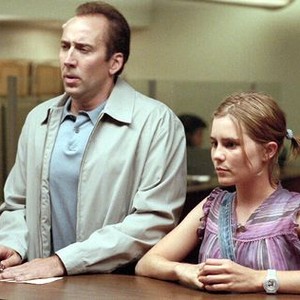
Nicolas Cage, director Ridley Scott, and writers Nicholas and Ted Griffin (adapting an Eric Garcia novel) do an interesting job of capturing the fractured and tortured consciousness of a small-time Los Angeles con artist riddled with compulsive disorders whose life achieves some focus when he encounters a teenage daughter (Alison Lohman) he never knew he had. (He also has a partner and a shrink, played respectively by Sam Rockwell and Bruce Altman.) The portraiture is so carefully done that I regret in some ways the tricky plot — which is also carefully done, but seems at times to belong to a different movie. Robert Zemeckis served as executive producer. 120 min. (JR)
Cinemania
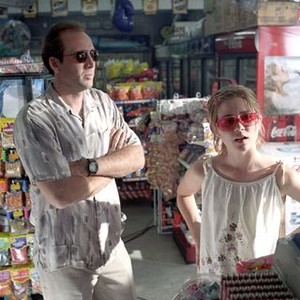
This 2001 American-German documentary by Angela Christlieb and Stephen Kijak isn’t very popular among normal cinephiles (if such a term isn’t already an oxymoron) because it exhibits five of the most extreme and dysfunctional cinemaniacs in Manhattan, figures already somewhat legendary among patrons of the Walter Reade Theater, the Museum of Modern Art, Film Forum, and similar venues. Roberta Hill, a pack rat who saves ticket stubs and flyers, was banned from one of her haunts after assaulting an usher who tore her ticket in half, while Harvey Schwartz, who lives with his mother in the Bronx, memorizes the precise running times of everything he sees. The filmmakers aren’t exactly cruel, but they focus on compulsion rather than passion, which by implication tends to tarnish the more intellectual and scholarly members of the breed. 80 min. (JR) Read more