Woodchuck Dreams: Field Notes From the Frozen North

Here’s a recent essay by one of my oldest friends, illustrated by her husband, Bob Fisher. The essay originally appeared in Blueline 43. It may not be reprinted in whole or in part without permission of the author. — J.R.

Bibi Wein

The first snow bedazzles. Overnight, it has transformed our brooding boreal woods into an enchanted forest. I rush around and look at everything: the familiar contours of the land reshaped and luminous, the frost a billion stars twinkling on the hemlock needles in the sunlight. In this incandescent world middle age falls away for a moment, and I am once again the girl of so many decades past, my energies ignited by a spark of freedom and discovery that city girl never knew.

                                             *

Three days later, I ponder the beauty of blizzards. I must admit I love a storm, though it can make me anxious if I’m alone. In winter, that’s rare these days in the log cabin I share with my husband Bob. The isolation of two is very different from the isolation of one.  With the protection of shelter and companionship, a storm turns me back into a child. Snowed in, all work is off, especially if the power fails. Read more

Basic Instinct

basicinstinct-bondage

BasicInstinct-sexscene

Reviewing Paul Verhoeven’s 1979 Dutch feature The 4th Man, Dave Kehr objected to conceptions of women as castrating harpies and of gays as predatory beasts that are insulting to all the sexualities involved. Working from a script by Joe Eszterhas, Verhoeven did an even better job of hammering home those notions 13 years later with Basic Instinct. I hated this movie when it was released, but on reflection I think that his appreciation of Sharon Stone as dominatrix/superwoman had a lot to do with what made her a star. Verhoeven also treats Michael Douglas, playing a gullible cop, with the kind of comic-book flourishes that might easily pass for derisiveness and sometimes come across as just plain hilarious. Despite (or maybe because of) his obligatory nods to Hitchcock, this is slick and entertaining enough to work as thriller porn, even with two contradictory denouements to its mystery (take your pick—or rather, ice pick). George Dzundza and Dorothy Malone are among the other actors along for the ride. R, 127 min. (JR)

BasicInstinctTripple

BasicInstinctDouglas Read more

Reveries and Elegies

From the Chicago Reader (April 12, 2002). — J.R.

elegy-of-a-voyage2

Like Yasujiro Ozu’s features with seasonal titles, Alexander Sokurov’s hallucinatory video elegies tend to be so similar, even in their running times, that they blur together in memory. Elegy of a Voyage (2001, 47 min.) — which might be more idiomatically titled Elegy for a Voyage — is a journey, a dream, a first-person narrative (visibly as well as audibly) that evokes the 19th century, and a hypnotic study in textures relating to fog, snow, and water that often entails a breakdown in the usual divisions between color and black and white (as well as fiction and documentary). It was commissioned by the Boijmans Van Beuningen Museum in Rotterdam, which asked Sokurov to look at a work of art in their collection “like a night watchman in a deserted museum.” By the time Sokurov creeps into the museum to reflect on Brueghel’s The Tower of Babel and seven other paintings, he seems to have trekked across substantial portions of his native Russia as well as the Helsinki harbor. I was less captivated by Laura Waddington’s minimalist video diary Cargo (2001, 29 min.), which uses many still and slow-motion shots and similarly fragmented narration to illustrate a trip she took from Venice to the Middle East on a freighter whose exploited crew was an international assortment of men without landing papers. Read more

Star Wars, Episode 5: Attack Of The Clones

From the Chicago Reader (April 2002). — J.R.

The whiff of amateur theatricals in The Phantom Menace, imparting a personalized clunkiness to the proceedings, is back in force in this aptly titled fifth installment, but this time the exposition is so thick that everyone except acolytes may tune out. Though the look aspires as usual to be both otherworldly and familiar, there’s nothing that doesn’t reek of southern California plastic, including the characters. Whatever showmanship director George Lucas brought to the earlier episodes has been paved over by calculation (Christopher Lee is about the only actor who looks comfortable). But Lucas is enough of a businessman to know that the earlier chapters helped foster the celebratory mood that greeted the previous gulf war (mainly by promoting the glee to be extracted from supposedly bloodless annihilation, delivered chiefly to faceless reptiles in desert settings), and the livelier final stretches here seem designed to help pave the way for more. PG, 138 min. (JR)

Read more

Annie Get Your Gun

From the Chicago Reader (April 1, 2002). — J.R.

annie-get-your-gun

This was my favorite movie the year it came out (1950), when I was seven years old, and I’ve gone back to it repeatedly since — partly because of its swell Irving Berlin score, partly because of Betty Hutton’s gender-bending embodiment of Annie Oakley, and partly because the spirited vulgarity of director George Sidney often makes a perfect match with the tailored opulence and slickness of MGM musicals during that era. It still holds up as splashy fun of a sort, if you can handle its sexual politics and its depictions of Native Americans (including J. Carroll Naish as Annie’s benign father figure). With Keenan Wynn, Howard Keel as Frank Butler, and Louis Calhern as Buffalo Bill. 107 min. (JR)

Annie-Get-Your-Gun-1950-3

j-carroll-naish-us-public-domain-publication-dateno-copyrightartist-lifecommons-wikimeaid-org

AGYG Read more

Over On The Big Ranch

From the Chicago Reader (May 21, 2004). — J.R.

over-on-the-big-ranch

Directed by Fernando de Fuentes, this popular 1936 feature helped launch a new genre in Mexican movies, the comedia ranchera, which mixed comedy and music in rural settings. It tracks the long-term friendship between a ranch owner (Rene Cardona) and the orphan who becomes his foreman (Tito Guizar); both fall for the same woman (Esther Fernandez), a conflict that’s brought to a head by a kind of musical duel. This is more nuanced than one might expect in the handling of gender and class, and the populist fervor that’s become part of the period flavor is infectious. The graceful cinematography is by the great Gabriel Figueroa, best known for later collaborations with John Ford and Luis Buñuel. In Spanish with subtitles. 100 min. Read more

Thx 1138: The George Lucas Director’s Cut

From the Chicago Reader (September 10, 2004). — J.R.

thx1138-1

The surprising thing about George Lucas’s first feature (1971), a dystopian SF parable now digitally enhanced and expanded by five minutes, is how arty it seems compared to his later movies: off-center ‘Scope compositions reminiscent of Antonioni, striking white-on-white costumes and sets, a highly inventive sound track by cowriter Walter Murch. Yet the film is just as claustrophobic as Star Wars, and its ideas are equally shopworn, drawing on Orwell, Huxley, Kubrick, and Godard’s Alphaville. A young Robert Duvall plays the title drone, who escapes from a totalitarian society after he and fellow cipher Maggie McOmie discover sex. Lucas’s use of northern California locations is inventive; costar Donald Pleasence is mainly tiresome. R, 88 min. (JR)

thx1138 Read more

If Looks Could Kill (II)

I am reprinting the entirety of my first and most ambitious book (Moving Places: A Life at the Movies, New York: Harper & Row, 1980) in its second edition (Berkeley: University of California Press, 1995) on this site in eleven installments. This is the seventh.

Note: The book can be purchased on Amazon here, and accessed online in its entirety here. — J.R.

II

Of married ones and single ones
And families and daters
There’s fun for all of you this week
At the Muscle Shoals Theatres!


“Three Stripes in the Sun” is the name of one
That’s playing the Shoals today
It concerns an Army sergeant
Better known as Aldo Ray.


“Blood Alley” refers to the Formosa Straits
A dangerous part of the ocean
Where Communists, storms and Lauren Bacall
Keep John Wayne in perpetual motion.
—from Stanley Rosenbaum’s Sunday column, Florence Times , January 8, 1956


Sometimes it wasn’t the movie at all but the configuration that went with it, or came out of it, or burned straight through it like a dropped cigarette—the static image summoned up by title, poster, billboard, newspaper ad, review, or some other form of promotion. Or maybe it was the false yet enduring and prevailing expectation. As Alvin said to me in Washington three months ago, Movies used to be the Rosenbaums’ Muzak —forever buzzing, blandly and gleefully, in the backs of our minds; and meanwhile adding up figures, busy as bees.

In some cases it might have been just a bit of ballyhoo that the theater manager devised, the real-life ads he staged, such as the giant robot from The Day The Earth Stood Still —or rather, a noble facsimile built by Bobby Stewart, the Shoals manager—patrolling the center of downtown Florence during the last shopping week before Christmas 1951, or the “moonshine still” that Aston (“Elk”) Elkins rigged up at the Colbert to push Thunder Road in 1958—a funny prank to play in a county where bootleggers and churches have joined forces to keep liquor illegal since 1952. Read more

If Looks Could Kill (I)

I am reprinting the entirety of my first and most ambitious book (Moving Places: A Life at the Movies, New York: Harper & Row, 1980) in its second edition (Berkeley: University of California Press, 1995) on this site in eleven installments. This is the sixth.

Note: The book can be purchased on Amazon here, and accessed online in its entirety here. — J.R.

3—


If Looks Could Kill

. . . Can it be that everybody is looking for a way to fit in? If so, doesn’t that imply that nobody fits? Perhaps it is not possible to fit into American Life. American Life is a billboard; individual life in the U.S. includes something nameless that takes place in the weeds behind it.
—Harold Rosenberg


I

Mommy was away at Payne Whitney, a hospital in New York City, for the better part of a year, from the fall of 1953 through the summer of 1954. She went there after she had a nervous breakdown toward the end of summer, sometime after we drove back to Alabama from Indian and Forest Acres; she said she needed to get away from the house and four boys and Stanley for a while, and Bo offered to pay for Payne Whitney, where she hoped to get better. Read more

Y tu mamá también

From the Chicago Reader (April 5, 2002). — J.R.

y_tu_mama_tambien

A genuine rarity: a sex comedy with brains. Even rarer, one with smart politics — so unobtrusive you may not notice — and wonderful acting. Writer-director Alfonso Cuaron — best known here for two Hollywood efforts, the enchanting A Little Princess and the less enchanting Great Expectations — went back to his native Mexico to put together this road movie about two 17-year-old boys from Mexico City, one privileged, the other working-class. On an impulse, they take off for a remote coastal beach with a 28-year-old married woman. It’s not difficult to understand why this movie has been a smash success in Mexico, especially with teenagers; few films deal with teenage hormones, Latin machismo, and the complexities of friendship in such a refreshing way. The movie keeps surprising you and stays with you long after it’s over. With Diego Luna, Gael Garcia Bernal, and Maribel Verdu. In Spanish with subtitles. 105 min. Century 12 and CineArts 6, Crown Village 18, Esquire, Landmark’s Century Centre, North Riverside.

YtumamaT Read more

Abyss Full of Tricks

This was probably my first review of a James Cameron film, published in the August 11, 1989 issue of the Chicago Reader. It’s a review that helps to explain, in any case, some of the reasons why I dislike Avatar. — J.R.

THE ABYSS

** (Worth seeing)

Directed and written by James Cameron

With Ed Harris, Mary Elizabeth Mastrantonio, Michael Biehn, John Bedford Lloyd, Leo Burmester, Todd Graff, and Kimberly Scott.

To satisfy these new cravings of human vanity, the arts have recourse to every species of imposture; and these devices sometimes go so far as to defeat their own purpose. Imitation diamonds are now made which may be easily mistaken for real ones; as soon as the art of fabricating false diamonds shall become so perfect that they cannot be distinguished from real ones, it is probable that both will be abandoned, and become mere pebbles again. — Alexis de Tocqueville, Democracy in America (1835)

I happened to see The Abyss with someone who only sees about three Hollywood movies a year. In a way it proved to be an appropriate choice for him, because it’s a veritable survey of big-budget Hollywood filmmaking in the 80s, as cannily up-to-date as the latest issue of Variety. Read more

Collected Consciousness [on MYSTERIOUS OBJECT AT NOON]

From the March 22, 2002 Chicago Reader. I’ve seen a good many more Apichatpong Weerasethakul films since then, including many of his early shorts, and he continues to amaze me with his range, versatility, and poetics. — J.R.

Mysterious Object at Noon

*** (A must-see)

Directed by Apichatpong Weerasethakul

Written by Thai villagers

With Somsri Pinyopol, Duangjai Hiransri, To Hanudomlapr, Kannikar Narong, Kongkiert Komsiri, and Mee Madmoon.

In America the cultural objects we know consist mainly of things publicists know how to advertise, journalists know how to describe, and teachers know how to classify. This might not be so bad if publicists, journalists, teachers, and the organizations they work for didn’t have fairly rigid ideas about cultural objects — about where they come from and what we’re supposed to do with them. Movie entertainment, we’re told, is produced in this country and Hong Kong; movie art is more apt to be produced in Europe. So when Spanish director Alejandro Amenabar makes an arty thriller — such as the 1997 Open Your Eyes — it gets shown here in a few art houses; when his film is remade as an even artier, though not as good, Hollywood thriller — last year’s Vanilla Sky — it winds up in thousands of shopping malls. Read more

The Wedding March

From the Chicago Reader (March 1, 2002). — J.R.

WeddingMarchcolor

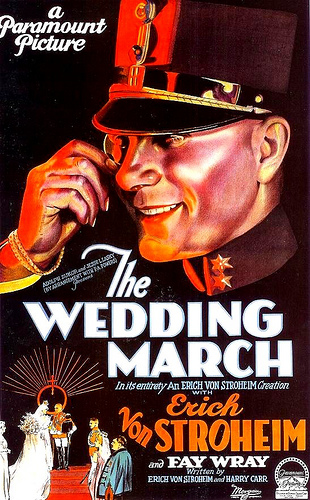
I seem to be in the minority in considering Erich von Stroheim’s 1928 extravaganza to be less than a masterpiece. It’s a bit obvious and redundant (apart from a brilliantly edited and extended mutual flirtation sequence), and it doesn’t compare with Blind Husbands, Foolish Wives, Greed, The Merry Widow, or Queen Kelly. But it’s exceptionally subtle and witty at times (one highlight is an early sequence in two-strip Technicolor), and even minor Stroheim is considerably better than most other filmmakers’ major work. The director, also one of the great silent actors, plays the lead, a flirtatious prince who agrees to marry for money to help his parents (ZaSu Pitts is the expectant bride, a crippled heiress) but falls in love with a poor woman (Fay Wray) shortly before the wedding. At great expense Stroheim re-created the decadent splendor of the Vienna of his youth, then saw his film mutilated by Paramount; the first half of the story is all that survives today in any form. 113 min. (JR)
TheWeddingMarchposter Read more

Naturally Shortsighted [HUMAN NATURE]

From the Chicago Reader (April 12, 2002). — J.R.

Human Nature

* (Has redeeming facet)

Directed by Michel Gondry

Written by Charlie Kaufman

With Patricia Arquette, Tim Robbins, Rhys Ifans, Miranda Otto, Robert Forster, Mary Kay Place, Rosie Perez, and Miguel Sandoval.

The energizing comic wackiness of Being John Malkovich made me wonder what to expect next from screenwriter Charlie Kaufman and director Spike Jonze. But their latest collaboration, Human Nature — which Kaufman wrote, Michel Gondry (a music video director, like Jonze) directed, and Jonze produced, along with three other people, including Kaufman — is disappointing. It’s almost as wacky in spots as Being John Malkovich, and at first I found it funny and provocative. But by the end of the ride I felt I’d been taken for one. Then I remembered that Being John Malkovich had also left me with a somewhat sour feeling; ultimately Kaufman had overplayed his hand.

The diminishing returns may have something to do with the filmmakers’ postmodernist approach — the flip attitude that puts somewhat mocking quotation marks around everything, so that a more apt title of this movie might be “Human” “Nature.” This makes me wonder if the TV backgrounds of Kaufman, Gondry, and Jonze have something to do with their built-in skepticism. Read more

Death and Life [on Alexander Dovzhenko]

From the June 7, 2002 Chicago Reader. This is also reprinted in my book Essential Cinema. — J.R.

Landscapes of the Soul: The Cinema of Alexander Dovzhenko

When I speak of poetry, I am not thinking of it as a genre. Poetry is an awareness of the world, a particular way of relating to reality….Think of Mandelstam, think of Pasternak, Chaplin, Dovzhenko, Mizoguchi, and you’ll realize what tremendous emotional power is carried by these exalted figures who soar above the earth, in whom the artist appears not just as an explorer of life, but as one who creates great spiritual treasures and that specific beauty which is subject only to poetry. Such an artist can discern the lines of the poetic design of being. He is capable of going beyond the limitations of coherent logic, and conveying the deep complexity and truth of the impalpable connections and hidden phenomena of life. — Andrei Tarkovsky, Sculpting in Time

It is possible that we are still in a pre-historic stage of cinema, for the great history of cinema will begin when it leaves the frame of ordinary artistic representation and grows into a tremendous and extraordinarily encompassing perceptive category. — Alexander Dovzhenko, 1933

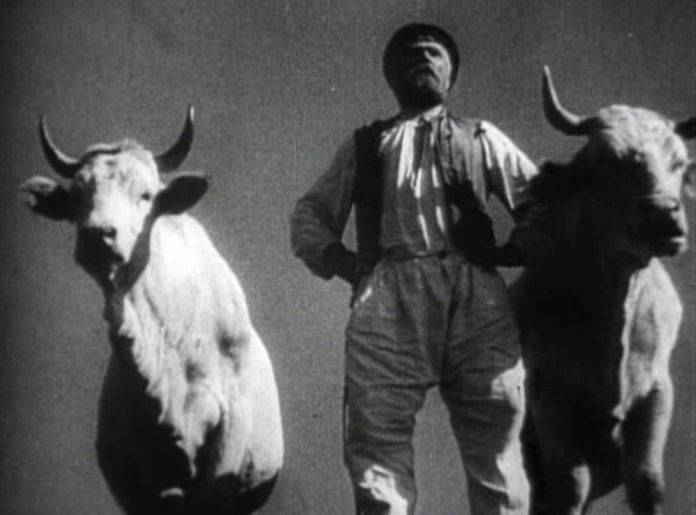
Ukrainian writer-director Alexander Dovzhenko may be the most neglected major filmmaker of the 20th century. Read more