Commissioned by Stanley Schtinter in the summer of 2019 for the limited LP release of Carles Santos’ soundtrack score for Pere Portabella’s Vampir Cuadecuc in early 2020. I received a copy of this LP from Stanley earlier that month — on the final day of a Portabella retrospective in London that began in November, when I gave a lecture at Close-up and Portabella himself, who’d just turned 93, was amiably present. — J.R.
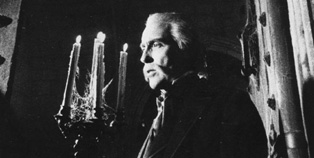
Masterpieces have many possible ports of entry. My own passport into Pere Portabella’s Vampir Cuadecuc (1970) — first seen multiple times at the Directors’ Fortnight in Cannes in 1971 and then celebrated in my festival coverage for the Village Voice — was composed of rampant cinephilia crossed with political ignorance, as well as a fascination with William S. Burroughs’ use of cut-ups in Naked Lunch (1959), The Soft Machine (1961-1966), and The Ticket That Exploded (1962-1967) to create scrambled syntax (echoed in Portabella’s capacity to shift his narrative focus within single shots from the Dracula story itself to the filming of it). I knew then that Portabella, one of the Spanish producers of Luis Buñuel’s Viridiana, had his own passport confiscated as punishment by Francoist Spain, accounting for his absence in Cannes, and that his film was mostly a silent documentary of the shooting of an adaptation of Bram Stoker’s Dracula by one Jesus Franco, accompanied by musique concrète. Read more
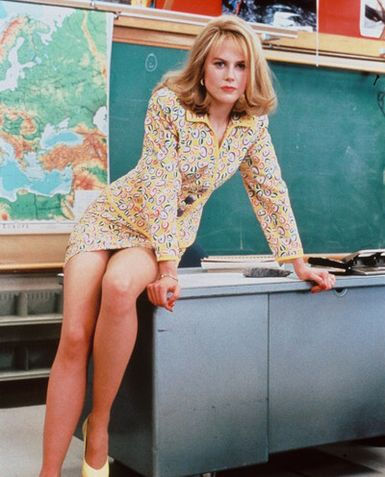 If, like me, you find things to admire in many of Gus Van Sant’s films, you may be especially gratified by what he’s done with this satirical anti-TV script by Buck Henry — suggested by a real-life crime and adapted from a Joyce Maynard novel — and a spot-on performance by Nicole Kidman that may be the best of its kind since Tuesday Weld’s wicked sexual turns in Pretty Poison and Lord Love a Duck. Charting the ruthlessness of an ambitious bimbo telecaster in Little Hope, New Hampshire, this staccato black comedy sustains its brilliant exposition and narration until the plot turns to premeditated murder, complete with hapless and semicoherent teenage accomplices. The movie loses much of its pitch and many of its laughs at this juncture, and there’s an uncomfortable tendency to equate the falsity and venality of TV too exclusively with Kidman’s character, thereby bypassing golden opportunities offered by Wayne Knight (as a station boss) and an uncredited George Segal to make the target less gender specific. But much of this is good nasty fun, with a fine secondary cast that includes Matt Dillon, Joaquin Phoenix, Alison Folland, Casey Affleck, Illeana Douglas, and Dan Hedaya; also look for striking cameos by David Cronenberg and screenwriter Buck Henry.