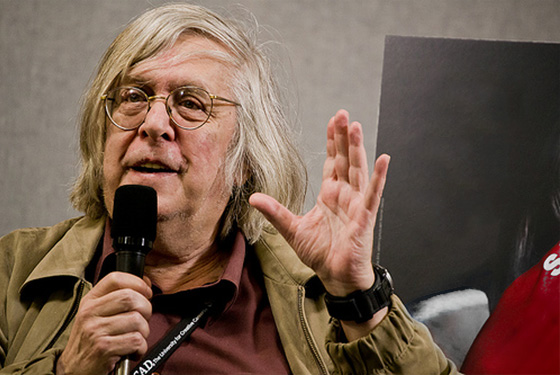
Another Day, Another Genre [MATCH POINT]

From the January 13, 2006 Chicago Reader. — J.R.

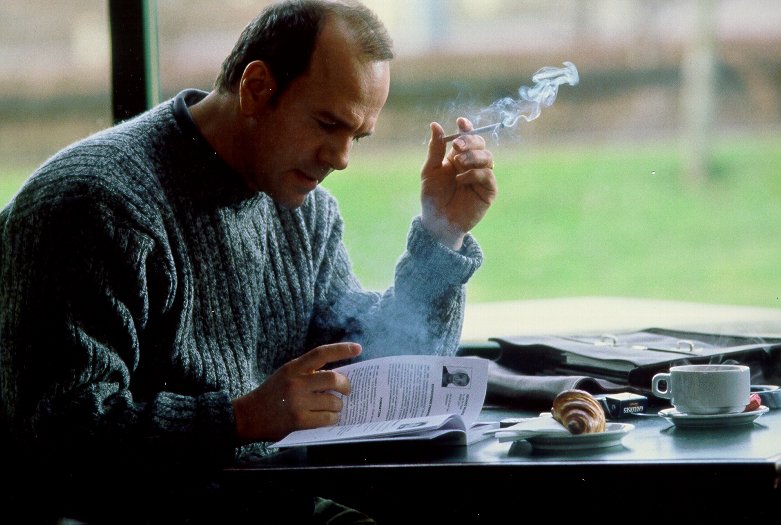
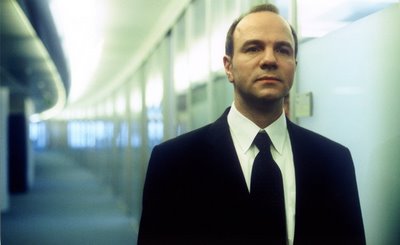
Match Point

*** (A must see)

Directed and written by Woody Allen

With Jonathan Rhys Meyers, Scarlett Johansson, Emily Mortimer, Matthew Goode, Brian Cox, and Penelope Wilton

Movie gossip writer Peter Biskind described Woody Allen in the December 2005 Vanity Fair as “an artist without honor in his own country” (apparently Biskind’s ecstatic write-up in Vanity Fair doesn’t count). He went on to compare Allen’s fate to those of some of Allen’s heroes, including Ingmar Bergman, Akira Kurosawa, Orson Welles, and Charlie Chaplin (assuming Chaplin’s “own country” was the U.S.). He added that Allen, who’s released 35 features to date, has made at least ten masterpieces “that can hold their own against” any of the four he credited to Robert Altman or the three he assigned to Francois Truffaut.

Altman, Bergman, Chaplin, Kurosawa, Truffaut, and Welles have changed our view of the world and of movies. Allen, despite his output and great one-liners and excellent taste in cinematographers, hasn’t. “If I was the teacher, I’d give myself a B,” he modestly told Biskind. Given his indebtedness to Bergman and Federico Fellini, that B would have to be for effort and polish, not originality. Read more

Recommended Reading

Once again, Fintan O’Toole proves his mettle as a political commentator by explaining or at least identifying the inexplicable with more insight than anyone else I’ve been reading. If like me you’ve been wondering how or why Trump can win over crowds with his brand of thuggery, O’Toole
does a plausible job of making sense out of what appears to be
senseless. [3/8/2024]

Read more

Identity Politics

From the Chicago Reader (April 1, 2005). — J.R.

I Am Cuba, Siberian Mammoth

*** (A must see)

Directed by Vicente Ferraz

The Journey: Portrait of Vera Chytilova

no stars (Worthless)

Directed by Jasmina Blazevic

Golub: Late Works Are the Catastrophes

*** (A must see)

Directed by Jerry Blumenthal and Gordon Quinn

I Am Cuba, Siberian Mammoth is a 2004 Brazilian documentary about the making of the legendary 1964 Russian-Cuban production I Am Cuba, a preposterous, beautiful, mannerist epic of Marxist agitprop celebrating the Cuban revolution. Early on the documentary — which, like the other two films reviewed here, is showing this week at the Chicago International Documentary Festival — focuses on one of the key sequences in the original film. The coffin of a radical student slain by Batista’s police during a mass uprising is carried by his comrades through downtown Havana, surrounded by a crowd that swells to Cecil B. De Mille proportions. In a delirious, breathtaking two-and-a-half-minute shot, the camera moves ahead of a young woman and past a young man — catching him in close-up as he turns around, hoists the front of the coffin onto his right shoulder, and walks away with the other pallbearers — then cranes up the five floors of a building, past people watching from balconies and parapets. Read more

Art School Is Murder

From the Chicago Reader (May 12, 2006). — J.R.

Art School Confidential

** (Worth seeing)

Directed by Terry Zwigoff

Written by Daniel Clowes

With Max Minghella, Sophia Myles, Matt Keeslar, John Malkovich, Jim Broadbent, Joel David Moore, Ethan Suplee, Steve Buscemi, and Anjelica Huston

The 2001 live-action Ghost World was the first collaboration involving director Terry Zwigoff, cartoonist Daniel Clowes, and John Malkovich’s production company. Art School Confidential is the second. It’s far more ambitious than its predecessor and suffers from too many ideas rather than too few, making it an inspired, fascinating, and revealing mess. Holding it together is the same anger about the way art is taught that gave so much edgy life to the scenes with Illeana Douglas in Ghost World. Even if one disagrees with some of its points, as I do, it offers plenty to mull over.

Both films faintly echo a four-page catalog of Clowes’s gripes called “Art School Confidential” that appeared in his comic book Eightball. (Having taught courses in film and critical writing in a university art department in the mid-70s,I can testify that art-world careerism was the main preoccupation of both my students and my colleagues.) Clowes clearly felt alienated as an art student and has been spewing bile ever since. Read more

A Brief Reflection on “Winning” and “Losing”


I’ve been haunted lately by a very moving and eloquent comment made last Saturday at a panel discussion which I participated in, held at the Smithsonian. The occasion was a screening of a restoration of Hai Ninh’s lovely 1974 North Vietnamese feature The Little Girl from Hanoi, a film so scarce that I can’t find any stills from it on the Internet to illustrate this post. [Update, 6/13/12: Some stills have subsequently appeared and have been posted with my review of the film, as well as on this page.]

After one of my (American) copanelists remarked that even though “we [sic] lost the war in Vietnam,” the country had a thriving market economy today, and then either he or someone else alluded to America “winning” the Cold War (which provoked an angry riposte from me that if the Cold War had any “winners” at all, these were gangsters on both sides), a Vietnamese diplomat in the audience, who said he was speaking not as a diplomat but simply as a Vietnamese, stated that he thought it was inappropriate to claim that anyone “won” the war in Vietnam. He was right, of course, which got me thinking that the American compulsion to see all of life (and death) in the simplistic terms of sports and games has a lot to answer for. Read more

Three From Vietnam

From the Chicago Reader (May 13, 1994). I’m delighted that stills from these and other Vietnamese films have finally become available on the Internet — which didn’t appear to be the case in October 2010, when I participated in a panel related to the first of these films in Washington, D.C. — J.R.

*** THE LITTLE GIRL OF HANOI

(A must-see)

Directed by Hai Ninh

Written by Hoang Tich Chi, Hai Ninh, and Vuong Dan Hoang

With Lan Huong, Tra Giang, The Anh, and Kim Xuan.

*** THE GIRL ON THE RIVER

(A must-see)

Directed and written by Dang Nhat Minh

With Minh Chau, Ha Xuyen, Anh Dung, and Tran Van Son.

** THE RETIRED GENERAL

(Worth seeing)

Directed by Nguyen Khac Loi

Written by Nguyen Huy Thiep

With Manh Linh, Doan Anh Thang, Hoang Cuc, and Tran Van.

“16 January 1990

“UNITED NATIONS FORCES ATTACK IRAQ, LAYING THE FIRST BLOW ON SADDAM HUSSEIN . . .

“In Powershift [Alvin] Toffler discusses power in its three forms, violence, wealth and knowledge. Now that knowledge is in the hands of everyone, all people, all Nations, television and satellites have forever made it impossible for one group to manipulate the knowledge of what is happening; World television is bringing this vital knowledge to everyone without being diminished. Read more

Precious Leftovers (THE GLEANERS AND I)

From the Chicago Reader (May 11, 2000). — J.R.
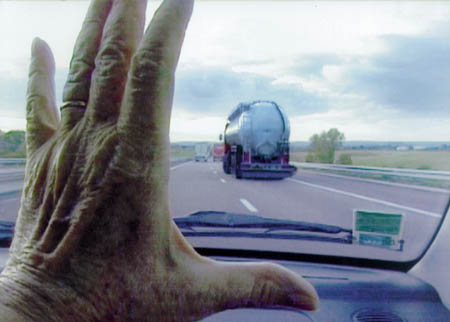
The Gleaners and I

Rating *** A must see

Directed and narrated by Agnes Varda.

Documentaries are a discipline that teaches modesty. — Agnes Varda, quoted in the press notes for The Gleaners and I
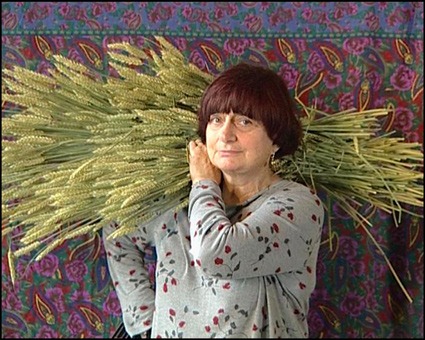
There’s a suggestive discrepancy between the French and English titles of this wonderful essay film completed by Agnes Varda last year. It’s a distinction that tells us something about the French sense of community and the Anglo-American sense of individuality — concepts that are virtually built into the two languages. Les glaneurs et la glaneuse can be roughly translated as “the gleaners and the female gleaner,” with the plural noun masculine only in the sense that all French nouns are either masculine or feminine. The Gleaners and I sets up an implicit opposition between “people who glean” and the filmmaker, whereas Les glaneurs et la glaneuse links them, asserting that she’s one of them.

Gleaners gather up the leftovers of edible crops — grain, fruit, vegetables — after the harvesters are finished with their work. Varda la glaneuse films what other filmmakers have left behind after their harvesting. The link between the two activities is made graphic at one point when Varda gleans a potato with one hand while filming it with the other. Read more
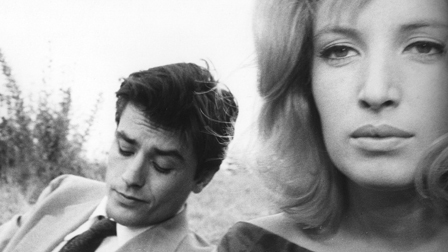
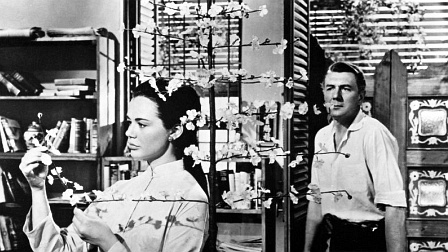
A Vigilance of Desire: Antonioni’s L’ECLISSE

A 2005 essay commissioned by Criterion for their DVD of Eclipse. — J.R.


Your vigilance as an artist is an amorous vigilance, a vigilance of desire.

— Roland Barthes to Michelangelo Antonioni, 1979

It’s lamentable that Michelangelo Antonioni, one of the most fashionable vanguard European filmmakers during the sixties, has mainly been out of fashion ever since. Part of this may be due to the sixties themselves — an era of artistic innovation when making ambitious films about the zeitgeist was still considered both possible and desirable — and all they’ve come to represent in ensuing decades. It seems that the curiosity and metaphysical doubts about the world, which resemble at times agnosticism about reality itself, are more easily tolerated when the glamour of that world is more readily apparent.

This was a time when intellectual activity about the zeitgeist could be debated, if not always welcomed, with Godard and Antonioni the two most commanding figureheads. L’eclisse (1962) appeared the year after Chronicle of a Summer, Last Year at Marienbad, and Paris Belongs to Us, the same year as The Exterminating Angel and Vivre sa vie, and the year before Contempt and Muriel — a period, in short, when large statements and narrative innovations often came together. Read more
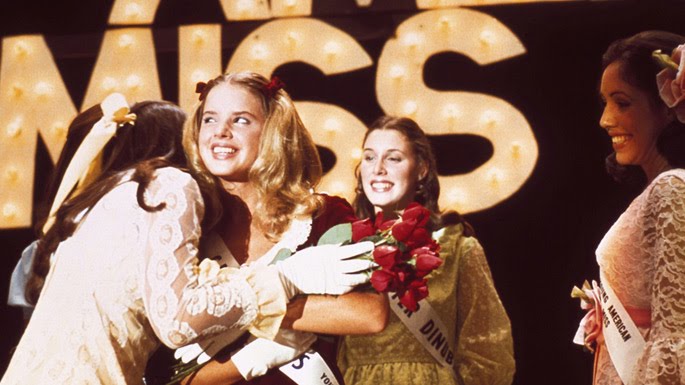
SMILE (1975 review)

From Monthly Film Bulletin, Vol. 42, No. 501, October 1975. — J.R.

Smile

U.S.A., 1974Director: Michael Ritchie

/wp-content/uploads/1975/10/smile-dern.jpg

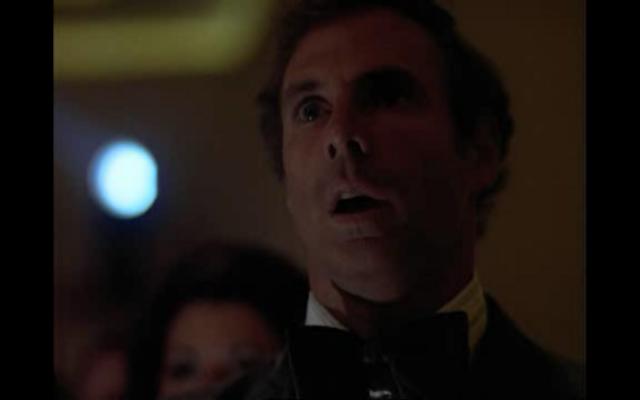
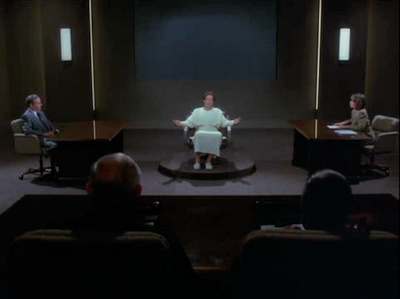
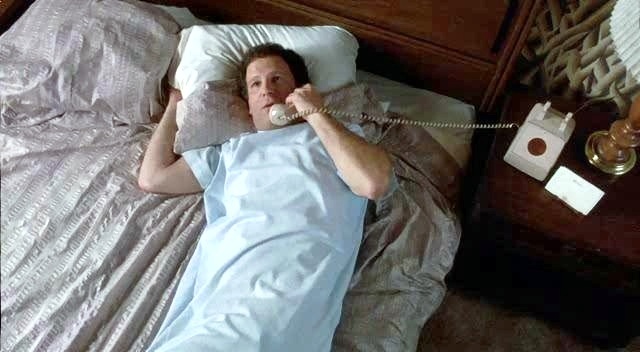
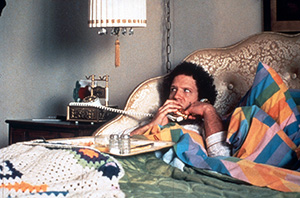
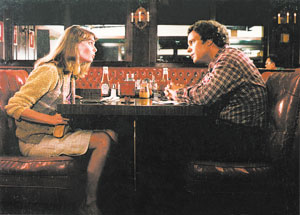
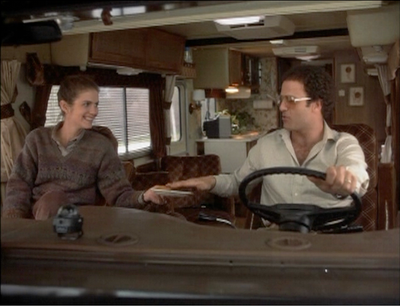
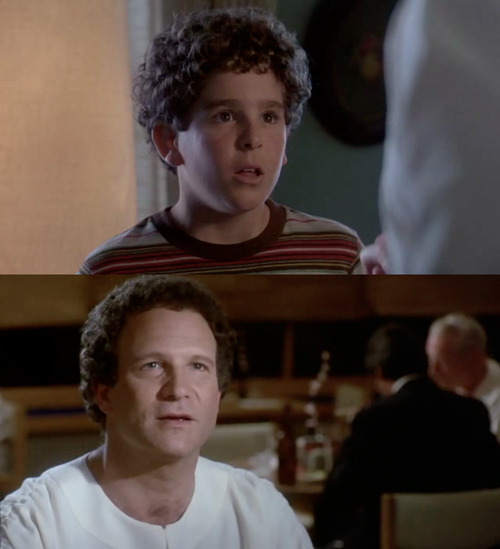
Thirty-three high school girls arrive in Santa Rosa, California, to compete in the annual Young American Miss Pageant. While the girls rehearse their individual and collective performances and are interviewed by a panel of judges — including former pageant winner Brenda DiCarlo [Barbara Feldon] and car dealer “Big Bob” Freelander [Bruce Dern], who codirect the event – Brenda’s husband Andy [Nicholas Pryor], a heavy drinker who runs a trophy shop, derides the silliness of the pageant and Freelander’s son, “Little Bob” [Eric Shea], takes orders from his friends for Polaroid nude snapshots of the girls. Professional choreographer Tommy French [Michael Kidd] arrives to train the girls in dance routines, “Little Bob” his caught with his Polaroid while the girls are undressing, a nude snapshot is confiscated by the police, and he is taken to see a psychiatrist by his father. Andy complains to “big Bob” about his sexual problems with Brenda, and is reluctantly persuaded to attend the Exhausted Rooster Ceremony (for local men who reach the age of 35) that night, the second evening of the pageant. Read more
A Possible Solution to a Mystery

For me, the most valuable single piece of film criticism by François Truffaut — the one that has taught me the most — is a fairly early one, “Un Trousseau de fausses clés,” about Alfred Hitchcock, that appeared in Cahiers du Cinéma no. 39, octobre 1954. I first encountered this article in an English translation (“Skeleton Keys”) that appeared in Film Culture (Spring 1964), then in Cahiers du Cinéma in English No. 2, 1966. I find it far more ingenious as well as useful as criticism than Truffaut’s over- fetishized “Une Certaine Tendance of Cinema Française,” and the part I remember best (I don’t have a copy handy, but trust my memory on this) is a detailed analysis of Hitchcock’s Shadow of a Doubt in terms of “rhyming” shots and scenes, such as the two reproduced above. Many of these visual/ thematic rhymes involve the film’s two Charlies, a serial murderer of women (Joseph Cotten) and his young and beloved niece (Teresa Wright).

This is an essay that clearly helped to spawn Godard’s own best (and most detailed) work of film criticism — “Le cinéma et son double,” about Hitchcock’s The Wrong Man — as well as the structure of doubling shots and scenes in Rivette’s Céline et Julie vont en bateau. Read more

Welcome, Stranger [UNCLE NINO & BECAUSE OF WINN-DIXIE]

From the Chicago Reader (February 18, 2005). — J.R.

Uncle Nino

** (Worth seeing)

Directed and written by Bob Shallcross

With Joe Mantegna, Pierrino Mascarino, Anne Archer, Trevor Morgan, and Gina Mantegna

Because of Winn-Dixie

** (Worth seeing)

Directed by Wayne Wang

Written by Joan Singleton

With AnnaSophia Robb, Jeff Daniels, Cicely Tyson, Dave Matthews, and Eva Marie Saint

An uninvited guest joins an already stressed household, causing pandemonium and upsetting the neighbors as well. The preoccupied, absentminded father assumes this obstreperous if good-natured invader is visiting only temporarily, but on and on he stays, irritating almost everyone apart from the young daughter. Eventually the interloper wins everyone over and brings them all together.

That’s the familiar plot of not one but two current commercial releases, both wholesome family pictures. The visitor in Uncle Nino, which opened last week, is the title hero (Pierrino Mascarino), an elderly Italian peasant with a minimal knowledge of English who flies to the U.S. to visit the family of his nephew Robert (Joe Mantegna) after his brother, Robert’s father, dies. The visitor in Because of Winn-Dixie, which opens this week, is also the title hero, a stray dog in a small town in southern bayou country that’s taken in by the ten-year-old heroine, Opal (AnnaSophia Robb), the daughter of a Baptist preacher (Jeff Daniels). Read more

Difficult Becomes Popular [Chicago Reader blog post, 12/08/06]

Film Difficult Becomes Popular

Posted By on 12.08.06 at 11:21 AM

It’s interesting to see how some of the most difficult and challenging examples of art cinema have become increasingly popular over the past decade. Back in the 60s and 70s, Robert Bresson was virtually a laughing-stock figure to mainstream critics, and someone whose films characteristically played to almost empty houses. Yet by the time that he died, a retrospective of his work that circled the globe was so successful in drawing crowds that in many venues — including Chicago’s Film Center — it had a return engagement. Much the same thing has happened with Andrei Tarkovsky — another uncompromising spiritual filmmaker, and one whose films are even tougher to paraphrase or even explain in any ordinary terms.

I’m just back from a trip to the east coast where I was gratified to find, when I turned up to introduce a screening of Jacques Rivette’s 252-minute L’amour fou (1968) in Astoria’s Museum of the Moving Image, that the film was playing to a nearly packed house. (Incidentally, this galvanizing love story about the doomed relationship between a theater director and his wife, played by Jean-Pierre Kalfon and Bulle Ogier, has never looked better to me, though I’ve been a big fan since the early 70s.) Read more

Deep in the Tarr Pit [THE TURIN HORSE]

From Film Comment (September-October 2011). — J.R.

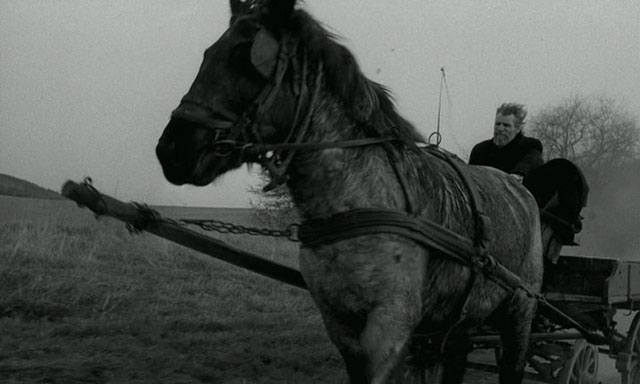
Recalling the incident in Turin that reportedly occasioned Friedrich Nietzsche’s final breakdown into madness — his weeping and embracing a cab horse that was being beaten by its driver for refusing to budge — Béla Tarr’s regular screenwriter, novelist László Krasznahorkai, has noted that no one seems to know or ask what happened to the horse. But The Turin Horse is only nominally concerned with this riddle. It’s more concerned with the horse’s driver and his grown daughter, who live in a remote stone hut without electricity, subsisting on an exclusive diet of potatoes and palinka (Hungarian fruit brandy) while a perpetual storm rages outside, then arbitrarily subsides, over a carefully delineated six days. Their abject life remains fixed by a few infernal routines, such as dressing, undressing, drawing water from a well, or looking out the window. (One exterior shot of the daughter doing just that towards the end of the film will haunt me the rest of my life). What passes for plot gradually becomes even more minimal by the driver’s horse first refusing to pull the wagon, then refusing to eat. Read more

Crimes of Passion [POISON]

From the Chicago Reader (July 12, 1991). — J.R.

POISON

*** (A must-see)

Directed and written by Todd Haynes

With Edith Meeks, Larry Maxwell, Susan Norman, Scott Renderer, James Lyons, John R. Lombardi, Tony Pemberton, and Andrew Harpending.

“The whole world is dying of panicky fright,” reads the title that opens Todd Haynes’s startling and original Poison. It’s a correct and judicious observation, one that helps to “explain” a fascinating and provocative movie, particularly if one sees it alluding directly to the specter of AIDS.

But if one starts to enumerate the symptoms produced by panicky fright in our culture, I’m afraid that the usual set of liberal grievances — greed, intolerance, xenophobia, repression, classism, sexism, racism, homophobia, war fever, and flag waving — doesn’t quite exhaust them. Some of the most cherished and least controversial emblems of postmodernist discourse — irony, stylistic pastiche, and a foreshortened sense of history and politics, all of which are usually employed together — may be symptoms of panicky fright as well. While the list of liberal grievances points to a fear of the world (especially the social world) as it is, postmodernist discourse suggests a fear of discourse (especially art) as it used to be and as it might be once again — a fear of unambiguous self-expression that implies another way of refusing to confront the present directly. Read more

The Apotheosis of Donald Phelps (and David Wayne)

For those of you who might be wondering what has become lately of film critic Donald Phelps — the most gifted and exacting of Manny Farber’s disciples, especially when it comes to low-key acting and pictorial nuance — you should proceed at once to the web site of Comics Journal, where he’s been flourishing in his recent commentaries on movies, prose fiction (ranging from the science fiction of Henry Kuttner and Theodore Sturgeon to the mysteries of Fredric Brown to Calder Willingham’s first novel), and comic strips. I’m especially impressed by parts one and two of his majestic “Like a Mechanical Bird: The Peculiar Stoicism of David Wayne,” posted earlier this month — a detailed and rather astonishing appreciation of one of the most overlooked of Hollywood and TV actors, whose special qualities seemed to flourish in such relatively unsung and/or out-of-reach works as Joseph Losey’s remake of M (1951), a couple of black and white sketch films at Fox in 1952  (O. Henry’s Full House and We’re Not Married, where he costars respectively with Charles Laughton and Marilyn Monroe), Henry King’s Wait Till the Sun Shines, Nellie (1952), which inspires some of Phelps’ best prose, and Down Among the Sheltering Palms (“an amiable bargain-counter South Pacific,” 1953).
Read more