Published by DVD Beaver in April 2006. I’ve updated this to include further links for films that have subsequently become available; there are in fact quite a few of these, and, unless I’ve missed something, only one title that isn’t currently available, The Argyle Secrets. — J.R.
Most of my favorite offbeat musicals are commercially available on DVD, and I wrote about them for DVDBeaver in March. I can’t say the same about most of my favorite noirs, and I’m not sure why this is so.
It’s also important to stress that “noir” isn’t a genre; it’s a category that’s applied retroactively to films with certain traits in common — a practice started by French critics and eventually continued by us Yanks and others. (Check out James Naremore’s definitive 1998 book on the subject, More Than Night: Film Noir in its Contexts.) This makes it something more flexible than a genre, and I’ve tried to honor this factor in some of my choices.
In the following list I’ve managed to make peace with myself by appending one SBA title (which stands for “should be available”) to each one that you can currently buy, in the same general category, with brief explanations added. Read more
Commissioned by the Belgian web site Cinetek and posted in December 2022.
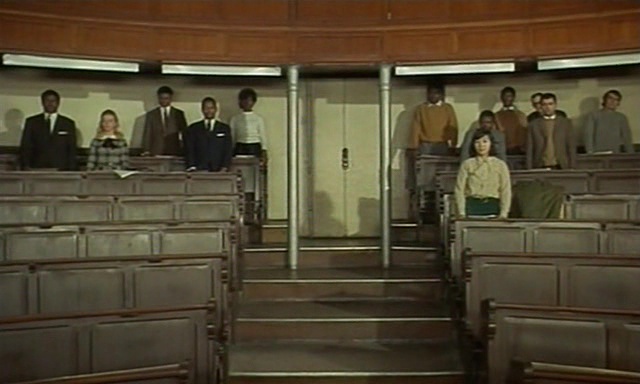
Displacement in relation to language stands at thecenter of André Delvaux’s troubling and troubled Unsoir, un train (1968) — so precisely and so relentlesslythat even the disquiet created by the collision ofdisparate nouns in the poetic title (a time and aplace/ thing/vehicle, improbably yoked together like achance meeting between a sewing machine and anumbrella on a dissecting table) arguably becomes lost orat least diluted in its English translation. One Night… ATrain, by contrast, feels like the opening phrase in a familiar-sounding narrative, a prosaic flow of wordsthat accounts for the three- period ellipsis, continuance replacing collision. And somewhere in between this collision and this continuance is the sort of stasis or uncertainty of both time and place evoked by the Flemish title of the Johan Daisne novella that the film is loosely based on, De trein der traagheid, which my Google translation engine, recognizing it as Dutch, translates as “The Train of Indolence”.
In the film, a conflict is being played out between Mathias (Yves Montand), a Flemish linguist and literature professor, and a theatrical stage designer named Anne (Anouk Aimée) who left France to live with him in Belgium and feels both excluded and scorned by the Flemish members of Mathias’ circle.Read more
My column in the Winter 2021 issue of CinemaScope. — J.R.
Teaching an online course on Agnès Varda at the School of the Art Institute this fall for 39 students has put me in regular touch with Criterion’s superb 15-Blu-ray box set, The Complete Films of Agnès Varda, every week. The packaging reminds me in some ways of the handsome 78 rpm albums I used to cherish as objects and totems in the mid- to late 1940s, when I was still a toddler, although Criterion’s version of this sort of assembly, held in a box, manages to be neater and more compact. There’s also a richly illustrated and annotated 200-page book inside the box, with essays by Amy Taubin, Ginette Vincendeau, So Mayer, Alexandra Hidalgo, and Rebecca Bengal, and excellent “program notes” on all the films by Michael Koresky. In short, plenty to keep a coronavirus shut-in busy, even without a course to teach.
The course has gradually brought home to me the complexly ambiguous lesson that Varda wasn’t really or exactly an auteur, at least not in the boys’-club meaning of that term as it’s most commonly used. But not being an auteur gave her a kind of freedom and a form of elasticity denied to most auteurs. Read more
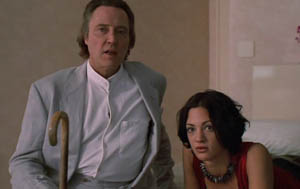
It’s not at all surprising that Abel Ferrara’s most recent feature (1998) has failed to find an American distributor or that some of his most eloquent defenders have labeled this transgressive adaptation of a William Gibson story the collapse of a major talent. A murky and improbable tale about prostitution, industrial espionage, and manufactured viruses, it works on the very edge of coherence even before the final 20 minutes or so, during which earlier portions of the film are replayed with minor variations and additions. On the other hand, few American films in recent years have been so beautifully composed and color coordinated shot by shot, and the overall experience of an opium dream is so intense that you might stop making demands of the narrative once you realize that none of the usual genre expectations is going to be met. Almost all the principal action occurs offscreen, and most of Ferrara and Christ Zois’s script concentrates on scenes between a corporate raider named Fox (Christopher Walken); his deputy, X (Willem Dafoe); and Sandii (Asia Argento, daughter of cult horror director Dario Argento), an Italian prostitute hired to seduce a Japanese scientist. Read more
#1. The bias against sound thinking is so deeply ingrained that it shapes and invades the most casual parts of our speech. Whenever we ask “What movie did you see?”, or discuss film as a visual medium, or refer to viewers or spectators, we participate in a communal agreement to privilege one aspect of a film text by masking another, identifying the part as a whole. Some might argue that this bias is a carryover from the silent era; yet once we acknowledge that silence is as integral to sound as empty space is to image – not so much a neutral terrain as a variable to be defined and/or filled in relation to an infinite variety of contexts – we can’t really claim that the problem started with the “talkies.” Indeed, we can’t even allude to “talkies” without agreeing to privilege speech over silence, sound effects and music, thereby participating in a related form of suppression.
#2. The point is that none of the terms we use are innocent, and the ones we have for discussing sound still aren’t far removed from Neanderthal grunts. Consider the brutal inadequacy of “sound effects”: it would seem barbaric if we spoke of visual composition in Eisenstein or Renoir as “visual effects,” if only because we perceive composition as a complex of interrelated decisions.
The following was written to accompany a film series put together by Ehsan Khoshbakht, Imogen Sara Smith, and myself for a tour in Turkey in late 2018 sponsored by the American Embassy. I don’t know if it was used in this form. — J.R.
“Fake news”, the term paradoxically used by Donald Trump for journalism that exposes his own lies and corruption, evokes what George Orwell called New-speak in 1984, whose slogans included “war is peace” and “ignorance is strength”. Trump’s cleverness as a media manipulator consists of appropriating the very term that describes his own practice while reversing its meaning so that his opponents — including the people who put together this film program about “fake news,” my colleagues and myself — can no longer use it without speaking on Trump’s behalf. This is surely manipulation with a vengeance, where control over both language and presence becomes another form of class inequality. So when TV executives remark that Trump is bad for America but good for television, they’re only suggesting that these two latter entities have separate agendas and even separate owners, neither of which happens to be the American public.
Feeding public fears with worst-case scenarios is the principal form of press manipulation found in Try and Get Me!Read more
From the Chicago Reader (March 17, 2000). I’m delighted that Criterion invited me to retool this review for a new edition of this film in 2020. In some ways, I like Ghost Dog more now than I did 23 years ago. — J.R.
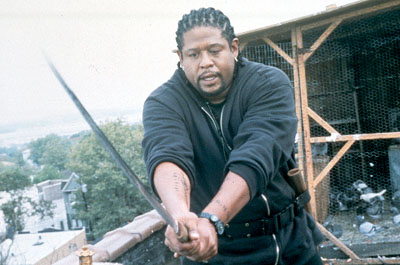
Ghost Dog: The Way of the Samurai
Rating *** A must see
Directed and written by Jim Jarmusch
With Forest Whitaker, John Tormey, Cliff Gorman, Frank Minucci, Richard Portnow, Tricia Vessey, Henry Silva, Isaach de Bankolé, and Camille Winbush.
Jim Jarmusch’s seventh narrative feature, Ghost Dog: The Way of the Samurai, which I’ve seen three times, may be a failure, if only because most of its characters are never developed far enough beyond their mythic profiles to live independently of them. But if it is, it’s such an exciting, prescient, moving, and noble failure that I wouldn’t care to swap it for even three or four modest successes.
Compared with a masterpiece like its controversial predecessor, the 1995 Dead Man, Ghost Dog seems designed to get Jarmusch out of the art-house ghetto, at least in this country, and into something closer to the mainstream. It’s full of familiar elements reconfigured in unfamiliar ways: Ghost Dog (Forest Whitaker), whose life was once saved by Louie, a New Jersey hoodlum, becomes Louie’s samurai hit man, communicating with him exclusively with homing pigeons. Read more
The Chiseler’s Daniel Riccuito discusses pre-Code talkies, noir and leftist politics with one of America’s leading film critics.
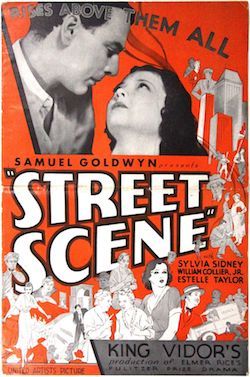
DR: We share a common enthusiasm for early talkies. Do you have any favorite actors, writers or storylines relating to the period’s ethnic, often radically left-wing, politics? I’m thinking of the way that, say, The Mayor of Hell suddenly busts into a long Yiddish monologue. Or movies like Counsellor at Law and Street Scene present hard Left ideas through characters with Jewish, Eastern European backgrounds.
JR: Both Counsellor at Law and Street Scene are plays by Elmer Rice (1892-1967) that Rice himself adapted, and both are terrific films with very good directors (William Wyler and King Vidor, respectively). It’s too bad that Rice’s plays aren’t revived more often today, although a few years ago, the TimeLine theater company in Chicago put on a fantastic, neo-Wellesian production of The Adding Machine. I also had the privilege of knowing Rice’s two children with actress Betty Field, John and Judy, who attended the same boarding school in Vermont, both of whom I remember quite fondly.
Although it isn’t as politically subversive as the Rice plays, the delightful Jewel Robbery (William Dieterle, 1932) is still a more radical comedy in its treatment of class and sex — specifically, the sexual lure of being robbed as another way of being sexually possessed and enjoyed — than Ernst Lubitsch’s Trouble in Paradise, released a little later the same year. Read more