Sound Thinking
From Film Comment, September-October 1978. — J.R.
Sound Thinking


The following was written to accompany a film series put together by Ehsan Khoshbakht, Imogen Sara Smith, and myself for a tour in Turkey in late 2018 sponsored by the American Embassy. I don’t know if it was used in this form. — J.R.


“Fake news”, the term paradoxically used by Donald Trump for journalism that exposes his own lies and corruption, evokes what George Orwell called New-speak in 1984, whose slogans included “war is peace” and “ignorance is strength”. Trump’s cleverness as a media manipulator consists of appropriating the very term that describes his own practice while reversing its meaning so that his opponents — including the people who put together this film program about “fake news,” my colleagues and myself — can no longer use it without speaking on Trump’s behalf. This is surely manipulation with a vengeance, where control over both language and presence becomes another form of class inequality. So when TV executives remark that Trump is bad for America but good for television, they’re only suggesting that these two latter entities have separate agendas and even separate owners, neither of which happens to be the American public.


Feeding public fears with worst-case scenarios is the principal form of press manipulation found in Try and Get Me! Read more
From the Chicago Reader (March 17, 2000). I’m delighted that Criterion invited me to retool this review for a new edition of this film in 2020. In some ways, I like Ghost Dog more now than I did 23 years ago. — J.R.
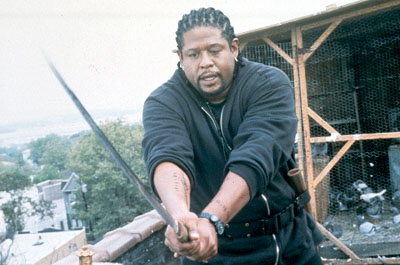
Ghost Dog: The Way of the Samurai
Rating *** A must see
Directed and written by Jim Jarmusch
With Forest Whitaker, John Tormey, Cliff Gorman, Frank Minucci, Richard Portnow, Tricia Vessey, Henry Silva, Isaach de Bankolé, and Camille Winbush.


Jim Jarmusch’s seventh narrative feature, Ghost Dog: The Way of the Samurai, which I’ve seen three times, may be a failure, if only because most of its characters are never developed far enough beyond their mythic profiles to live independently of them. But if it is, it’s such an exciting, prescient, moving, and noble failure that I wouldn’t care to swap it for even three or four modest successes.
Compared with a masterpiece like its controversial predecessor, the 1995 Dead Man, Ghost Dog seems designed to get Jarmusch out of the art-house ghetto, at least in this country, and into something closer to the mainstream. It’s full of familiar elements reconfigured in unfamiliar ways: Ghost Dog (Forest Whitaker), whose life was once saved by Louie, a New Jersey hoodlum, becomes Louie’s samurai hit man, communicating with him exclusively with homing pigeons. Read more
Posted May 18, 2020. — J.R.

The Chiseler’s Daniel Riccuito discusses pre-Code talkies, noir and leftist politics with one of America’s leading film critics.
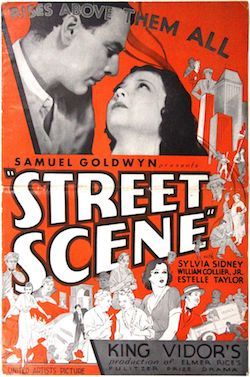
DR: We share a common enthusiasm for early talkies. Do you have any favorite actors, writers or storylines relating to the period’s ethnic, often radically left-wing, politics? I’m thinking of the way that, say, The Mayor of Hell suddenly busts into a long Yiddish monologue. Or movies like Counsellor at Law and Street Scene present hard Left ideas through characters with Jewish, Eastern European backgrounds.
JR: Both Counsellor at Law and Street Scene are plays by Elmer Rice (1892-1967) that Rice himself adapted, and both are terrific films with very good directors (William Wyler and King Vidor, respectively). It’s too bad that Rice’s plays aren’t revived more often today, although a few years ago, the TimeLine theater company in Chicago put on a fantastic, neo-Wellesian production of The Adding Machine. I also had the privilege of knowing Rice’s two children with actress Betty Field, John and Judy, who attended the same boarding school in Vermont, both of whom I remember quite fondly.
Although it isn’t as politically subversive as the Rice plays, the delightful Jewel Robbery (William Dieterle, 1932) is still a more radical comedy in its treatment of class and sex — specifically, the sexual lure of being robbed as another way of being sexually possessed and enjoyed — than Ernst Lubitsch’s Trouble in Paradise, released a little later the same year. Read more