Written for The Unquiet American: Transgressive Comedies from the U.S., a catalogue/ collection put together to accompany a film series at the Austrian Filmmuseum and the Viennale in Autumn 2009. My thanks to Sara Driver for introducing me to this feature. — J.R.
IDIOCRACY (2006)
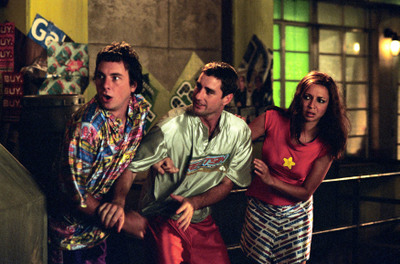
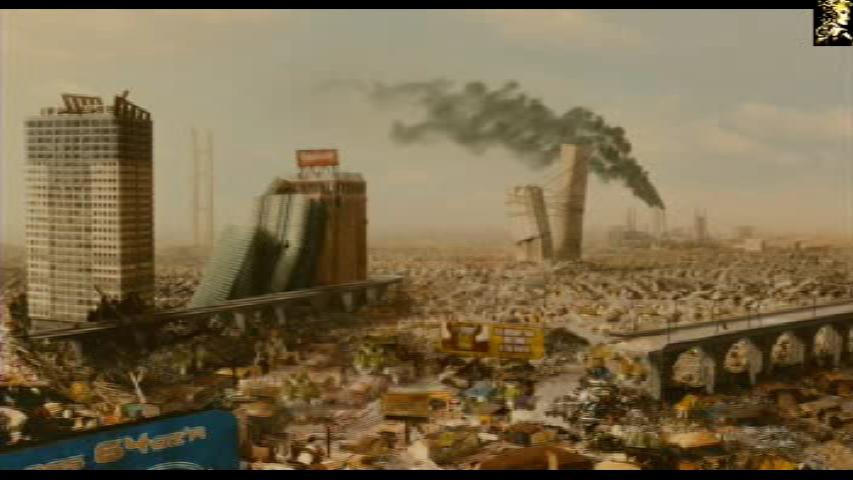
My only concession in this series to the recent vogue in gross-out, bad-taste comedies (as exemplified by such Farrelly brothers features as Dumb & Dumber, There’s Something About Mary, and Stuck on You) as well as comedies predicated on their characters’ stupidity (on which both Sacha Baron Cohen and the Coen brothers have virtually built their respective careers) is this dystopian satire (2006), directed and cowritten by Mike Judge, the creator of MTV’s Beavis and Butt-Head. It’s mainly set in the year 2505, when fast-food franchises and all-American stupidity, helped along by The Great Garbage Avalanche, have taken over the mental, spiritual, and physical landscape of presumably the entire planet, to the exclusion of everything else. (The implication that the entire planet now consists of a single country -– or else that, solipsistically speaking, the United States’ lack of awareness of the remainder of the planet has now become total -– is never spelled out, yet it remains inescapable.) Read more
This review appeared in the Spring 1979 issue of Film Quarterly (vol. XXXII, no. 3). Consider it Part 1 of a two-part consideration of Alan Rudolph, carried out over a span of a dozen years, to be followed by my much more ambivalent take on Mortal Thoughts (1991) for the Chicago Reader, which deals with some of the same issues involving both class and music. (I suspect that Rudolph’s best movie remains Choose Me, but I’d have to see this again to be sure.) — J.R.
REMEMBER MY NAME
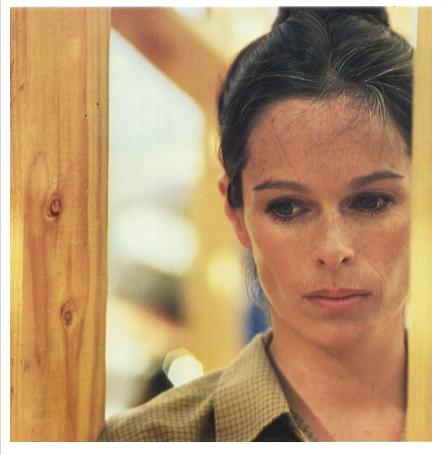
Director: Alan Rudolph. Script: Rudolph. Photography: Tak Fujimoto. Music: Alberta Hunter. Lagoon Films.
Alan Rudolph’s second film was financed by Columbia, then written off as a disaster before it was released, but it has been running successfully in Paris for months and opens shortly in New York. It strikes me as the most exciting Hollywood fantasy to come along in quite some time. Admittedly, I am a Rivette enthusiast; I am fascinated by narrative suspension and indeterminacy, and tend to lose interest when a plot is laid out in full view, because I’ve usually seen it before. Remember My Name deliberately suspends narrative clarity for the better part of its running time, and never entirely eliminates the ambiguities that keep it alive and unpredictable — even though its themes, thanks to Alberta Hunter’s offscreen blues songs, are never really in question. Read more
I only learned about Michael Snow’s death today, at the age of 94, when I received an invitation from Sight and Sound to write his obituary. Not long after Godard and Straub, another giant of the avant-garde has left us.
This is the second of two interviews I’ve had with Snow. (The first, “The `Presents‘ of Michael Snow,” can be found elsewhere on this site.) Commissioned by Simon Field, it ran in the Winter 1982/83 issue (no. 11) of the excellent English magazine Afterimage, a special issue called “Sighting Snow,” and it concerns both So Is This and Presents. I’ve incorporated some but not all of the additions from the version of this article that was reprinted in my book Film: The Front Line 1983 (Arden Press). I regret some of the hectoring tone of my political rhetoric here, and it became clear to me after Film: The Front Line 1983 was published that Snow objected to some of this rhetoric in the book even more, thus curtailing some of our friendship that had prevailed beforehand. Read more
This is the first ten-best round-up I ever did for the Chicago Reader, which ran in their January 8, 1988 issue. Having recently been reading the Library of America’s mammoth collection of Manny Farber’s film criticism (which is coming out in September), I’ve become especially aware of how much one’s taste and preferences tend to change over time. Today, for instance, I suspect I would have placed Mélo in the number #1 slot, and probably wouldn’t include House of Games or Universal Hotel/Universal Citizen in the also-rans but would move them both up to the main list. The first photo, incidentally, directly below, is from Godard’s still woefully neglected King Lear.––J.R.
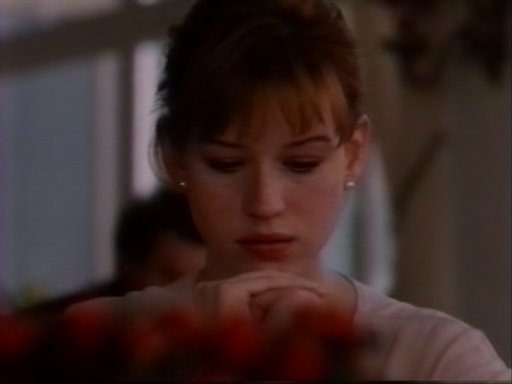
What is the meaning of a ten best list? For me, at any rate, it means a list of movies with the highest possible mystery quotient — the movies that fascinate me the most because they still have secrets to withhold. And the best litmus test that I know for determining this quality is repeat viewings. If a movie that knocked me out seems less mysterious after a return visit — as was the case with Broadcast News, Cross My Heart, and Orphans — then it doesn’t belong on the list. Read more
The following exchange appeared in Cinema Scope no. 8, September 2001. — J.R.
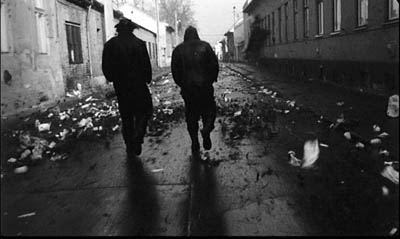
In the past, when I’ve interviewed filmmakers it’s been at my own initiative — or at least at the initiative of an editor making an assignment. This time, at the Buenos Aires Festival of Independent Film in April 2001, where I was serving on the jury and introducing Béla Tarr at some of his screenings, someone handed me a tape recorder, and Mark Peranson agreed to transcribe the interview afterwards if I would speak to Béla, who’s been a friend ever since Sátántangó. I hope that the casual grammar on both sides of this conversation doesn’t obscure too much of the meaning. (J.R.)
BELA TARR: […] In Sátántangó, we had a set. The doctor’s flat, it was built.
JONATHAN ROSENBAUM: You know, that’s my favorite scene in the film.
TARR: Yes, but it was built! It is artificial, but you don’t feel it in the movie…
ROSENBAUM: Maybe that’s why I like it so much, because it’s in such a small space.
TARR: No, it wasn’t small.
ROSENBAUM: But it feels small in the film.
TARR: Yeah, sure.
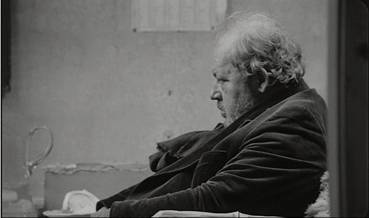
ROSENBAUM: Was the actor playing the doctor a professional actor or a nonprofessional? Read more
From The Movie No. 71, 1981. — J.R.


From Psycho and Spartacus (both 1960) to The Wild Bunch and Easy Rider (both 1969), the Sixties might be regarded as the period when screen violence gained a new aesthetic self-consciousness and something approaching academic respectability, at least in the public mind. To put it somewhat differently, the contemporary spectator of 1960, shocked by the brutal shower murder of Marion Crane (Janet Leigh) in Psycho as an event — without observing that it was a composite film effect created by several dozen rapidly cut shots –- would have been much likelier to notice, in 1969, the use of slow motion in the depiction of several dozen violent deaths in The Wild Bunch.
The key film document of the decade, endlessly scrutinized and discussed, was not an entertainment feature at all, but the record of an amateur film-maker named Abe Zapruder of the assassination of John F. Kennedy in Dallas on November 22, 1963; the close analysis to which this short length of film was subjected was characteristic of a changing attitude towards the medium as a whole.
In the Sixties many established cultural, social, and political values were radically thrown into question, at the same time that the media -– including television and pop music as well as cinema — were becoming closely examined in their own right. Read more
From Paris Journal, Film Comment, Summer 1972 (excerpt). –J.R.
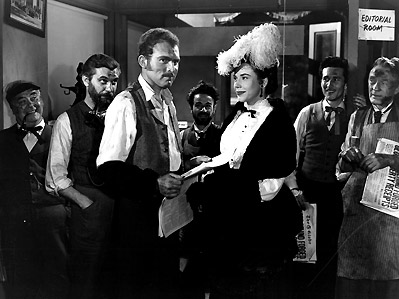
Nearly two decades have elapsed between the making of Samuel Fuller’s PARK ROW and its premiere at the Cinema Mac-Mahon. In the interim, Fuller has gone from being a cause célèbre in France to a critical industry in England, where no less than three books on his films have already appeared. A major limitation of this overkill, which is threatening to “assimilate” Douglas Sirk as its next victim, is its absolute humorlessness — a quality that was rarely present in Godard’s or Luc Moullet’s writing on either director in the 50s. Reviewing Sirk’s A TIME TO LOVE AND A TIME TO DIE, Godard affirmed that “ you have to talk about this kind of thing…deliriously, you can be quietly, or passionately delirious, but delirious you have to be, for the logic of delirium is the only logic that Sirk has ever bothered about.” In addition to being about as delirious as the London Times, most of the English writing about Sirk and Fuller suffers from myopia as well. Compare Moullet’s three half-pages on Sirk’s THE TARNISHED ANGELS (Cahiers du cinéma #87) to Fred Camper’s 25 pages in the recent Sirk issue of Screen: the former, for all its giddiness, develops a persuasive stylistic link between Faulkner’s rhetoric and Sirk’s mobile camera; the latter, for all its sobriety, fails to mention the words “Faulkner” or “Pylon” even once. Read more
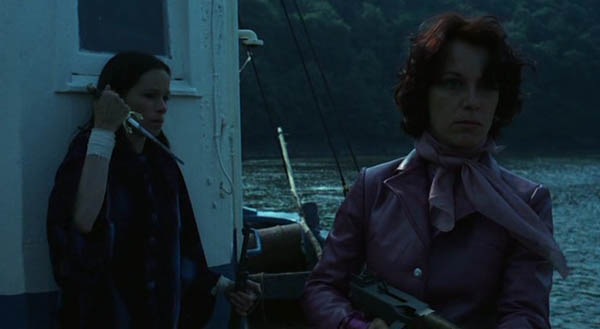
The strangest by far of Jacques Rivette’s films (1976), and perhaps the last gasp of the modernist strain that infused his work from L’amour fou to Out 1 to Celine and Julie Go Boating, this is a violent and unsettling fusion of a female pirate adventure (filmed on some of the same locations used for The Vikings and inspired in part by Lang’s Moonfleet, but set in no particular place or period), mythological fantasy, Jacobean tragedy (with many lines borrowed from Tourneur’s Revenger’s Tragedy), experimental dance film (with live improvised music from a talented trio of musicians), and personal psychodrama. The eclectic cast includes Geraldine Chaplin, Bernadette Lafont, Kika Markham (Two English Girls), and a few members of Carolyn Carlson’s dance company. While the mise en scène and locations are often stunning, the film seems contrived to confound conventional emotional reactions of any sort. It’s a movie where the casual slitting of someone’s throat and the swishing sounds of Lafont’s leather pants are made to seem equally relevant — a world apart from Rivette’s more recent La belle noiseuse. Yet Rivette’s feeling for duration, immediacy, and moods of menace are fully present here, and days or weeks after you see this chilling conundrum of a movie, sounds and images may come back to haunt you. Read more
From the Chicago Reader (April 21, 2006). — J.R.
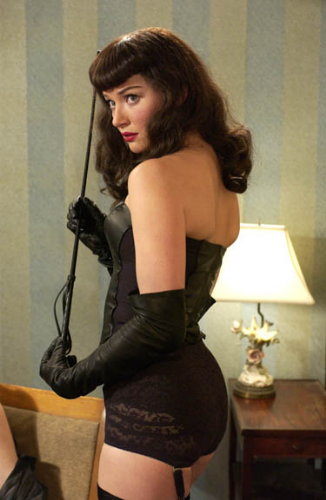

The Notorious Bettie Page
*** (A must see)
Directed by Mary Harron
Written by Harron and Guinevere Turner
With Gretchen Mol, Chris Bauer, Jared Harris, Sarah Paulson, Cara Seymour, David Strathairn, Lili Taylor, and John Cullum
Basic Instinct 2
** (Worth seeing)
Directed by Michael Caton-Jones
Written by Leora Barish and Henry Bean
With Sharon Stone, David Morrissey, David Thewlis, Charlotte Rampling, Hugh Dancy, Flora Montgomery, Indira Varma, and Heathcoate Williams
The Notorious Bettie Page — about the pinup and soft-core-bondage film and magazine star of the 50s — mixes archival black-and-white and color footage with re-creations. The mix of materials evoking the period is far from seamless, and we can’t always be sure what’s archival and what’s simulated because sometimes the filmmakers are trying to fool us. But their preoccupation with the manufacture of images keeps this exercise in exposure and concealment interesting.
Page, effectively played by Gretchen Mol, is shown as a cheerful airhead who loves her work as a model and maintains a good-natured innocence about it. That is, until the puritanical Senate porn investigation of Estes Kefauver (whom David Strathairn makes almost interchangeable with his Edward R. Murrow in Good Night, and Good Luck) drives her back to the religion of her childhood, which the movie persuasively suggests was the only logical place for her to go at that point. Read more
From Moving Image Source (May 18, 2009). — J.R.

I wouldn’t say that video art per se makes me break out in hives. I even like some examples of it, including work by Thom Andersen, Gregg Bordowitz, Joan Braderman, Pedro Costa, Adam Curtis, Steve Fagin, Jean-Luc Godard (for me, his best work over nearly the past two decades), Ken Jacobs, Jia Zhangke, Abbas Kiarostami, Alexander Kluge, Mark Rappaport, Raúl Ruiz, Aleksandr Sokurov, Michael Snow, Leslie Thornton, and Bill Viola. But when it comes to most early American video art, I have an allergic reaction. A dozen years ago, while co-teaching a course with video artist Vanalyne Green at Chicago’s School of the Art Institute called “Film and Video: What’s the Difference?” I even tried -— without much sustained success — to combat this allergy homeopathically.
More recently, I’ve tried again by attempting to come to terms with the Video Data Bank’s multiregional DVD box set, Surveying the First Decade: Video Art and Alternative Media in the U.S. — a mammoth compilation curated by Christine Hill, encompassing eight discs, 68 titles, and over 16 hours, produced for institutional rather than consumerist use. (The cost is otherwise prohibitive: $1,350 before September 1, $1,500 afterward, and postage is extra.) Read more
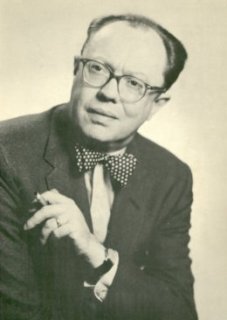
The following is a one-page story submitted to Anthony Boucher, the editor of The Magazine of Fantasy and Science Fiction, in April 1956, when I was 13, and accepted by him the following month, after a couple of rewrites guided by his suggestions. (The use of the drug “euphorin” was his own idea and invention.) Later that summer, on a family trip to the west coast, we (my parents and one or two of my brothers and I) actually managed to track down Boucher in his Berkeley home (we’d naïvely assumed that the address on his stationary was the magazine’s editorial office) and spent a very pleasant hour or so with him. The story was eventually published in the November 1957 issue (on the last page) and I received a check for $25 for my work. Later the story appeared in Spanish and Japanese translations in foreign editions of the magazine; I still have a copy of each. — J.R.
Now and Then
by Jonathan Rosenbaum
When the time machine started, I realized that I had forgotten to ask the professor its destination. But under the influence of a heavy dose of euphorin, it hardly mattered to me. To escape the tensions of the present, almost everybody I knew was taking the same or similar tranquilizers. Read more
From the Chicago Reader (August 9, 1996). — J.R.

Red Hollywood
Rating *** A must see
Directed and written by Thom Andersen and Noël Burch
Narrated by Billy Woodberry.
By Jonathan Rosenbaum
When Peter Wollen wrote about canon formation in the English film magazine Sight and Sound three years ago, he conceptualized “a motley set of cultural gate-keepers and taste-makers.” Archivists come first, determining which films to acquire, preserve, and screen; then come the academics and critics, singling out the touchstones and masterpieces; they’re followed by filmmakers and, finally, the audience. As Wollen notes, “The process of cultural negotiation among these many gate-keepers of taste results not only in the surface phenomena of lists and programs, but also in the crystallization of an implicit aesthetic paradigm at a deeper level.”
I can think of several sources critical to the formation of my own canon. When I was in my early teens, the only sources I could find were library books like Arthur Knight’s The Liveliest Art, which is useful as a beginner’s survey, and Agee on Film, which is hampered by its limited coverage. During my freshman year in college I purchased my first film magazine: the Winter 1961-’62 issue of Sight and Sound, which contained the results of an international poll of critics about the ten best movies ever made; I resolved to see as many movies on the composite and individual lists as possible. Read more
From the October 13, 1988 Chicago Reader. — J.R.
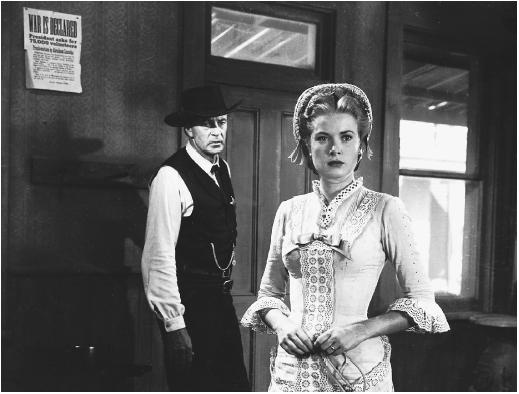
After many years of being vastly overrated, this liberal adult western of 1952 may be underrated in some quarters today. While the film angered Howard Hawks into making one of his masterpieces (Rio Bravo) as a kind of rebuttal, it got smothered in Oscars; still, it’s not entirely devoid of virtues. Gary Cooper is a sheriff who’s about to retire (so he can marry Grace Kelly) but has to face a final gunfight alone when all of the townspeople refuse to help him. Carl Foreman wrote the script and planned to direct until the Hollywood blacklist made this impossible; Fred Zinnemann took over and did a fairly good job of milking suspense out of the situation — the film’s 84 minutes are meant to correspond to the actual time in which the plot unfolds — with his usual somewhat mechanical polish. Some of the results ring false, but the memorable theme song and some equally memorable character acting (by Thomas Mitchell and Lon Chaney Jr. more than Lloyd Bridges and Katy Jurado) help things along. (JR) Read more

Sergei Eisenstein’s controversial, unfinished trilogy, with a Prokofiev score and a histrionic, campy (albeit compositionally very controlled) performance in the title role by Nikolai Cherkassov (1945). The ceremonial high style of the proceedings has been interpreted by critics as everything from the ultimate denial of a cinema based on montage (under Stalinist pressure) to the greatest Flash Gordon serial ever made. Thematically fascinating both as submerged autobiography and as a daring portrait of Stalin’s paranoia, quite apart from its interest as the historical pageant it professes to be, this is one of the most distinctive great films in the history of cinema — freakishly mannerist, yet so vivid in its obsessions and expressionist angularity that it virtually invents its own genre. 184 min. In Russian with subtitles. (JR)
 Read more

Fourteen years ago, the underrated (or at least undervalued) Michael Kinsley reported in The New Yorker (“The Intellectual Free Lunch,” February 6, 1995, reprinted in his collection Big Babies) on a reputable survey that found that “75 percent of Americans believe that the United States spends ‘too much’ on foreign aid, and 64 percent want foreign-aid spending cut.” (“Apparently,” Kinsley added as an aside, “a cavalier 11 percent of Americans think it’s fine to spend ‘too much’ on foreign aid.”)
The same people were asked how much of the federal budget went to foreign aid, and “The median answer was 15 percent; the average answer was 18 percent.” But “the correct answer is less than 1 percent: the United States government spends about $14 billion a year on foreign aid (including military assistance) out of a total budget of $1.5 trillion.” When asked about how much foreign-aid spending would be “appropriate,” the median answer was 5 percent of the budget; and the median answer to how much would be “too little” was 3 percent, i.e. over three times the actual amount spent.
Kinsley then adds, “This poll is less interesting for what is shows about foreign aid than for what it shows about American democracy. Read more