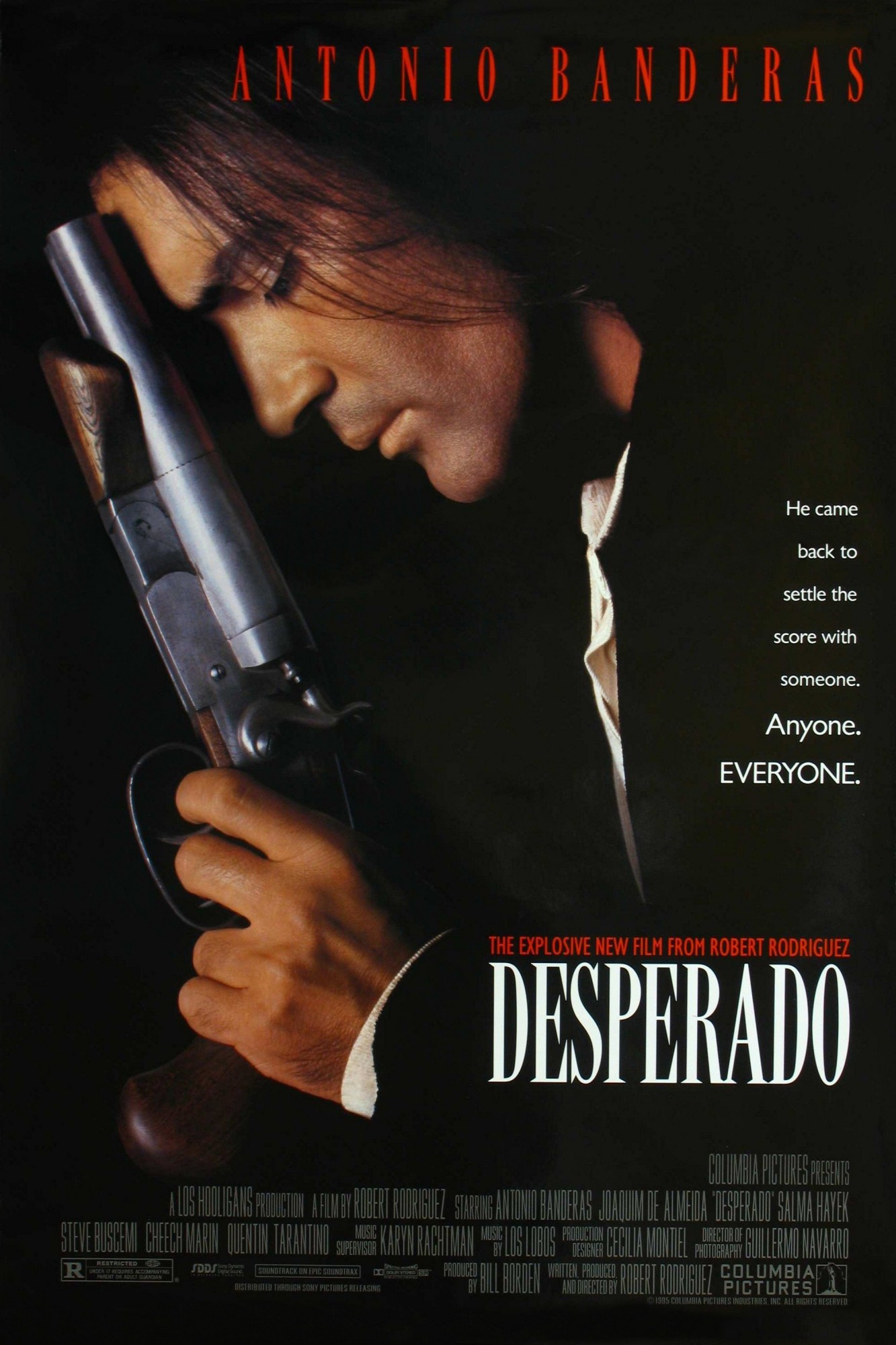
To no one’s surprise but the producer’s, Robert Rodriguez’s bigger-budget spin-off/remake of (and occasional sequel to) his impressive action quickie El mariachi doesn’t stand comparison with its predecessor. On the other hand, Rodriguez is clearly a talent to watch, and there’s plenty to be entertained or impressed by here — fancy, violent action sequences (which gradually develop from barroom shoot-outs to outright war battles); a feisty interaction between hero (Antonio Banderas) and heroine (Salma Hayek) that suggests the influence of Howard Hawks; some enjoyable actorly bits by Cheech Marin, Quentin Tarantino (who’s at least around long enough to tell a funny joke), and Steve Buscemi; an enjoyable villain (Joaquim de Almeida, not a gringo here as he was in El mariachi); a nice Mexican score by Los Lobos; and even a halfway tolerable twist in the plot. What’s mainly missing is the sort of conviction and passion that gave El mariachi its charge; one feels at almost every moment that Rodriguez is fulfilling a contract rather than saying something he has to say. There’s a lot of panache here, but not much inspiration. (JR)
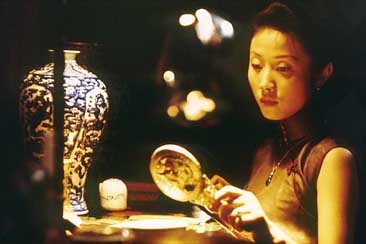
From The Guardian (June 6, 2003). Happily, Fei Mu’s 1948 masterpiece is now available on a decent DVD with English subtitles from the BFI, and I’ve recently written a lengthy essay about it for the final issue of the French quarterrly Trafic, to be published in French this fall and on this site in English around the sane time..– J.R.
If I had to pinpoint what makes so much of contemporary life intolerable, something I’d call remake mentality might head the top of the list. The mindset that dictates that anything new has to be a recycling of something familiar — that old markets be exhausted before any new ones are contemplated, and that viewers be regarded as mindless brats demanding only more of the same — is so common by now that it has become fully internalised, and not only within the film industry.
The fact that we’re supposed to be looking forward to two sequels to The Matrix in the same year implies that we are fixed marketing units, programmed to relish staying in our well-appointed ruts. But there are just as many spinoffs predicated on our ignorance of the originals, suggesting that the avoidance of fresh thinking may not simply be our own. Read more
Written for Sight and Sound‘s blog in July 2011. — J.R.
Not exactly a film festival or a conference in the usual sense, Il Cinema Ritrovato has many of the benefits of each without their professional drawbacks -– namely the frantic boom-or-bust atmosphere promulgated by the entertainment press at Cannes, and the relative dullness and institutional oppressiveness of a long succession of academic papers.
A relaxed yet intense eight-day bash devoted to film restorations, Il Cinema Ritrovato is held over some of the hottest days of the summer in the oldest university town in Europe, and sponsored by one of film restoration’s leading institutions, the Cineteca Bologna, which boasts the rejuvenation of Charlie Chaplin’s works among its achievements. Frequented chiefly by teachers, students, archivists, programmers, film historians and various others involved with restoration (such as people working for various DVD labels), the events are usually split between three auditoriums in the daytime –- although this year a fourth screen was added, making for many more choices as well as conflicts -– followed by huge, free outdoor screenings for everyone in the Piazza Maggiore every evening.
Whether the individual attractions are populist (among the Piazza restorations this year were Nosferatu (1922) and The Phantom of the Opera (1925) with full-scale orchestral -– and in the latter case vocal -– accompaniments, Les Enfants du Paradis (1945), the 1940 Thief of Bagdad and Taxi Driver (1976) or more specialized (some of this year’s retrospective subjects were Boris Barnet, Albert Capellani, early Howard Hawks, Elia Kazan and educational documentaries by Eric Rohmer, Maurice Tourneur and Conrad Veidt), the opportunities to reevaluate film history are plentiful. Read more
For those who share my suspicion that most of the language we encounter nowadays no longer comes from human beings, check out the first three items in “Harper’s Index” (in the November 2025 Harper’s), which reports that 2024 was the first year in which more internet traffic was generated by bots (51%) than by people (49%). But talk about cognitive dissonance: the cover story of the same issue of Harper’s is a roundtable discussion about why so many people mistrust journalism now. Surely the fact that most of the language we encounter every day, on the street or in our homes, everywhere we go, is blatantly insincere, inflated advertising–lies designed to pick our pockets and cheat our emotions—has something to do with the awfulness of our shared contemporary culture. It’s a disease that infects us all, yet it appears that we no longer trust language enough even to discuss it.
Excerpted from Movie Wars: How Hollywood and the Media Limit What Films We Can See (A Cappella Books, 2000).From the Chicago Reader (November 17, 2000). — J.R.
Nowadays the line between journalism and publicity is often blurred, and one common, systematic method of blurring it is the movie junket. Generally a studio flies journalists to a location where a movie’s being shot or to a large city where it’s being previewed, puts them up at fancy hotels, then arranges a series of closely monitored interviews with the “talent,” most often the stars and the director. The journalists are expected to go home and write puff pieces about the movies that run in newspapers and magazines as either reportage or as a form of film “criticism.” If the journalists don’t oblige — and sometimes obliging entails not only favorable coverage but articles that emphasize what publicists want emphasized and suppress what they want suppressed — then the studios won’t invite them on future junkets.
There are probably more of these articles about new or forthcoming movies in newspapers and magazines than any other kind, and many entertainment writers — including plenty who double as film reviewers — make a profession out of these junkets. Read more
A column for Caiman Cuadernos de Cine, submitted May 28, 2018. — J.R.
The commodification of film categories that publicists otherwise find difficult to market — especially “independent,” “restoration,” and “film noir”—often involves a certain amount of deception when it comes to existential identities.
“Independent” became a commercial category only after moguls maintained that the Sundance Festival was devoted to celebrating films without studio backing — even though “success” at Sundance meant a studio sale that typically entailed a loss of independence. “Restoration” is a label that absurdly gets slapped onto all sorts of real or alleged upgrades of older films, such as one with a newly mutilated and reconfigured soundtrack (the 1992 rerelease of Orson Welles’ Othello), a re-edit (the 1998 Touch of Evil), a belated first edit (the posthumous 2018 The Other Side of the Wind), and sometimes merely a new print. And “film noir” — a term whose meaning has already been slippery to begin with, applied retrospectively to a group of films said to share certain stylistic, formal, and thematic traits — now functions ahistorically and sometimes deceptively while increasing the market value of a given feature by obfuscating its politics.
On Criterion’s new Blu-ray of Frank Borzage’s Moonrise (1948), Peter Cowie’s interview with Hervé Dumont — whose book on the director should be shelved alongside Chris Fujiwara’s book for the same publisher (McFarland) on Jacques Tourneur — primed me perfectly for my second look at this masterpiece. Read more
R.I.P. Nicolas Roeg, 1928-2018. From The Movie no. 85, 1981.— J.R.
It is surely more than just a coincidence that director Nicolas Roeg has used leading pop stars and rock personalities in three of his five features to date. The sheer satanic presences of Mick Jagger in Performance (1970), of David Bowie in The Man Who Fell To Earth (1976) and, to a lesser extent, Art Garfunkel in Bad Timing (1980), all have something slightly magical about them — as if they held the implicit promise that unusual and outsized events were going to take place around and, in large measure, because of them. Boldly delineated in each case like the demonic princes of dark impulses, they are offered as guides and portals into the decadent fantasies which these films often traffic in. As Roeg told critic Harlan Kennedy in an interview:
What I find interesting about singers is that they all have the qualities of performers but they’re untouched in terms of acting. They’re not from the New York school of this or that: they’re not from the London theatre….So many actors have lost their intent, their beginnings. They’re not this travelling group of players that one evening is a king, another evening is a beggar.Read more
Written for my collection Cinematic Encounters 2: Portraits and Polemics (2019), although it has also appeared by now in Spanish (in Caiman Cuadernos de Cine,November 2018), in Persian (in Sazandegi, December 19-20, 2018), and in French (in Trafic,March 2019). The Other Side of the Wind is still visible and available on Netflix, but I think we’re still a long way from it being adequately “digested” or coherentlydismissed, much less adequately defined. (I’ve also heard from Criterion, which has an arrangement with Netflix, that they have no plans to release the film digitally.) Even those who consider it a failure haven’t, for the most part, come up with very persuasive accounts of what it is and does. Superficial replays of rumors about the film that circulated decades ago, many of them half-baked, continue to predominate. But of course this is nothing new when it comes to groping after the meaning and value of Welles’ work, which rarely comes at the time a film is released,. — J.R.
The Other Side of the Argument:
First Thoughts on Orson Welles’s Demonic Fugue
The only time I ever met Orson Welles — in 1972, in response to a letter of mine, to discuss his very first Hollywood project, an updated adaptation of Conrad’s Heart of Darkness that I was writing about — I also had occasion to ask him about the status of his more recent projects. Read more
An email from Cindy Keefer updating and correcting much of what follows:
Dear Jonathan,
I hope this reaches you.
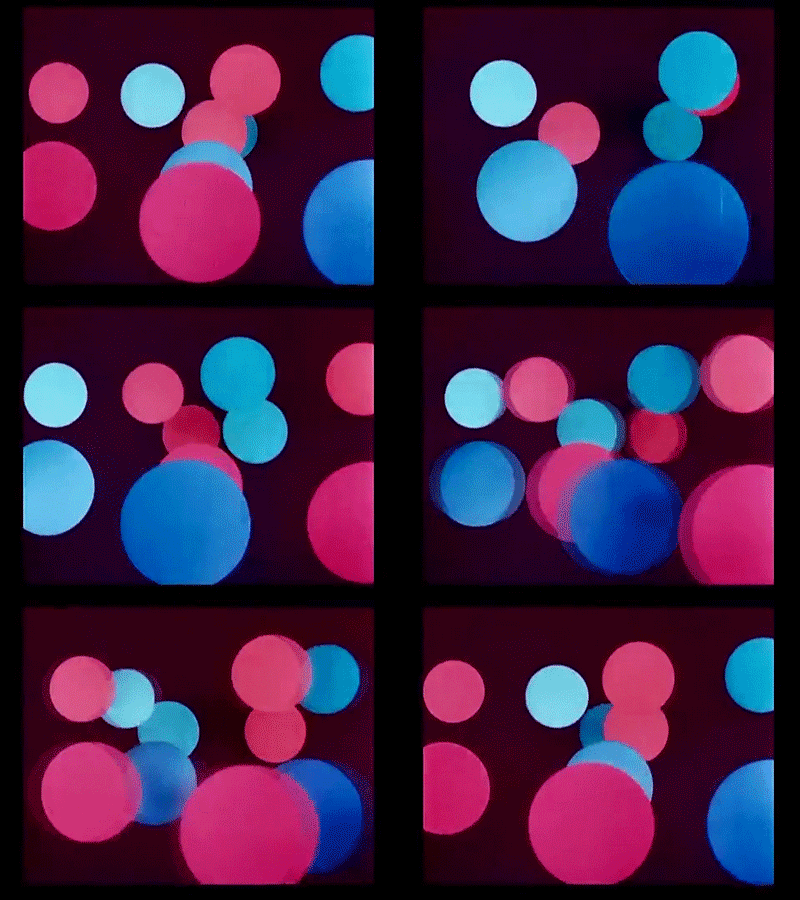
I just noticed and am very curious why you’ve reposted a 17 year old post about Oskar Fischinger on your blog, reposted on Jan 26, 2018. And those “up to the minute additions” by me at the end, are years old now, definitely no longer up to the minute!! More of the info you have given has changed by this point; one detail is that Center for Visual Music now owns the Fischinger films (gift from the Fischinger Trust). Thus, all those films stills you have online are now (c) Center for Visual Music.
Since then there has been a LOT more Fischinger news, exhibitions and releases – and just now, a new Oskar Fischinger DVD release! Info below.
ALSO – as you may know, I am the curator/archivist for the restoration/reconstruction of Oskar Fischinger: Raumlichtkunst, which has been exhibited in museums worldwide. Though credited incorrectly, you did give some attention to this in artforum in 2012 (my name was excluded as curator, and credit was mistakenly given to a Whitney curator, much to my chagrin). That HD three projector installation continues to be exhibited, most recently in San Francisco, in New Zealand, and at the Whitney for the second time in the recent Dreamlands exhibition.
With its continuing devotion to the independent and marginal, the Rotterdam Film Festival offered fewer peaks this year than last, but more than enough rolling happy valleys in between. Full-bodied retrospectives given to Jonathan Demme and Nelson Pereira dos Santos wove their way almost contrapuntally through the nine days of movies -– providing the selection with a sturdy populist backbone. Guided by the Langlois-like eclecticism and passion of director Hubert Bals, the festival virtually rebaptises every film that it shows under the banner of a relaxed, low-budget freedom that the Spielbergs and Coppolas can only dream about.
Pereira dos Santos and Demme are cases in point. From the sixteenth century (How Tasty Was My Little Frenchman) to the post-nuclear future (Who Is Beta?) to the impoverished present (Rio, 40 Degrees; Vidas Secas), dos Santos’ films blend anthropological wit with neo-realist compassion. The sociological wit and Renoir-like warmth of Demme exude a comparable bias towards the downtrodden. Oddly enough, the two sensibilities nearly come together in the very different pop/folk musicals Estrada da Vida (1980) and Stop Making Sense (1984). Respectively a docu-drama about wall painters who make it big as country singers in Sao Paulo, and an on-stage concert performance by the Talking Heads, both films make striking use of flat colour backdrops to objectify and enhance the cultural clout of the performers. Read more
From the Chicago Reader (February 1, 1988). — J.R.
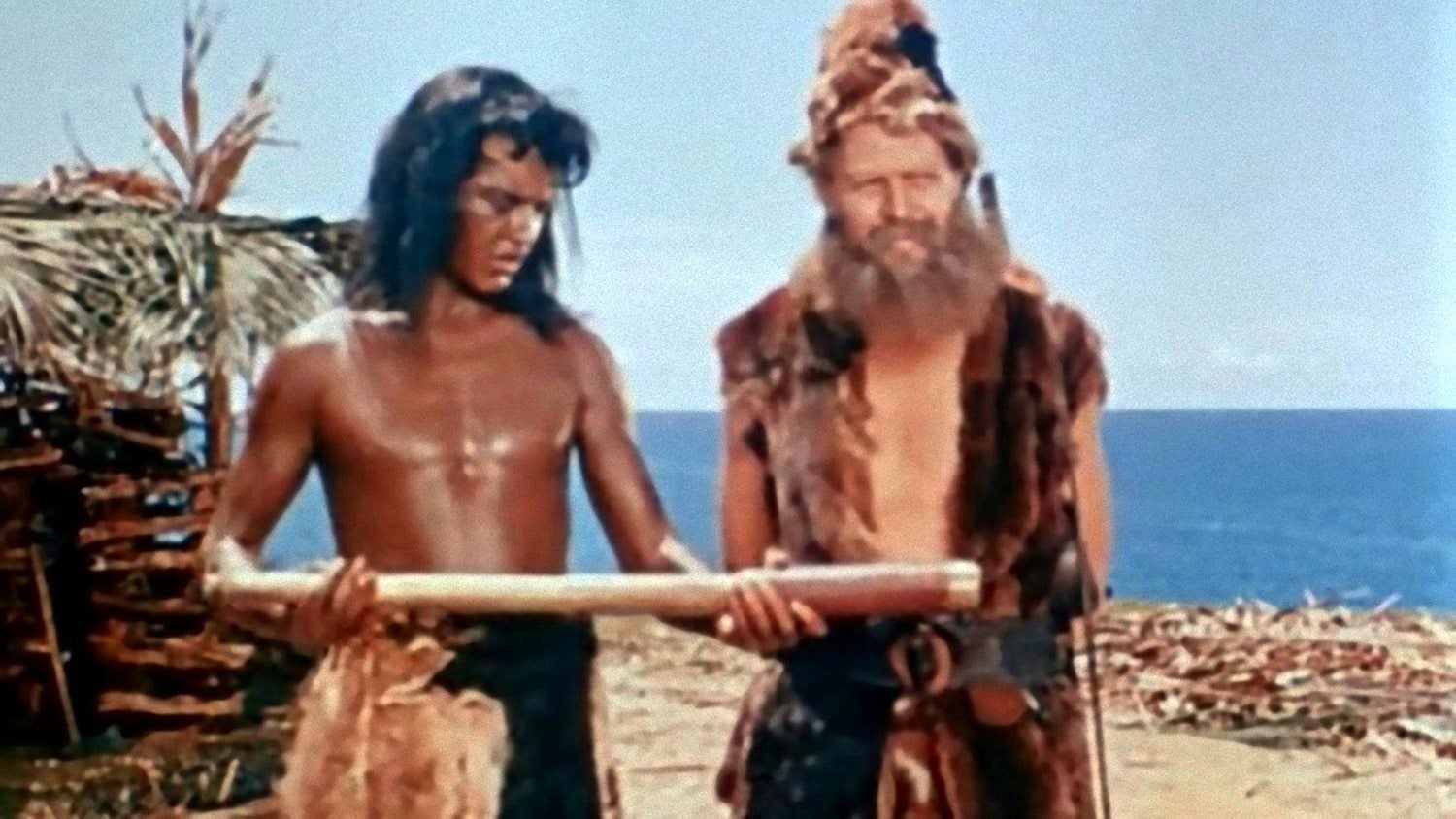
One of the most unjustly neglected of Luis Buñuel’s films, this 1952 feature also happens to be one of the two he directed in English (the other is the equally neglected The Young One). Buñuel shows an overall fidelity to the plot of Daniel Defoe’s classic novel while steering the thematic concerns in a somewhat different direction, and even manages to incorporate a few touches of surrealism. Dan O’Herlihy is superb in the title role (he was nominated for an Oscar when this film was belatedly released in the U.S.), while Jaime Fernandez makes a more than adequate Friday. The color photography is also distinctive. 90 min.
This appeared in the June 11, 1993 issue of the Chicago Reader; I’ve also appended an irate response from a reader that appeared in a subsequent issue, along with my response. –J.R.
CLIFFHANGER
** (Worth seeing)
Directed by Renny Harlin
Written by Michael France and Sylvester Stallone
With Sylvester Stallone, John Lithgow, Michael Rooker, Janine Turner, Rex Linn, Caroline Goodall, Leon, Paul Winfield, and Ralph Waite.
Kitsch is the daily art of our time, as the vase or the hymn was for earlier generations. For the sensibility it has that arbitrariness and importance which works take on when they are no longer noticeable elements of the environment. In America kitsch is Nature. The Rocky Mountains have resembled fake art for a century.
There is no counterconcept to kitsch. Its antagonist is not an idea but reality. To do away with kitsch it is necessary to change the landscape, as it was necessary to change the landscape of Sardinia in order to get rid of the malarial mosquito. –Harold Rosenberg, The Tradition of the New (1959)
Cliffhanger #1 (rating: four stars): Towering mountain ranges, yawning chasms, awesome expanses of stony matter, endless reaches of empty space, daunting inclines, imposing immensities that cause your jaw to drop and freeze into a painful rictus. Read more
It appears that I hated Basic Instinct when it came out in 1992 (this review appeared in the Chicago Reader on April 3), before I became something of a diehard Paul Verhoeven fan, and now I like the movie a lot. Or maybe I was a fan back then, at least in a back-handed sort of way, and wouldn’t or couldn’t admit this to myself. I offer the following as evidence of my former position, whatever it might have been.– J.R.
BASIC INSTINCT
No stars (Worthless)
Directed by Paul Verhoeven
Written by Joe Eszterhas
With Michael Douglas, Sharon Stone, George Dzundza, Jeanne Tripplehorn, Denis Arndt, Leilani Sarelle, and Dorothy Malone.
By Jonathan Rosenbaum
What’s really news about Basic Instinct isn’t that it’s number one at the box office; after all, that happens to some movie every week. Nor is it that you get to see Sharon Stone’s (quite ordinary looking) twat for a few seconds when she uncrosses her legs. Even the bisexual and lesbian psycho serial killers, which gay groups are protesting, aren’t news.
No, the real news about Basic Instinct is that Joe Eszterhas got $3 million for the script. This is clearly a script that’s going to be studied and emulated for some time to come. Read more
From the Chicago Reader (December 5, 2003); also reprinted in my collection Goodbye Cinema, Hello Cinephilia. I’m delighted to report that Wichita became available on DVD, and in the correct CinemaScope format, in 2009. — J.R.
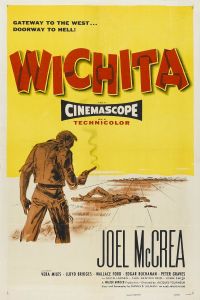
Wichita
**** (Masterpiece)
Directed by Jacques Tourneur
Written by Daniel B. Ullman
With Joel McCrea, Vera Miles, Lloyd Bridges, Walter Coy, Wallace Ford, Edgar Buchanan, Peter Graves, Jack Elam, and Mae Clarke.
One reason why Jacques Tourneur (1904-1977) remains a major but neglected Hollywood filmmaker is that elusiveness is at the core of his art. A director of disquiet, absence, and unsettling nocturnal atmospheres whose characters tend to be mysteries to themselves as well as to us, he dwells in uncertainties and ambiguities even when he appears to be studiously following genre conventions. In other words, his brilliance isn’t often apparent because he tends to stay in the shadows. As with Carl Dreyer, it took me years to fully appreciate the textures of his work, but now I can’t get enough of his films.
A case in point is Wichita(1955), Tourneur’s first film in CinemaScope and possibly the most traditional of all his westerns, showing in LaSalle Bank’s classic film series this Saturday.
Every gun that is made, every warship launched, every rocket fired signifies, in the final sense, a theft from those who hunger and are not fed, those who are cold and not clothed. This world in arms is not spending money alone. It is spending the sweat of its laborers, the genius of its scientists, the hopes of its children. This is not a way of life at all in any true sense. Under the cloud of threatening war, it is humanity hanging from a cross of iron.
–Dwight D. Eisenhower, from a speech to the American Society of Newspaper Editors, April 16, 1953