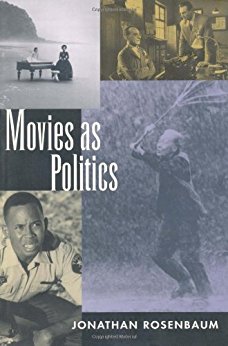
My introduction to my 1997 collection MOVIES AS POLITICS. — J.R.
A feeling of having no choice is becoming more and more widespread in American life, and particularly among successful people, who are supposedly free beings. On a concrete plane the lack of choice is often a depressing reality. In national election years, you are free to choose between Johnson and Goldwater or Johnson and Romney or Reagan, which is the same as choosing between a Chevrolet and a Ford — there is a marginal difference in styling. Just as in American hotel rooms you can decide whether or not to turn on the air conditioner (that is your business), but you cannot open the window.
— Mary McCarthy, Vietnam, 1967
I await the end of Cinema with optimism. — Jean-Luc Godard, Cahiers du cinéma, 1965
Thirty years later, both these general sentiments describe an impasse in American life that is vividly reflected in the movies we see and the ways that we see them. If the range of cultural choices apparently available at any given time merits some correlation with the range of political choices, it is also true that Godard’s optimistic apocalypse heralds a new scale of values, though we don’t yet know enough about these to be able to judge them with any confidence. Read more
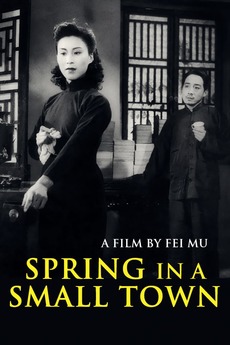
An astonishing and mysterious fact: I’ve just discovered from Google Analytics that over the past 28 days, more visitors to www.jonathanrosenbaum.net came from China (7,696) than from the U.S.(6,756) — even though the U.S. had a higher event count (37,219 over China’s 23,266). The only possible explanation for this that I’ve come up with is that I posted pieces in October about digital releases of a Jia Zhangke box set and Tian Zhuangzhuang’s remake of Fei Mu’s SPRING IN A SMALL TOWN.
From Film Quarterly, Vol. 36, No 4, Summer 1983. In 1996, during my first visit to Australia, I had the pleasure of “touring” with Feuer in various southern locations where we both lectured. -– J.R.
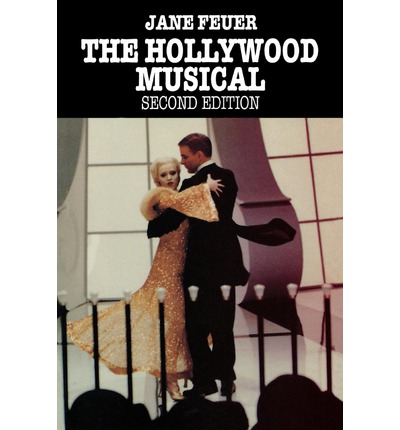
THE HOLLYWOOD MUSICAL
By Jane Feuer. Bloomingtion: Indiana University Press, 1982.
Since the advent of Pauline Kael and the anti-intellectual approach to popular genres that she has successfully championed, serious writing about the Hollywood musical that wishes to offer anything more than consumer tips, stray bit of gossip or trivial local evaluations — all useful enough services in their own right – has often had to remain doggedly academic in order to be recognized at all. Yet it is one of the rare virtues of Jane Feuer’s long-awaited The Hollywood Musical that, contrary to the ideological assumptions of the Kaelians and neo-Kaelians, it manages to be rigorously analytical and loads of fun at the same time. And thanks to Feuer’s witty style, the intellectual vantage point and the sense of play, far from seeming in any respect contradictory or inappropriate to its subject, work together to mutual advantage –- creating, like the musical itself, a high concentration of energy and grace under pressure.
Rick Altman’s excellent BFI Reader on the musical, which I reviewed in these pages last year, gave more than one foretaste of this possibility. Read more
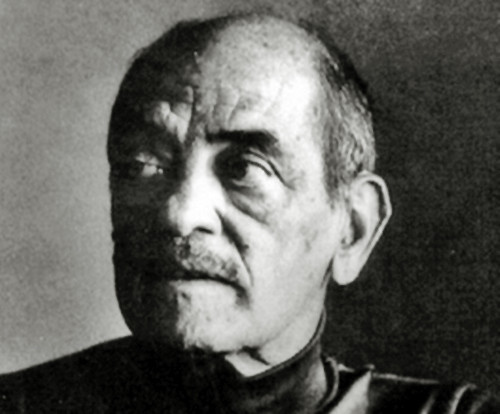
I’ve been revisiting a good many of Buñuel’s films lately, and a couple of traits of his work as a whole that I haven’t been sufficiently aware of in the past have been the centrality of class issues and his uncanny ability to predict or anticipate the future — not only the rise of terrorism but an escalation in income inequality and even, to my surprise, some of the lessons of feminism. These are traits that come together most tellingly and provocatively in his final feature, That Obscure Object of Desire (1977).
I’ve previously regarded this film as a bit of a letdown after the formal radicalism and thematic freedom of its immediate predecessors, The Discreet Charm of the Bourgeoisie (1972) and The Phantom of Liberty (1974). But it’s now more apparent to me that the play with multiple narratives really starts with The Milky Way in 1969 (or, much earlier, with Un chien andalou and L’age d’or), that the inability to complete a sex act in That Obscure Object complements and rhymes with the inability to finish a meal in The Discreet Charm, that the economic and sexual exploitation of That Obscure Object is already present in Tristana (1970), and that despite Buñuel’s reputation for kinkiness and cruelty, sadomasochism has never been his particular forte. Read more
From the World Socialst Web Site [wsws.org], January 6, 2020. I’m very grateful for the seriousness and care that David Walsh brought to this interview. — J.R.
I recently spoke to Jonathan Rosenbaum, the longtime and widely respected film critic for the Chicago Reader and author of numerous books on filmmaking. He has been writing about cinema and cultural life since the 1960s. His latest effort is a two-volume work, with the overall title of Cinematic Encounters, published by the University of Illinois Press. The first volume (November 2018) is subtitled Interviews and Dialogues, the second (June 2019) Portraits and Polemics. The books consist of essays, interviews and reviews covering several decades.
Jonathan Rosenbaum in Paris, 2017
Rosenbaum was born in Florence, Alabama in 1943. His grandfather owned and operated a small chain of movie theaters in the South, including one in Florence. Remarkably, Rosenbaum was raised in a house designed for his parents by the illustrious architect Frank Lloyd Wright. In a memoir, the critic describes himself during his youth as “an Alabama moviegoer who largely grew up in my family’s movie theaters.”
The convulsions produced by the civil rights movement and other social struggles clearly influenced Rosenbaum, as they did many members of his generation. Read more
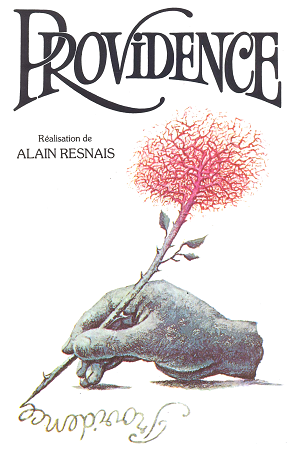
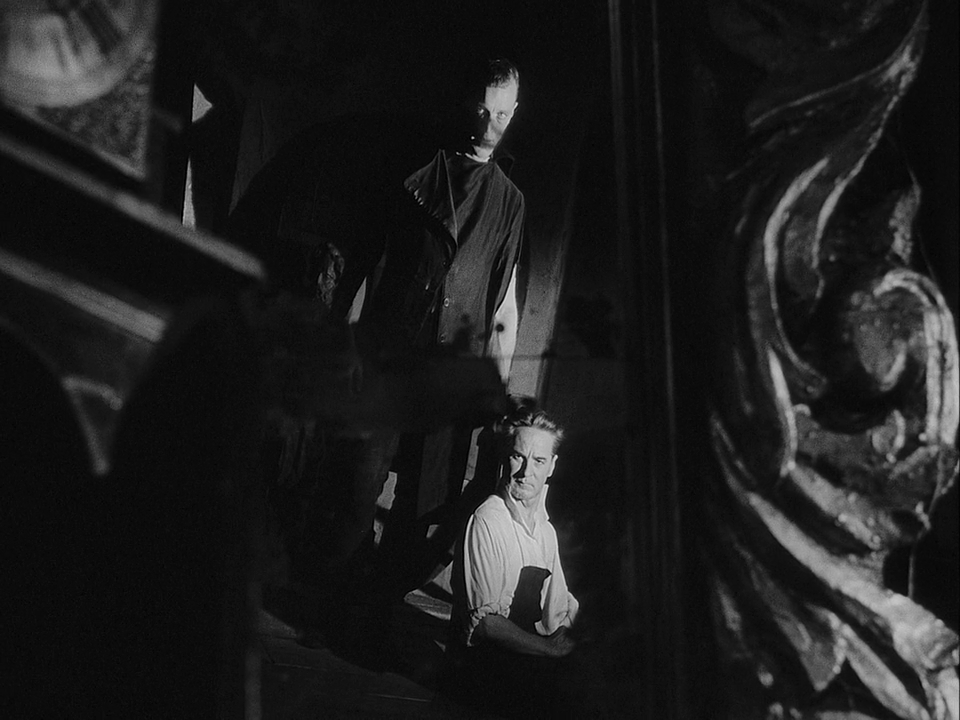
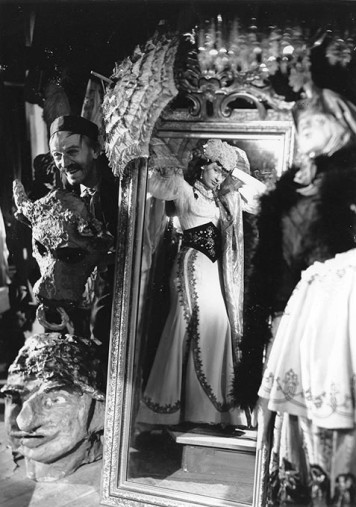
I shelled out $56.19 in US dollars (including postage) to acquire the definitive and restored, director-approved DVD of Providence (1977) from French Amazon, and I hasten to add that this was money well spent. Notwithstanding the passion and brilliance of Alain Resnais’ first two features, Providence is in many ways my favourite of his longer works, quite apart from the fact that it’s the only one in English. And I can’t ascribe this preference simply to the contribution of David Mercer (1928-1980). I recently resaw the only other Mercer-scripted film I’m familiar with, Karel Reisz’s Morgan!, and aside from the wit of its own sarcastic dialogue I mainly found it just as flat and tiresome as I did in 1966, for reasons that are well expounded in Dwight Macdonald’s contemporary review (reprinted in his collection On Movies).
I haven’t yet been able to see The Life of Riley (Aimer, boire et chanter), Resnais’ swan song, but clearly part of what gives Providence even more resonance now, writing less than a month after Resnais’ death, is the theme it shares with his penultimate feature, You Ain’t Seen Nothin’ Yet (2013): an old writer facing his own death, and trying to create some form of art in relation to it. Read more
I’m pretty sure that this was the first submitted draft of my commissioned Op Ed piecefor the New York Times, written in late July, 2007. It comes far closer to what I felt at the time than the version that emerged after three separate rewrites were requested by my editor, Mark Lotto, which was published on August 4, and which I hadn’t much desire to reprint until mid-October 2018, when I decided to attach the printed version as an afterthought. Typically, the title that was run with the piece, “Scenes from an Overrated Career,” wasn’t mine, yet paradoxically (if understandably) this was what many readers seemed to find most objectionable.
I’m sorry that I haven’t been able to illustrate the attic scene that I describe in The Magician, so I’ve substituted a still from Sawdust and Tinsel at the head of this piece that suggests some spatial disorientation. [2015 postscript: a generous reader, Dan Roy, has helped me out with the attic scene.] –- J.R.
If memory serves, my first taste of Ingmar Bergman was The Magician, seen at the 5th Avenue Cinema in the spring of 1960, en route from a New England boarding school to my home in Alabama during spring break. Read more
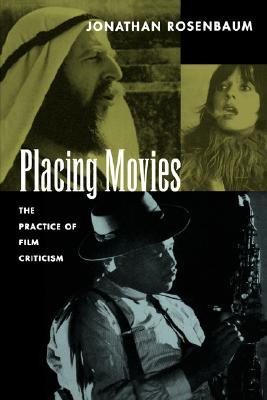
This is the Introduction to the second section of my first collection, Placing Movies: The Practice of Film Criticism (University of California Press, 1993). I’ve taken the liberty of adding a few links to some of the pieces of mine mentioned here which appear on this web site.
My original title for this section of the book was “Masterpieces,” but the editor, Ed Dimendberg, who had a much better sense of what was academically acceptable than I did, got me to change it to “Touchstones”. For the record, I still think that “Masterpieces” is better. — J.R.
It seems to me that one of the most underrated elements in criticism is quite simply information — relevant facts deriving from research — and how this is imparted to the reader in relation to other elements. Thanks to the prestige of theory in academia and the equally valued role played by rhetoric in journalistic criticism, facts often seem to be held in relatively low esteem in critical writing nowadays, but as long as criticism aspires to be a vehicle for discovery, it seems to me that research should play a much larger role than it normally does. I bring this matter up because the value of the information imparted in all the pieces in this section seems to me inextricably tied to what I have to say about these films, and my analyses would be appreciably different without it — a factor that is probably most obvious when it comes to GERTRUD and OTHELLO.* Read more
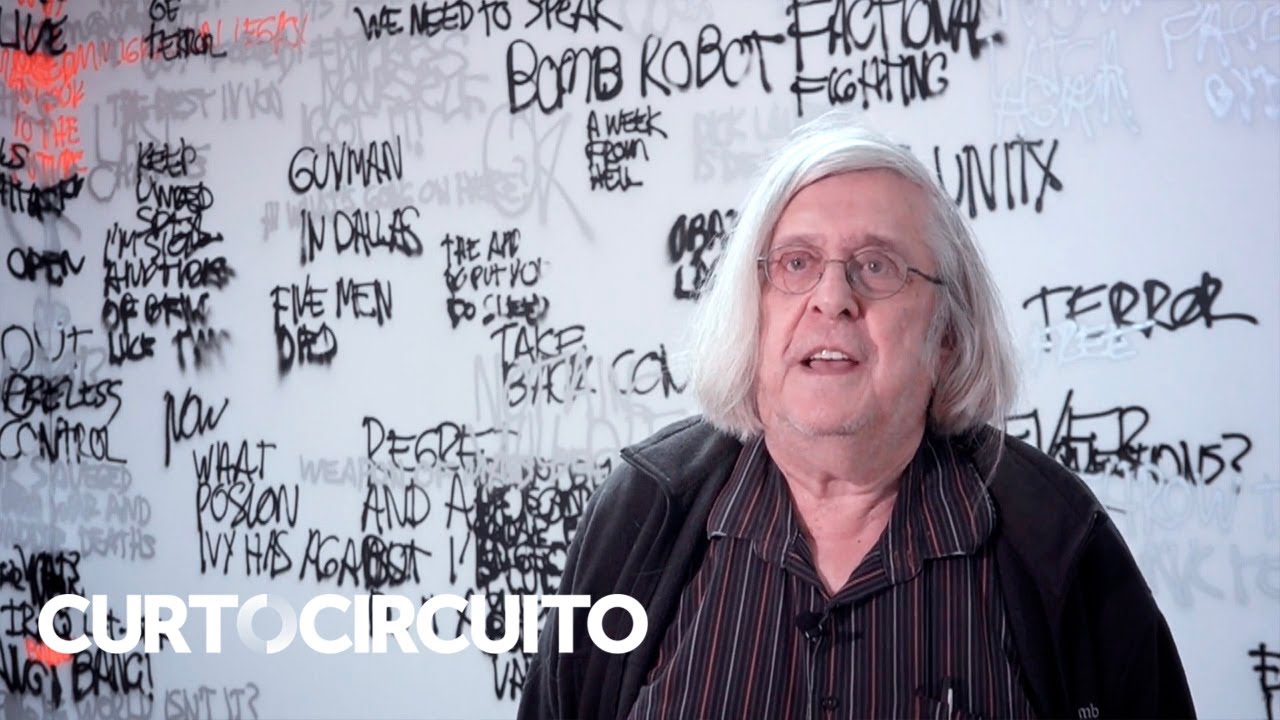
The following interview by Sara Donoso, printed in Spanish and English in Fotocinema no. 14 (2017), was conducted in Santiago de Compostela while I was serving on the jury of Curtocircuíto, the international festival of short films held there. I’ve taken the liberty of lightly revising Donoso’s English, and I’ve also retained her Spanish introduction.– J.R.
THE EXPANSION OF CRITICISM: AN INTERVIEW WITH JONATHAN ROSENBAUM
Sara Donoso
Universidad de Santiago de Compostela, España
saradonosocalvo@gmail.com
Crítico, ensayista y teórico de cine, la pluma de Jonathan Rosenbaum es de aquellas que practican el ejercicio de la resistencia; que se oponen a la clasificación, las etiquetas, al mundo del mainstream y a la cultura del espectáculo. Podríamos decir que es uno de esos críticos tal vez incómodos para algunos pero necesarios y reveladores para quienes aprecian el séptimo arte. Tras trabajar como principal crítico del Chicago Reader entre 1987 y 2008, actualmente sigue ejerciendo el ejercicio de la escritura cinematográfica a través de su página web, en la que no solo postea periódicamente reseñas de libros o películas sino que cuenta además con un archivo de publicaciones anteriores.
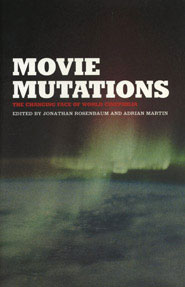
Como autor y editor, ha contribuido a través de diferentes proyectos a la difusión y dignificación del cine más allá de los circuitos comerciales, siendo responsable de títulos como Movie Mutations: The Changing Face of World Cinephilia (2003),Essential Cinema: On the Necessity of Film Canons (2004) o Goodbye Cinema, Hello Cinephilia: Film Culture in Transition (2010). Read more
From the Winter 2019 issue of Cinema Scope. — J.R.
Since I don’t have much investment in parsing Arnaud Desplechin’s arsenal of “personal” references, I had to look elsewhere for the intermittent pleasures of Ismaël’s Ghosts (2017), available on a two-disc Blu-ray from Arrow Films. I often find myself so hard put to navigate Desplechin’s multiple allusions to and borrowings from Philip Roth and Woody Allen (for me, the most overrated and least interesting members of his overstuffed pantheon), much less those from James Joyce, Alfred Hitchcock, Norman Mailer, and Alain Resnais, that I have to forsake any sustained effort to rationalize how these and countless other figures could all belong to the same curious tribe of role models. Maybe this is because Desplechin appears to regard these touchstones as sacred talismans more than as meaningful or helpful artistic influences. Apart from naming László Szabó and Louis Garrel’s characters “Bloom” and “Dedalus,” respectively, it’s difficult to determine how much he’s actually learned or adapted from Ulysses—and when he combines nods to both Ulysses and Vertigo (1958) in the name of Marion Cotillard’s character “Carlotta Bloom,” the whole thing begins to seem like the silliest kind of fool’s game. As for Ismaël himself (Mathieu Amalric), is his name supposed to start us thinking about Moby-Dick, the Bible, or maybe both? Read more
It’s important to acknowledge that part of what makes Jia Zhangke the most exciting and important mainland Chinese filmmaker currently active also makes him one of the most disconcerting and sometimes even bewildering. This has a lot to do with his propensity for viewing fiction and non-fiction, and, even more radically, fantasy and reality, as reverse sides of the same coin, and, in keeping with this complex duality, a talent for bold stylistic shifts not only between successive films but between and within separate sequences. His ambitions are such that even his ‘failures’ are worth more than the successes of many of his colleagues — and, for that matter, what we might describe as a Jia ‘failure’ often means simply a film that we should see again and reconsider.
Confounding us still further in A Touch of Sin (2013), his seventh feature, Jia reverses his previous position of avoiding on-screen violence by delivering it this time by the bucketful. In his earlier features, treatments of violence tended to be reticent or elliptical, so that government executions in Platform (2000) registered as distant gunshots and the tragic and fatal industrial accident of a construction worker in The World wasn’t shown at all. Read more
From the Chicago Reader (November 10, 2000). — J.R.
Films by Luis Buñuel
By Jonathan Rosenbaum
It seems to be universally agreed that Luis Buñuel (1900-1983) is the greatest Spanish-language filmmaker we’ve ever had, but getting a clear fix on his peripatetic career isn’t easy. The authorized biography, John Baxter’s 1994 Buñuel, isn’t available in the U.S., and the deplorable English translation of Buñuel’s autobiography, My Last Sigh (1983), is actually an unacknowledged condensation of the original French text. Better are an interview book translated from Spanish, Objects of Desire, and a recently published translation of selected writings by Buñuel in both Spanish and French, An Unspeakable Betrayal, which includes his priceless, poetic early film criticism.
A more general problem is that Buñuel is not only “simple” and direct but full of teasing, unresolvable ambiguities. A master of the put-on, he often impresses one with his earthy sincerity. A political progressive and unsentimental humanist, he was also, I’ve learned from Baxter, an active gay basher in his youth, and those who’ve read the untranslated but reputedly fascinating memoirs of his widow report that he was a very old-fashioned and prudish male chauvinist throughout his life. He was a onetime devout Catholic who lost his faith in his youth and was fond of exclaiming years later, “Thank God I’m still an atheist!” Read more
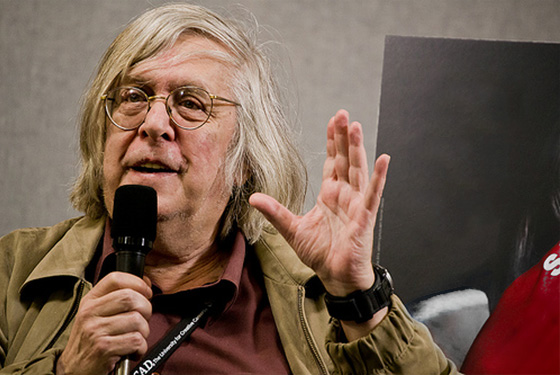
The following interview took place in a hotel lobby in early February 2020. My friend Kinga Keszthelyi, who arranged my visit to Budapest, is on the left, and Simon is on the right. — J.R.
From Movie Mutations to 1968:
An Interview with Jonathan Rosenbaum in Budapest
Simon Petri-Lukács
Jonathan Rosenbaum visited Budapest earlier this year to give a lecture about Abbas Kiarostami and Orson Welles. During this special seminar, he discussed the similarities in the two filmmakers’ relations to self-criticism and the dominating presences of investigations, interrogations and unsolved mysteries in both oeuvres.
I felt great liberation when I discovered Jonathan Rosenbaum’s criticism at the end of my teenage years. The stupidity of critics I was aware of at the beginning of my cinephilia actually led me to the nonsensical conclusion that I had to become a filmmaker to speak about other people’s films in an acceptable and intellectually satisfying way. On my first encounter with Jonathan’s work, I found what I didn’t know I was seeking and it changed my attitude forever. Having said that, it’s quite obvious that I was over the moon to be able to interview him.
I have been interviewing Alexander Horwath for the last two years about several topics and my main interest was to ask Jonathan about his book, Movie Mutations. Read more
My column for the abril 2018 issue of Caiman Cuadernos de Cine. — J.R.
“I personally can’t define the difference between a documentary and a narrative film,” Abbas Kiarostami once said to me, adding that he considered the difference between a good movie and a bad one more important. I would further note that films that blur distinctions between documentary and fiction, including Kiarostami’s, are sometimes better because they do so. This was recently brought home to me when I belatedly discovered that one of my favorite films of 2017, Heinz Emigholz’s Streetscapes [Dialogue], wasn’t a scripted restaging in Uruguay of the filmmaker’s psychoanalysis with its two original participants, as I had naïvely assumed, but a scripted restaging with an American actor and an Argentinian filmmaker — a discovery that made the film even more provocative and impressive.
When I start to reflect on the widely different ways in which documentaries and fictional narratives are shown and marketed, I begin to realize that obfuscating such issues are often marketing decisions, much as obfuscating distinctions between art and politics often turn out to be. As I suggested in my last column, while decrying the public indifference to Harvey Weinstein’s artistic crimes, this is business as usual in current transatlantic discourse — a recognition that Weinstein’s sexual crimes are “commercial” and his artistic crimes “non-commercial”. Read more
For a long time, I hesitated about reprinting this, but learning about Ray Carney’s unspeakable treatment of filmmaker Mark Rappaport (as detailed here) eliminated my compunctions.
For more about Rappaport’s work, here are three of the many links on this site:
Cassavetes on Cassavetes
Edited by Ray Carney. London and New York: Faber and Faber, 2001. 526 pp., illus. Paperback: $25.00.
The Films of John Cassavetes: Pragmatism, Modernism, and the Movies
by Ray Carney. Cambridge, New York and Melbourne: Cambridge University Press, 1994. 322 pp., illus. Paperback: $24.95.
John Cassavetes: The Adventure of Insecurity
by Ray Carney. Second Edition. Walpole, MA: Company C Publishing, 2000. 64 pp., illus. Paperback: $15.00.
Shadows
by Ray Carney. London: British Film Institute (BFI Film Classics), 2001. 87 pp., illus. Paperback: $12.95.
John Cassavetes: Lifeworks
by Tom Charity. London, New York and Victoria: Omnibus Press, 2001. 257 pp., illus. Paperback: $19.95.
As nearly as I can remember, I had two opportunities to meet John Cassavetes in the flesh, both times in New York, and I deliberately passed on both of them. Shortly after Faces came out in the mid-Sixties, a friend from my home town in Alabama who worshipped that film even more than I did — Shadows was still my own favorite then — came to town and found a way of contacting and then going to meet his idol, who was preparing Husbands at the time; he invited me to come along, and I declined. Read more