From the April 2015 Sight and Sound. Happily, both versions of both Macbeth and Othello are now available in the U.S. — J.R.
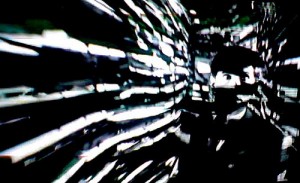
Who ever said Orson Welles’ filmography has to be neat? But one rudimentary way of bringing some order would be to distinguish between nine films he completed to his satisfaction (Citizen Kane, Macbeth, Othello, The Fountain of Youth, The Trial, Chimes at Midnight, The Immortal Story, F for Fake, and Filming Othello) and nine others he didn’t complete and/or lost control of (The Magnificent Ambersons, It’s All True, The Stranger, The Lady from Shanghai, Mr. Arkadin, Touch of Evil, Don Quixote, The Deep, The Other Side of the Wind). Yet even this isn’t as neat as it sounds, because he completed two separate versions of both Macbeth (1948 and 1950 — the second at the studio’s request — to eliminate the Scottish accents and shorten the running time by two reels; both are available today in France) and Othello (1952 and 1953; neither, alas, is commercially available anywhere — only an alteration of the second version, edited for the U.S. Read more
My liner notes for the Criterion DVD of the restored, 65 mm version of Jacques Tati’s Playtime, written in 2006. This also appears on Criterion’s web site, but, following the cue of an anonymous commentator there, I’ve corrected a confusing error that mysteriously appeared only in this online version of the essay. (It isn’t in the essay that’s included with the DVD.) — J.R.
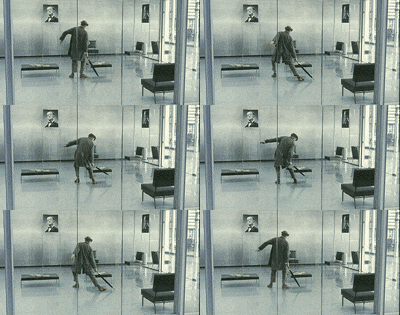
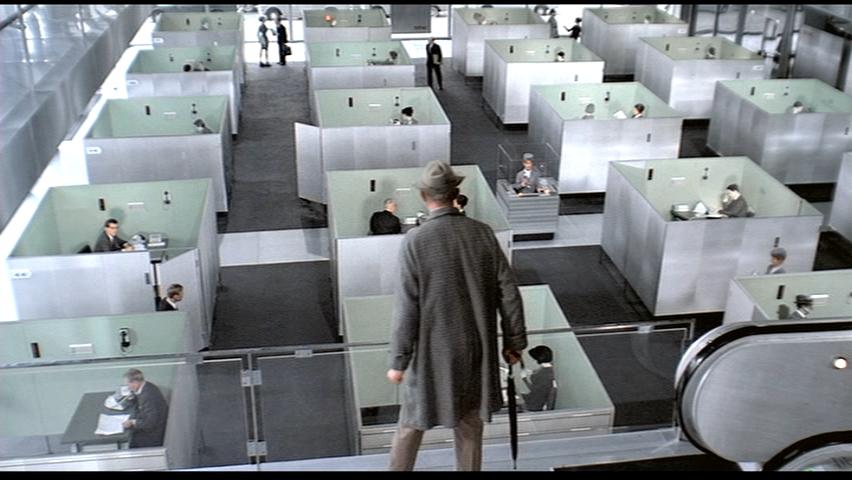
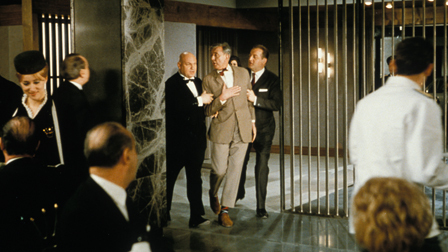
I suppose it could be argued that I saw Playtime for the first time in ideal circumstances — as an American tourist in Paris. Yet to argue this would mean overlooking the film’s suggestion that, like it or not, we’re all tourists nowadays — and all Americans in some fashion as well.
It’s a brash hypothesis, arguably somewhat middle-class and rooted in the assumptions of the 1960s — but then again, a great deal of what’s known today as “the sixties” can be traced back to the vision and activity of middle-class Americans. I was certainly enough of a middle-class American tourist to find myself bemused as well as amused by this account of a day spent in a mainly studio-built Paris — and sufficiently intrigued by the seeming absence of focal points during several busy stretches to return to the movie a couple of times. Read more
Written for the Criterion dual format (Blu-ray & DVD) edition of The Young Girls of Rochefort, released in a box set, “The Essential Jacques Demy,” in July 2014. This essay is also posted on Criterion’s web site. — J.R.

Braque, Picasso, Klee, Miro, Matisse . . . C’est ça, la vie.
— Maxence in The Young Girls of Rochefort
Life is disappointing, isn’t it?
— Kyoko in Yasujiro Ozu’s Tokyo Story
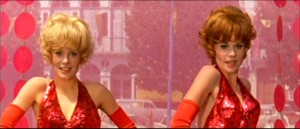
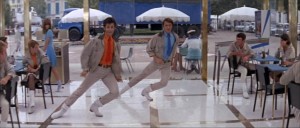

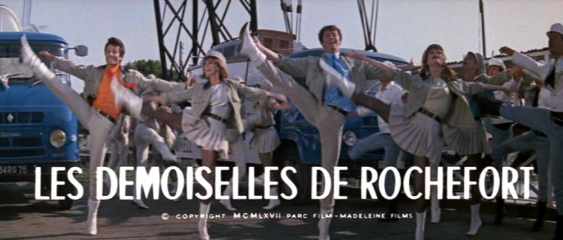
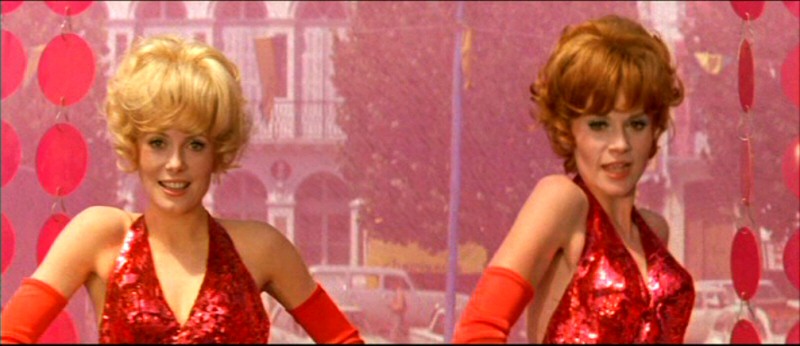
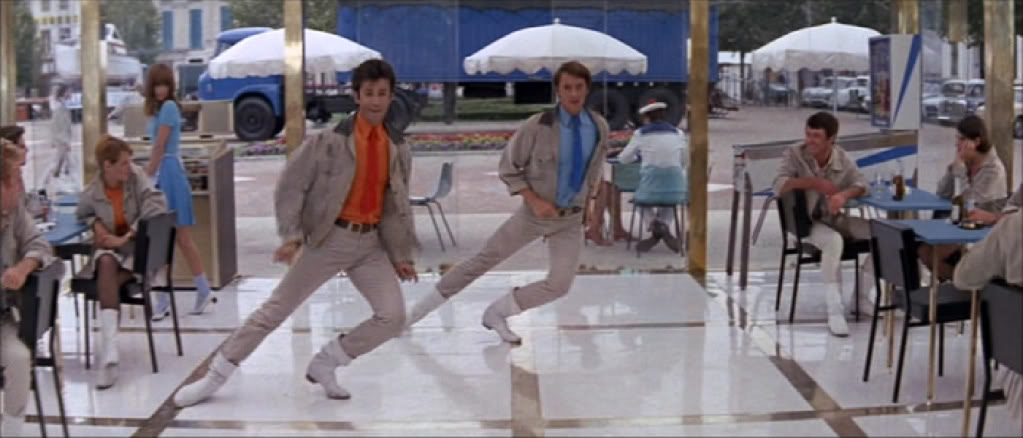
Broadly speaking, Jacques Demy’s The Young Girls of Rochefort (1967) is loved in France but tends to be an acquired taste elsewhere. From a stateside perspective, its launch in the U.S. in April 1968 was relatively inauspicious and uncertain. In the New York Times, Renata Adler began her two-paragraph notice by saying, “The Young Girls of Rochefort, a musical that opened at the Cinema Rendezvous, is another of those strange, offbeat movies produced by Mag Bodard in which a conventional, gay form is structured over what would be, in its terms, a catastrophe.” (The three other Bodard films she had in mind were Agnès Varda’s Le bonheur, Michel Deville’s Benjamin, and Demy’s previous film, The Umbrellas of Cherbourg. Read more
From the Chicago Reader (June 1, 2000). — J.R.

A failure, but an endlessly fascinating one. Between making his only SF film (The Damned) and his first successful art movie (The Servant), blacklisted expatriate Joseph Losey directed this 1962 film, adapted by Hugo Butler and Evan Jones from a James Hadley Chase novel, about a washed-up Welsh novelist of working-class origins (Stanley Baker) who unsuccessfully pursues a high-class hooker (Jeanne Moreau) while effectively driving his wife (Virna Lisi) to suicide. The film is pretentious and plainly derivative; I’ve always regarded as unwarranted and philistine Pauline Kael’s ridicule of Antonioni, Resnais, and Fellini in an article of the period called “The Come-Dressed-as-the-Sick-Soul-of-Europe Parties”, but she might well have included Losey’s film, with its clear debt to all three. It’s a painful testament of sorts (Losey himself can be glimpsed in a bar during a pan that also introduces the hero, showing his personal stake in the proceedings from the outset), though it makes wonderful use of locations in Venice and Rome and features an excellent jazz score by Michel Legrand (with a pivotal use of three Billie Holiday cuts). A decadent period piece and a sadomasochistic view of sexual relations, this singular, resonant, and at times even inspiring mannerist mess is far more interesting than a good many modest successes. Read more
2.

Part of what makes James Benning’s masterpiece such a satisfying culmination of his prodigious work in 16-millimeter is the way it both clarifies and intensifies the tension in his work between formal and political preoccupations, which could also be described as his love-hatred for industrial waste — a near-constant in his work.
You can find an excellent account of many of this film’s formal preoccupations from Kristin Thompson, who has just posted her comments on RR (seen at the same festival). [2020: I can’t easily provide a link anymore, but go to davidbordwell.net and search from there.] The political preoccupations of the film are partially outlined in Mark Peranson’s interview with Benning in Cinema Scope; they figure in some of the added sound materials (most obviously, Woody Guthrie’s “This Land is Our Land”), but even more crucially in the way many of the images (perhaps most notably the very last) manage to be both nostalgic and apocalyptic in the way they sum up what trains mean and have meant in relation to both American life and the American landscape. (As the interview suggests, sometimes the trains have to be understood not as parts of the landscapes but as despoilers of them.) Read more
From the Chicago Reader (November 4, 1994). — J.R.
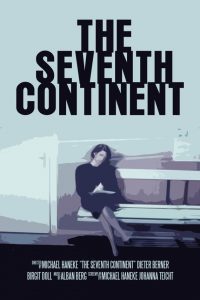
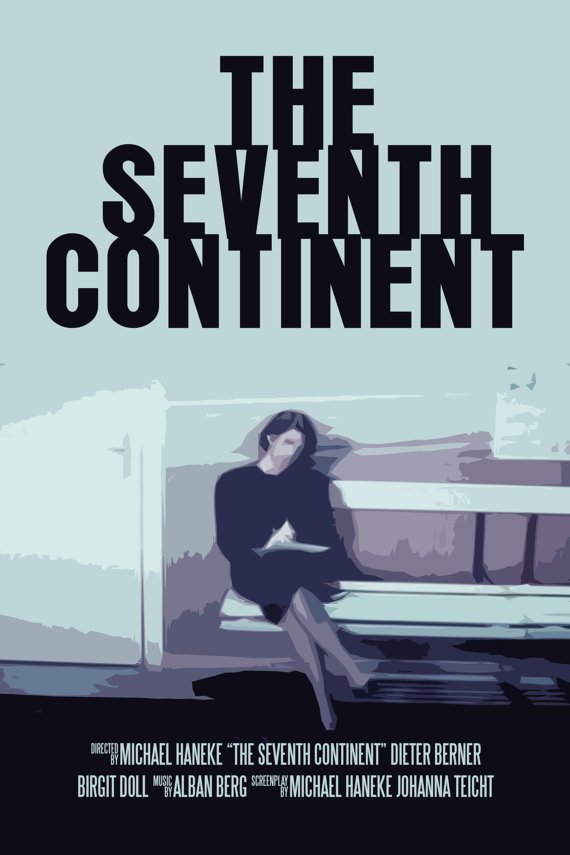
A powerful, provocative, and highly disturbing Austrian film by Michael Haneke that focuses on the collective suicide of a young and seemingly “normal” family (1989). Prompted by Austria’s high suicide rate and various news stories, the film’s agenda is not immediately apparent; it focuses at first on the family’s highly repetitive life-style, taking its time establishing the daily patterns of the characters. The roles of television and money in their lives are crucial to what this film is about, but the absence of any obvious motives for the family’s ultimate despair is part of what gives this film its devastating impact. Its tact and intelligence, and also its reticence and detachment, make it a shocking and potent statement about our times — to my mind a work much superior to the two other films in Haneke’s trilogy about contemporary, affectless violence, Benny’s Video and 71 Fragments of a Chronology of Chance. With Birgit Doll, Dieter Berner, Leni Tanzer, and Udo Samel. Facets Multimedia Center, 1517 W. Fullerton, Friday and Saturday, November 4 and 5, 7:00 and 9:00; Sunday, November 6, 5:30 and 7:30; and Monday through Thursday, November 7 through 10, 7:00 and 9:00; 281-4114. Read more
From the July 1, 1998 Chicago Reader. — J.R.
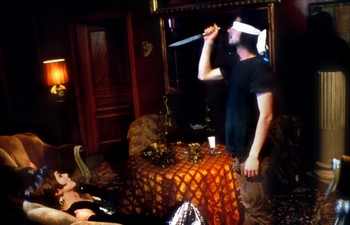
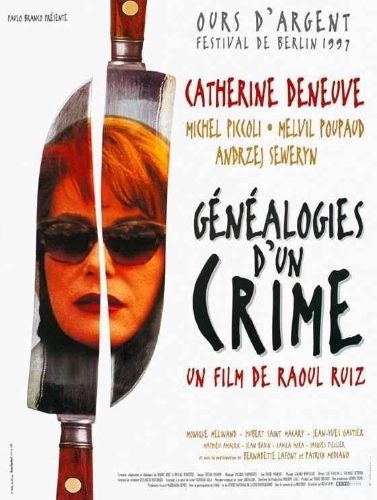
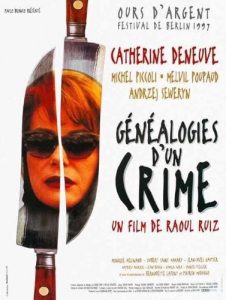
An uncharacteristically somber and mainly straightforward 1997 drama by prolific Chilean-born French postsurrealist Raul Ruiz (Three Lives and Only One Death). Catherine Deneuve plays a defense lawyer whose young client (Ruiz standby Melvil Poupaud) has murdered his aunt. (The aunt had belonged to a psychoanalytic group that believed criminal tendencies form by the age of five, an issue prominently debated throughout the film.) Over time the young man begins to associate the defense lawyer with his dead aunt while she identifies him with her dead son –a relationship that grows even stranger once the two become lovers. The film has strong perfomrmances by Deneuve and Poupaud as well as by Monique Melinand (as the lawyer’s mother), Michel Piccoli (as the head of a psychoanalytic group), and Bernadette Lafont. Beautifully shot and relatively concentrated for Ruiz — who usually prefers to ramble, constructing baroque visual tangents to his fictions — it delivers the sting of a sharp novella. (JR)
 Read more
A mild, romantic comedy-thriller, set in Austin, Texas, in 1954. If only the actors — Kim Basinger, Jeff Bridges, Rip Torn, and Gwen Verdon — had more to sink their teeth into, they could have had a field day; but writer-director Robert Benton gives them so little nourishment or stimulus that even a pro like Bridges seems somewhat bemused by the lack of material, while Rip Torn looks so bored with his own cardboard villain that he might as well be phoning in the part. Neither the setting nor the period is made distinctive, and apart from a few minor Hitchcockian jolts, the overall strategy seems to be banking everything on the behavioral cuteness of the two leads, who do the best they can with their condescendingly sketched-in southern working-class characters. Not even cinematography by Nestor Almendros can juice up the proceedings; the movie chugs along, but barely. Although Benton went to school in nearby Austin in the 50s, he seems to remember the movies he saw there better than the region, which is scaled down to sitcom proportions. (JR)
Read more
While lack of feeling is ascribed more often to Stanley Kubrick, Brian De Palma qualifies more as a detached formalist. Here the relative absence of directorial emotion works hand in glove with the slickness and cynicism (as well as craft) of this big-scale 1987 adaptation by David Mamet of the 60s TV series, shellacked with a grandiloquent Ennio Morricone score. The results are watchable enough, with a particularly adept use of Sean Connery, Chicago locations, and period details. But De Palma’s vulgar habit of copying and thereby reducing sequences from better directors is even more offensive when he turns to Eisenstein instead of the usual Hitchcock; his Odessa Steps hommage to Potemkin is the worst kind of kitschy student exercise. There’s much more of Kevin Costner (as Eliot Ness) here than there is of Robert De Niro (as Al Capone), though Costner is quite effective in setting the Reaganite law-and-order tone. Still, it’s a pity to have Charles Martin Smith eliminated so early in the proceedings. 119 min. (JR) Read more
It’s almost impossible to imagine an uninteresting film about Chuck Berry, but Taylor Hackford’s overextended and poorly edited documentary (1987) makes a stab at being one. There are, to be sure, some very enjoyable sequences — in particular some excerpts from a three-way conversation between Berry, Bo Diddley, and the volatile Little Richard — but a good deal of this film is devoted to a 60th birthday celebration concert for Berry that pairs him with Linda Ronstadt, Julian Lennon, Etta James, and others and tends to reduce him to a show-biz icon, the George Jessel of rock. What one misses most of all are some glimpses of the earlier Chuck Berry, as seen in the black-and-white rock movies of the 50s, when the intensity of his music and his jackrabbit moves had more satanic majesty. Berry is still a dynamite performer when he wants to be, but he’s done the same tunes so many times that he knows he can get away with relatively little, and too much of this film shows him at half-throttle. The film also skimps on certain portions of his career — most noticeably his brushes with the lawt — that are treated in fuller detail in his autobiography. Read more
Set mainly in and around an establishment called the Blue Water Grill in Texas, this is a small film, but within its own terms a delightful and virtually perfect one. The charactersthe dreamy grill owner (Gene Hackman), who compulsively watches home movies of his long-vanished wife; his grumpy yet serene father-in-law (Burgess Meredith); a slightly retarded handyman (Elias Kotias); and a bus driver (Teri Garr) who has her sights set on the grill owner — all seem to come out of Erskine Caldwell and Tennessee Williams, but Bill Bozzone’s capable script, Peter Masterson’s deft direction, and Fred Murphy’s handsome photography all show them off to best advantage, and the movie’s playlike story moves effortlessly. Funny and appealing, this is the kind of quiet and assured Hollywood movie that used to be more common in the 50s; the local flavor is caught perfectly, and every member of the cast shines. (JR) Read more
Despite the apparent havoc wreaked on this film by David Begelman–who eliminated 29 minutes from Michael Cimino’s cut and reedited the remainder more for action than for the meditative rhythms the director (who reportedly used Visconti’s The Leopard as a model) had in mind–this is one of Cimino’s best films, with a fine sense of spectacle and landscape, following the bloody career of Salvatore Giuliano (effectively played by Christopher Lambert), the violent and idealistic Robin Hood of the Sicilian peasantry in the 40s. The rhetorical self-importance of Cimino’s films makes them resemble Stalinist epics, and the nonstop wallpaper music of David Mansfield certainly doesn’t help this one. But the uncredited dialogue of Gore Vidal has a cynical, bantering polish that helps to keep things in perspective, and the film’s visual sweep commands respect even when it becomes hyperbolic, which is fairly often. (Steve Shagan receives sole credit for the script, adapted from Mario Puzo’s novel.) What emerges might be described as great moments from Michael Cimino’s The Sicilian. With Terence Stamp, Joss Ackland, John Turturro, Richard Bauer, and Barbara Sukowa in her first English-speaking role. (JR) Read more
Ridley Scott’s 1987 feature takes a conventional romantic police thriller script, written by Howard Franklin, and dresses it up like a Christmas tree. A happily married rookie police detective from Queens (Tom Berenger) is assigned to protect a wealthy and attractive Manhattan woman (Mimi Rogers) who is the material witness to a homicide by (you guessed it) a psycho who’ll stop at nothing (Andreas Katsulas). Despite class barriers and the detective’s devotion to his plucky wife (Lorraine Bracco), he and the witness fall in love and have an affair. While the actors show some sensitivity and Scott works up a modicum of suspense and involvement, the real interest of this picture is the radiance of the imagesa mastery of lighting and decor second only to Scott’s Blade Runner, with atmospheric textures so dense you can almost taste them. Unfortunately, this mastery bears only the most glancing relationship to the story at hand, and Scott becomes guilty of the sort of formalism that used to be charged (less justly) against Josef von Sternberg. But even though the movie doesn’t leave much of a residue, it looks terrific while you’re watching it: Manhattan has seldom appeared as glitzy or as glamorous. With Jerry Orbach, John Rubenstein, and a nice rendition of the Gershwin title tune by Sting. Read more
Richard Cheech Marin has expanded his video spoof of Bruce Springsteen’s anthem of the 80s, Born in the U.S.A., into a throwaway comedy that really delivers. Written, directed by, and starring Cheech himself and cheerfully indifferent to technique, the film follows a Mexican-American and his comic misadventures with the Immigration and Naturalization Service. The picture gets a respectable number of laughs out of the parallel multiple misunderstandings of the non-Spanish-speaking hero stranded in Tijuana and his equally monolingual Mexican cousin in LA, with plenty of healthy digs at the crassness of white Americans in dealing with Latinos on both sides of the border; it’s down-home ethnic humor with lots of sentiment and sincerity. (Chong appears only as a painting of Christ on the cross with eyes that open and shut.) With a supporting cast including Daniel Stern, Kamala Lopez, Paul Rodriguez, and Jan-Michael Vincent. (JR) Read more
Coming from the same director (Stephen Frears), writer (Hanif Kureishi), and producers (Tim Bevan and Sarah Radclyffe) who gave us My Beautiful Laundrette, this lively film about social and political turmoil in Thatcher England bears the same relationship to that earlier film as Richard Pryor Live on the Sunset Strip has to Richard Pryor Live in Concerti.e., a spontaneous gathering of forces whose energies and inspirations hit a raw nerve is succeeded by a more deliberate and self-conscious effort to bring the same powers into play. In this case, the return of corrupt, old-fashioned Rafi (Shashi Kapoor) to London to visit his son Sammy (Ayub Khan Din) and daughter-in-law Rosie (Frances Barber) reveals to him the cataclysmic changes the country has been undergoingrace riots, sexual warfare, and political upheavalsand he never quite recovers from the shock, even after he goes to see his old girlfriend Alice (Claire Bloom). When Sammy throws a dinner party for Rafi, he remarks to Rosie, We’ll round up the usual social deviants, communists, lesbians, and blacks, with a sprinkling of the mentally subnormal, and the rather stylized landscape of interracial couples, bombed-out streets, and multisexual adventurers goes beyond the relative naturalism of My Beautiful Laundrette to create a world more akin to the scene of 50s turmoil in the underrated Absolute Beginners. Read more