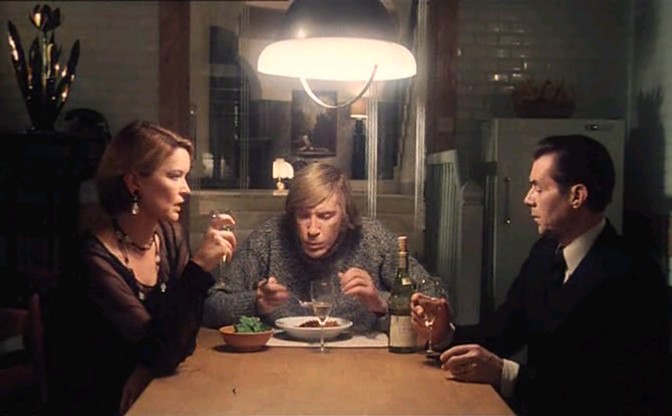
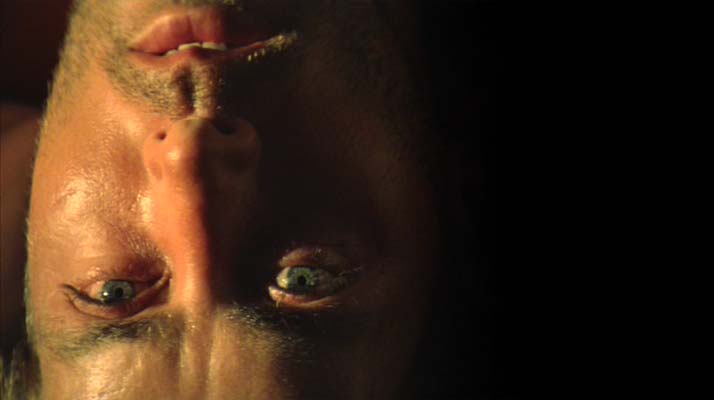
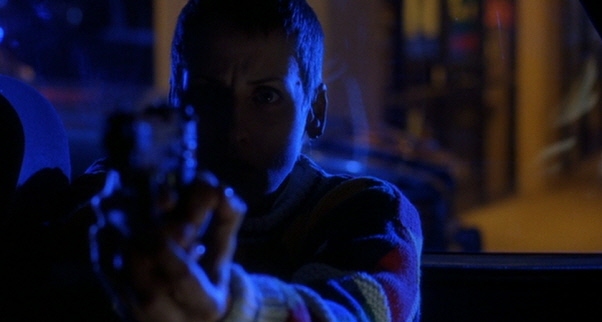
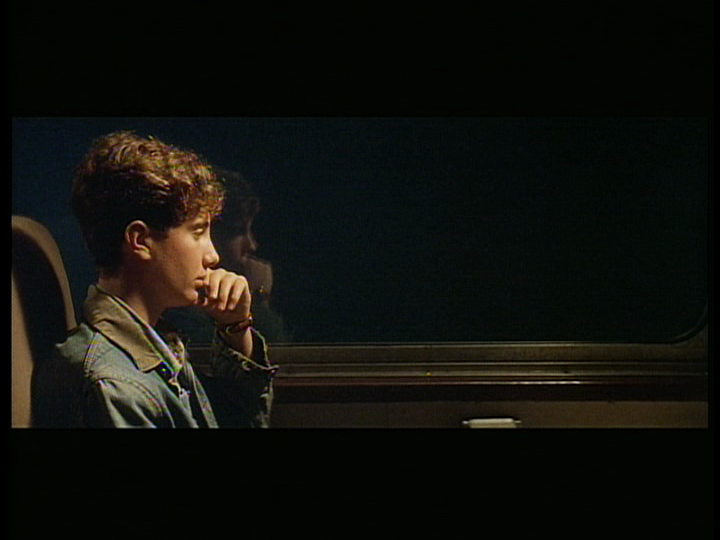
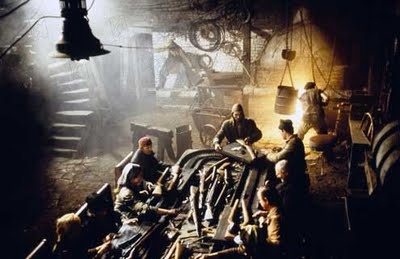
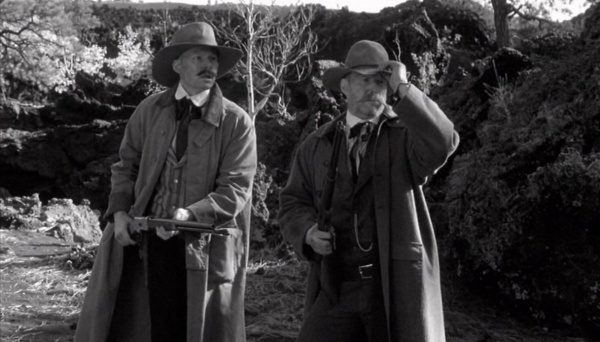
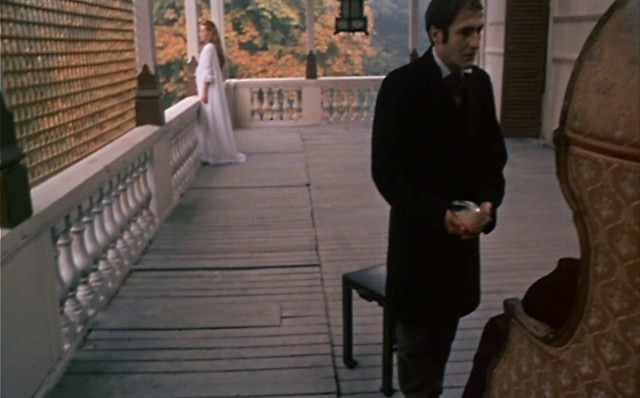
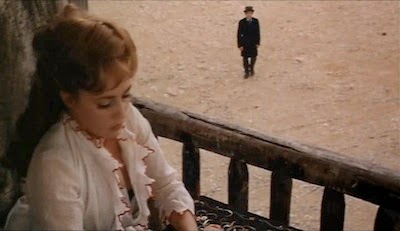
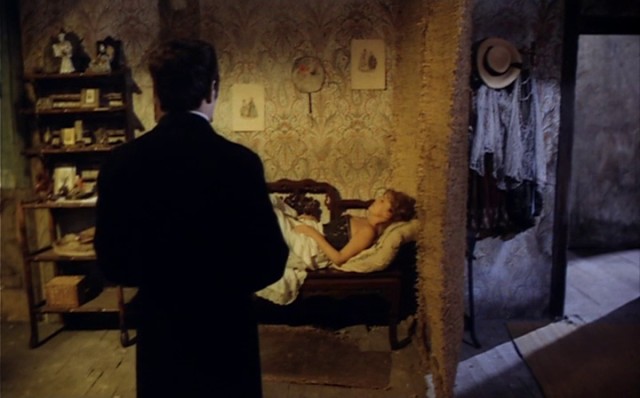
I shelled out $56.19 in US dollars (including postage) to acquire the definitive and restored, director-approved DVD of Providence (1977) from French Amazon, and I hasten to add that this was money well spent. Notwithstanding the passion and brilliance of Alain Resnais’ first two features, Providence is in many ways my favourite of his longer works, quite apart from the fact that it’s the only one in English. And I can’t ascribe this preference simply to the contribution of David Mercer (1928-1980). I recently resaw the only other Mercer-scripted film I’m familiar with, Karel Reisz’s Morgan!, and aside from the wit of its own sarcastic dialogue I mainly found it just as flat and tiresome as I did in 1966, for reasons that are well expounded in Dwight Macdonald’s contemporary review (reprinted in his collection On Movies).
I haven’t yet been able to see The Life of Riley (Aimer, boire et chanter), Resnais’ swan song, but clearly part of what gives Providence even more resonance now, writing less than a month after Resnais’ death, is the theme it shares with his penultimate feature, You Ain’t Seen Nothin’ Yet (2013): an old writer facing his own death, and trying to create some form of art in relation to it. Read more
Written for Lola no. 7, posted in November 2016. — J.R.
Suspense on Ice
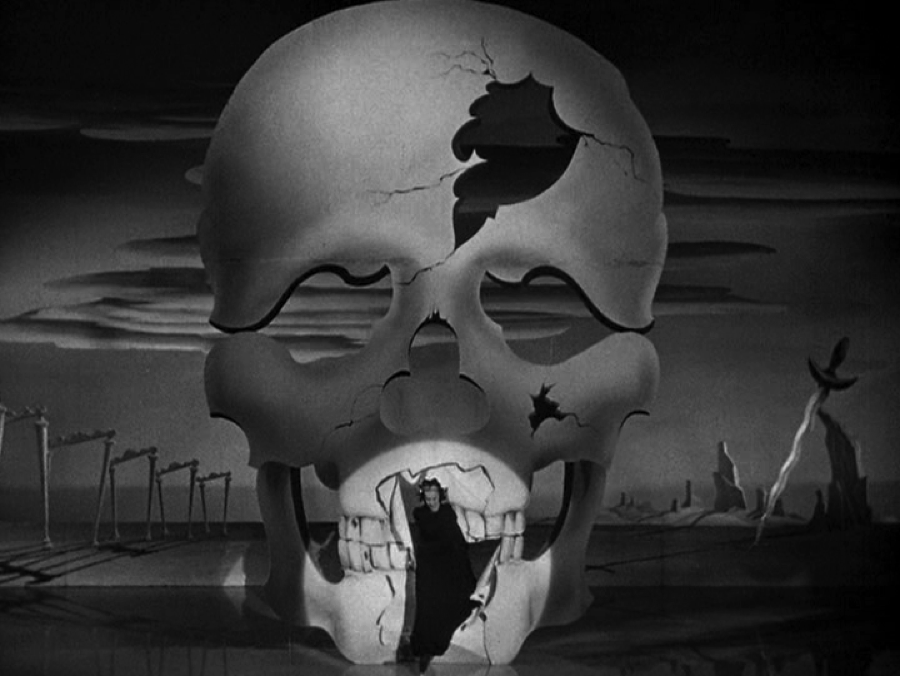
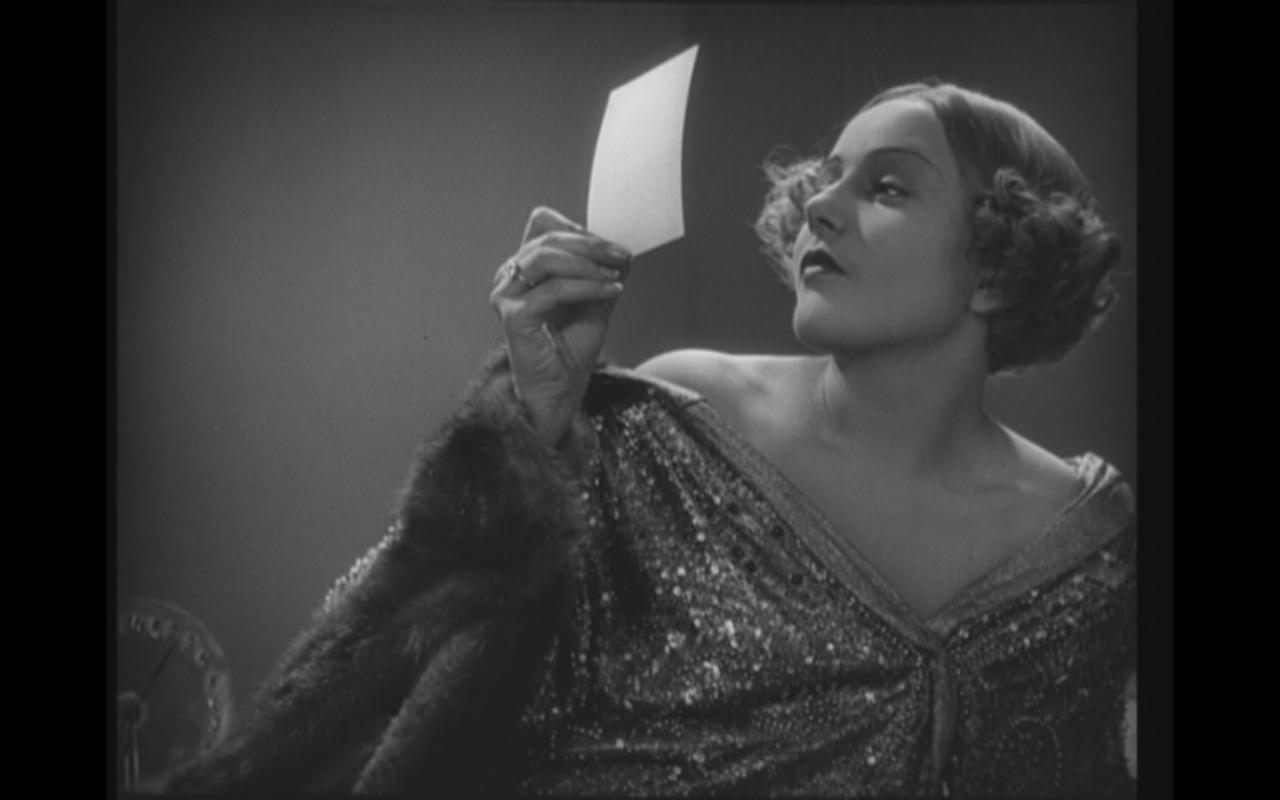
An ice-skating noir musical? More or less, with Belita serving as Monogram’s answer to Sonja Henie, and a few A-picture production numbers (such as the Daliesque one glimpsed above, climaxing with the heroine diving through a wheel ringed by long, sharp daggers pointed towards the center). Not quite a two-dollar movie (the Warners Archive DVD is pricier), but an intriguing curiosity. Philip Yordan’s original script is so pro forma that one can almost imagine him writing it in his sleep, In its early stretches, it suggests a lazy rip-off of Gilda, with different sexual inflections (no homoerotic undertones, no heterosexual love-hatred, and this time the hero and villain are the same character, played by Barry Sullivan), Yet most of it was shot at the same time as Gilda, in late 1945.
Most curious of all is the almost total lack of motivation whereby Sullivan, a thuggish tramp, gets accorded a free white coat and shave by the owner of The Ice Parade so that he can sell peanuts to the customers, and then, after dreaming up the wheel-of-dagger stunt, which Belita accepts without hesitation, gets asked by her husband-boss (Albert Dekker) to take over his position when he leaves on a trip, allowing Sullivan more of a chance to romance his beloved spouse and star. Read more
Written for the catalogue of Il Cinema Ritrovato, June-July 2016. — J.R.
Apocalypse Now
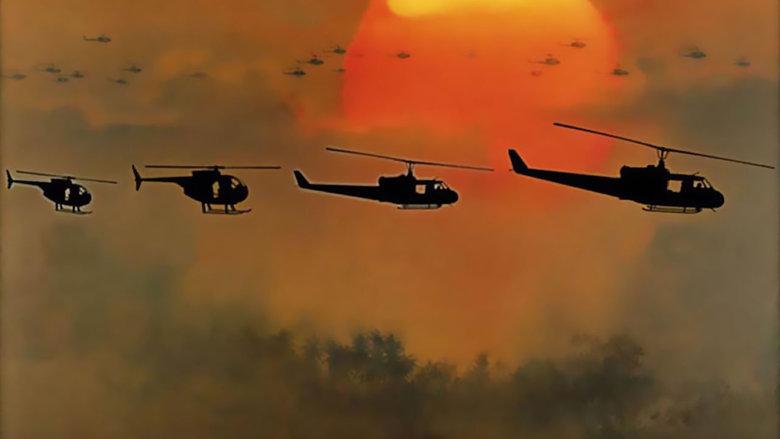
Like much of Coppola’s best work -– The Conversation, the Godfather trilogy, Bram Stoker’s Dracula –- Apocalypse Now teeters on the edge of greatness, and perhaps it wouldn’t teeter at all if greatness weren’t so palpably what it was lusting after. To my mind it functions best as a series of superbly realized set pieces bracketed by a certain amount of pretentious guff, some of which could be traced back to Joseph Conrad’s novella Heart of Darkness, the movie’s point of departure, as well as some powerful voiceover narration written by Michael Herr, whose book Dispatches offered some authentic glimpses of the war from the American side. Much of the guff, I would argue, stems from the fact that Coppola never quite worked out what he wanted to say, a fact he often acknowledged at the time. Indeed, Coppola’s continuing doubt is a major element of the saga being celebrated here: the Passion of the Artist writ large, made to seem far more important than the mere suffering and deaths of a few hundred thousand nameless and faceless peasants (and American soldiers) across the South China Sea. Read more
A column for Caiman Cuadernos de Cine, printed in their March 2023 issue (#170).. — J,R.
It’s because I don’t understand this woman, because I didn’t understand her at the trial, and I still don’t understand her now….That’s what I offer to the viewer—to ask him or herself questions.
Alice Diop
I still haven’t seen any Diop documentaries, but her first fiction feature, Saint Omer, is a classic example of a masterpiece asking questions without providing answers, and one of its best ways of doing so is refusing to cut to a reverse angle whenever one expects it. This is a film carried largely by close-ups and dialogue, and many of its reverse angles are between women in France who never meet, although they do exchange glances at one climactic moment.
It’s devoted to a French trial, based on the real trial of Fabienne Kabo that Diop attended as a curious spectator in 2016, of a well-educated Senegalese woman who left her infant daughter on a seashore to drown, for reasons never clearly articulated (and much of the film’s dialogue comes from the real trial). Diop was pregnant when she attended the trial, and so, we learn eventually, is Rama (Kayije Kagame), a novelist and professor. Read more
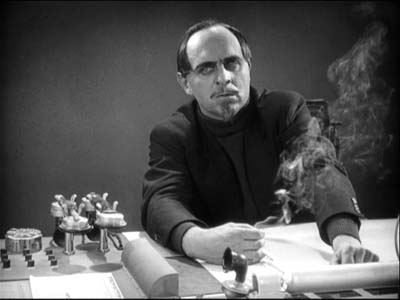
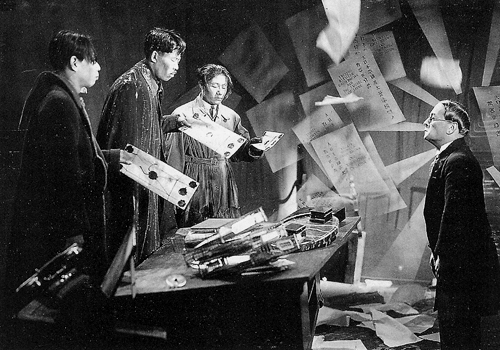
Perhaps Fritz Lang’s most neglected major work, this stunning silent German thriller (1928) both summarizes and refines his first Dr. Mabuse film while introducing some of the principles of editing continuity found in M. Scripted by Thea von Harbou (Lang’s second wife), it pits a government agent (Willy Fritsch) against a wheelchair-bound international banker (Rudolph Klein-Rogge) whose spy ring is stealing classified documents, and its fanciful and imaginative approach to the thriller form clearly inspired both Alfred Hitchcock and Thomas Pynchon. This restoration of the 175-minute German release is almost twice as long as the much more common version released for export, yet Lang edited both of them, and each has glories of its own. Erotic, mysterious, abstract, full of uncanny images and ideas, and rich with multiple identities and intrigue, this is essential viewing for anyone interested in the great director’s work. With Gerda Maurus. (JR)
With Michael Boatman, Lori Petty, Ice Cube, Elliott Gould, Richard Anderson, Don Harvey, Michael Ironside, Michael Gregory, Bernie Casey, and M. Emmet Walsh.
Smoke
Rating * Has redeeming facet
Directed by Wayne Wang
Written by Paul Auster
With William Hurt, Harvey Keitel, Stockard Channing, Harold Perrineau, Giancarlo Esposito, Ashley Judd, and Forest Whitaker.
My dozen favorite films at Cannes this year? Terence Davies’s ecstatic wide-screen The Neon Bible, set in a perfectly imagined Georgia of the early 40s, with Gena Rowlands; Emir Kusturica’s Yugoslav black-comedy epic Underground; Hou Hsiao-hsien’s beautiful if difficult Good Men, Good Women; Jim Jarmusch’s transgressive western Dead Man; Jafar Panahi’s The White Balloon, an Iranian urban comedy about children that unfolds in real time; Zhang Yimou’s Shanghai Triad, a cross between Sternberg’s The Devil Is a Woman — with Gong Li taking the place of Marlene Dietrich — and Billy Bathgate; and Manoel de Oliveira’s The Convent (Ruizian metaphysics and theology with John Malkovich and Catherine Deneuve). Then there were such pleasures on the market as Gianni Amelio’s Lamerica, a mordant treatment of the collapse of communism in Albania; lively low-budget musicals by Jacques Rivette and Joseph P. Read more
Written for Criterion‘s DVD and Blu-Ray of The Immortal Story, released in 2016. — J.R.
Where the story-teller is loyal, eternally and unswervingly loyal to the story, there, in the end, silence will speak. Where the story has been betrayed, silence is but emptiness. But we, the faithful, when we have spoken our last word, will hear the voice of silence…
— Grandmother in Isak Dinesen’s “The Blank Page” (Last Tales)
Virginie had a taste for patterns; one of the things for which she despised the English was that to her mind they had no pattern in their lives. She frowned a little, but let Elishama go on. “Only,” he went on, “sometimes the lines of a pattern will run the other way of what you expect. As in a looking-glass.”
“As in a looking-glass,” she repeated slowly.
“Yes,” he said. “But for all that it is still a pattern.”
— Dinesen’s “The Immortal Story” (Anecdotes of Destiny)
Aside from William Shakespeare, no writer excited Orson Welles’ imagination more than Isak Dinesen (1885-1962) — a Danish baroness who wrote mainly in English — especially when it came to the films he wanted to make. Read more
Think of French cinema, and the New Wave springs immediately to mind. This association is hardly accidental. History, it is often said, gets written by the victors. And the victories recounted in the standard film histories — whether they are critical successes or box-office triumphs — are inevitably at the expense of other movies, individuals, or social trends that presumably failed to scale the same heights.
But the New Wave, like other movements in film history, is significant not only for what it gave us — films like Truffaut’s The 400 Blows, Godard’s Breathless, and Resnais’ Hiroshima, mon amour — but also for what it took away, for the films it rebelled against, repudiated, buried in the dustbin of history. Now a fascinating new program of forty-six subtitled French films made between 1930 and 1960 helps sketch out the rudiments of just such an alternative history.
This group of films, appropriately entitled “Rediscovering French Film,” has been put together by New York’s Museum of Modern Art in cooperation with the French government and, after premiering in Manhattan this month, is scheduled to travel next year to Washington, Berkeley, Los Angeles, Houston, and Chicago. Read more
Commissioned by Fandor Keyframe in late January 2016. — J.R.
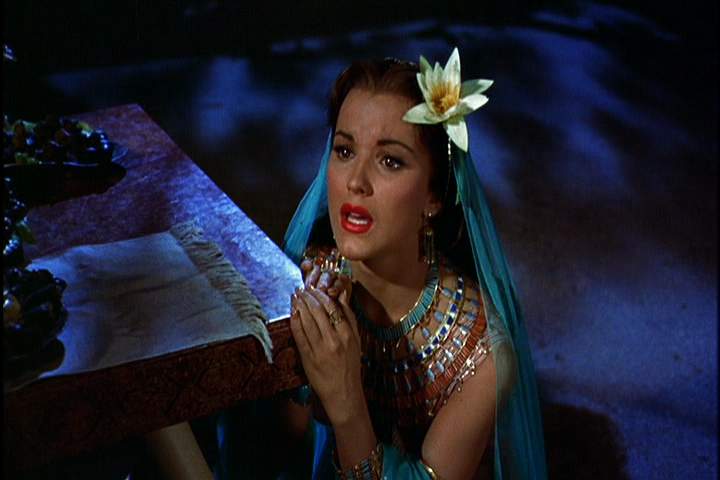
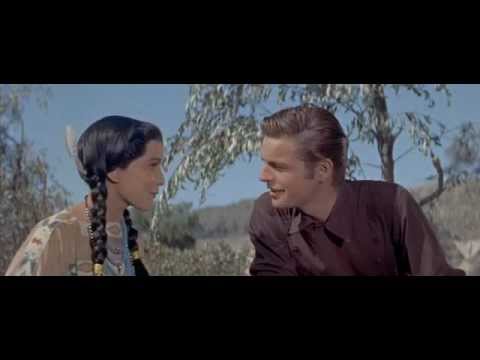
Mark Rappaport and I have been friends for well over three decades. He’s a year older than me, and even though our class and regional backgrounds differ, we’re both film freaks and film historians who grew up with the same Hollywood iconographies, for better and for worse. How these experiences might qualify as better or worse have been the source of countless friendly arguments, all the more so when they converge on the same objects of fascination — as the title of his latest video puts it, Debra Paget, For Example.
Thirty-six minutes and thirty-six seconds long, this juicy video about the 15-year screen career of Debra Paget (1948-1963, ages 14 to 29, including a busy eight-year stretch as contract player at Fox, 1950-1957) seems at times to cover almost as much material and as much cultural ground as Rappaport’s two star-centered film features, Rock Hudson’s Home Movies (1992) and From the Journals of Jean Seberg (1995), both of which I’ve reviewed in the past. (See www.jonathanrosenbaum.net/1992/11/rock-criticism and www.jonathanrosenbaum.net/2022/12/riddles-of-a-sphinx for specifics.) It might even be called a compendium of Rappaport’s rhetorical strategies, such as using an actor to play the star in question — as in those two features, although here only offscreen (as was also done in his brilliant recent video I, Dalio, or The Rules of the Game), with Paget voiced by Caroline Simonds — and using Rappaport’s own voice, as in another recent video, The Circle Closes.Read more
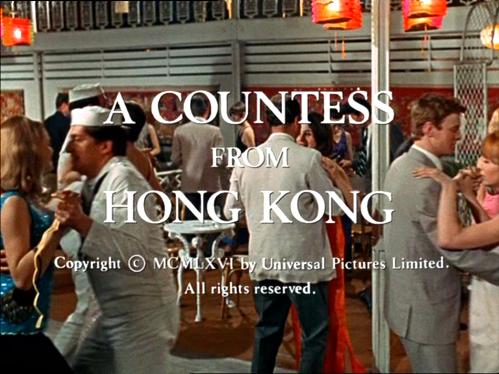
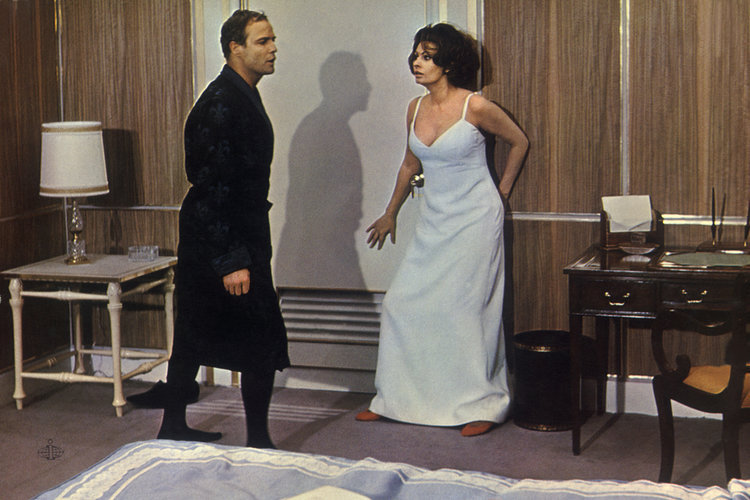
One of my reasons for recently revisiting Chaplin’s last feature, while preparing to teach a ten-hour course about him in Brazil, was trying to figure out why it’s so bad. There are other examples one could cite of unredeemably bad films by great filmmakers, but this one seems to belong in a category all its own. I certainly wouldn’t confuse it with his previous three features, some or all of which are considered bad by many of my colleagues but all of which I consider great in different ways (and to different degrees), even when they’re at their most distasteful. A Countess from Hong Kong is never distasteful in the various ways that A King in New York, Limelight, and Monsieur Verdoux can be at times, but it also never comes close to being revelatory in any profound way, as they continue to be.
Here is one possible explanation: Chaplin’s greatness as a director doesn’t invariably depend on his presence as the central star attraction, as A Woman of Paris amply demonstrated. But a major part of his greatness is still tied to a kind of dialogue he (mainly) had or (less often) attempted to have with his public throughout his career, most of which was tied in one fashion or another to his physical presence and/or his personal autobiography. Read more
Selected Moments: Some Recollections of Movie Time
1. My first sixteen years (1943-1959) — growing up in northwestern Alabama as the grandson and son of Jewish movie theater exhibitors — ensured that time and cinema were alternately parallel and crisscrossing rivers that coursed through my childhood, along with the Tennessee River that separated Florence from Sheffield. Florence, where I lived, had three of the Rosenbaum theaters, at least until 1951, all within a three-block radius, while Sheffield, which I could see across the river from my back yard, had two more theaters, one around the corner from the other. For Southerners like myself, the past was always present, a kind of double vision that movies taught me as well — a camera’s recording of the past becoming the present of both a screen and an audience, which then in retrospective memory becomes the past as well. And for Jews like myself, the past was also identity — meaning one’s past, present, and future. This explains why Lanzmann’s Shoah represents a shotgun marriage between the present tense of existentialism and the past tense of Judaism. Read more
From the Chicago Reader (September 1, 2000). — J.R.
Conceived as a kind of irreverent parody of both Rififi and The Asphalt Jungle, Mario Monicelli’s stumblebum heist film (1958) about a group of incompetent crooks trying to rob a safe full of jewels is one of the funniest Italian comedies ever made — certainly much funnier than the many imitations and remakes (i.e., rip-offs) it’s spawned over the years, including Louis Malle’s Crackers and Woody Allen’s Small Time Crooks. Monicelli’s sense of character is priceless, and his fabulous cast — including Marcello Mastroianni, Vittorio Gassman, Claudia Cardinale, and Renato Salvatori — makes the most of it. 111 min. (JR) Read more
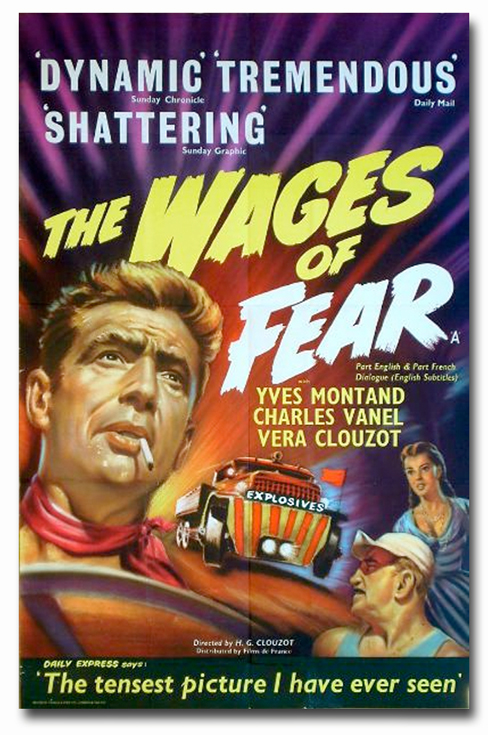
In Henri-Georges Clouzot’s 1953 suspense classic, four out-of-work Europeans (Yves Montand, Charles Vanel, Folco Lulli, Peter Van Eyck), trapped in a squalid South American village that’s exploited by a U.S. oil company, agree to drive two truckloads of nitroglycerine over 300 miles of primitive roads in exchange for $2,000 eachif they survive. When this existentialist shocker opened in the U.S., 43 minutes had been hacked away, but the gripping adventure elements left intact were still enough to turn the film into a hit. (This restored and at least semicomplete version of the film, 148 minutes long, was released in the early 90s.) A significant influence on Peckinpah’s The Wild Bunch, this grueling pile driver of a movie will keep you on the edge of your seat, though it reeks of French 50s attitude, which includes misogyny, snobbishness, and borderline racism. It’s also clearly a love story between two men (Montand and Vanel). In French with subtitles. (JR)
Chapter Seven of my bookMovie Wars: How Hollywood and the Media Limit What Films We Can See (Chicago: A Cappella Books, 2000). The cover below is that of the U.K. edition published by the Wallflower Press. Because of the length of this chapter, I’m posting it in two parts. — J.R.
TRANSATLANTIC REALITY AVOIDANCE: A REPORT FROM THE FRONT (MAY 1999)
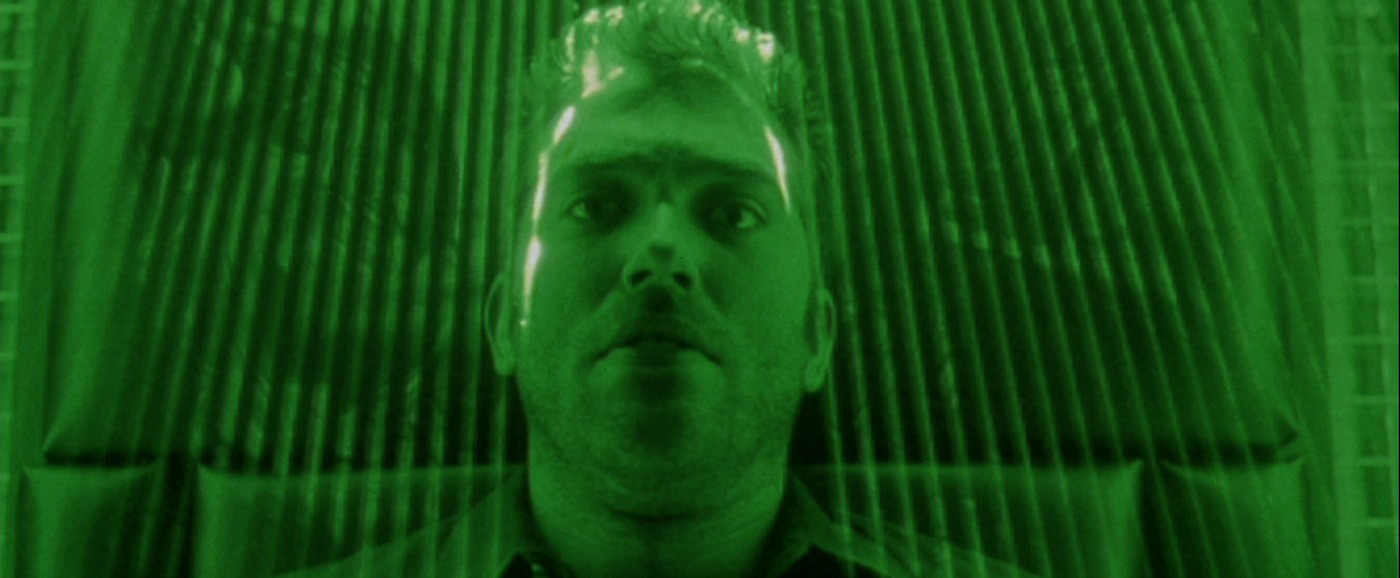
“ ‘I think, therefore I am,’ ” reads the opening epigraph of The Thirteenth Floor, the fourth virtual‐reality thriller I saw in Chicago in as many weeks in the spring of 1999, followed by the quotation’s source, “Descartes (1596–1650).” It’s an especially pompous beginning for a movie whose characters scarcely think, much less exist, but not an unexpected one given the metaphysical claims and pronouncements that usually inform these thrillers.
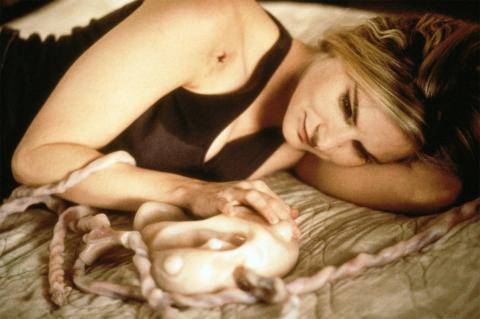
If any thought at all can be deemed the source of these pictures cropping up one after the other — with the exception of David Cronenberg’s eXistenZ, a film with a lot more than generic commercial kicks on its mind — this might be an especially low estimation of what an audience is looking for at the movies. The assumed desire might be expressed in infantile and emotional terms: “I don’t like the world, take it away.” Read more
Chapter Seven of my bookMovie Wars: How Hollywood and the Media Limit What Films We Can See (Chicago: A Cappella Books, 2000). The cover below is that of the U.K. edition published by the Wallflower Press. Because of the length of this chapter, I’ll be posting it in two parts. — J.R.
Is it possible that because of the rise of the new media, which have given us the ability to manufacture what we call virtual reality, we are now able, without quite knowing what we are doing, to create a secondary world that we are liable to mistake for the primary world given to our senses at birth? If so, the prime need it serves is probably not political at all but the one Freud identified as the chief motive for dreaming: wish fulfill-‐ ment—a need catered to both by our luxuriously proliferating sources of entertainment and the means of their support, namely, advertisement of consumer products. In our variant of self-‐deception, pleasure plays the role that terror plays under totalitarianism.
— Jonathan Schell, “Land of Dreams,” The Nation, January 11/18, 1999
This chapter and the next explore complementary and mutually alienating attitudes: the desire to keep out foreign influences in order to preserve American “purity,” and the fact that what we consider American “purity” is often composed of foreign influences.