This review from the August 1976 issue of Monthly Film Bulletin may represent my most exhaustive (and exhausting) attempt to extend the one-paragraph review format of that magazine almost to the point of infinity. — J.R.
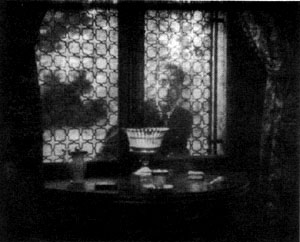
Vampyr: Der Traum des Allan Gray (Vampyr: The Strange Adventure of David Gray)
Germany/France, 1932
Director: Carl Th. Dreyer
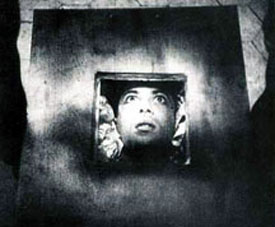
Cert — A. dist –– Cinegate. p.c –- Tobis-Klangfilm-France (Berlin-Paris)/Dreyer Filmproduktion (Paris). p –- Carl Th. Dreyer, Baron Nicolas de Gunsburg. asst. d –- Ralph Holm, Éliane Tayara, Preben Birck. sc -– Carl Th. Dreyer, Christen Jul. Inspired by the collection of stories In a Glass Darkly by Sheridan Le Fanu. ph -– Rudolph Maté, Louis Née. ed –- Carl Th. Dreyer. a.d –- Hermann Warm, Hans Bitman, Cesare Silvagni. m -– Wolfgang Zeller. English titles -– Herman G. Weinberg. sd -– Hans Bittman. Post-synchronisation -– Paul Falkenberg. l.p -– Julian West [Baron Nicolas de Gunzberg] (David Gray), Henriette Gérard (Marguerite Chopin), Sybille Schmitz (Léone), Renée Mandel (Gisèle), Maurice Schutz (Lord of the Manor), Jan Hieronimko (Doctor), Jane Mora (Nurse), Albert Bras and A. Babanini (Servants at the Manor). Read more
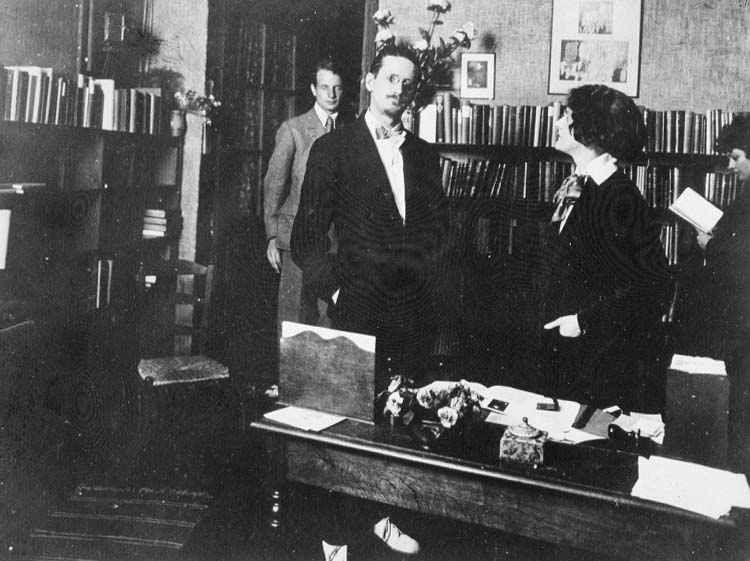
The year is 1921, the place Sylvia Beach’s celebrated Shakespeare and Company, publisher of the first edition of James Joyce’s Ulysses, Rue de l’Odéon, Paris. The figures, reading from left to right, are John Rodker, James Joyce, Sylvia Beach, and her younger sister Cyprian — the only one shown reading, to whom Sylvia dedicated the first edition of Ulysses.
In a review of Sylvia Beach’s letters by James Campbell in the March 19 issue of the Times Literary Supplement I learn that Cyprian “played `Belles Mirettes’ in the French silent film series Judex“. After some rummaging around, I discover that, in fact, `Miss Cyprien Giles’ played Gaby Belles Mirettes, a member of a criminal gang, in La Nouvelle Mission de Judex (1918), the only one of Louis Feuillade’s major crime serials I’ve never seen, and, according to the Internet Movie Database, appeared later in The Fortune Teller (1920), L’aiglonne (1921), and L’amie d’enfance (1922). And from Campbell’s review I learn that “she later lived with a somewhat better-known actress, Helen Jerome Eddy” (see photo below) — an actress who lived from 1897 to 1990 and who, according to the same IMDB, appeared in 130 films (not always credited) between 1915 and 1947, including The Bitter Tea of General Yen, Man’s Castle, and Bride of Frankenstein. Read more
From the Chicago Reader (May 9, 2003). — J.R.
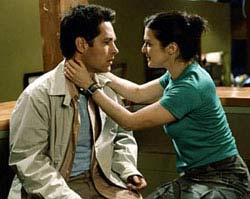
The Shape of Things
*** (A must-see)
Directed and written by Neil LaBute
With Rachel Weisz, Paul Rudd, Frederick Weller, and Gretchen Mol.
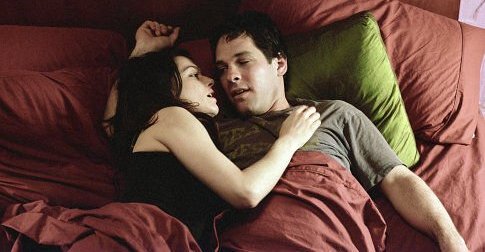
The first time I saw Neil LaBute’s The Shape of Things it packed a wallop. When I saw it again three weeks later it didn’t. Its force depends largely on a shock ending that transforms one’s sense of the characters, action, and overall theme with the authority of a masterpiece. Without this shock value, the film is still an infernal machine — designed, like LaBute’s In the Company of Men, to goad us into dark reflection — but its meanings tend to contract rather than expand.
Surprise endings either cancel out the impressions that come before, making the story seem contrived and artificial the second time around, or they enhance and complicate those impressions. The twist at the end of The Shape of Things comes closer to doing the first. The second time I saw it I felt I was watching the demonstration of a theorem more than the unraveling of characters, though it was only after having absorbed the disclosures of a first viewing that I became aware of certain interesting ambiguities. Read more
From the Summer 1974 issue of Sight and Sound. — J.R.
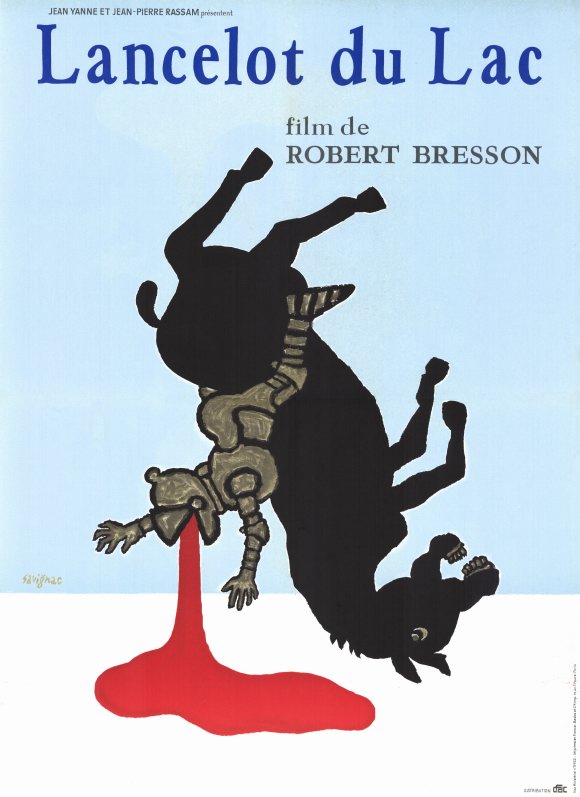
The Rattle of Armor, the Softness of Flesh: Bresson’s LANCELOT DU LAC
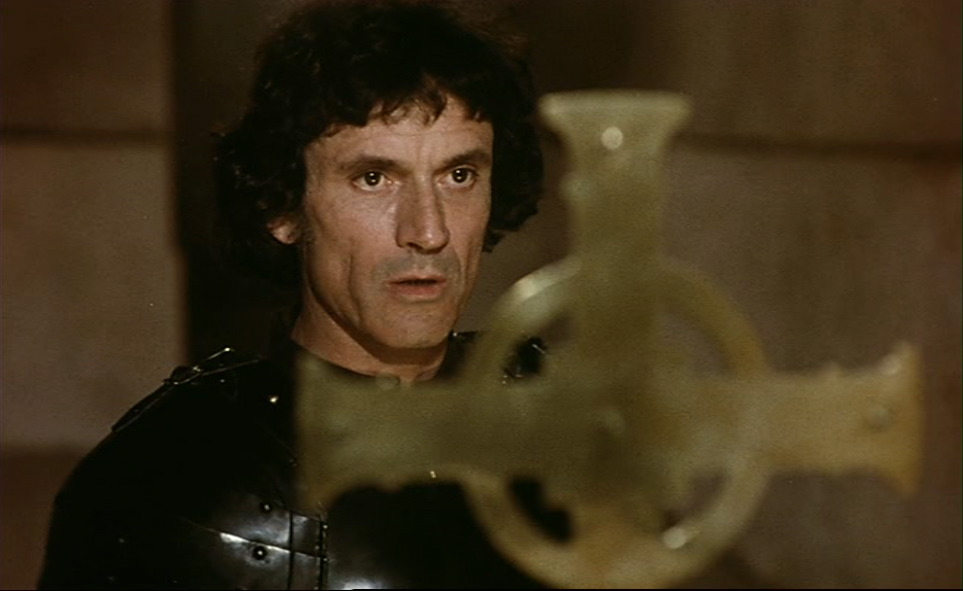
LANCELOT DU LAC embodies the perfection of a language that has been in the process of development and refinement for over thirty years. If it stuns and overwhelms one’s sense of the possibilities of that language— in a way, perhaps, that no predecessor has done, at least since AU HASARD BALTHAZAR — this is not because it represents a significant departure or deviation from the path Robert Bresson has consistently followed. The source of amazement lies in the film’s clarity and simplicity, a precise and irreducible arrangement of sounds and images that is so wholly functional that nothing is permitted to detract from the overall narrative complex, and everything present is used. It is a film where the rattle of armor and the neighing of horses are as essential as the faces and bodies of the characters, where indeed each of these elements serves to isolate and define the importance and impact of the others.
The sheer rawness of what is there disconcerts, but it shouldn’t lead one to focus unduly on what isn’t there, or track down some elusive clue to the Bressonian mystery. Read more


Two consecutive items from Harper’s Index (Harper Magazine, December 2010):
Percentage of Americans who believe that Stephen King wrote Moby-Dick: 4
Number of U.S. states in which it is legal to own a tiger without a license: 9
[11/18/20]
 Read more
From the Winter 1972–1973 Sight and Sound. — J.R.
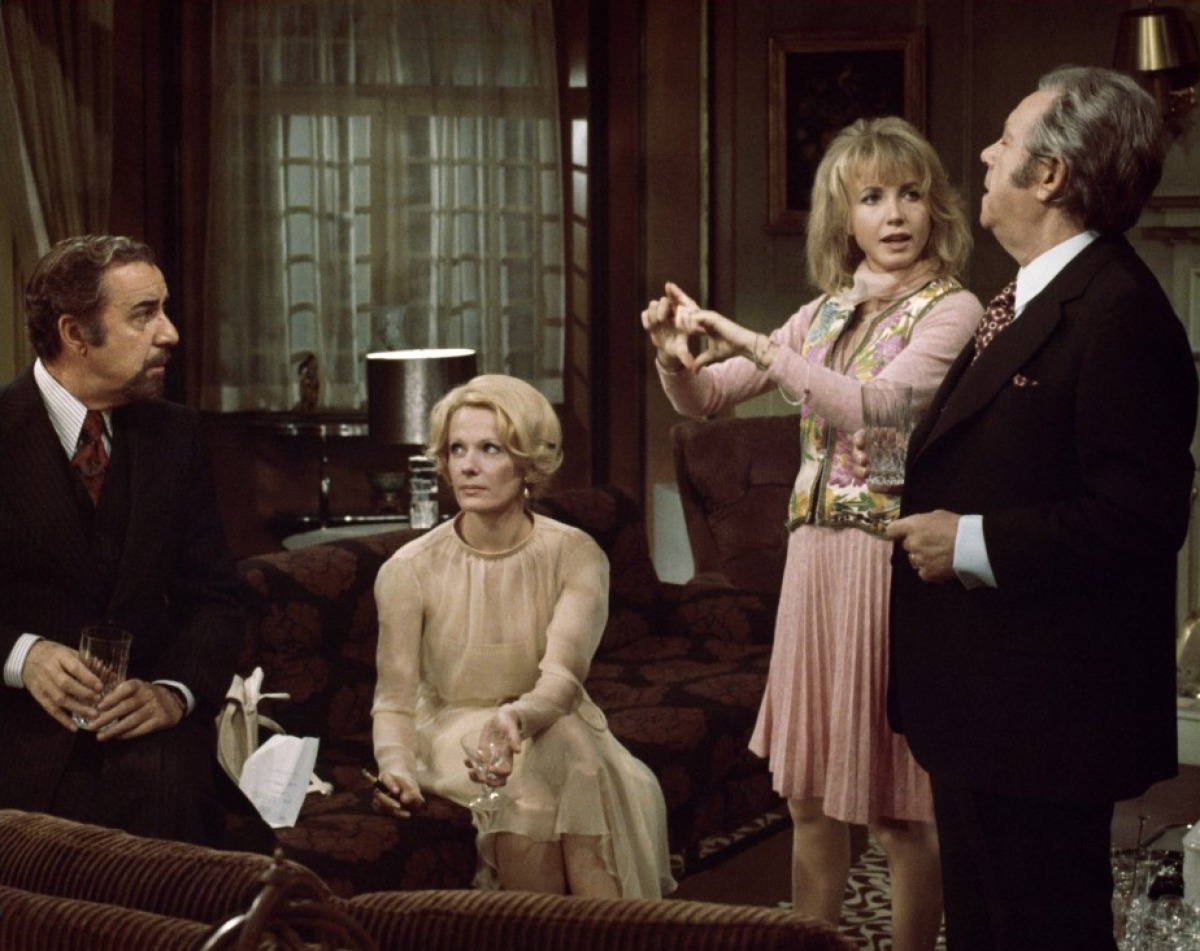
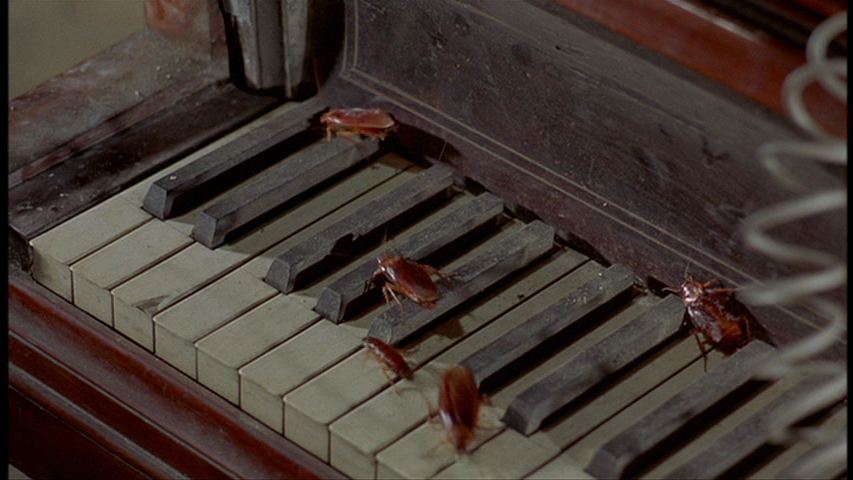
REPORTER: Who are your favorite characters in the movie?
BUÑUEL: The cockroaches.
— from an interview in Newsweek
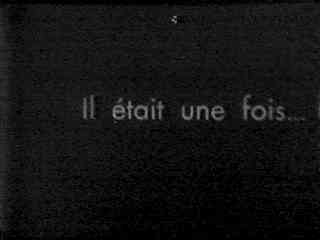
“Once upon a time . . .” begins UN CHIEN ANDALOU, in mockery of a narrative form that it seeks to obliterate, and from this title onward, Buñuel’s cinema largely comprises a search for an alternative form to contain his passions. After dispensing with plot entirely in UN CHIEN ANDALOU, L’AGE D’OR, and LAS HURDES, his first three films, and remaining inactive as a director for the next fifteen years (1932–1947), Buñuel has been wrestling ever since with the problem of reconciling his surrealistic and anarchistic reflexes to the logic of story lines. How does a sworn enemy of the bourgeoisie keep his identity while devoting himself to bourgeois forms in a bourgeois industry? Either by subverting these forms or by trying to adjust them to his own purposes; and much of the tension in Buñuel’s work has come from the play between these two possibilities.
Buñuel can always tell a tale when he wants to, but the better part of his brilliance lies elsewhere. Read more
This was written for the Writers Guild magazine Written By; it ran in their August 1997 issue and was later reprinted in my collection Essential Cinema.
My comparison of May with Erich von Stroheim, which may sound frivolous, is actually something I take very seriously. Both filmmakers are mainstream figures with the temperaments of avant-garde artists; Orson Welles’ description of Stroheim’s style as “Jewish baroque” also fits May’s quite well; and perhaps most significantly of all, both of these highly obsessional writer-director-performers create films populated almost exclusively by monsters, yet characters whom their creators clearly love. In this latter respect, May might even be considered more radical than Stroheim because one can’t cite a single villain in her four features — unlike, say, Schani the butcher (Matthew Betz) in Stroheim’s The Wedding March. Furthermore, for me, the two greatest Stroheim films, Foolish Wives and Greed, are echoed in many respects by The Heartbreak Kid and Mikey and Nicky, the two best films of May.
On the evening of June 27, 2010, in Bologna, Italy, I had the rare, unexpected, and delightful privilege of spending a couple of hours with May. It was a friendly conversation over dinner rather than any sort of interview, but she did tell me in passing a few things about her life and work that I’ve added to this piece as footnotes. Read more
From the Chicago Reader (April 2, 2004). This wonderful documentary, incidentally, is now available on the Criterion DVD of Pickpocket. One of its most fascinating paradoxes for me is that Mangolte, a friend, isn’t a religious person, but this documentary strikes me as profoundly spiritual; Lasalle’s home is even treated as a sacred shrine. — J.R.
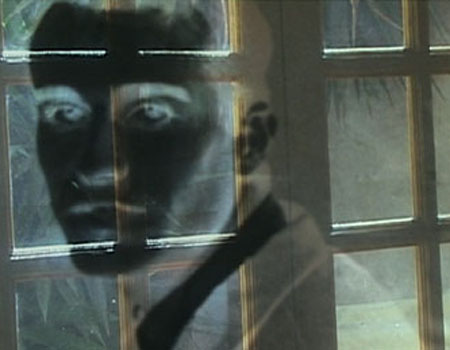
Les modèles de “Pickpocket”
***
Directed and written by Babette Mangolte
With Pierre Leymarie, Marika Green, and Martin Lasalle.
Not until he was in his late 90s did Robert Bresson get the recognition he deserved. He died in 1999 at the age of 98, living long enough to see his work affirmed by a retrospective the Toronto Cinematheque’s James Quandt organized that traveled around the world to full houses.
For years mainstream critics regarded Bresson as esoteric, pretentious, even something of a joke. “The chief fault is that the hero is a vacancy, not a character,” wrote Stanley Kauffmann in one of the more sympathetic reviews of Bresson’s 1959 Pickpocket, a free adaptation of Dostoyevsky’s Crime and Punishment. “Martin Lasalle, who plays the part, has a bony, sensitive face, but no deader pan has crossed the screen since Buster Keaton. The besetting fallacy of modern French films and novels is the belief that nullity equals malaise and/or profundity.” Read more
This appeared in the May 14, 2004 issue of the Chicago Reader, and occasioned one of the few thank-you notes I’ve received from a filmmaker for a review. I hope both Guy Maddin and those reading this will forgive me for immodestly reproducing his email: “Dear Jonathan: I usually try to avoid setting precedents that violate what should be a no-fly zone between critics and filmmakers, but I must say that your review of Saddest Music left me feeling understood at last!!! What a feeling. Thank you for supplying this euphoria. You also win bonus points for the Laura Riding discovery — I always liked her characters’ names. George Toles, who is terrified of reading reviews, will be thrilled to see his unsung name given its proper due. Not only that, you disabled Anthony Lane’s stinkbombs. A million thanks, Jonathan!! Warmest, Guy” — J.R.
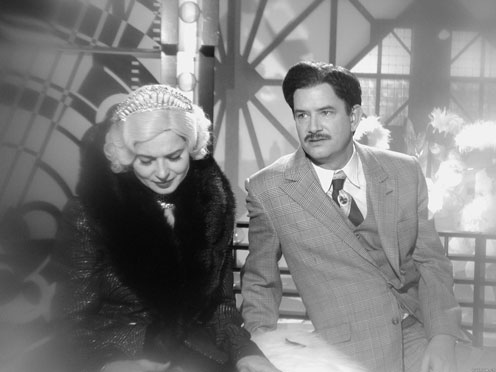
The Saddest Music in the World
**** (Masterpiece)
Directed by Guy Maddin
Written by George Toles, Maddin, and Kazuo Ishiguro
With Mark McKinney, Isabella Rossellini, Maria de Medeiros,
David Fox, and Ross McMillan.
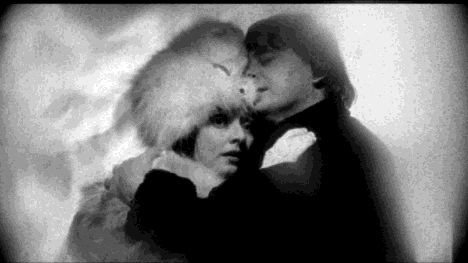
To Guy Maddin, every contemporary story that feels true is at bottom an amnesia story. — screenwriter George Toles
When all the archetypes burst out shamelessly, we plumb Homeric profundity. Read more
Below is my Foreword to The Medieval Hero on Screen: Representations from Beowulf to Buffy (McFarland, 2004), a collection edited by Martha W. Driver and Sid Ray, minus a few editorial tweaks and abridgements. — J.R.
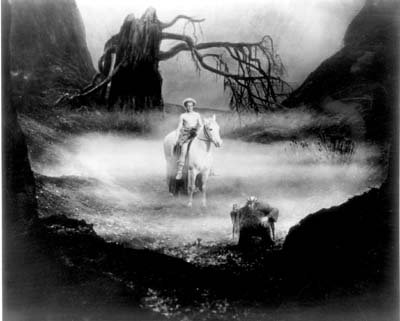
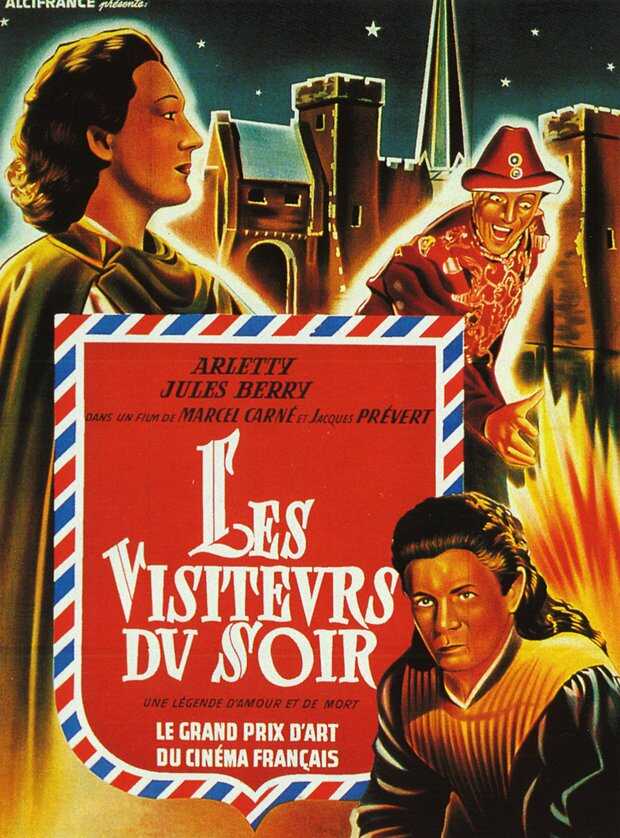
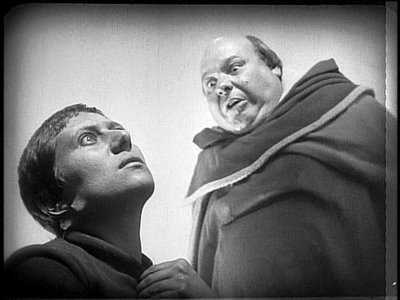
It’s a curious fact, at least to me, that I’m writing a forword to this book, even a short one. I’m neither a medievalist nor a historian; I haven’t seen many of the films discussed, and, perhaps because I spend much of my time reviewing films for a weekly newspaper, the Chicago Reader, I have seen but have mainly forgotten some of the others. As a professional film critic who occasionally gets invited to speak and teach at college campuses, I have the benefit of both close and long-range views of film history, and try to create some two-way traffic between these positions in my writing.
It has always been a handicap for film scholars that one can’t necessarily count on all the important works being widely accessible or even widely known. In the essays that follow, some of my favorite films with medieval themes and settings have only been briefly touched upon —- I’m thinking especially of Carl Dreyer’s The Passion of Joan of Arc and Eric Rohmer’s Perceval -— while others, including Fritz Lang’s magnificent two-part, five-hour Die Nibelungen (1924), and Les visiteurs du soir (1942), a haunting fantasy written by Jacques Prévert and Pierre Laroche and directed by Marcel Carné during the French Occupation, are not mentioned. Read more
From the March 19, 2004 issue of the Chicago Reader. — J.R.
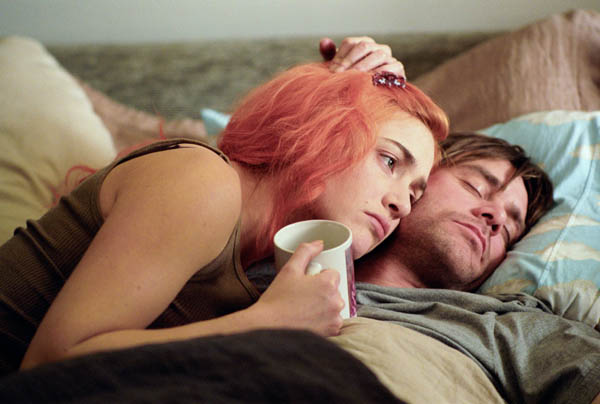
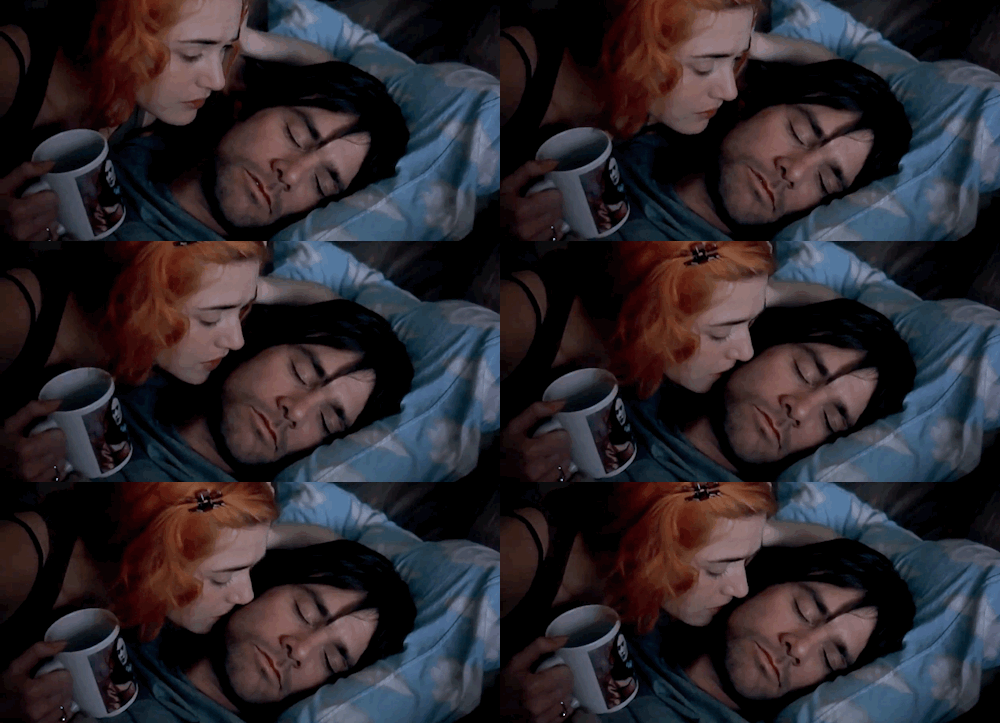
Eternal Sunshine of the Spotless Mind
**** (Masterpiece)
Directed by Michel Gondry
Written by Charlie Kaufman, Gondry, and Pierre Bismuth
With Jim Carrey, Kate Winslet, Elijah Wood, Mark Ruffalo, Kirsten Dunst, and Tom Wilkinson.

How happy is the blameless vestal’s lot!
The world forgetting, by the world forgot.
Eternal sunshine of the spotless mind!
Each pray’r accepted, and each wish resign’d;
Labour and rest, that equal periods keep;
“Obedient slumbers that can wake and weep;”
Desires compos’d, affections ever ev’n,
Tears that delight, and sighs that waft to Heav’n.
–Alexander Pope, “Eloisa to Abelard” (1717)

Only once in a blue moon does a screenwriter who isn’t a director become known as an auteur. Plenty of distinctive movie writers have reputations as actors or as actor-directors, starting with such giants as D.W. Griffith, Charlie Chaplin, and Erich von Stroheim, but they’re rarely celebrated for their writing. You have to go back to Robert Towne, who’s done only a little directing, and Paddy Chayefsky, who never did anything but write and produce, to find auteurs known mainly as writers.
A Chayefsky movie isn’t hard to identify, but I think it’s safe to say that these days a Charlie Kaufman movie is even more recognizable. Read more
Written in November 2014 for my February 2015 “En movimiento” column in Caimán Cuadernos de Cine. Given the precipitous decline in Truman Capote’s literary reputation since his death, it seems a pity that he’s better known as a screenwriter on the overrated Beat the Devil than on The Innocents, a far more durable though far less celebrated work. — J.R.
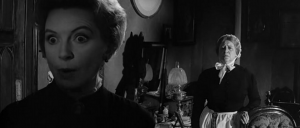
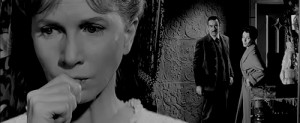
Bonus features are an important part of digital film culture, and one shortcoming is the attention usually accorded to both literary and cinematic sources. While these sources aren’t necessarily ignored, they’re rarely emphasized, so that younger viewers watching, for the first time, Jack Clayton’s The Innocents (1961) and Robert Wise’s The Haunting (1963) –- two exceptionally literate and intelligent horror films, both beautifully and resourcefully filmed in black and white CinemaScope -– are apt to overlook the fact that they’re adapted quite faithfully from what Stephen King has called the two “great novels of the supernatural in the last hundred years,” namely Henry James’ The Turn of the Screw (1898) and Shirley Jackson’s The Haunting of Hill House (1959). Though both novels are cited and discussed in the extras (and Truman Capote’s contribution of Southern Gothic elements to the screenplay for The Innocents is rightly applauded), they’re rarely accorded the attention they deserve. Read more
This is a story, never before published, written during my first years of high school — most likely in 1958, when I was a sophomore. I’ve done some light editing. The illustrations, which I realize are not always consistent with one another or precisely congruent with the story, are all gleaned from the Internet. This story is the first in a series of three to be posted here, all fantasies and all written when I was in high school . — J.R.
The Tower
By Jonathan Rosenbaum

When I first woke up in the tower, I looked around, feeling strange and disoriented. I’d never been there before – never been anywhere before, as well as I can recall – and I’d just woken up, yet I’d never gone to sleep. I felt clean and fresh and wore plain clothes, but who was I, and what was I doing here?
I was in a small room that was empty except for the cot I was lying on and a chair. Read more
Barring only the one time I took over my father’s weekly promotional movie column in my home-town newspaper in March 1957 (briefly excerpted in my first book, Moving Places, on pp. 123-124), which doesn’t exactly count, this must be my first published film criticism, even though my name was misspelled. (The correct spelling was Jonny.) It appeared in The Stimulator, my biweekly high school newspaper (published at Coffee High School in Florence, Alabama), on October 16, 1958, when I was 15, a sophomore. Phil Stanford, incidentally, was a senior and good friend at the time. I’m nearly positive that the title wasn’t my own, and if this “column” had any sequels, I have yet to uncover them. (Esoteric footnote: “The Tri-Cities” in this period consisted of Florence, Sheffield, and Tuscumbia, before Muscle Shoals City grew, thanks to its recording studios, from the size of a modest speed trap, thereby yielding The Quad-Cities.) — J.R.
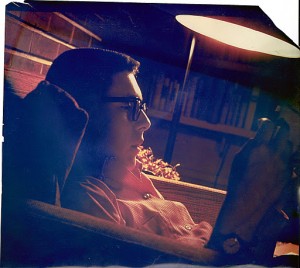
Front Row Center
By JOHNNY (sic) ROSENBAUM
This column, which will alternate with Phil Stanford’s, is to be devoted to reviews of movies, television programs, and the occasional plays put on in the Tri-Cities. Read more
From the Chicago Reader (July 10, 1992). For more on Endfield, see Brian Neve’s excellent new biography, The Many Lives of Cy Endfield: Film Noir, the Blacklist, and Zulu, as well as my subsequent Reader article about him and my essay “Pages from the Endfield File,” which grew out of the preceding two pieces and is reprinted in my 1997 collection Movies as Politics. This particular piece has been upgraded in terms of illustrations. — J.R.
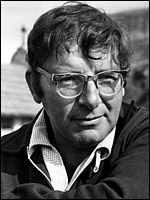
FILMS BY CY ENDFIELD
The role of a work of art is to plunge people into horror. If the artist has a role, it is to confront people — and himself first of all — with this horror, this feeling that one has when one learns about the death of someone one has loved. — Jacques Rivette in an interview, circa 1967
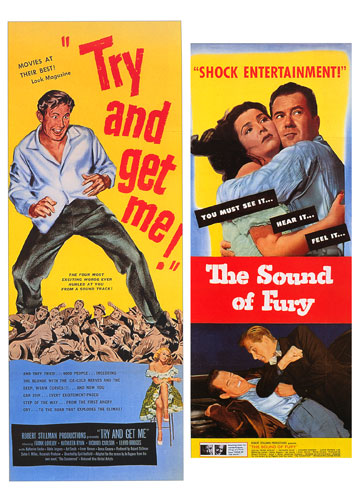
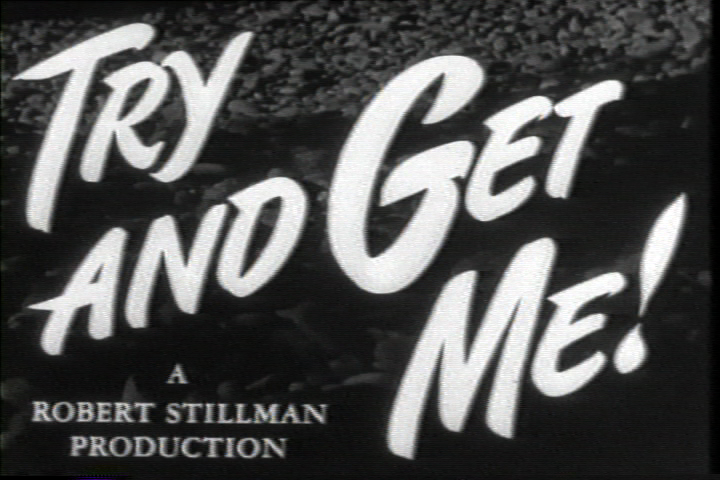
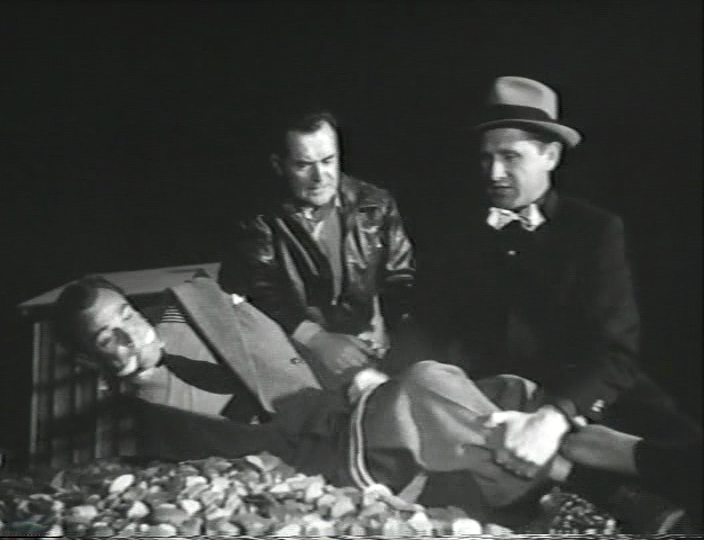
Cyril Raker Endfield, who will turn 78 this November, is the sort of filmmaker auteurist critics like to call a “subject for further research.” To the best of my knowledge, he has directed 21 features — the first 7 in the United States between 1946 and 1951, the remainder in England, continental Europe, and South Africa between 1953 and 1971 — and worked on the scripts for most of them, as well as on the scripts of two Joe Palooka films (apart from the two he directed), a Bowery Boys picture (Hard Boiled Mahoney, 1947), Douglas Sirk’s Sleep My Love (1948), a prison picture called Crashout (1955), Jacques Tourneur’s Curse of the Demon (1958), and Zulu Dawn (1979), a sort of prequel to Endfield’s only hit, Zulu (1964). Read more