The main problem with Jacques Doillon’s 1987 filmdevoted exclusively to the problems encountered by a couple when the woman starts to imagine the man’s previous affairs in his country houseis that the script doesn’t offer us or the actors more to work with. Jane Birkin and Alain Souchon both attack the premise gamely, but the fact remains that two-actor films are notoriously difficult to sustain, even with the best talent available: The Four Poster, Sleuth, and even Carl Dreyer’s seldom seen Two People all have related difficulties, and it doesn’t seem coincidental that all three are adaptations of plays. Comedy! was written for the screen, but nevertheless seems just as stagy as the others. Still, for those interested in following Doillon’s development, it remains an instructive and occasionally enjoyable experiment. (JR) Read more
Writer-director-producer James L. Brooks’s romantic comedy, his first film after Terms of Endearment, takes on the world of network news in one of the best entertainments of 1987. Holly Hunter plays a gifted and idealistic producer, and her performance is something of a revelation: her short, feisty, socially gauche, aggressive-compulsive character may be the most intricately layered portrait of a career woman that contemporary Hollywood has given us. Albert Brooks as a bright, caustic behind-the-scenes reporter and her best friend, who hankers after something more in both departments, gives the performance of his career. Completing the triumvirate and romantic triangle is William Hurt, also at his best, as a rapidly rising anchorman who lacks the creativity and intelligence of his two colleagues, but beats them hands down in public charisma. The movie is at its finest when it shows all three working together to produce the evening newsan exciting and instructive look into the processes involvedand at its worst when it saddles them with a pat prologue and epilogue showing the characters years before and after the film’s main events. Shot entirely in Washington, D.C., the film is full of relevant insights into the kinds of compromises, trade-offs, and combinations of skills and personalities that produce media, and the personal stories are deftly integrated. Read more
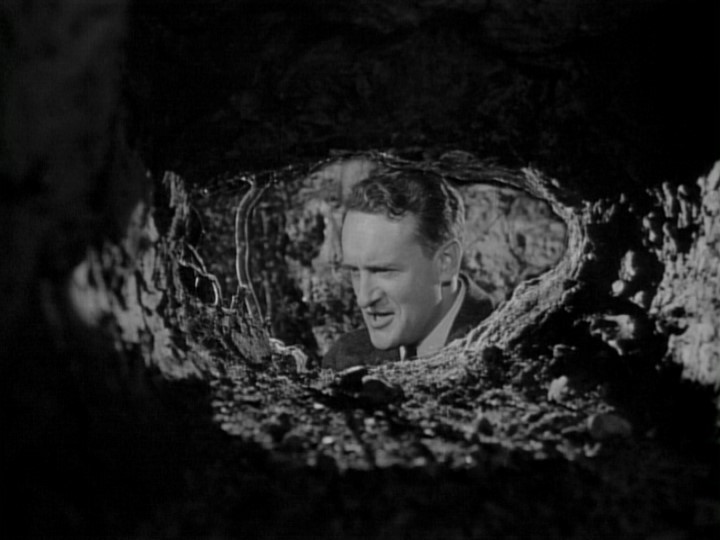
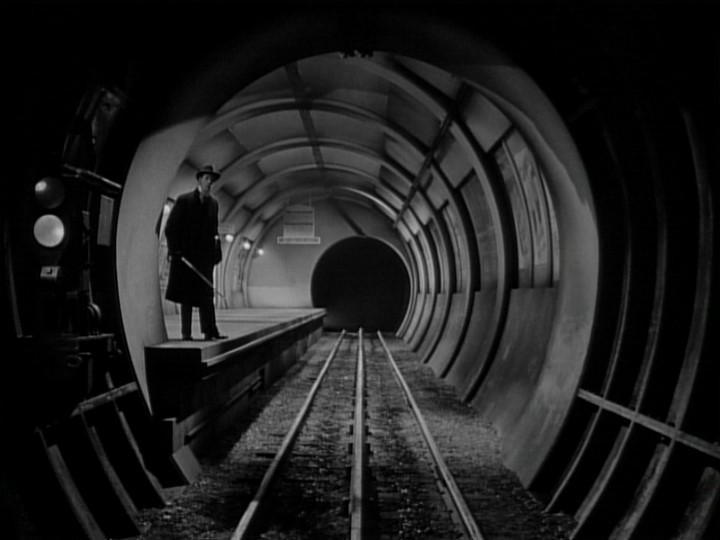
With Walter Pidgeon, Joan Bennett, George Sanders, John Carradine, Roddy McDowall, Heather Thatcher, and Frederick Worlock.
A sparkling new 35-millimeter print of Fritz Lang’s 1941 Man Hunt is running at the Gene Siskel Film Center all this week, and I can recommend it without reservation. It’s not quite a masterpiece, but it’s considerably more entertaining than any new thrillers I’m aware of.
Man Hunt‘s status within Lang’s body of work is somewhat ambiguous and contested. Ten years ago one of France’s major film historians, Bernard Eisenschitz, wrote a 270-page book on the film in which he pored over many of the production materials as if they were holy writ. Yet Tom Gunning’s authoritative recent critical study, the 528-page The Films of Fritz Lang: Allegories of Vision and Modernity, scarcely deals with the film at all, apart from mentioning that it “would reward close analysis” and contending that it, like Lang’s three other anti-Nazi films — Hangmen Also Die! (1943), Ministry of Fear (1944), and Cloak and Dagger (1946) — is limited by its propagandistic qualities.
The first four letters say it all. Nostalgie de la boueliterally, nostalgia for mudtends to motivate Barbet Schroeder’s fiction films, which have focused on heroin addicts (More), hippies (The Valley Obscured by Clouds), masochists (Maitresse), and gamblers (Tricheurs). This 1987 treatment of flophouse drunks, his first American film, is no less voyeuristic. Working from an original and autobiographical screenplay by Charles Bukowski, Schroeder amasses a lot of talent to yield what is essentially a tourist’s-eye view of the lower depths, defended from within as a way of life. An unshaven Mickey Rourke delivers his lines like W.C. Fields and swaggers like a gutter prince, Faye Dunaway as a fellow alcoholic seems even more authentically disassembled, and Robby M Read more
From the Chicago Reader (September 5, 1997). — J.R.
Contempt
Rating **** Masterpiece
Directed and written by Jean-Luc Godard
With Brigitte Bardot, Michel Piccoli, Jack Palance, Fritz Lang, Giorgia Moll, and Godard.
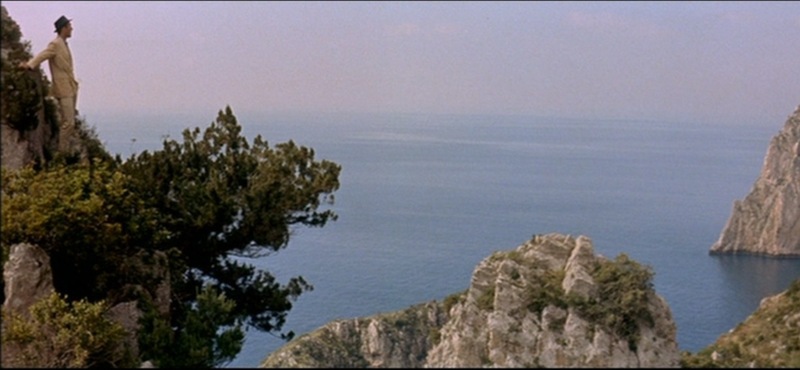
Almost exactly 33 years ago, in October 1964, the critical reception of Jean-Luc Godard’s widest American release of his career and his most expensive picture to date was overwhelmingly negative. But now that Contempt, showing this week at the Music Box, is being rereleased as an art film — in a brand-new print that’s three minutes longer — the critical responses have been almost as overwhelmingly positive. It’s tempting to say in explanation that we’re more sophisticated in 1997 than we were in 1964 — that we’ve absorbed or at least caught up with some of Godard’s innovations — but I don’t think this adequately or even correctly accounts for the difference in critical response. Despite all the current reviews that treat Le mépris as if it were some form of serene classical art, it’s every bit as transgressive now as it was when it first appeared, and maybe more so. But because it’s being packaged as an art movie rather than a mainstream release — because Godard is a venerable master of 66 rather than an unruly upstart of 33 — we have different expectations. Read more
The following text, a late addition to this web site, was copied almost verbatim (apart from the correction of typos) from the laptop of the late Peter Thompson, thanks to the help of his widow, Mary Dougherty. — J.R.
Jonathan Rosenbaum, “Talking to Strangers: A Look at Recent American Independent Cinema”,ARTPAPERS,Vol. 13, No. 5,September/October 1989,pp. 6-10.
The following article is excerpted from a lecture given on June 15, 1989 in Lisbon, Portugal, at a seminar organized for the Luso-Americanos de Arte Contemporanea at the Fundacao Calouste Gulbenkian to introduce screenings of a dozen recent American independent films selected by Richard Peña and myself. Peña and Jon Jost also gave lectures at the same seminar — the former offered a broad history of independent filmmaking in the U.S., while the latter gave a subjective account of his own experiences as an independent filmmaker — followed by interventions from Portuguese critics.
It is virtually impossible to treat recent American independent film as a unified, homogeneous body of work. While there has been an unfortunate tendency in academic criticism to treat Italian neo-realism. the French nouvelle vague, or Hollywood films during any particular decade as if they had homogeneity and unity, such an effort can be made only if one views the work incompletely and superficially, and this is perhaps even more true with an unwieldy category such as American independent film.Read more
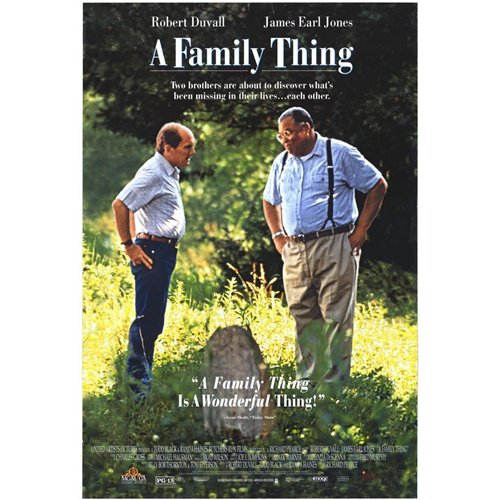
With Robert Duvall, James Earl Jones, Michael Beach, Irma P. Hall, David Keith, Grace Zabriskie, Regina Taylor, Mary Jackson, Paula Marshall, and James Harrell.
If good quiet movies seem as rare as hen’s teeth nowadays, one reason is that they’re gone before most of us get around to seeing them. As a rule, it’s the loud movies, good and bad (usually bad), that claim our attention first — the ones that yell at us from afar through monster ad campaigns tricked up with socko clips and hyperbolic quotes. Those that speak to us in a normal tone of voice, without flash or filigree, seep into our consciousness more gradually — and gradual discoveries are fast becoming impossible given that the commercial fate of a new feature is often sealed the opening weekend.
The first time I saw A Family Thing — not only the best but pretty nearly the only good quiet Hollywood movie I’ve seen this year — was at a press show in late February, back-to-back with The Birdcage. It took me completely by surprise — unlike The Birdcage, which had been shouting from the rooftops for months — and when I finally got around to seeing it a second time I found it every bit as affecting. Read more
From the Chicago Reader (September 15, 2000). It’s delightful to report that this film is now available in the U.S. from Icarus Films. — J.R.
One Day in the Life of Andre Arsenevich
Rating **** Masterpiece
Directed and written by Chris Marker.
Industry flacks claim that Hollywood movies have been dumbed down out of commercial necessity — they’re just giving audiences what they want. I don’t buy it. Audiences aren’t being offered intelligent movies, or at least those aren’t the ones getting multimillion-dollar ad budgets. This was especially the case during the past summer, though as usual, most of the press tolerantly excused the fare as standard silly-season stuff — as if we and not the industry and their advertisers were responsible. The flacks may love to shift the blame by telling us how dumb we all are, but their contempt finally may be causing a minor counterreaction.
Difficult, demanding, and incorrigibly serious art movies have been becoming more popular — though that may be less the result of a backlash against Hollywood than of a growing awareness that the makers of art movies are more respectful of the seriousness, intelligence, and spirituality of moviegoers. The first solid indication of this trend I noticed was the nationwide success of the Robert Bresson retrospective, which came to the Film Center in the spring of 1999 and drew enough crowds to warrant a partial revival of the series a few months later. Read more
Posted on Sight and Sound‘s web site 18 July 2013, and then expanded (by about 50%) at the request of Trafic‘s Raymond Bellour later that month for its French translation in Trafic #88, published in early December. This has also appeared in German translation in the September 2013 issue of Cargo, and a Spanish translation appeared in mid-August 2014 on Roger Koza’s web site. I’ve slightly updated the version here in a few particulars and added some photos.
I returned to Film.Factory for my fourth two-week stint to date on October 24, 2015, this time to teach a history of independent cinema around the world. — J.R.
First of all, what is film.factory?
It’s usually thought of and referred to as a film school that’s been recently set up in Sarajevo, housed at the Sarajevo Film Academy. But Béla Tarr, who created it, isn’t happy with this classification. He’d rather call it a workshop or, as its name suggests, a factory that produces films in which he serves as a producer. And he’d rather speak of the sixteen filmmakers he selected late last year from fourteen countries (Austria, the Czech Republic, France, the Faro Islands, Iceland, Iran, Japan, Mexico, Poland, Portugal, Serbia, Spain, the U.K., Read more
From the May 12, 2000 issue of the Chicago Reader. –J.R.
Negative Space
Rating *** A must see
Directed and written by Chris Petit
With Robert Mitchum, Manny Farber, Dave Hickey, and (as narrator) Petit.
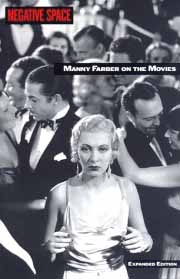
There aren’t many films or videos about film criticism, especially ones that perform the actual work of film criticism. An interesting and ambitious exception is Chris Petit’s Negative Space (1999), an experimental 39-minute video made for BBC TV that’s being shown for free by Chicago Filmmakers at the Chicago Cultural Center this Friday, along with Petit’s The Falconer (1998). Named after the only book by film critic, painter, and teacher Manny Farber — a 1971 collection reprinted in an expanded edition in 1998 — Petit’s video wrestles with American landscape and culture, irony, memory, Las Vegas, the beginning of a new millennium, death, desert, film versus video, J.M.W. Turner’s painting, several movies (including Howard Hawks’s The Big Sleep, Jacques Tourneur’s Out of the Past, and Roberto Rossellini’s Voyage to Italy), as well as two critics, Farber and Dave Hickey. Petit also looks at Farber as a painter and an art critic and Hickey as an art critic, a resident of Las Vegas, an appreciator of Farber, and a commentator on American culture. Read more
Written forThe Unquiet American: Transgressive Comedies from the U.S., a catalogue/collection put together to accompany a film series at the Austrian Filmmuseum and the Viennale in Autumn 2009. — J.R.
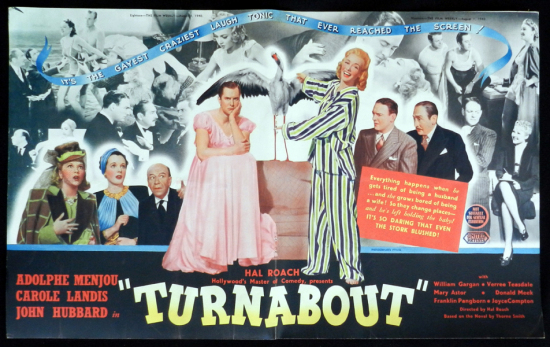
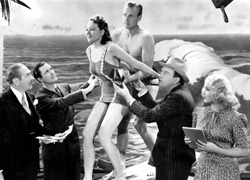
TURNABOUT (1940)
A bickering husband and wife (John Hubbard and
Carole Landis) switch bodies and lives (but not voices)
after encountering a Buddhist curse. Hal Roach
directed this extremely odd 1940 comedy -– the only
feature I’ve selected not because it’s good, exactly
(some would regard it as pure camp), but because of
how singular and uncanny it is as a kind of freakish
prelude to Adam’s Rib, with gay undertones to spare.
(Not surprisingly, the Catholic Legion of Decency
found it “objectionable”.) It’s adapted from a novel
of the same title by Thorne Smith (1892-1934), who
became one of the most popular sources of erotic
fantasy and whimsy used in Hollywood movies of the
30s and early 40s (in Night Life of the Gods, Topper
and its sequels, and René Clair’s I Married a Witch,
among others). The secondary cast is also notable:
Adolphe Menjou (actually given top billing),
William Gargan, Mary Astor, Donald Meek,
Franklin Pangborn, and Marjorie Main.
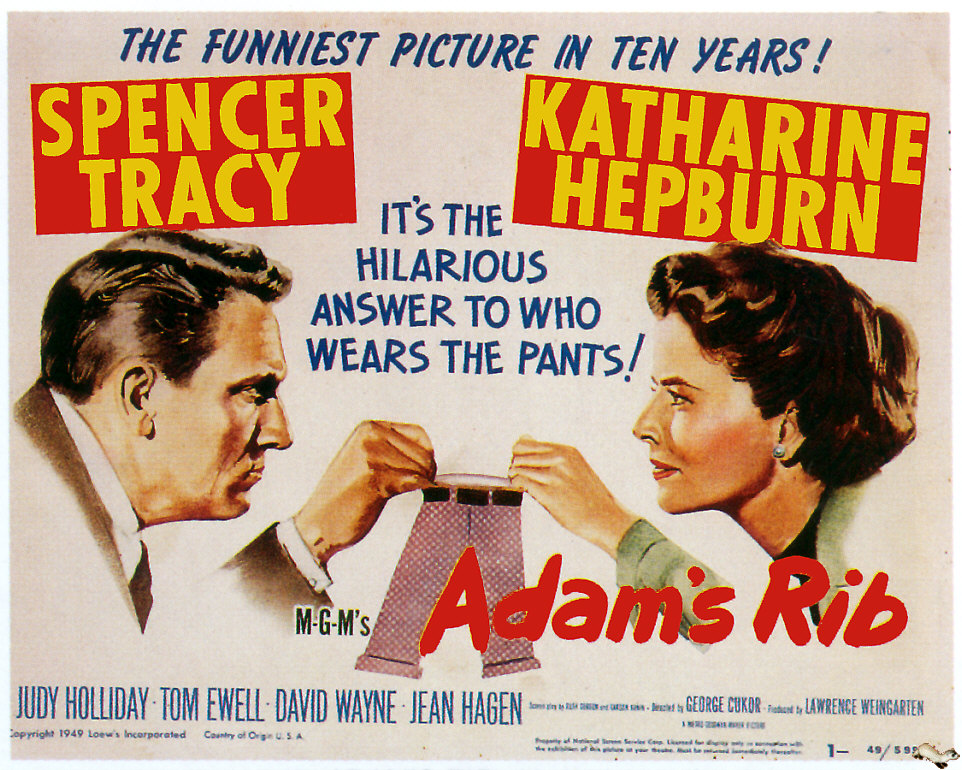
ADAM’S RIB (1949)
This comedy, directed by George Cukor from a script by Ruth
Gordon and Garson Kanin, is probably the best of all the features
pairing Katharine Hepburn and Spencer Tracy. Read more
Written in early October for “En movimiento,” my bimonthly column for Caimán Cuadaernos de Cine, written in alternation with Adrian Martin, for their November 2013 issue. — J.R.
It was a little over 25 years ago, shortly after I moved to Chicago, that I first encountered the staggering work of Peter Thompson, a local independent filmmaker I’d never heard of. I saw his first four films (he was never to make more than six) –- two “diptychs” consisting of films about his parents (Two Portraits, both made in 1981) and Universal Hoteland UniversalCitizen, both made in 1986, exploring respectively eleven photographs and two drawings of a Polish POW who was frozen and then thawed by a German prostitute as part of a Nazi experiment and Thompson’s attempts to photograph a Libyan Jewish smuggler and former Dachau inmate in a Guatemalan jungle. Not long afterwards, seeing Thompson interviewed one afternoon on local TV, I felt an urgent desire to become friends with him, and we met soon afterwards.
Eventually we became neighbors as well as good friends, and I saw his two subsequent films, the 83-minute El movimiento, (2003), charting the complicated relationship over a decade between himself, an American anthropologist (William C. Read more
For my second Tuesday screening at the Metrograph on January 18. Commissioned by Metrograph and posted by them on December 2, 2021. — J.R.
What do we mean when we talk about exploitation films? Most often, we’re alluding to sensation-driven movies that are politically incorrect, like those of Quentin Tarantino. And what are we saying when we complain that we can’t identify with any of a film’s characters? Some of us tend to resist movies that make us think both inside and outside their stories rather than swallow them whole, and identifying with characters is arguably one way of limiting our thought processes.
What’s singular about many of the films of Yasuzô Masumura (1924–1986) is that they’re intellectual forms of exploitation—politically incorrect experiences that are consciously sociopolitical critiques, unlike the roller-coaster rides of Tarantino. You might even say that they shock us into thinking. But it’s hard to make too many generalizations about someone who made 58 films, mostly assignments at Daiei before that studio closed in 1971. A fair number of Masumura’s films are routine time-wasters, but the best of them, which for me include at least three of the five Metrograph is showing—Giants and Toys (1958), Black Test Car (1962), and Irezumi (1966)—are quite remarkable. Read more
For my first Tuesday screening at the Metrograph (January 18). Written for the first issue of the Trafic Almanach, in Jean-Luc Mengus' French translation, in January 2023. -- J.R.
To burglarize Marx, we don’t make love under circumstances we choose, we make love under the circumstances we inherit, and even pre-pandemic, the inherited circumstances had been feeling pretty toxic when it came to bodily matters….If love is a matter of attractions and repulsions, of bodies and how they collide, the afflictions of the social body bleed into our individual desires and disgusts too. Laura Kipnis, Love in the Time of Contagion
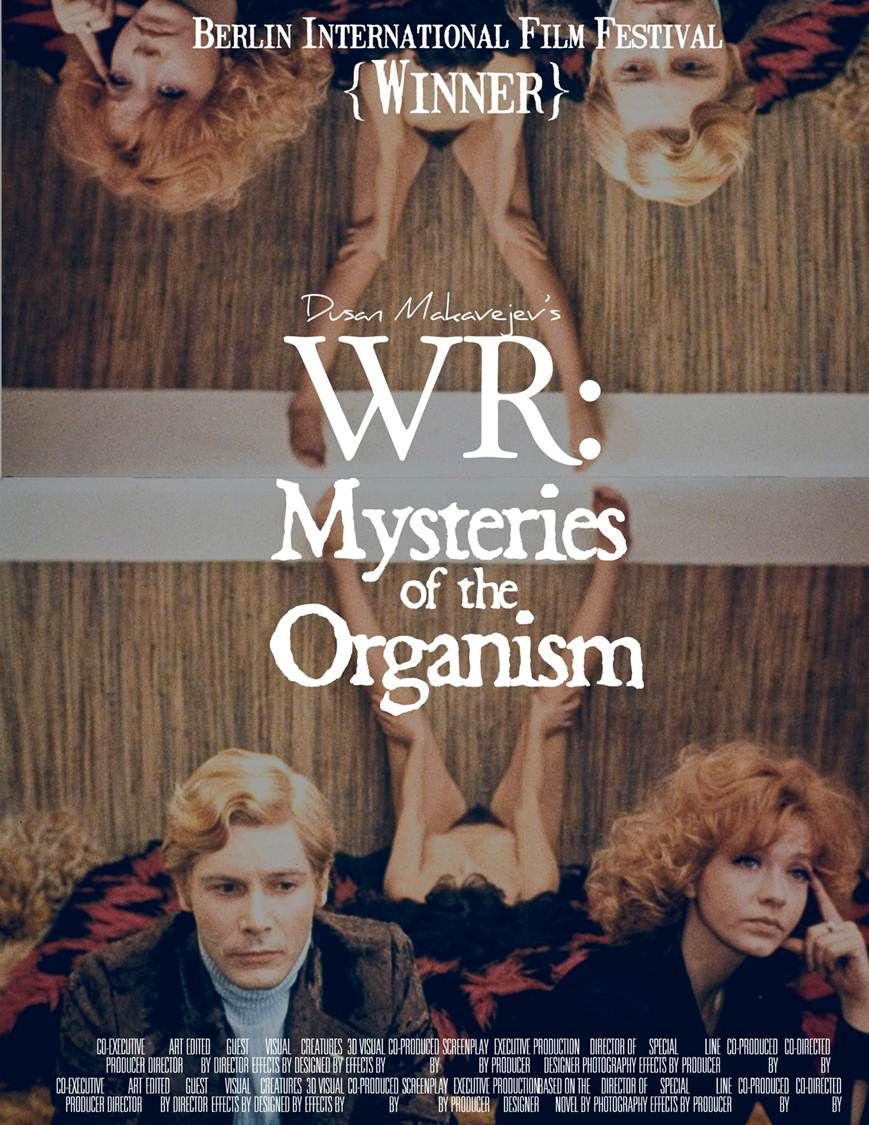
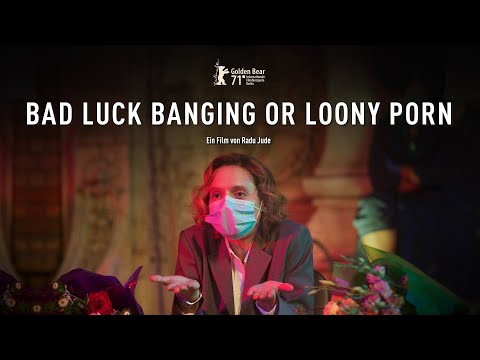
The bracing shock delivered by Radu Jude’s entertaining Bad Luck Banging or Loony Porn (2021) reminds me of the shock carried by another entertaining Eastern European feature dealing with both sex and fear of sex, both contemporary culture and contemporary cultural restrictions, half a century earlier: Dušan Makavejev’s WR: Mysteries of the Organism (1971).
Of course, 1971 and 2021 are separated from each other by more than just fifty years and two notions of entertainment. The struggle to reconcile Freud with Marx that animated so much of the oeuvre of Bernardo Bertolucci, at least until its simplified resolution at the end of The Last Emperor (1987) in favor of Marx (”Is that so terrible?” Read more
Last week Jon Jost, a Chicago-born independent filmmaker, was having the first commercial run of his career — All the Vermeers in New York, his tenth feature, at the Music Box. Typically, he couldn’t be around for the event because he was busy shooting his 12th feature in Oregon.
The Music Box engagement launches a Jost retrospective that continues at Chicago Filmmakers on weekends for the remainder of this month. It’s the most exciting and important American retrospective to hit town since the Music Box’s John Cassavetes series last fall, though like that series it isn’t quite complete: only about half of Jost’s shorts — most made in the 60s and early 70s — are included, and two of his features, Bell Diamond (1985) and Sure Fire (1990), are omitted. (Sure Fire may open here in the fall if enough people go to see All the Vermeers in New York.) Still, it’s the most comprehensive show of Jost’s work that’s ever come to Chicago, and it offers a great chance to catch up with a singular career that has been more subterranean than most, even among American independents. Read more