This appeared in the Chicago Reader on November 21, 2003. — J.R.
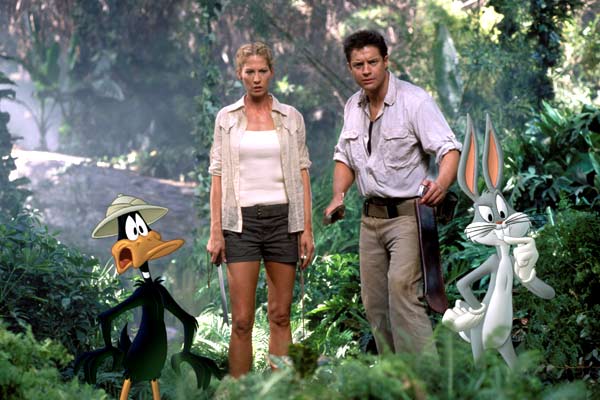
Looney Tunes: Back in Action
*** (A must-see)
Directed by Joe Dante
Written by Larry Doyle
With Brendan Fraser, Jenna Elfman, Steve Martin, Timothy Dalton, Joan Cusack, Heather Locklear, and the voice of Joe Alaskey.

Ever since the word “auteur” became part of the standard English vocabulary in the late 60s and early 70s there’s been some confusion about its meaning. In French auteur simply means “author,” and when François Truffaut started formulating a “politique des auteurs,” or policy of authors, in Cahiers du Cinéma in the mid-50s, he had in mind a critical policy that recognized the stylistic and thematic unity certain directors gave their films. And because politique means “politics” as well as “policy,” he was also implying a ranking of those directors.
In his early writings Andrew Sarris transformed these ideas into an “auteur theory” that focused less on policy and politics. This is where the confusion started, because it wasn’t clear to most people whether this was a theory about how films were made or about how they should be viewed and interpreted. Because the mainstream discourse centered on the powerful Hollywood studios, the theory came to be understood as focusing on how films were made, with the emphasis on film as a business. Read more
A film adaptation of Christopher Hampton’s play, which is based in turn on Choderlos de Laclos’ classic 18th-century epistolary novel Les liaisons dangereuses. Aiming for a mixture of erotic decadence and upscale artiness a la The Draughtsman’s Contract, the film seems a bit studied, but the creepy plot still holds a certain fascination, and Glenn Close, John Malkovich, Michelle Pfeiffer, Swoosie Kurtz, and Keanu Reeves all do their best with it, though Mildred Natwick in a cameo manages to steal the show (1989). (JR) Read more
Lawrence Kasdan’s comedy-drama, based on Anne Tyler’s novel, reunites the two stars of Body Heat, Kasdan’s first feature, William Hurt and Kathleen Turner. The plot concerns a writer of guidebooks for reluctant travelers (Hurt) whose wife (Turner) leaves him; Geena Davis plays the unusual dog trainer he meets. Unlike Body Heat, the interest here is wholly a matter of story and character rather than style, and Hurt’s character is so inert and unemotional that some spectators may find it difficult to stay interested in him. A dog, a ten-year-old boy, and several eccentrics do give things a bit more flavor. The locations include Paris, London, and Baltimore; Amy Wright, David Ogden Stiers, Ed Begley Jr., and Bill Pullman are among the stars (1989). (JR) Read more
Tama Janowitz adapts her own collection of stories in James Ivory’s mainly studio-shot movie (1989) about the downtown art scene in Manhattan, a world of self- absorbed male artists, their girlfriends, and others struggling to promote themselves. Bernadette Peters plays the central character, and good as she’s been elsewhere as a foil to Steve Martin, she’s pretty much defeated by the studied flakiness of both her character (who often recalls the heroine of I’ve Heard the Mermaids Singing in her helplessness, naivete, and Woody Allen-like nebbishness) and the movie as a whole, which etches out a view of Manhattan bohemia that’s every bit as caricatured as in Funny Face (without the benefit of Fred Astaire or Audrey Hepburn). Offering a view of predators and victims that mainly winds up being too cute for words (or images, for that matter), the film tries so hard to be with it that it winds up on another planetand not a very interesting one at that. With Chris Sarandon, Mary Beth Hurt, Madeleine Potter, Adam Coleman Howard, Nick Corri, Charles McCaughan, and Mercedes Ruehl. (JR) Read more
FRANKLY, MY DEAR: GONE WITH THE WIND REVISITED by Molly Haskell (New Haven/London: Yale University Press), 2009, 244 pp.
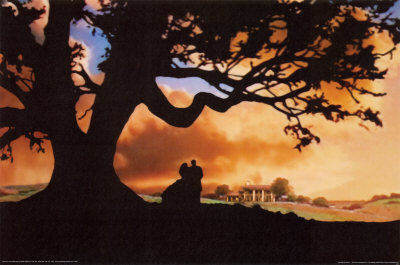
I’m glad that Armond White gave this book a favorable review in the New York Times, which it clearly deserves. But I wish he hadn’t muddied his kindness with lazy misinformation and lazier prose.
Misinformation: “Haskell gave up regular reviewing in the early ’90s, leaving criticism that seriously examined the big-screen image of women and the popular representation of female social roles to go underground — into academic studies where abstruse, tenure-seeking jargon is used to rebuff popular taste.” I’m not aware that Haskell ever left the kind of criticism White describes; unless one decides to make a very big deal out of her brief stint of teaching, she certainly didn’t go into “academic studies”, abstruse, jargony, or otherwise; and if White knows something that the rest us don’t about her rebuffing of popular taste, I wish he’d enlighten us further on this subject.
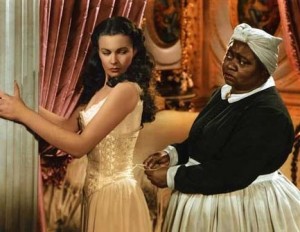
Prose: “Haskell intertwines her own history with Mitchell’s Georgia background, Leigh’s British origins and Selznick’s Jewish American determination.” (Whenever White gets around to identifying Haskell’s abstruse, jargony rebuffing of popular taste, he might also explain what Jewish American determination consists of — unless Haskell explains this herself, which I doubt. Read more
This very agreeable and funny low-budget documentary by Tony Buba, set in a steel-mill town just outside Pittsburgh, documents the decline of the area as the mills shut down and his own 15-year activity as a local independent filmmaker. Concerned with union organizing, his temperamental and eccentric star Sweet Sal Carullo, his dwindling finances, and his own soul, Buba has a lot of interesting things to say and show, and this witty and intelligent portrait of him and his community has charm to spare (1989). (JR) Read more
At last, a teenage love story with real characters instead of cliches, poses, and attitudes (1989). The directorial debut of Cameron Crowe (Jerry Maguire), it follows two very different high school graduates in Seattleaspiring kickboxer Lloyd (John Cusack) and brilliant student Diane (Ione Skye), who’s just won a fellowship to study in Englandas, to everyone’s surprise, they gradually get involved. John Mahoney plays Diane’s devoted but demanding father. Produced by Polly Platt, with James L. Brooks serving as executive producer, the movie stands out mainly because its attention to detail is so precise; Cusack and Skye are especially fine, but the overall treatment of contemporary teenagers is so refreshing that it almost makes up for dozens of phony and superficial predecessors (and for once the adults aren’t viewed exclusively from the wrong end of the telescope). As in Brooks’s Broadcast News, it’s the characters and their interrelationships that make the story. 100 min. (JR) Read more
Gallons of PBS-style piety are lavished here on a trite tale about a widowed clock maker (Kurt Russell) with a little girl who settles down with an unwed mother (Kelly McGillis) in a southern mountain community in the 30s, and then becomes involved in various intrigues involving the father of her child and two feuding families. Adapted by Carol Sobieski from a novel by John Ehle and directed by Ted Kotcheff, the film has a likable performance by Lloyd Bridges as the unwed mother’s father. McGillis strives hard to be believable in what is essentially an impossible role for her, while Kurt Russell is amiably professional but predictable. The film is shot (by Francois Protat) in ‘Scope, but the effort is essentially wasted by dull center framing that makes the format superfluous (1989). (JR) Read more
From Moving Image Source (www.movingimagesource.us), posted September 22, 2009. Also reprinted in my collection Goodbye Cinema, Hello Cinephilia. — J.R.

Following James Agee: Film Writing and Selected Journalism (2005), and American Movie Critics (2006), Farber on Film: The Complete Film Writings of Manny Farber is the Library of America’s third and so far most ambitious effort to canonize American film criticism — a daunting task that’s been lined at every stage with booby traps, at least if one considers the degree to which film criticism might be regarded as one of the most ephemeral of literary genres. And this is certainly the volume that adds the most to what has previously been available; by rough estimate, it easily triples the amount of film criticism by Manny Farber that we have between book covers.
As Karl Marx once pointed out, quantity changes quality, but this doesn’t entail any lessening of Farber’s importance. I would even argue that both the nature and evolution of his taste and writing over 30-odd years, before he gave up criticism to concentrate on his painting, still make him the most remarkable figure American film criticism has ever had.
Bringing a painter’s eye to film criticism and couching even his most serious observations in a snappy, slangy prose, Farber was the first American in his profession to write perceptively about the personal styles of directors and actors without any consumerist agendas or academic demonstrations. Read more
The first feature directed by actor Bob Balaban (1989) brings back the late 50s in the form of a highly original comic nightmare. Mary Beth Hurt and Randy Quaid star as the parents of a disturbed little boy (Bryan Madorsky) who has bad dreams about his parents’ sex lives and carnivorous habits; Sandy Dennis does one of her best turns as the neurotic school psychologist. Some critics have compared Balaban to David Lynch, but the differences are revealing. Balaban’s sense of the awfulness of the physical and spiritual decor of the 50s is actually closer in some ways to John Waters, while his politics are virtually the reverse of Lynch’s in Blue Velvet: nostalgia for innocence and purity couldn’t be further from his agenda. The script runs out of ideas long before he does, and the film doesn’t build dramatically as much as it could. But it’s an impressive debut, full of bizarre imagination and visual flaira must for fans of offbeat horror films. R, 82 min. (JR) Read more
Well-made treacle (1989), adapted by writer-director Phil Alden Robinson from W.P. Kinsella’s novel Shoeless Joe. A fledgling farmer (Kevin Costner) hears a voice in an Iowa cornfield and has a vision that convinces him that if he builds a baseball diamond in his field, Shoeless Joe Jackson, of the notorious 1919 White Sox, will turn up to play there. Other messages and signs follow, leading the hero to meet a former novelist in hiding (James Earl Jones) and a deceased ballplayer who ended his life as a doctor (Burt Lancaster). The strange mixture of nostalgia, poetry, pop mysticism, and innocence suggests both Ray Bradbury and Steven Spielberg, at their best as well as their worst; the conception is sentimental, but the storytelling remains assured and effective. With Amy Madigan as the hero’s sympathetic wife, Gaby Hoffmann as their daughter, and Ray Liotta as Shoeless Joe. PG, 106 min. (JR) Read more
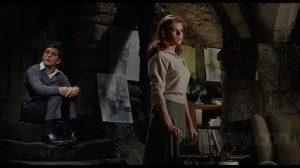
Perhaps the most interesting element of John Fowles’s novel is its alternation between two narrators — the shy and eccentric butterfly collector who kidnaps a young woman to add to his collection, and the woman herself. By jettisoning this structure, this 1965 film has precious little to hold one’s interest, apart from Terence Stamp and Samantha Eggar as the leads; Stanley Mann and John Kohn’s script adaptation is relatively flat-footed, and William Wyler’s direction is as academic as ever. 119 min. (JR) Read more
Clint Eastwood plays a skip-tracer cop with a taste for impersonations who’s assigned to track down a woman (Bernadette Peters) on the lam with her eight-month-old baby. The wife of an ex-con (Timothy Carhart) who’s linked to a group of white supremacists (a band of misfits and speed freaks that the movie has great fun ridiculing), she jumps bail after being arrested for passing counterfeit money; Eastwood follows her to Reno and then finds himself gradually shifting his loyalties. Buddy Van Horn (The Dead Pool) directed from a John Eskow script, but in fact this is very much an Eastwood movie, full of his cranky personality and quirky intelligence, and brimming with ideas. Not all of these ideas are successfully dramatized, and you may have trouble believing in most of the characters, but as a deeply personal work about free-floating existential identities, this 1989 film has the kind of grit and feeling that few action comedies can muster, with Eastwood and Peters interesting and unpredictable throughout. With John Dennis Johnston and Michael Des Barres. 122 min. (JR) Read more
In his first American picture (1987) Scottish director Bill Forsyth adapts Marilynne Robinson’s much-acclaimed novel about two orphaned sisters (played by Sara Walker and Andrea Burchill) who share their ramshackle house with their eccentric aunt (Christine Lahti). The setting is the Pacific northwest in the 1950s, and Forsyth does a remarkable job with period detail and the beautiful natural settings, assisted by his own UK crew of cinematographer Michael Coulter, production designer Adrienne Atkinson, costume designer Mary-Jane Reyner, and editor Michael Ellis. But the most impressive thing about this haunting fable is Forsyth’s fluidity and grace as a storyteller, which gives this understated tale some of the resonance one associates with Terrence Malick’s Badlands and Days of Heaven. The story suggests a kind of feminist version of Huckleberry Finn, with the sisters playing Huck and Tom to their aunt’s Jim; the performances by all three actresses are impeccable. A film to be savored rather than gulped. (JR) Read more
This essay — commissioned originally in the mid-1990s by Alexander Horwath for a collection in German published by the Viennale, and later published in 2004 by the Amsterdam University Press as The Last Great American Picture Show: New Hollywood Cinema of the 1970s, coedited by Thomas Elsaesser, Alexander Horwath, and Noel King — overlaps with various other pieces of mine, and is obviously out of date in some of its details, but it seems worth reprinting for some of the arguments it draws together. And it’s been fun hunting up illustrations for it on the Internet. — J.R.
“New Hollywood” and the 60s Melting Pot
Jonathan Rosenbaum


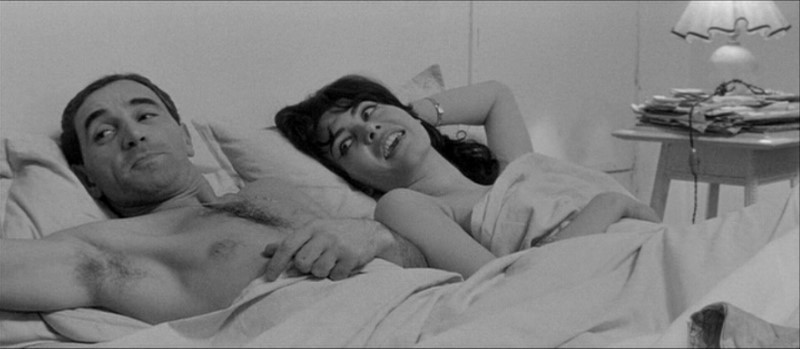
Let me begin with a few printed artifacts, all of them from New York in the early 60s: two successive issues of the NY Film Bulletin published in early 1962, special numbers devoted to Last Year at Marienbad and François Truffaut; and three successive issues of Film Culture, dated winter 1962, winter 1962-63, and spring 1963. Cheaply printed but copiously illustrated, the two special numbers of the NY Film Bulletin are the 43rd and 44th issues of a monthly, respectively twenty and twenty-eight pages in length. The Last Year at Marienbad issue consists exclusively of interviews with Alain Resnais, Alain Robbe-Grillet, and editor Henri Colpi, all translated from French magazines, and a briefly annotated Resnais filmography. Read more