I’d like to suggest that the theme of Atom Egoyan’s Chloe –- a woman’s midlife crisis –- hasn’t been identified by any of the film’s reviewers that I’ve read so far. Many of them have been calling the movie a hoot (Jim Hoberman, meet Anthony Lane) and perhaps just as many have been reaching for Fatal Attraction as their principal point of comparison and abuse. Since that crude shocker isn’t a film about a woman’s midlife crisis, I assume they’re misreading Chloe, which is easy enough to do if you’re mainly restricting the story to — that is, viewing most of it through — its bombastic penultimate scenes.
Disregarding the Anne Fontaine movie that served as this movie’s basis, which I haven’t seen, I think what’s sneaky and deliberately misleading about the story is that it starts off pretending to be a movie about a husband’s midlife crisis and then winds up as a movie about his wife’s midlife crisis. (If this constitutes a spoiler, tough luck; all I can say as a rejoinder is that comparing the movie to Fatal Attraction is a spoiler as well.) Read more
If James Cameron (Titanic) is entitled to risk making a fool of himself, why not Sally Potter? The writer-director of the wonderful if much-reviled The Gold Diggers (her first black-and-white musical) and the mediocre if much-praised Orlando plays herself in this second black-and-white musical, a wistful pipe dream set in Paris, London, and Buenos Aires, about learning the tango from a master (Pablo Veron, also playing himself). She’s always dreamed of being a dancer, he’s always dreamed of being in a film, and the main problem between them in this joint enterprise is who gets to lead — a metaphorical premise that?s milked for everything it’s worth, and then some. Meanwhile Potter is seen writing a script for what appears (in color snatches) to be a god-awful film combining the worst elements of her first two features, and there’s some enigmatic material about both characters supposedly being Jewish. The film’s division into 12 “lessons” might at times seem a little arch, but when Potter and Veron are dancing — which is at least half the time — the movie becomes rapturous and joyful, so who cares if she’s being presumptuous? Read more
Not one of Billy Wilder’s best efforts (I wonder if it was motivated by his desire to show his ideological “correctness” during the Red Scare, by celebrating a much-beloved antisemite), this lengthy 1957 account of Lindbergh’s flight across the Atlantic, shot in CinemaScope, still has some interest because of James Stewart’s performance, which is very nearly a one-man show. With Patricia Smith, Murray Hamilton, Marc Connelly, and a score by Franz Waxman. 138 min. (JR)
Dracula’s daughter — and more specifically, Lambert Hillyer’s Dracula’s Daughter (1936) — comes to Manhattan’s East Village in a quirky, lyrical independent feature by writer-director Michael Almereyda. It’s shot in luscious, shimmering black and white, with prismatic, pointillist interludes shot with a toy Pixelvision camera (also used by Almereyda in Another Girl, Another Planet, his previous feature), transferred to 35-millimeter without letterboxed framing. Produced by David Lynch, who turns up in a cameo, this offbeat horror item works much better as a dreamy mood piece with striking poetic images and as a semicomic appreciation of a few quintessential low-budget actors than as straight-ahead storytelling. In some ways it’s a throwback to the pathos of Twister, Almereyda’s first feature — a black comic treatment of various dysfunctional family members yearning for normality. With Elina Lowensohn, Martin Donovan, Peter Fonda, Galaxy Craze, Suzy Amis, Karl Geary, and Jared Harris. (JR)
My 1995 liner notes for the Voyager/Criterion laserdisc of Orson Welles’ Othello in its original, untampered-with form. — J.R.
There are two ways of viewing the film career of Orson Welles which have tended, by and large, to be mutually exclusive. One can regard it as a fascinating but largely frustrating attempt to make mainstream Hollywood movies — an effort that yielded one indisputable triumph (Citizen Kane) and five other brilliant if uneven studio releases (The Magnificent Ambersons, The Stranger, The Lady from Shanghai, Macbeth, and Touch of Evil) hampered by dealings with studio management. Or one can regard it as the career of a restless independent making pictures whenever and however he could, a pursuit yielding not only the aforementioned half-dozen features, but seven more — Othello, Mr. Arkadin, The Trial, Chimes at Midnight, The Immortal Story, F for Fake, and Filming Othello, not to mention substantial portions of at least half a dozen unfinished pictures as well.
These two opposing views of Welles’s career were in effect even before he got to Hollywood; in the mid-’30s, he was illegally funneling his sizable earnings as a radio actor into his state-funded stage productions with John Houseman — much as he would later help to finance his own Othello, shot piecemeal and on the run, by concurrently acting in several mainstream pictures that were being made in Europe. Read more
I’m very grateful to Adam Shatz for drawing my attention to Tom Perchard’s After Django: Making Jazz in Postwar France [NYR, July 9]and for offering, along with Perchard, a provocative and useful introduction to a neglected subject. But I was brought up short by the following grotesque sentence: “[André] Hodeir eventually gave up jazz criticism to write novels for children.” In fact, this collapses and distorts a phrase from Perchard: “From the beginning of the 1970s to his death in 2011, Hodeir would devote himself to writing novels and children’s books, often with a musical theme.”
Indeed, to account for the two or three books for children and the half-dozen or so books of fiction that Hodeir published at the end of his career, and the singular evolution and development this represented from his former jazz composing, one has to factor in not only his last collection of jazz criticism in English, The Worlds of Jazz, but also his last two major musical works, Anna Livia Plurabelle (which is discussed over five pages by Perchard, but which Shatz fails to mention) and Bitter Ending, each drawn from and built around passages from Finnegans Wake.
Like almost every other year within recent memory, I wind up seeing a masterpiece after I can vote for it or include it in any poll. Alice Diop’s first fiction feature is a classical example of a film that asks questions more than provides answers, and one of its best ways of posing or suggesting questions is not cutting to a reverse angle whenever you’re expecting it to. This is a film carried largely by its close-ups and its dialogue, and many of its reverse angles are between its two protagonists, two young and black Senegalese women in France who never meet, although they do exchange glances at one climactic, privileged moment. It’s a film devoted to a trial whose outcome is never recorded, but it has generated enough questions by the end to make a verdict seem either impossible or superfluous. Consciously or not, it carries more than one echo of Ousmane Sembene’s great La noire de… (Black Girl, 1966). [1/3/2023]
From the Chicago Reader (February 1, 1992). — J.R.
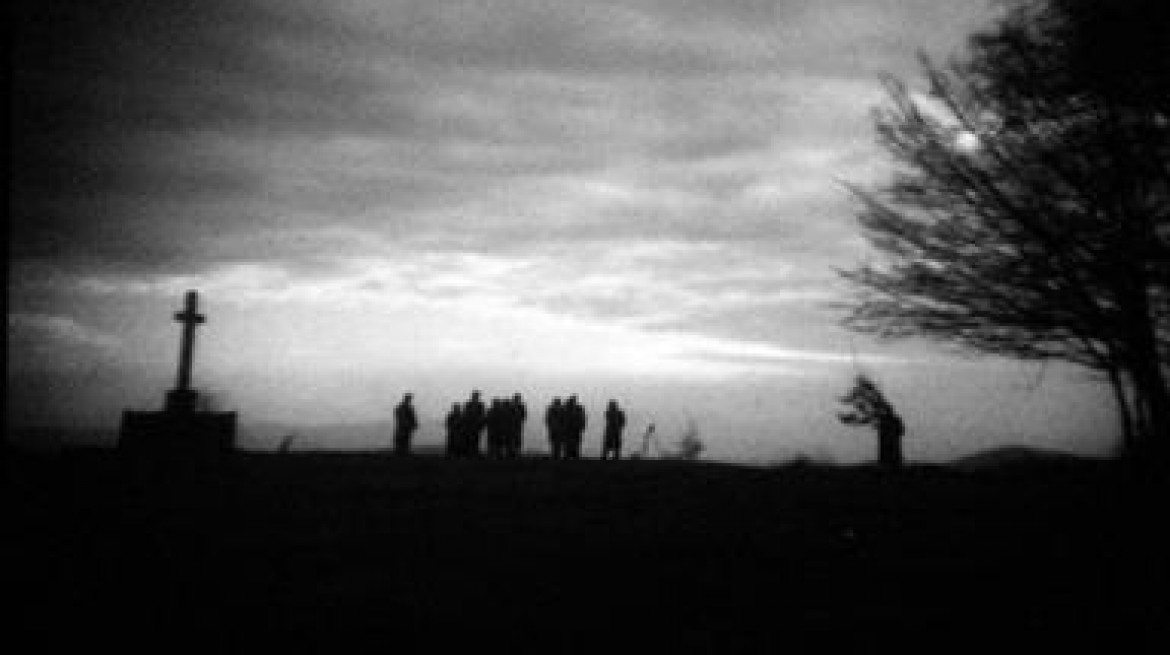
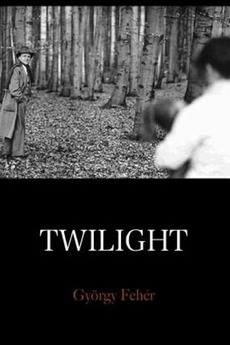
A dirgelike Hungarian thriller by Gyorgy Feher about the search for a serial killer whose victims are little girls. The striking visual style (high-contrast black-and-white cinematography by Miklos Gurban) and creepy pacing tend to dominate the plot so thoroughly that I found myself tuning the narrative out and not being terribly worried about what I was missing. While the slow-as-molasses dialogue delivery and camera movements superficially suggest Tarkovsky (or, closer to home, Bela Tarr’s Damnation), Feher’s script and mise en scene are considerably more mannerist — employed more to conjure an atmosphere than to convey a particular vision or a distinctive moral universe. The closest American equivalent to this sort of exercise might be Rumble Fish: sumptuous visuals that impart more filigree than substance (1990). (JR)
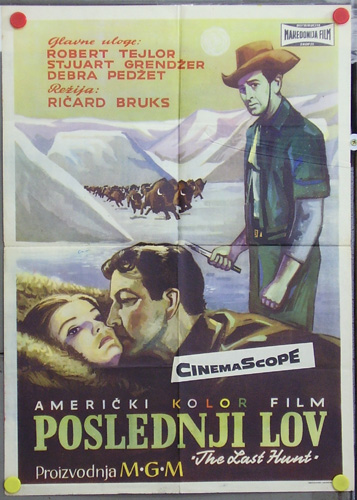
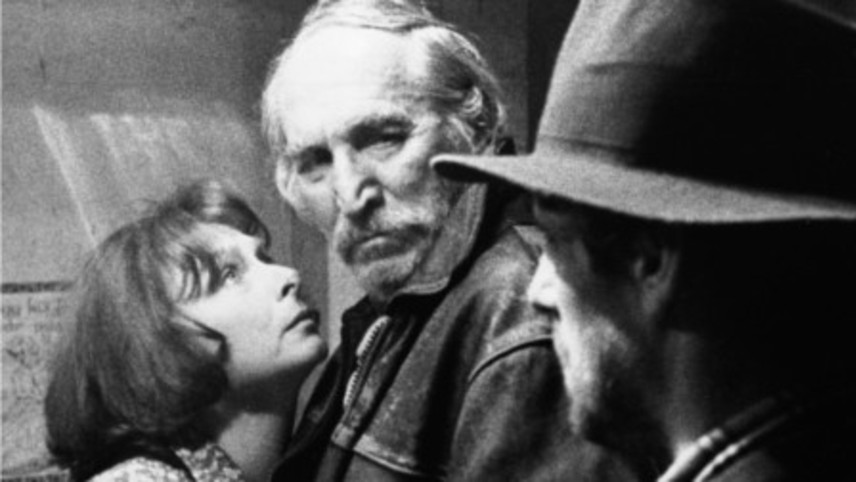
A very dated but absorbing – and, in its own terms, effective – liberal CinemaScope western, all the more interesting for its dated qualities. In anticipation of Jim Jarmusch’s DEAD MAN, an explicit correlation is made between genocide of Native Americans and the decimation of buffalos, personified in this case by a racist and wanton killer played by Robert Taylor -– contrasted with the humane, reluctant buffalo killer played by Stewart Granger, who grew up with Native Americans and respects both them and their own respect for white buffalos, unlike Taylor. Lloyd Nolan plays the Walter Brennan part, a drunken old geezer who also comes along on the last hunt and winds up siding more with the good guys (i.e., everyone except Taylor, a dyed-in the-wool villain throughout).
The politically incorrect monkey wrench tossed into this scheme, at least by today’s standards, is the fact that the two major Native American characters are played by Russ Tamblyn (a half-breed) and Debra Paget, who function as Granger’s son figure and romantic interest, respectively. In short, no real Native Americans to be seen anywhere, making this movie a good target for the kind of conservative, anti-liberal scorn that a critic like Manny Farber might have had towards such a film. Read more
by James Naremore. Cambridge University Press, 1993. 202 pp, illus., Hardcover: $65.00. Paperback: $27.99.
The critical position of James Naremore is Frankfurt school auteurism, a seeming contradiction. That is, he shares the Marxist orientation of many Frankfurt school intellectuals but not their disdain for the artifacts of mass culture. (To be sure, not all Frankfurt school members can be characterized in quite so monolithic a fashion; see, for instance, the prewar journalism of Siegfried Kracauer published this year in The Mass Ornament.) As a consequence, Naremore’s work shows an interest in style and pleasure that runs against the puritanical grain of most American Marxists, without ever losing sight of the social and political issues avoided by most American auteurists.
This is an idiosyncratic and progressive book in a series, the Cambridge Film Classics, that has mainly been conformist and conservative, especially in relationship to non-American filmmakers. Its volumes always focus on a few “representative” features rather than complete oeuvres, and Naremore’s study of Minnelli focuses on Cabin in the Sky, Meet Me in St. Louis, Father of the Bride, The Bad and the Beautiful, and Lust for Life, but only after an Introduction and first chapter that take up a quarter of the book and lay a considerable amount of contextual groundwork. Read more
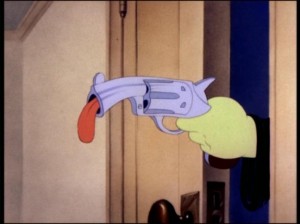
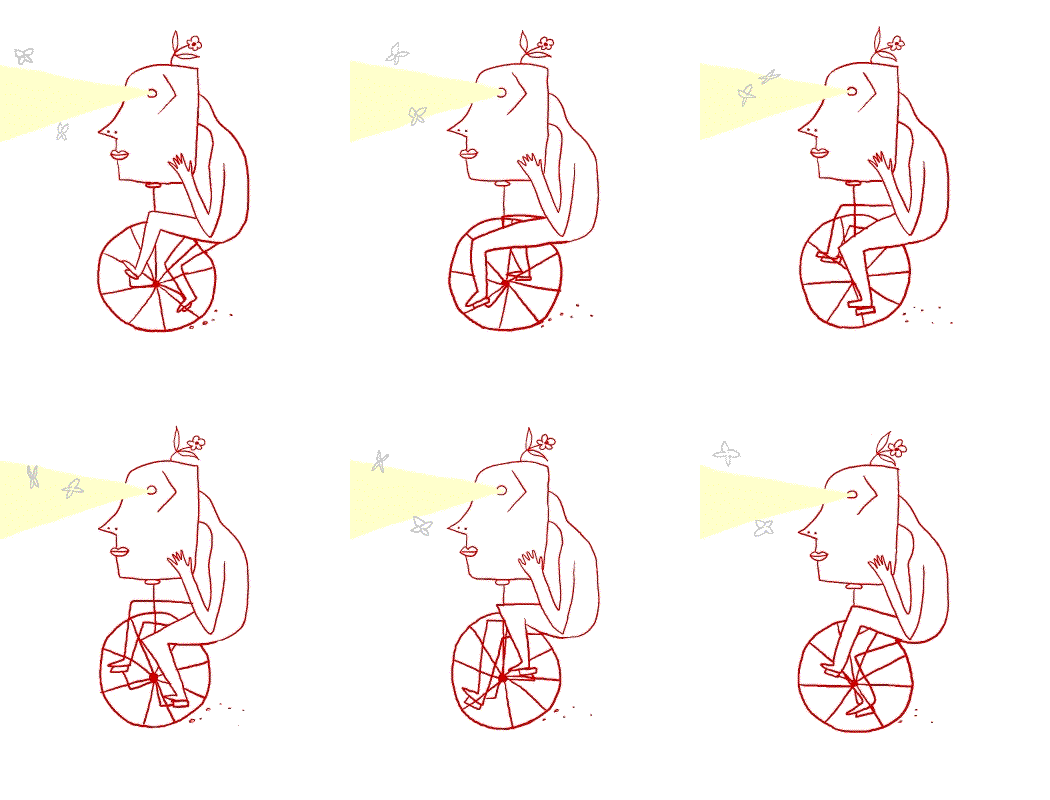
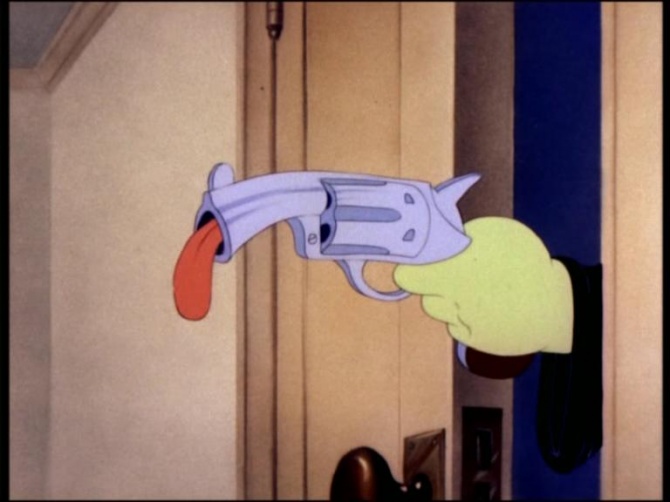
From The Soho News (June 11, 1980). I’m sorry I haven’t had better luck in finding illustrations for the experimental and independent animated shorts reviewed here. But at least if you hit the first illustration, you can see it move. — J.R.
New American Animation
Film Forum, June 12-15 and l9-22
Cartoonal Knowledge
Thalia, Mondays (June through August)
Did you ever step out of a movie theater in the good old days and exclaim, “Gee, that cartoon was better than the feature”? Whether you did or not, there’s precious little chance of such a thing happening today. Thanks to some of the packaging principles that currently dominate media, short animation is often treated like a ghetto art —quarantined in its own little category and asked to stay there, mind its manners and keep a low profile, in such out-of-the-way corners as kiddie matinees and museums.
Consequently, to write about the New American Animation series at Film Forum — the last program for the season — is a bit like having to write about the Third World (another Film Forum specialty), rather than, say, simply Brazil or Algeria. And Greg Ford’s massive “Cartoonal Knowledge” series at the Thalia – encompassing 13 Mondays this summer, and billed as “probably the largest and most comprehensive cartoon festival ever mounted in a straight ‘theatrical’ context” — etches out an umbrella subject that is equally daunting to nonspecialists. Read more
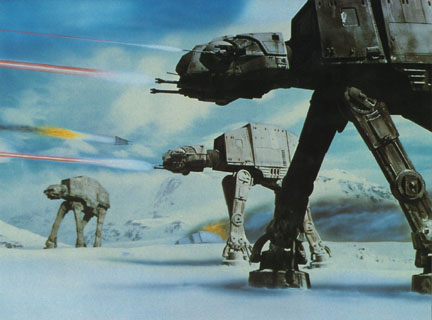
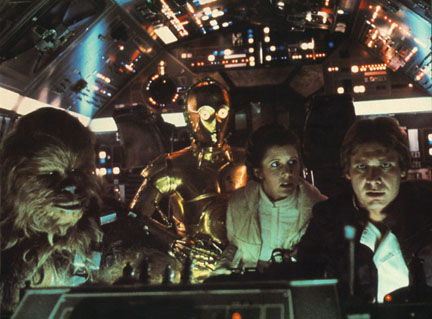
Let’s face facts. Whether you or I love, hate or feel indifferent to The Empire Strikes Back — or any of the seven sequels and “prequels” to Star Wars slated to interfere with our lives over the next two decades — doesn’t make the slightest bit of difference in the long run, on the cosmic scale of things. Nor does it matter all that much in the mundane short run, either. Even if you stay away from the movie, manage to shun the novel and T-shirt and comic, avoid the soundtrack album and toys and video cassette, you can bet that a skilled team of disinterested humanitarians and technocrats, working round the clock with computers has decided that it’s so good for you and your kids that there’s no way you can prevent it from being crammed down your throats, in one form or another.
You’d better grin and bear it, if you know what’s good for you. The celestial machinery that has already turned Star Wars into the biggest grosser to date (“of all time” might seem a little excessive in forestalling the future) isn’t taking any chances in its investment by branching our or experimenting much. Read more