Written by Abbas Kiarostami, Panahi, and Parviz Shahbazi
With Aida Mohammadkhani, Mohsen Kalifi, Fereshteh Sadr Orfani, Anna Bourkowska, Aliasghar Samadi, Mohammad Shahani, and Mohammad Bahktiari.
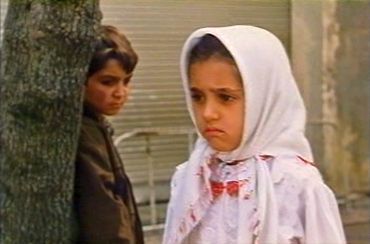
In Iran the first day of spring is New Year’s Day, the celebration of which starts at a different time of day every year, and among the objects used in the celebration is a goldfish, which symbolizes life. The plot of Jafar Panahi’s extraordinary first feature, The White Balloon (opening this week at the Music Box), involves the adventures of Razieh (Aida Mohammadkhani), a seven-year-old girl who has her heart set on buying a new goldfish for the celebration, insisting that the ones her family already has are “too skinny.”
Only 85 minutes long, the film unfolds in real time and almost exclusively in exteriors along a few blocks of Tehran the morning of the New Year. The film opens in a market, where Razieh’s mother (Fereshteh Sadr Orfani) is shopping; she collects Razieh, who’s carrying a blue balloon, and they walk home together. Nearly all of the film’s other major characters — and even a couple of minor ones — are fleetingly glimpsed during this prelude, though we don’t recognize any of them yet. Read more
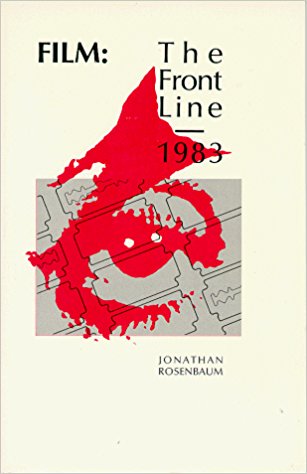
From Film: The Front Line 1983 (Denver, CO: Arden Press, 1983).
Although I still agree with most of my arguments here, it’s now clear to me that my characterization of Paul Schrader’s politics in 1983 were oversimplified at best, and simply wrong at worst.— J.R.
Tenants of the house,
Thoughts of a dry brain in a dry season.
T.S. Eliot, Gerontion
Preface: When I was approached last year about inaugurating a series of volumes surveying recent avant-garde film, I immediately started to wonder about how this could be done. Having lived nearly eight years in Paris and London and about as long in New York, I’ve had several opportunities to note the relative degree of information flow between these and other centers of avant-garde film activity, and the growing isolation of New York from these other centers made my own fixed vantage point less than ideal in some ways. When a colleague told me that Jonas Mekas had recently said that it was no longer possible to know what was happening in experimental film as a whole, a bell of recognition rang in my head, and I knew at once that Mekas was the only available oracle l could turn to. Read more
From Film: The Front Line 1983 (Denver, CO: Arden Press, 1983). Due to the length of this, I’ll be posting it in four installments. — J.R.
Tenants of the house,
Thoughts of a dry brain in a dry season.
T.S. Eliot, Gerontion
Preface: When I was approached last year about inaugurating a series of volumes surveying recent avant-garde film, I immediately started to wonder about how this could be done. Having lived nearly eight years in Paris and London and about as long in New York, I’ve had several opportunities to note the relative degree of information flow between these and other centers of avant-garde film activity, and the growing isolation of New York from these other centers made my own fixed vantage point less than ideal in some ways. When a colleague told me that Jonas Mekas had recently said that it was no longer possible to know what was happening in experimental film as a whole, a bell of recognition rang in my head, and I knew at once that Mekas was the only available oracle l could turn to. The Lithuanian patron saint of the American avant-garde film, now 60, has been an American filmmaker for at least half of his life, and a chronicler of the avant-garde film in New York — mainly in The Village Voice and (more briefly) Soho News — for at least 15 years. Read more
An article about “remakes” of independent documentaries, from the November 20, 1998 Chicago Reader. — J.R.
Shulie
Rating *** A must see
Directed by Elisabeth Subrin
With Kim Soss, Larry Steger, Rick Marshall, Eigo Komei, E.W. Ross, Marion Mryczka, Ed Rankus, Kerry Ufelmann, and Jennifer Reeder.
What is it about American culture that compels the film industry to do remakes? The compulsion has been growing over the past two decades — one of my oldest friends, a cinephile and sometime screenwriter based in Hollywood, was already viewing it with philosophical resignation ten years ago. As she put it, “My best friends and I have been spending most of the 80s sitting in cars discussing remakes.”
Since the early 80s we’ve been inundated with more cultural objects than ever before, but we have less and less sense of what to do with them. It’s easy to explain the Hollywood remake syndrome as unimaginative cost accounting: it made money before, so why not do it again? Then there’s the expanding youth market, which encourages unimaginative cost accountants to figure that former hits can be recycled for younger generations — one of the justifications offered by Gus Van Sant for his forthcoming remake of Alfred Hitchcock’s Psycho. Read more
DARKNESS VISIBLE: A MEMOIR OF MADNESS by William Styron (New York: Vintage Books), 1990, 84 pp.
HAVANAS IN CAMELOT: PERSONAL ESSAYS by William Styron (New York: Random House), 2008, 162 pp.
Two late autobiographical books by a writer I’ve always liked —- the first somewhat disappointing, perhaps because I came to it with the wrong expectations, the second a pleasurable surprise.
I guess what I was hoping to encounter in DARKNESS VISIBLE, Styron’s brief and somewhat sketchy account of his own excruciating bouts with depression in the 1980s, was some clarification or extension of what I found so powerful about his treatment of bipolar behavior in SOPHIE’S CHOICE (1979) -– specifically the depiction of Nathan, which seemed to derive from some deep personal understanding of this condition. But Styron points out early on that his own malady was “unipolar,” not the same thing at all. Still, I admire the scrupulous way he avoids leaping to too many conclusions about a condition that he’s still far from fully understanding.
The late essays collected in HAVANAS IN CAMELOT deal with such topics as a few amicable encounters with John F. Kennedy (the title essay), an apparent contraction of syphilis during his youth (as a fledgling Marine at a naval hospital in South Carolina), his friendships with fellow novelists (Truman Capote, James Baldwin, and Terry Southern), some late prostate trouble, and walks with his dog in his early 80s.Read more
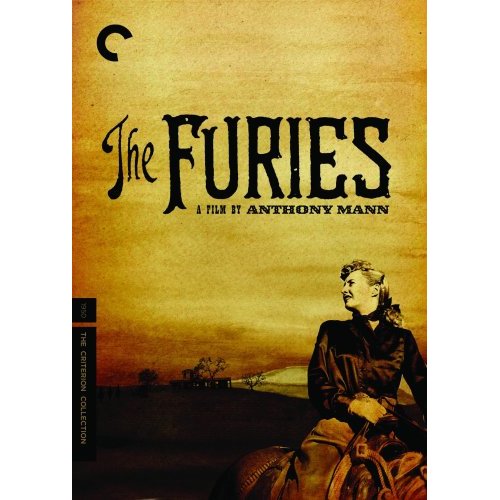
THE FURIES, directed by Anthony Mann (1950, 109 min.), in a Criterion box set.
Last night, I saw this grand, exciting, unruly failure, Mann’s first western, for the first time, thanks to the timely arrival of the DVD from Criterion, handsomely boxed with the Niven Busch novel that Charles Schnee (and Mann, uncredited) adapted it from. I haven’t yet sampled the Jim Kitses commentary, but there’s also an excellent new essay by Robin Wood that’s very attentive to both the strengths and weaknesses of the film, cross-referencing KING LEAR in all the right ways. And on the same disc, a Paul Mayersburg interview with Mann shortly before his death that was recorded for British television–the first I’ve ever seen–as well as a no less revealing interview with Mann’s daughter Nina, which introduces me to certain relevant aspects of Mann’s childhood: specifically, growing up mainly without parents in a Theosophical Institute in San Diego where there was an outdoor amphitheater that produced Greek tragedies, among other things.
My only complaint, really, is that there’s no allusion in the booklet to Arthur Hunnicutt’s uncredited appearance in the film––the same year he appeared as Chloroform Wiggins in Jacques Tourneur’s STARS IN MY CROWN. Read more
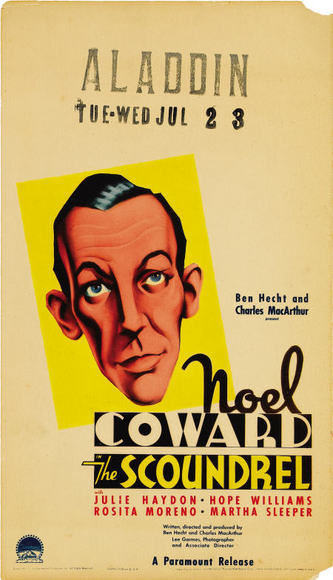
THE SCOUNDREL, written and directed by Ben Hecht and Charles MacArthur, with Noel Coward (1935, 76 min.)
Interesting to discover from Alfred Kazin’s AN AMERICAN PROCESSION -– specifically, from the beginning of his chapter about AN AMERICAN TRAGEDY and THE SOUND AND THE FURY -– that Horace Liveright, the onetime publisher of Dreiser, was “the model for Ben Hecht’s maliciously engaging film THE SCOUNDREL“. Having recently reseen and again hugely enjoyed the second feature codirected as well as cowritten by Ben Hecht and Charles MacArthur, starring Noel Coward in the title role as Anthony Mallare (apparently his first film part, unless one counts his uncredited cameo in Griffith’s 1918 HEARTS OF THE WORLD), I’d been wondering how much of this memorable antihero was attributable to the imaginations of the writer-directors and how much came from life.
Hecht directed or codirected seven features in all, starting with the equally mannerist CRIME WITHOUT PASSION (with its deliriously campy avant-garde prologue) in 1934 and concluding with the rather awful ACTORS AND SIN (codirected by Lee Garmes) in 1952. All of them are difficult to find nowadays, though I’ve managed to track down a few from various Mom and Pop operations on the Internet. Read more
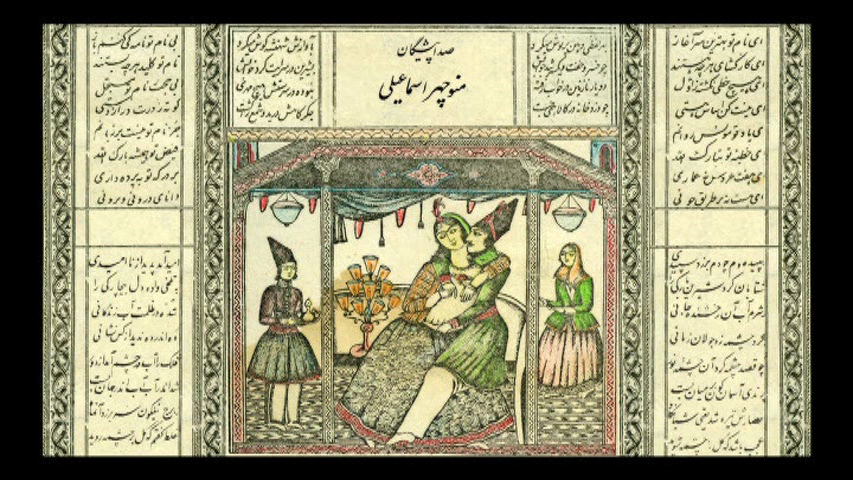
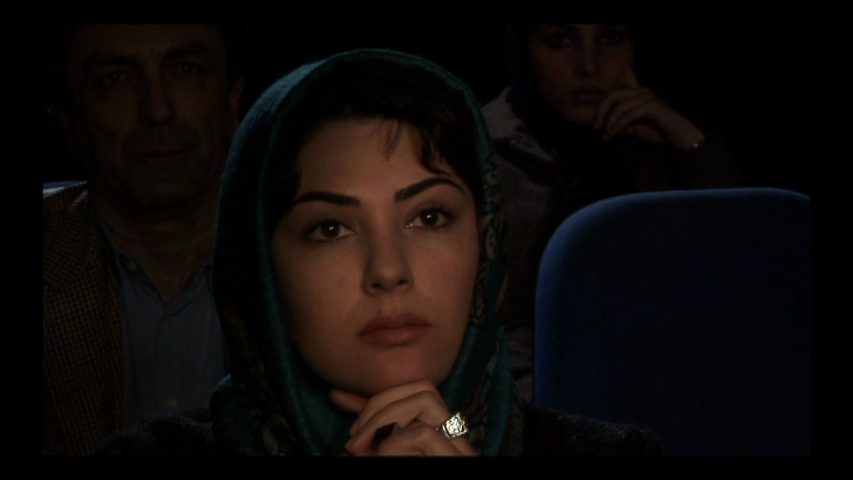
One of Abbas Kiarostami’s trickiest and most radical experimental works, this fascinating 2008 feature focuses on women spectators of a movie that we hear but don’t see—a lush and seemingly action-packed drama adapted from a famous Persian medieval poem by Nazami Ganjavi, “Khosrow and Shirin.” Typical of Kiarostami’s mastery as an illusionist is that he created the offscreen soundtrack himself, but only after he’d shot close-ups of Juliette Binoche and 112 Iranian film actresses watching the fictional film. (The makeshift audience contains some males too, but they’re never featured.) It’s as if Kiarostami had capitulated to the requests of his friendly critics that he make a movie with stars and an easy-to-follow story, then perversely turned the movie into a nonnarrative film. In Farsi with subtitles. 92 min. (JR)
There’s something fraudulent about writer-director-star Alan Alda’s implicit claim to be giving us the straight lowdown on midlife crises, in a story about a divorced middle-aged couple (himself and Ann-Margret) embarking on new relationships, when the gist of his message boils down to the usual Hollywood standbys: meeting Mr. (or Ms.) Right, facing up to one’s shortcomings, exercising self-improvement, steering clear of transsexuals in singles bars, and, above all, living one’s life as if Joseph Turrin’s tacky adaptations of baroque music were constantly playing on the sound track. The real trouble, as usual with Alda, is the auteur’s limitless self-absorption, which makes all the other characters elusive shadow figures, including those who are supposed to matter. Ann-Margret, for instance, makes a game try at bringing some reality to the hero’s ex-wife, who, like him, is having an affair with someone nearly half her age, but the material offered to her and her boyfriend John Shea is so elliptically threadbare that they have to build their performances in quicksand; Veronica Hamel as the doctor who becomes Alda’s second wife, and Hal Linden as his best friend and partner at the New York Stock Exchange, suffer from similar undernourishment. Read more
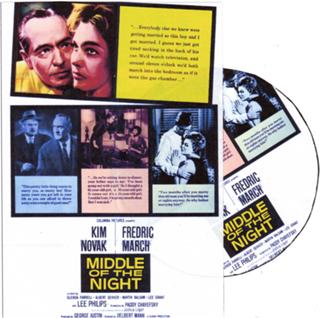
MIDDLE OF THE NIGHT, written by Paddy Cheyevsky, directed by Delbert Mann, with Kim Novak and Fredric March (1959, 118 min.)
Just a brief postscript to my recently posted “Kim Novak as Midwestern Independent”. If memory serves, I hadn’t seen this profoundly depressing piece of New York Chayevsky realism since I was 16, when it came out. Now it comes across, for better and for worse, like another version of Mikio Naruse depicting the shallow rewards and prospects of the urban, aging lower-middle-class. What’s distinctly un-Naruse-like, though, is Kim Novak, who brings a nervous, almost hysterical energy to her part as the divorced, 24-year-old secretary, girlfriend, and fiancée of a middle-aged widower and garment-industry worker (Fredric March), almost as if she were trying her hand at a Method performance. The fact that I can only believe in her character part of the time stems from the fact that I can so easily see her trying. Still, the mood swings of her character are often terrifying and believable in a way that even seems to go beyond the demands of the material –- as if she were constantly trying on the part for size and then immediately changing her wardrobe in a fit of impatience. Read more
KISS ME, STUPID, written by Billy Wilder and I.A.L. Diamond, directed by Wilder, with Dean Martin, Kim Novak, Ray Walston, Felicia Farr, and Cliff Osmond (1964, 126 min.)
A fresh look at one of Billy Wilder’s most underrated films clarifies for me two essential facts about it for the first time: (1) It seems likely that this masterpiece mainly received a C or “condemned” rating from the Legion of Decency because of its scathing portrait of the hypocrisy of American small-town life and the corruption of big-time media, not because of its depiction of sex per se. (2) Wilder’s return to the American Southwest after his earlier Ace in the Hole (1951) is in fact a return to these very same topics, seen with a no less jaundiced eye — something Wilder was apparently fully aware of, as signaled by a virtual quote of a shot from the previous film: Dean Martin in the driving seat of a car being towed replicates Kirk Douglas in the driving seat of his own car being towed.
If Robert Osborne on TCM is to be believed, the previous C rating bestowed by the Legion of Decency prior to Kiss Me, Stupid was eight years before — which would make it Baby Doll (1956). Read more
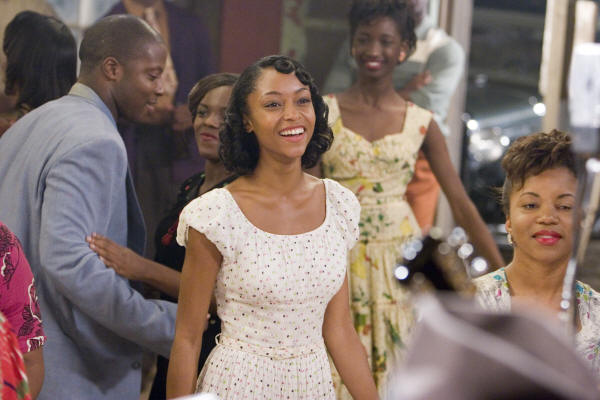
HONEYDRIPPER ***
DIRECTED AND WRITTEN BY JOHN SAYLES
It may seem like dirty pool to begin a discussion of one of my favorite John Sayles movies by zeroing in on its weak points. But writing about Honeydripper recently in the New Yorker, David Denby noted that “moviemaking seems to have become almost magically easy for this independent writer-director,” and that’s absurd, since Sayles himself wrote in the introduction to his story collection Dillinger in Hollywood that “getting a movie made resembles the passage of a bill through Congress.”
Denby concedes that Sayles’s virtuosity as a writer-director “is rhetorical rather than visual.” And Sayles himself says that when he gets a story idea that “seems best expressed in fiction, I feel it in words, not pictures.”
The brief flashback in the middle of Honeydripper’s climactic sequence is a good indication of how labored Sayles’s treatment of images continues to be. The flashback — it comes when Tyrone “Pine Top” Purvis (Danny Glover) is about to break up a fight between a couple of angry customers in his Honeydripper Lounge — isn’t just clunky as visual storytelling and phony in its florid, bloody action and garish setting, it’s seriously underimagined. Read more
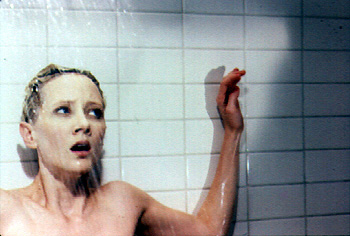
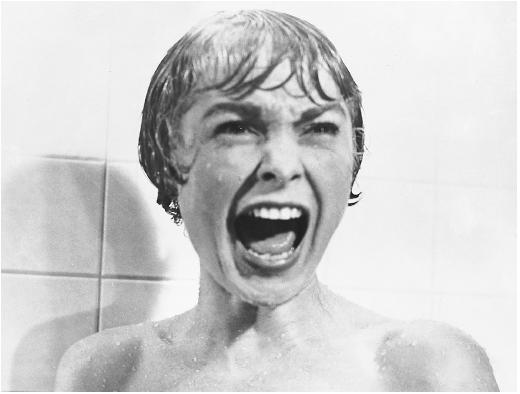
There are few films of the past decade that have irritated me quite as much as Van Sant’s idiotic remake of Psycho, and in some ways I was irritated even more by the rationalizations some cinephiles came up with in their tortured efforts to justify it. I tried my best to behave like a gentleman towards Lisa Alspector, the Reader film reviewer whose capsule sparked my longer review in the December 25, 1998 issue, but I don’t know whether or not I succeeded. — J.R.
Psycho
Rating — Worthless
Directed by Gus Van Sant
Written by Joseph Stefano
With Vince Vaughn, Anne Heche, Julianne Moore, Viggo Mortensen, William H. Macy, Robert Forster, Philip Baker Hall, Ann Haney, and Chad Everett.
Psycho has never been one of my favorite Alfred Hitchcock pictures. The first time I saw it, during its initial release in 1960, I’d already read the Robert Bloch novel it’s based on, a fairly routine horror thriller, so the surprise ending was anything but surprising. I saw the movie back-to-back with Let’s Make Love, which I liked a lot more. Yves Montand spoke English awkwardly, but Marilyn Monroe was irresistible — for practically the only time in her late career, she played a character who was smart and feisty. Read more
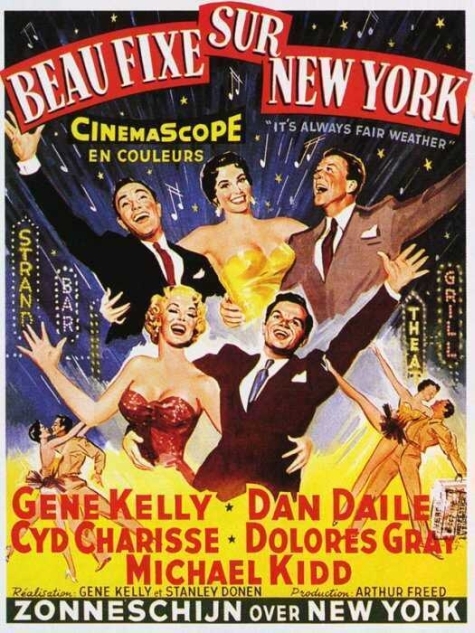
IT’S ALWAYS FAIR WEATHER, directed by Stanley Donen and Gene Kelly, written by Betty Comden and Adolph Green, with Kelly, Cyd Charisse, Dan Dailey, Michael Kidd, and Dolores Gray.
Has there ever been a more deceptive title and ad for a movie than this Belgian poster for the depressive 1955 musical IT’S ALWAYS FAIR WEATHER? Not that the original title or the strained happy ending are exactly apt either. [I resaw this movie yesterday, on my last day at Il Cinema Ritrovato, and might have written about this sooner -– i.e., before I returned to Chicago -– if I’d been able to figure out a way to paste in photos on my laptop.] But in fact it expresses more negative feelings about American culture at mid-century than anything by Frank Tashlin. Tashlin, after all, always seems to love his characters, but what mainly typifies the satirical feelings here about television, advertising, and other forms of corruption are disgust, disillusionment, self-hatred, and anger. It seems characteristic that Kelly and Charisse, the romantic leads, never even get to dance together, and that Dolores Gray’s climactic number, “Thanks a Lot, but No Thanks” (see still), registers as a conscious ripoff of Monroe’s glacially bitter “Diamonds Are a Girl’s Best Friend” in Gentlemen Prefer Blondes. Read more