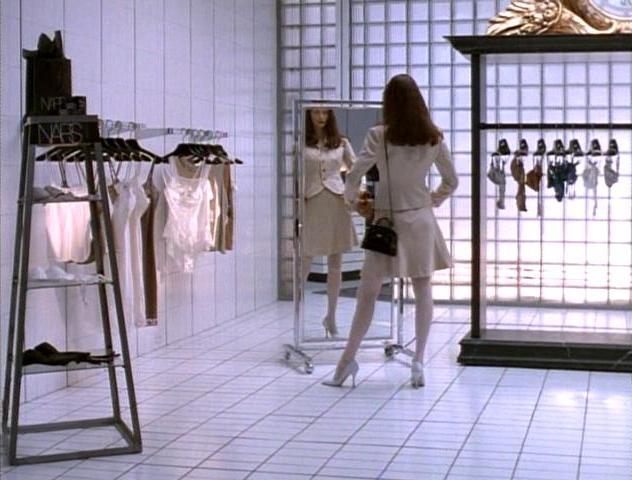
An adventurous and sometimes sexy, if only fitfully successful, adaptation of Louise Kaplan’s celebrated nonfiction book by Susan Streitfeld, working with a script she wrote with Julie Hebert (1996). The focus is on the life of a successful single prosecutor (British actress Tilda Swinton, displaying an impeccable American accent) as she waits to discover whether she’s been appointed as a judge, her kleptomaniac-scholar sister (Amy Madigan), the prosecutor’s boyfriend, a lesbian psychotherapist she has a fling with, and other people in her orbit. Oscillating between everyday events in her life and her dreams and fantasies, the film is much more successful with the former than with the latter, which often get heavy-handed and obscure. But the freshness of Streitfeld’s approach toward gender anxiety and social conditioning fascinates even when the overall clarity diminishes. Not for everyone, but those who like it will probably like it a lot. With Karen Sillas, Clancy Brown, Frances Fisher, Laila Robins, Paulina Porizkova, and Dale Shuger. Music Box, Friday through Thursday, May 2 through 8. — Jonathan Rosenbaum
Probably the Coen brothers’ most enjoyable movie — glittering with imagination, cleverness, and filmmaking skill — though, as in their other films, the warm feelings they generate around a couple of salt-of-the-earth types don’t apply to anyone else in the cast: you might as well be scraping them off your shoe. The Chandler-esque plot has something to do with Jeff Bridges being mistaken for a Pasadena millionaire, which ultimately involves him as an amateur sleuth in a kidnapping plot. A nice portrait of low-rent LA emerges from this unstable brew, as do two riotous dream sequences. Set during the gulf war and focusing on a trio of dinosaurs — an unemployed pothead and former campus radical (Bridges), a cranky Vietnam vet (John Goodman), and a gratuitous cowboy narrator (Sam Elliott) — this 1998 feature may be the most political Coen movie to date, though I’m sure they’d be the last to admit it. With Julianne Moore, Steve Buscemi, David Huddleston, John Turturro, and Ben Gazzara. R, 117 min. (JR) Read more
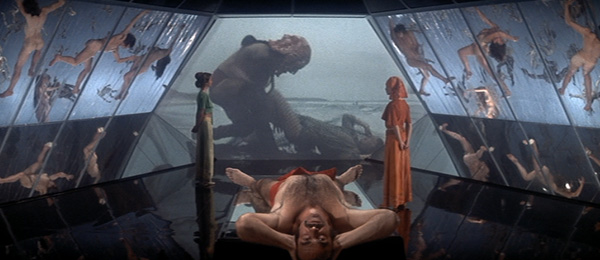
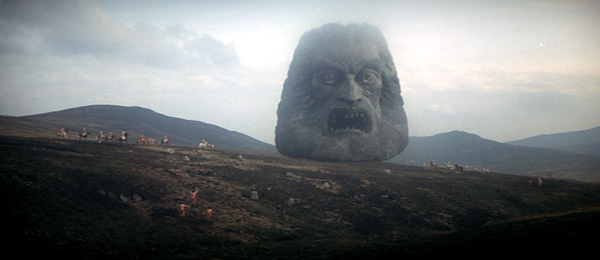
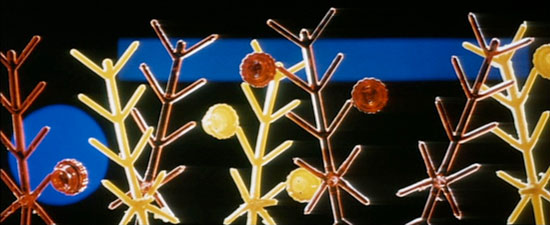
Probably John Boorman’s most underrated film — an impossibly ambitious and pretentious but also highly inventive, provocative, and visually striking SF adventure with metaphysical trimmings (1974). Set in a postapocalyptic society in 2293, it stars Sean Connery as a warrior and noble savage with dawning awareness; interestingly enough, the plot in many ways resembles that of Boorman’s best film, Point Blank. (JR)
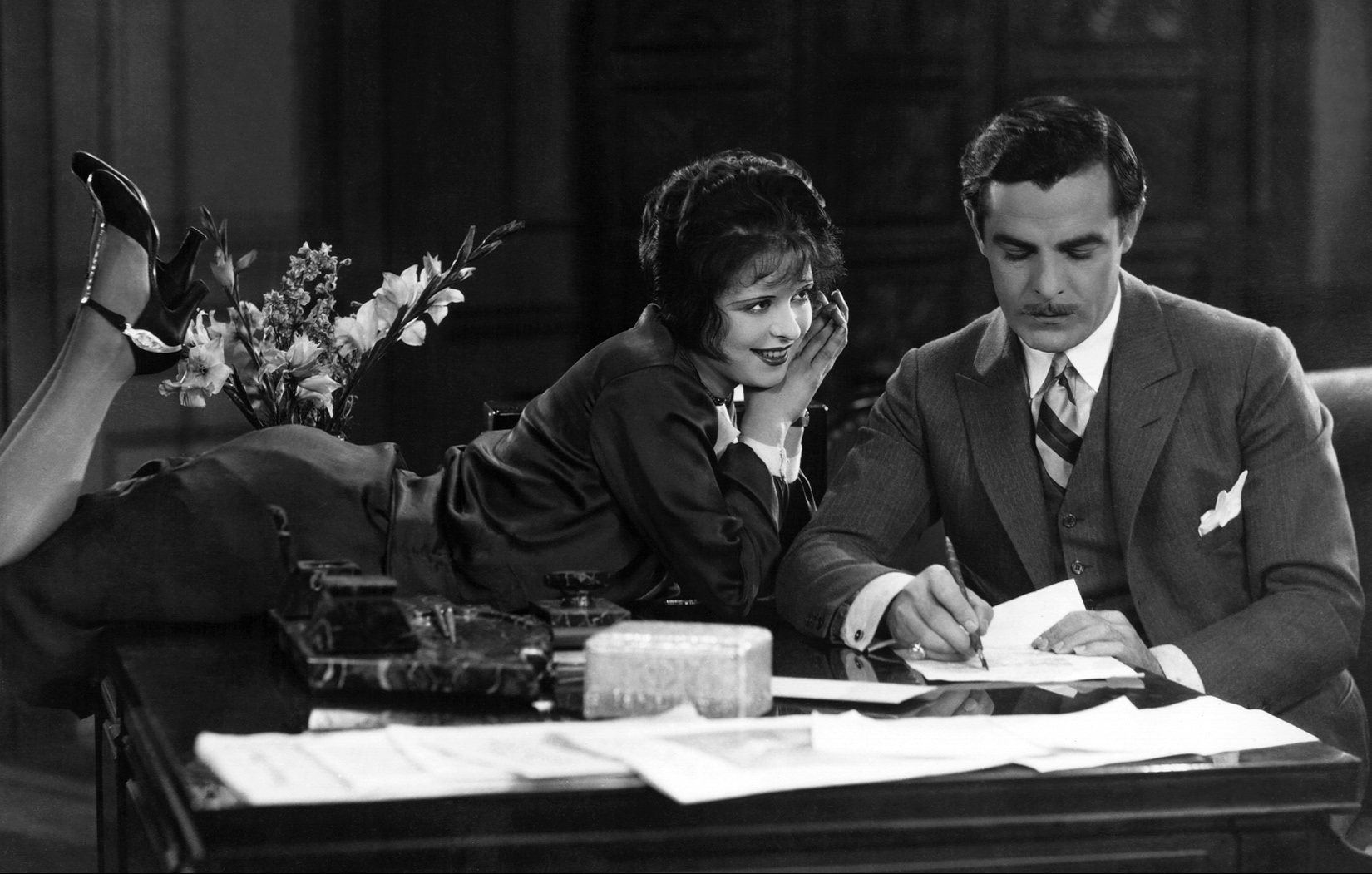
A department store clerk (Clara Bow) tries to live according to the tenets of Elinor Glyn’s book about sex appeal (also titled It) and winds up marrying her boss. This fast and funny silent comedy of 1927 has one of the great lines of the period — “Hot socks! Here comes the boss!” — and as Dave Kehr has pointed out, it “launched Clara Bow as a star of extraordinary dimensions (most of them around the hips).” Directed by Clarence Badger, with Antonio Moreno, William Austin, Jacqueline Gadsdon, a young Gary Cooper, and Glyn herself, who worked on the script with Hope Loring and Louis D. Lighton. A real treat. (JR)
The greatness of Carl Dreyer’s first sound film (1932, 82 min.) derives partly from its handling of the vampire theme in terms of sexuality and eroticism and partly from its highly distinctive, dreamy look, but it also has something to do with Dreyer’s radical recasting of narrative form. While never less than mesmerizing, it confounds conventions for establishing point of view and continuity, inventing a narrative language all its own. Some of the moods and images are truly uncanny: the long voyage of a coffin, from the apparent viewpoint of the corpse inside; a dance of ghostly shadows inside a barn; a female vampire’s expression of carnal desire for her fragile sister. The remarkable sound track, created entirely in a studio (in contrast to the images, all filmed on location), is an essential part of the film’s voluptuous, haunting otherworldliness. It was originally released by Dreyer in four separate versions — French, English, German, and Danish; most prints now contain portions of two or three of these versions, although the dialogue is pretty sparse.) (JR)
The widespread distrust of film theory still persisting in mainstream criticism is scarcely confined to Anglo-American film culture. Less than a decade back, when Noël Burch’s Praxis du cinéma -– later translated as Theory of Film Practice –- first appeared in France, someone at Gallimard hit on a rather demented sales pitch, and the book was marketed with a wraparound banner boldly proclaiming, ‘Contre toute théorie.’ The curious science fiction tone of this declaration highlights a subterranean bias which informs most film reviewing on and off the continent: the idea that theory is an option best left to dusty academicians, while everyone else is better off operating on free-floating intelligence and intuition. Ironically, this is an assumption which expresses a theory of its own: that knowledge is essentially empirical. And the definition accorded to ’empiricist’ by the Concise Oxfordmay be worth at least considering:'(person) relying solely on experiment; quack.’
In all fairness to ‘anti-theorists’, it should be conceded that science and art are hardly the same thing. If a sizeable part of our knowledge of the former is grounded in theory, the parti pris underlying our knowledge of cinema tends to be a much more random affair, a generally murky blend of half-examined predilections and working hypotheses. Read more
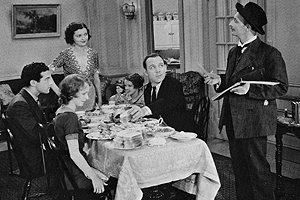
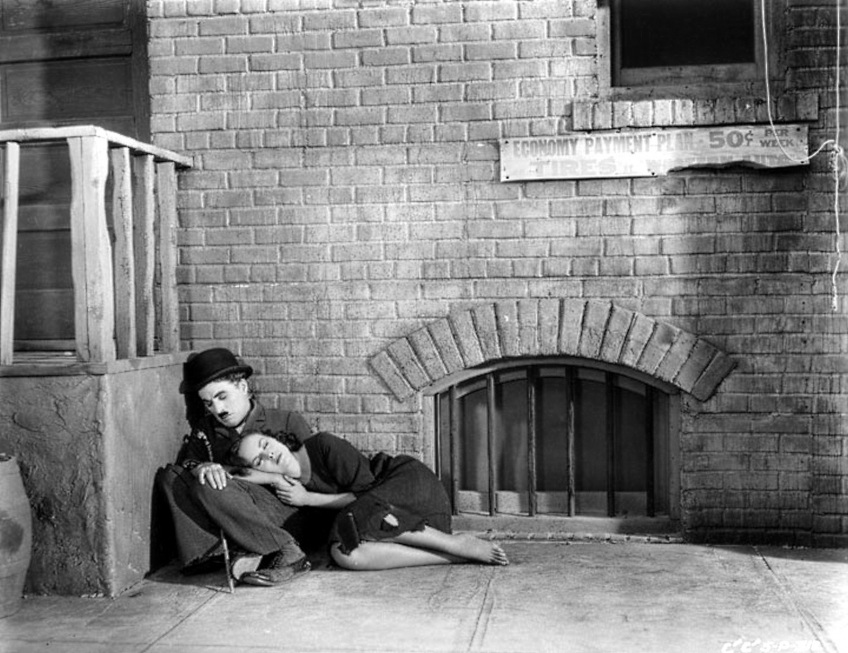
D.W. Griffith’s last film (1931) was unquestionably dated when it was released at the height of the Depression, both as an antidrinking polemic — probably fueled in part by Griffith’s own struggles with alcoholism — and as a Victorian melodrama. Yet today it emerges as one of his most powerful and intensely felt works — not merely a heartbreaking story and a portrait of the Depression at its grimmest, but a poignant summary of everything that Griffith could do with a camera, even in low-budget, unspectacular circumstances. With Hal Skelly and Zita Johann. 87 min. (JR)
From the Autumn 1984 Film Quarterly. I reviewed this book at Biskind’s request, and my position was hampered by the fact that he was the main editor of American Film at the time, where his commissions were essential to my livelihood. Our relationship became even more strained after I was all set to review the book and he then informed me that he wished I weren’t reviewing it. — J.R.
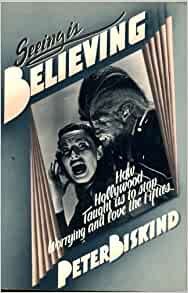
SEEING IS BELIEVING: How Hollywood Taught Us to Stop Worrying and Love the Fifties By Peter Biskind. NewYork: Pantheon Books, 1983. $22.95 cloth, $10.95 paper.
The first thing to be said about Peter Biskind’s ambitious and long-awaited study of ideology in Hollywood movies of the fifties is that it can’t be dipped into at random with out a considerable amount of confusion setting in. Without the benefit of Biskind’s careful construction and preparation, the unwary reader who plunges in midstream is bound to be bewildered or dismayed by many of the political labels, whereby Thieves Highway, for instance, is designated as a “right-wing film,” or High Noon and The Blob as “radical films.” Even in the Introduction, which tends to be more cautious than the rest of the book, several eyebrows are likely to be raised by the following sentence: “The films of Robert Aldrich can usually be counted on to be somewhere on the left, just as the films of Elia Kazan are frequently in the middle, while those of John Ford are to the right of his and those of Alfred Hitchcock are to the right of his. Read more
From the Chicago Reader (July 8, 1994). Also reprinted in my collection Movies as Politics. — J.R.
** FORREST GUMP (Worth seeing)
Directed by Robert Zemeckis
Written by Eric Roth
With Tom Hanks, Robin Wright, Gary Sinise, Mykelti Williamson, Sally Field, Michael Humphreys, and Hanna Hall.
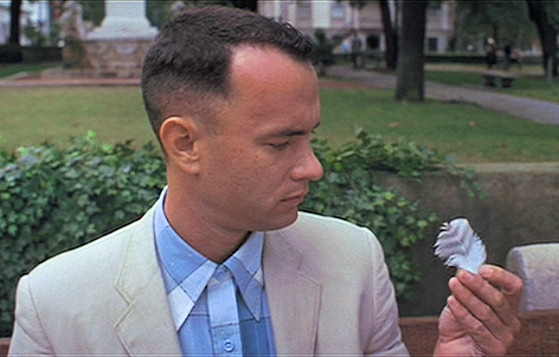
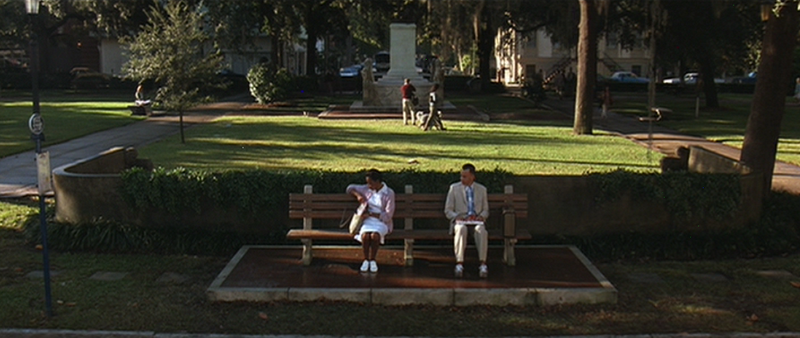
In the opening shot of Forrest Gump — a movie that might be described as Robert Zemeckis’s flag-waving Oscar bid — the camera meticulously follows the drifting, wayward trajectory of a white feather all the way from the heavens to the ground, just beside the muddy tennis shoes of the title hero (Tom Hanks). Forrest Gump, a slow-witted, sweet-tempered, straight-shooting fellow from Alabama with an IQ of 75, is waiting for a bus in a small park in Savannah, Georgia. Picking up the feather and placing it inside a book, he proceeds to recount his life story to various passing strangers; in the film’s final shot, over two hours later, we see a breeze carry the same white feather up and away.
These framing shots — a poetic statement about the vicissitudes of chance, how histories are made, unmade, and remade — are meant to say something about a half-century of American life, from the 40s to the present; and the tragicomic life of Forrest Gump, a saintly fool, is meant to embody those years. Read more
Written to introduce a dossier in Farsi on Alain Resnais prepared by Ehsan Khoshbakht in March 2012. — J.R.
Alain Resnais is clearly one of our greatest living filmmakers. But he’s also one of the most elusive, for a number of reasons. He started out as the most international of all the French New Wave artists, at least in his early features (especially Hiroshima mon amour,Last Year at Marienbad, La Guerre est finie,Je t’aime, je t’aime, and Providence), but then went on to become the most French of French directors (not only in obvious cases such as Mon oncle d’Amérique, Stavisky…, Mélo, Same Old Song, Not on the Lips, and Wild Grass, but even in films derived from English or partially American sources, such as I Want To Go Home, Smoking,No Smoking, and Private Fears in Public Places). Even before he got around to making features, he made by far the greatest films in the history of cinema about racism and colonialism (Statues Also Die), the Holocaust (Night and Fog), plastic (La Chant du Styrène), and libraries (Tout la mémoire du monde).Among Read more
Commissioned by Stanley Schtinter in the summer of 2019 for the limited LP release of Carles Santos’ soundtrack score for Pere Portabella’s Vampir Cuadecuc in early 2020. I received a copy of this LP from Stanley earlier that month — on the final day of a Portabella retrospective in London that began in November, when I gave a lecture at Close-up and Portabella himself, who’d just turned 93, was amiably present. — J.R.
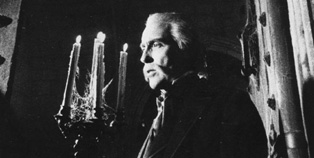
Masterpieces have many possible ports of entry. My own passport into Pere Portabella’s Vampir Cuadecuc (1970) — first seen multiple times at the Directors’ Fortnight in Cannes in 1971 and then celebrated in my festival coverage for the Village Voice — was composed of rampant cinephilia crossed with political ignorance, as well as a fascination with William S. Burroughs’ use of cut-ups in Naked Lunch (1959), The Soft Machine (1961-1966), and The Ticket That Exploded (1962-1967) to create scrambled syntax (echoed in Portabella’s capacity to shift his narrative focus within single shots from the Dracula story itself to the filming of it). I knew then that Portabella, one of the Spanish producers of Luis Buñuel’s Viridiana, had his own passport confiscated as punishment by Francoist Spain, accounting for his absence in Cannes, and that his film was mostly a silent documentary of the shooting of an adaptation of Bram Stoker’s Dracula by one Jesus Franco, accompanied by musique concrète. Read more
I don’t have much patience with colleagues who dismiss Charlie Chaplin by saying that Buster Keaton was better (whatever that means). To the best of my knowledge, with the arguable exception of Dickens, no one else in the history of art has shown us in greater detail what it means to be poor, and certainly no one else in the history of movies has played to a more diverse audience or evolved more ambitiously from one feature to the next. The recent European release of his eight major features on DVD, digitally restored and with superb bonus materials, has been matched over here by only four titles so far, including Modern Times (1936), the second of his two Depression-era masterpieces — though viewing it on a big screen is required for maximal impact. The opening sequence of the Tramp on the assembly line is possibly his greatest slapstick encounter with the 20th century, and as Belgian filmmakers Luc and Jean-Pierre Dardenne brilliantly observe on one of the DVD extras, the famous shot of his being run through machinery equates him with a strip of film. Still, there’s more hope here than in City Lights, perhaps because this time the Tramp has Paulette Goddard, another plucky urchin, to keep him company. Read more
From the Chicago Reader (October 3, 1995); slightly tweaked in late 2013. — J.R.
If, like me, you find things to admire in many of Gus Van Sant’s films, you may be especially gratified by what he’s done with this satirical anti-TV script by Buck Henry — suggested by a real-life crime and adapted from a Joyce Maynard novel — and a spot-on performance by Nicole Kidman that may be the best of its kind since Tuesday Weld’s wicked sexual turns in Pretty Poison and Lord Love a Duck. Charting the ruthlessness of an ambitious bimbo telecaster in Little Hope, New Hampshire, this staccato black comedy sustains its brilliant exposition and narration until the plot turns to premeditated murder, complete with hapless and semicoherent teenage accomplices. The movie loses much of its pitch and many of its laughs at this juncture, and there’s an uncomfortable tendency to equate the falsity and venality of TV too exclusively with Kidman’s character, thereby bypassing golden opportunities offered by Wayne Knight (as a station boss) and an uncredited George Segal to make the target less gender specific. But much of this is good nasty fun, with a fine secondary cast that includes Matt Dillon, Joaquin Phoenix, Alison Folland, Casey Affleck, Illeana Douglas, and Dan Hedaya; also look for striking cameos by David Cronenberg and screenwriter Buck Henry. Read more
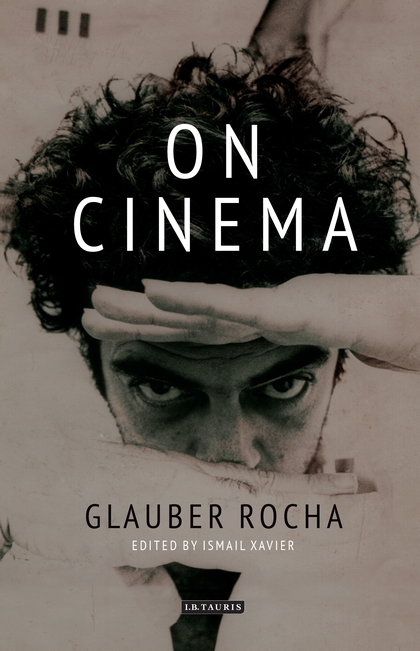
By Glauber Rocha, edited by Ismail Xavier. London/New York: I.B. Taurus, 2019, 306 pp., Hardcover: $110, Kindle: $85.
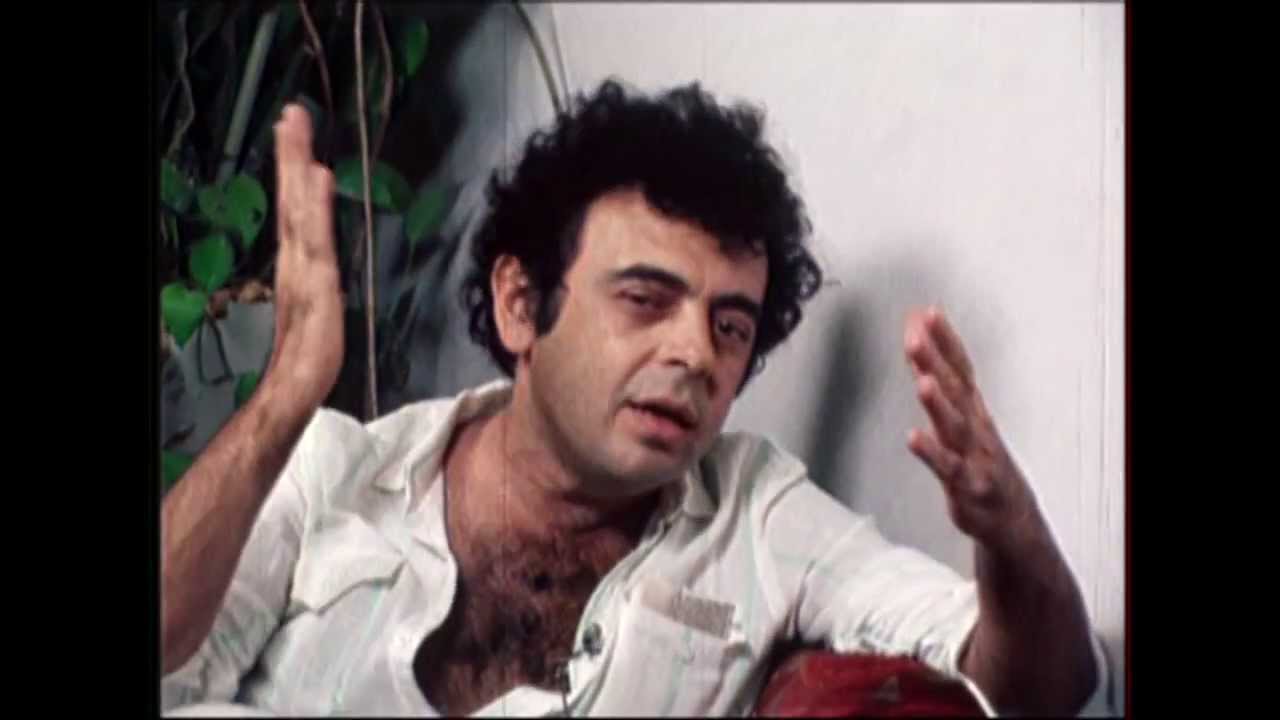
I’m strictly an amateur on the subject of Glauber Rocha (1939-1981), identified on the back cover of this pricey volume as “Brazil’s most important filmmaker and founder of the 1960s and ‘70s Cinema Novo movement”. But even a cursory glance at the limited availability of his films to Anglo-Americans without a grasp of Portuguese reveals that I have plenty of company, and this book offers us an invaluable starting-point for diminishing our ignorance. Eleven years in the making (and with ample confirmation that this painstaking care has paid off in terms of fluidity and clarity), with five individuals apart from Rocha listed on the title page — editor Xavier, general coordinator Lúcia Negib, Cecília Mello for final text and notes, and Stephanie Dennison and Charlotte Smith as translators — this is a rich assembly of articles drawn from three separate collections of Rocha’s writing: Critical Review of Brazilian Cinema (1963), The Cinema Novo Revolution (1981), and The Century of Cinema (1983), the first two of which were put together by Rocha himself. Read more
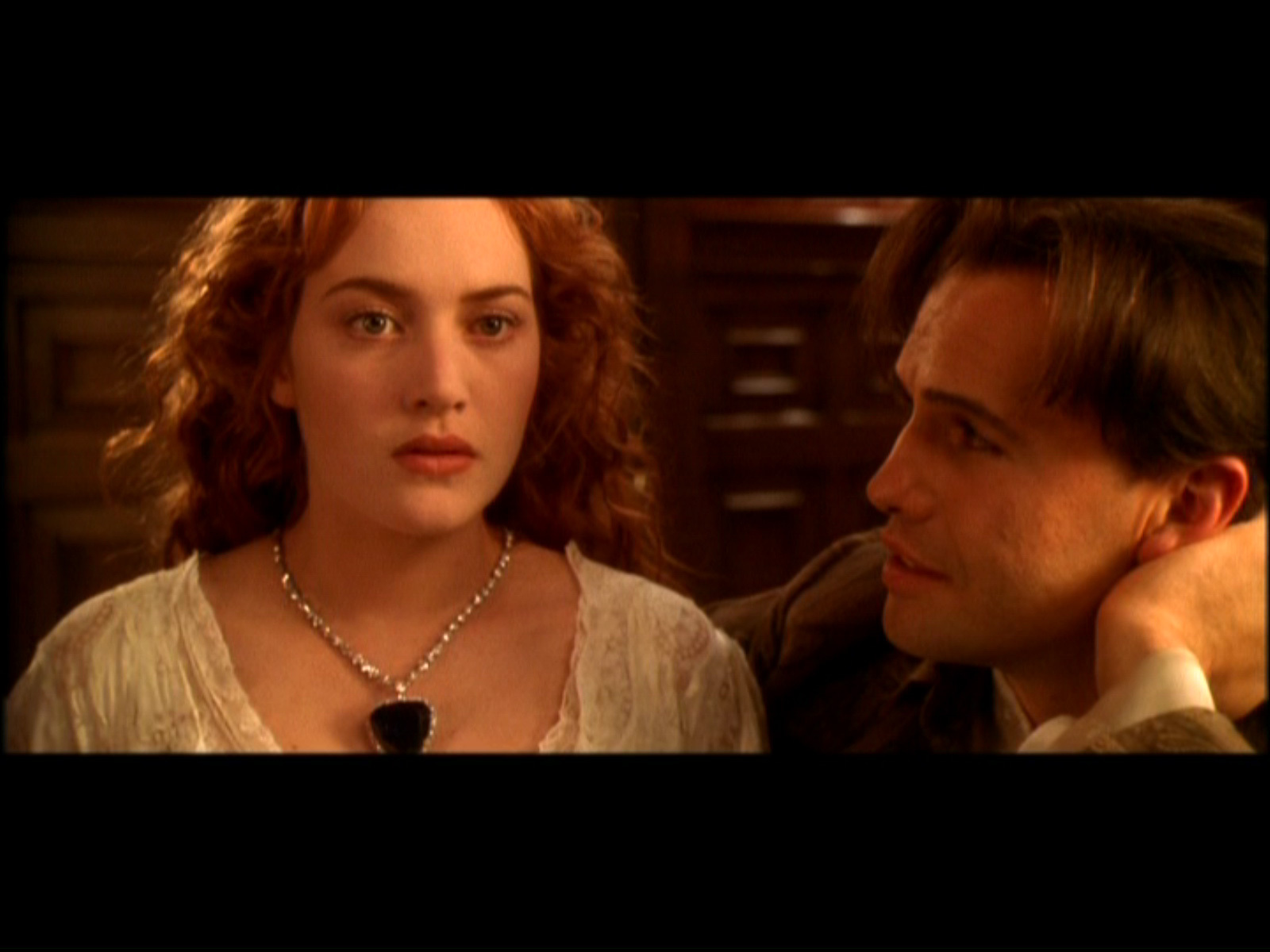
For better and for worse, James Cameron’s hokey yet moving $200 million blockbuster (1997) tells you quite a bit about first class, a little about third class, and nothing at all about second class. This is mainly because Titanic, unlike most disaster movies, has virtually no subplots; the whole 194 minutes pivot around a fictional love story on the doomed ship between a rebellious bride-to-be (Kate Winslet) and a penniless artist (Leonardo DiCaprio). The elemental style and broadly defined characters recall D.W. Griffith at times (though there’s no equivalent to either of the Gish sisters), and for a movie set in 1912 this seems entirely appropriate. Some of the invented story is certainly fanciful, and a few details are downright stupid, yet overall what the movie has to say about its era and, more implicitly, our own in terms of class rings true. All things considered, Titanic is old-fashioned epic filmmaking that carries a wallop. With Billy Zane, Kathy Bates, Frances Fisher, David Warner, and Bill Paxton. (JR)






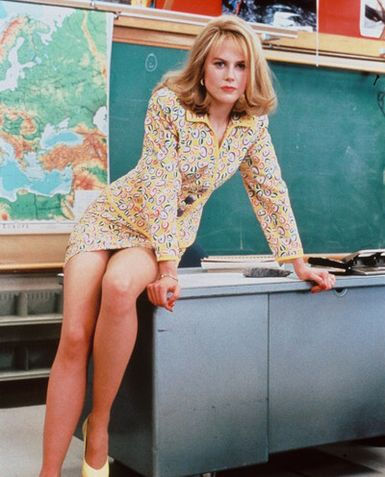 If, like me, you find things to admire in many of Gus Van Sant’s films, you may be especially gratified by what he’s done with this satirical anti-TV script by Buck Henry — suggested by a real-life crime and adapted from a Joyce Maynard novel — and a spot-on performance by Nicole Kidman that may be the best of its kind since Tuesday Weld’s wicked sexual turns in Pretty Poison and Lord Love a Duck. Charting the ruthlessness of an ambitious bimbo telecaster in Little Hope, New Hampshire, this staccato black comedy sustains its brilliant exposition and narration until the plot turns to premeditated murder, complete with hapless and semicoherent teenage accomplices. The movie loses much of its pitch and many of its laughs at this juncture, and there’s an uncomfortable tendency to equate the falsity and venality of TV too exclusively with Kidman’s character, thereby bypassing golden opportunities offered by Wayne Knight (as a station boss) and an uncredited George Segal to make the target less gender specific. But much of this is good nasty fun, with a fine secondary cast that includes Matt Dillon, Joaquin Phoenix, Alison Folland, Casey Affleck, Illeana Douglas, and Dan Hedaya; also look for striking cameos by David Cronenberg and screenwriter Buck Henry.