This appeared in the February 12, 1999 issue of the Chicago Reader. –J.R.

Rushmore
Rating *** A must see
Directed by Wes Anderson
Written by Anderson and Owen Wilson
With Jason Schwartzman, Bill Murray, Olivia Williams, Seymour Cassel, Brian Cox, Mason Gamble, Sara Tanaka, Stephen McCole, Connie Nielsen, and Luke Wilson.
Rushmore has a good deal of content and human qualities to spare, but what makes it such a charming and satisfying experience is its style. Its segments are introduced by parting curtains, each labeled with the name of the appropriate month, which serves as a chapter heading — a neat way of calling attention to the broad and attractively composed ‘Scope frames and of parceling out the story in bite-size seasonal units. Less obvious and functional but unmistakably style-driven is the fact that the curtains come in different colors, giving another kind of lift to the proceedings. All the scenes are short (at least until the film moves into its homestretch), and director Wes Anderson also films these scenes in long and medium shots; in general he indulges in long scenes and close-ups only after he’s earned them. Because this is a studio effort that knows what it’s doing — a rare breed these days — it makes you wonder how many close-ups and long scenes are squandered in other studio releases. Read more
From Film Comment (July-August, 2009). — J.R.
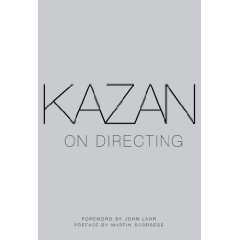
Kazan on Directing
Elia Kazan
Alfred A. Knopf, $30.00
This is a class act, given something like the Library of America treatment. The editor, Robert Cornfield, is similarly credited not on the title page but two pages later, and similarly provides a Chronology and Notes at the end (as well as an Introduction and Afterword). Extra boosts come from a canny Foreword (John Lahr) and fleeting Preface (Martin Scorsese). Virtually all the plays and films in Kazan’s oeuvre get entries, chronologically placed, apart from some of the less canonical items, accorded “Short Takes” at the end of each section.
But apart from some letters and notebook entries, this is a recycling operation — and that includes the final 40-page stretch, “The Pleasures of Directing”, the only portion not assembled by Cornfield (though no other editor gets mentioned). Even though this book was started by Kazan himself in the 1980s, it was always a paste-up job. On many occasions when the prose moves into high gear, a quick look at the Notes reveal that it comes from either Kazan’s autobiography (A Life) or An American Odyssey (a collection of his writing edited by Michel Ciment), both published in 1988. Read more
This review appeared in the December 1976 issue of Monthly Film Bulletin. For whatever it’s worth, my favorite among Rohmer’s features remains his most unjustly neglected Perceval le Gallois (1978), the feature he made immediately after this “tasteful” betrayal of von Kleist’s Die Marquise von O… –J.R.
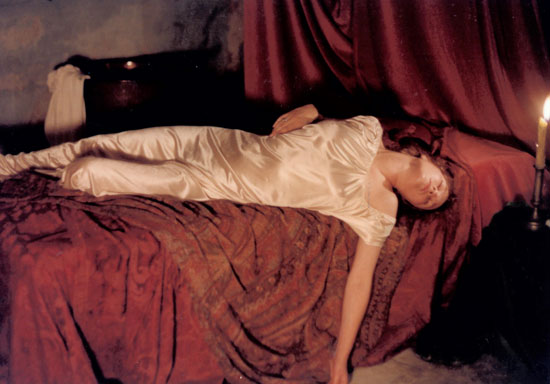
Marquise von O…, Die
West Germany/France, 1976
Director: Eric Rohmer
Probably the most faithful of all the disciples of André Bazin, Eric Rohmer has shared his mentor’s philosophical fascination with “ambiguity” in his criticism and films alike. A position derived from Catholic existentialism which adheres to a “realist” aesthetic whose prime model is the naturalistic novel as exemplified by Dos Passos, Hemingway and Hammett, this orientation is clearly at the root of his version of Kleist’s masterpiece, which subtly betrays the awesome energies of the original while maintaining an overall fidelity to its plot and characters that is rare in contemporary cinema. Widely and justifiably praised for its immaculate direction, acting, and visual sophistication, it can none the less be regarded as a Jamesian re-write of the novellas that dims the passion of the latter with a form of delicate detachment quite in keeping with the tenor of Rohmer’s Contes Moraux. A minor omission like the very Kleistian blood “gushing” from the mouth of a would-be rapist whom the Count “smashes” in the face with the hilt of his sword — a detail which the film tastefully keeps off-screen -– reveals this strategy on a rather trivial level; and the splitting in half of the Count’s childhood anecdote about the swan of which he is reminded by the Marquise -– so that its conclusion now comes at the end of the plot -– can easily be defended as a sensible dramatic expedient. Read more
It’s possible that I overrated Twilight and underrated The Big Lebowski in this Chicago Reader piece (March 6, 1998); I’d have to resee both these films in order to be sure. —J.R.
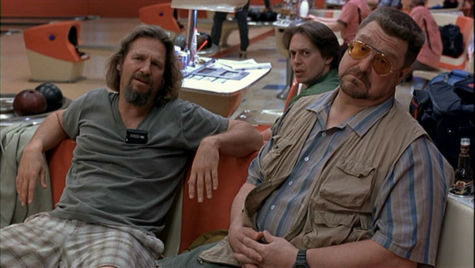
The Big Lebowski
Rating ** Worth seeing
Directed by Joel Coen
Written by Joel and Ethan Coen
With Jeff Bridges, John Goodman, Julianne Moore, Steve Buscemi, David Huddleston, Philip Seymour Hoffman, John Turturro, David Thewlis, Ben Gazzara, and Jon Polito.
Twilight
Rating *** A must see
Directed by Robert Benton
Written by Benton and Richard Russo
With Paul Newman, Susan Sarandon, Gene Hackman, James Garner, Stockard Channing, Reese Witherspoon, and Giancarlo Esposito.
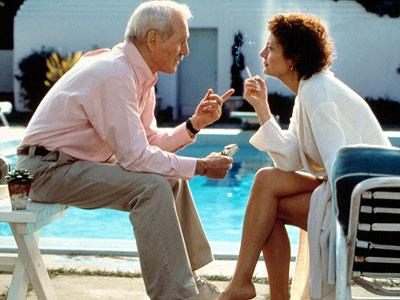
It’s purely a matter of chance that two neo-Chandler mysteries with contemporary Los Angeles settings are opening this week. But although Joel and Ethan Coen’s The Big Lebowski and Robert Benton’s Twilight differ in tone, style, milieu, and generational perspective, both films arrive at their private-eye stories through the unorthodox detour of the western. In Benton’s case the western reference is harder to detect but central to the conception throughout; the film even climaxes with the equivalent of a western showdown and shoot-out. In the Coens’ case it’s much more blatant but proves to be window dressing. Read more

From the August 11, 2006 Chicago Reader. — J,.R.
World Trade Center
** (Worth seeing)
Directed by Oliver Stone
Written by Andrea Berloff
With Nicolas Cage, Michael Pena, Maria Bello, Maggie Gyllenhaal, Jay Hernandez, Armando Riesco, and Michael Shannon
“The Holocaust is about six million people who get killed,” Stanley Kubrick reportedly said to screenwriter Frederic Raphael in the late 90s. “Schindler’s List was about 600 people who don’t.” Assuming the quote is right, Kubrick’s speaking about the Holocaust in the present tense and about a movie made half a century later in the past tense suggests something about his priorities.
They probably aren’t the priorities of Oliver Stone, whose ruthlessly circumscribed World Trade Center isn’t about the 2,749 citizens of 87 countries who got killed in the 9/11 assault on the Twin Towers and who are mentioned only in a title when the movie’s over. It’s about two citizens of one of those countries who survived, John McLoughlin and William Jimeno, both real-life Port Authority policemen. The story of what they experienced is gripping and inspiring, but however true it is to their lives — it’s hard to imagine any two men on the planet could be as conventional as the filmmakers make these heroes — the way it’s told restricts what the movie can say about the larger tragedy. Read more
Some thoughts on Kon Ichikawa, from the June 3, 1988 issue of Chicago Reader. — J.R.

AN ACTOR’S REVENGE
**** (Masterpiece)
Directed by Kon Ichikawa
Written by Daisuke Ito, Teinosuke Kinugasa, and Natto Wada With Kazuo Hasegawa, Fujiko Yamamoto, Ayako Wakao, Ganjiro Nakamura, and Raizo Ichikawa.

ALONE ON THE PACIFIC (aka ALONE ACROSS THE PACIFIC)
*** (A must-see)
Directed by Kon Ichikawa
Written by Natto Wada
With Yujiro Ishihara, Kinuyo Tanaka, Masayuki Mori, Ruriko Asaoka, and Hajime Hana.
Scopophilia is a Freudian term that means the love of gazing, or pleasure in seeing. A punning use of the word often comes to mind when I consider the pleasures to be found in viewing ‘Scope movies. ‘Scope is movie buffs’ jargon for the anamorphic widescreen process known as CinemaScope (introduced by Twentieth Century-Fox in 1953 with The Robe) and a number of similar wide-screen formats; they dominated commercial filmmaking across much of the globe for well over a decade.
While a certain number of American movies today still make expressive use of this Band-Aid-shaped format — Shy People is an outstanding recent example — most directors consciously avoid it because they know that at least a third of the image will get lopped off when their work gets transferred to video. Read more
This essay was comissioned by the French magazine Trafic — founded by the late Serge Daney shortly before his death, and still going strong today — where I’ve served for many years as one of the advisory editors. Their 50th issue, published in the summer of 2004, was devoted to various answers to the Bazinian question, “What is Cinema?” This is also the title essay in my 2010 collection, published by University of Chicago Press. — J.R.
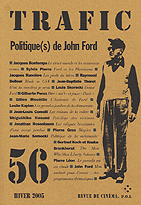
Goodbye Cinema, Hello Cinephilia
by Jonathan Rosenbaum
What is cinema?
Before one can even start to answer this question, it becomes necessary to acknowledge that one can’t formulate precisely the same definition of cinema for France and for other countries. And the reason why one can’t should be obvious: in France, an important part of this definition pertains to film as an art form—-a distinction that is generally perceived elsewhere only as a minority position, and sometimes even as an elitist one. But if, on the other hand, one were to ask the question, “What is cinephilia?”, it starts to become easier to come up with a definition that applies to everywhere. A seeming contradiction, it can perhaps be explained by saying that the “cinema” in “cinephilia” is not quite the same thing as “cinema” seen as a self-sufficient term, without reference to social forms. Read more
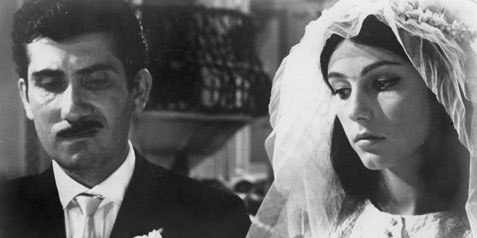
It’s been about 45 years since I last saw Pietro Germi’s Seduced and Abandoned (1964). I’m sure it already looked like a savage social satire when I was 21 or so, but one additional meaning it’s picked up in the interim is the devastating putdown it offers of The Godfather and its first sequel years before either one was made. (The second-best putdown—Coppola’s own The Godfather: Part III—would come much later.)
If memory serves, Germi’s earlier Divorce, Italian Style (1961) is funnier, largely because it’s less overflowing with bile than Seduced and Abandoned—and also no doubt because it has Mastroianni. But even so, I’m not at all surprised that Manny Farber would describe Divorce as an “unfunny farce”. What probably distinguishes Germi (1914-1974) most sharply from a Farber favorite like Preston Sturges (1898-1959) is the latter’s affection for even his dumbest and crassest characters, little of which Germi appears to permit himself. The hypocrisy of most of the small-town Sicilians in Seduced and Abandoned is too consistent and unvarying to allow for much indulgence, much less love or amusement. Even the title victim, played by Stefania Sandrelli, ultimately becomes a bit dehumanized by all the free-floating scorn, which eventually devolves into a kind of nightmare horror show, almost on the order of something like Rosemary’s Baby. Read more
I’ve been getting a lot of pleasure lately from the new Blu-Ray Mel Brooks box set, especially in catching up with the two Brooks features I hadn’t seen before, The Twelve Chairs (1970) and Silent Movie (1976). The only gaping absence for me in this deluxe collection isn’t so much The Producers (1968), his first feature, and certainly not his most recent and weakest, Dracula: Dead and Loving It (1995), but Life Stinks (1991), which in retrospect I may have underrated — and which Kino Lorber is bringing out this July. Which is largely why I’m resurrecting my mixed review of it. This originally appeared in the Chicago Reader’s August 2, 1991 issue. — J.R.
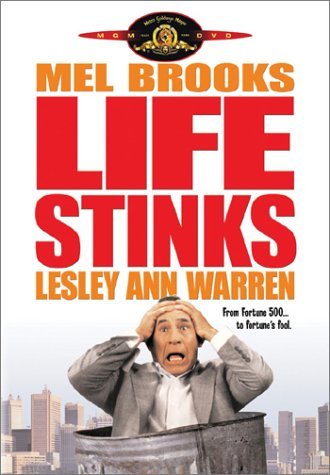

LIFE STINKS
** (Worth seeing)
Directed by Mel Brooks
Written by Brooks, Ron Clark, Rudy De Luca, and Steve Haberman
With Mel Brooks, Lesley Ann Warren, Jeffrey Tambor, Stuart Pankin, Howard Morris, and Rudy De Luca.
“Tragedy is if I cut my finger. . . . Comedy is if you walk into an open sewer and die.” —Mel Brooks
For a long time now Mel Brooks has been one of my guilty pleasures. It’s difficult to refute the protestations of friends and colleagues about the general feebleness of History of the World–Part I and Spaceballs — his previous two features as writer-director, and the only ones that appeared in the 80s — but there are moments in both films that I deeply treasure, not so much as evidence of a writer’s, director’s, or performer’s craft, but rather as moments that make me laugh hard and long and make me feel good afterward. Read more
This appeared in the Chicago Reader‘s July 8, 2005 issue. — J.R.
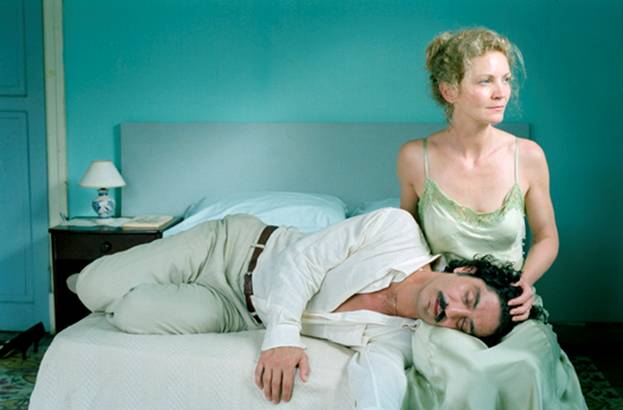
Yes
**** (Masterpiece)
Directed and written by Sally Potter
With Simon Abkarian, Joan Allen, Shirley Henderson, Sam Neill, Wil Johnson, Gary Lewis, Raymond Waring, and Stephanie Leonidas

Yes. A film that irrefutably deserves its title. A film of affirmation. Which is not the same as a story with a happy ending…. If the places in this story become characters, what is the scene? The area of world politics today, nothing less, is the scene — and, above it, the sky to which everyone, at one moment or another, prays. — John Berger
Apparently sales of poetry go up in times of war. — Sally Potter
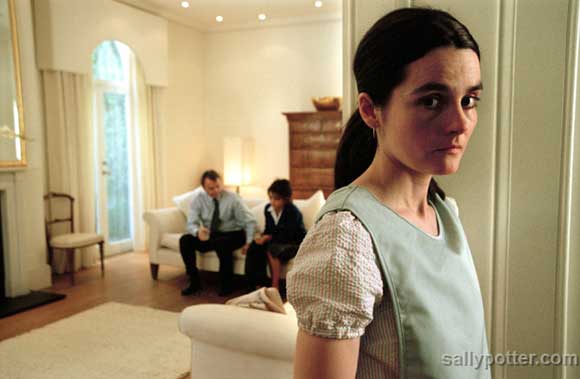
Many people feel a sense of helplessness about the ongoing war in the Middle East, feelings they’re often unable to articulate, much less address. Sally Potter’s Yes shows one way these feelings can be processed, and in doing so overturns some of the usual assumptions about what movies can and should do. It won’t please everyone, and the sensitive topics it touches on may make some viewers mad enough to spit.
Yes is a post-9/11 love story, set chiefly in London, about a passionate adulterous affair between an Irish-American scientist (Joan Allen), who’s unhappily married to an English politician, and a somewhat younger Lebanese cook (Simon Abkarian), who’s unmarried and used to work as a surgeon in Beirut. Read more
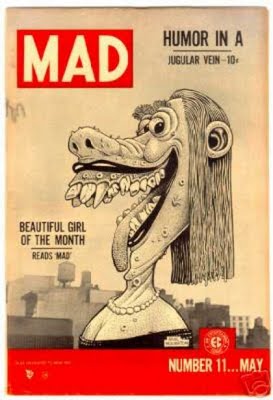
If I’d had to depend entirely on the quality and interest of the films released in any given week, I probably wouldn’t have remained a movie reviewer for several decades. Luckily, I often found ways of writing about other topics, using the film or films being released as excuses. This was especially true during my extended stint of writing for Soho News almost every week for about about a year and a half (1979-1981), reviewing books (mainly fiction and literary criticism) as well as movies, and during my more than twenty years of writing about films for the Chicago Reader, I usually had the same freedom, at least as long as I had a fair amount of length at my disposal. Perhaps the most obvious example of this freedom at Soho News was the following piece about Mad that I did in 1980, for the July 16 issue, occasioned by a very forgettable comedy released that week. — J.R..
A Fond Madness
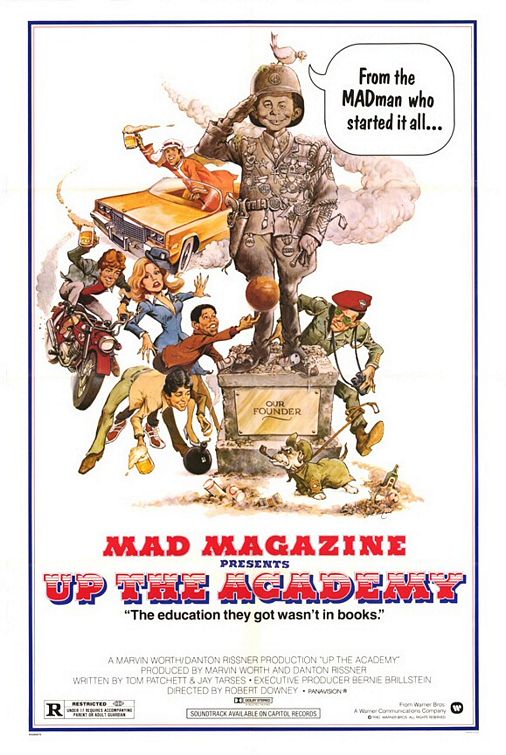
Though the ads for the crude, uneven Up the Academy are at some pains to link the movie to Mad — a publication (first a comic book, then a magazine) –- now in its 28th year, the connection clearly has more to do with packaging than with contents. Read more
Here’s my Cannes coverage for Film Comment‘s September-October issue in 1973, the fourth year I attended the festival.
A couple of apologies: (1) In my haste to defend Some Call it Loving against Andrew Sarris’s and Molly Haskell’s scorn, I managed to forget or overlook the fact that one sequence, in a nightclub, does feature some nudity; and (2) I no longer find my curt dismissal of History Lessons at all persuasive — in particular my claim that it duplicates the style and/or methodology of Othon. — J.R.
Cannes Journal
Jonathan Rosenbaum
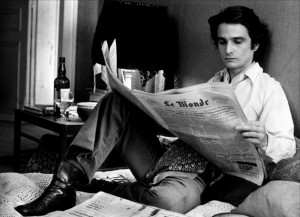
If TOUCH OF EVIL, as Paul Schrader has suggested, is film noir’s epitaph, jean Eustache’s LA MAMAN ET LA PUTAIN (THE MOTHER AND THE WHORE) may well turn out to be the last gasp and funeral oration of the Nouvelle Vague — the swan song of a genre/school that shatters its assumptions and reconstructs them into something else, and newer model that is sadder but wiser and tinged with more than trace of nostalgic depression. MCCABE AND MRS. MILLER, for that matter, may be the Western’s epitaph, or at least one of the prettier flowers to have grown out of Tombstone Gulch. In very different ways, all three films tell us a lot about what growing older feels like and chide us both for what we are and what we used to be. Read more
The reference-book entry was written in the mid-1970s for Richard Roud’s Cinema: A Critical Dictionary (1980). (A much-expended version appeared in the January-February 1975 issue of Film Comment.) And the review that comes after this was written for the Monthly Film Bulletin (May 1976, vol. 43, no. 508) — a publication of the British Film Institute, where I was serving at the time as assistant editor — and it follows most of the format of that magazine by following credits with first a one-paragraph synopsis and then a one-paragraph review. Mostly we covered features (all of those released in the country), but occasionally we also did shorts, such as this one. —J.R.

Tex Avery
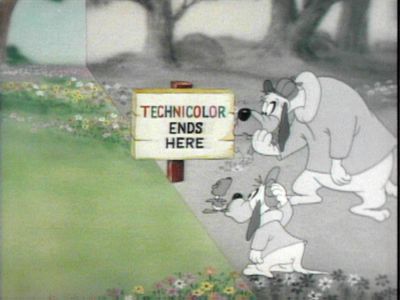
Tex Avery’s best cartoons seem to take off in one of two possible surrealist/narrative directions. A scattershot Hellzapoppin technique thrives on speed, multiplicity, surprise, incongruity, and paradox, with whatever plastic and thematic results ensue from this method. (Examples: Who Killed Who, 1943; Happy-Go-Nutty, 1944; Little Rural Riding Hood, 1949.) A more demonic-obsessive approach develops a single idée fixe to reductio ad absurdum proportions, maintaining roughly the same plastic and thematic concerns throughout. (Examples: Dumb Hounded, 1943; King Size Canary, 1947; Half-Pint Pygmy, 1948.) Read more
This is second and (to date) final time that I did Cannes film festival coverage for The Village Voice, which ran in their June 29, 1972 issue. –J.R.
Surprises at Cannes: Huston redeemed, Tashlin reincarnated
by Jonathan Rosenbaum
CANNES, France — After 15 days of feeding in darkness, and blinking at the sun only between screenings, the Cannes Festival inevitably turns the persistent moviegoer into a blood relative of Dracula. regrettably, this year’s festival was long on celluloid — 700 films’ worth, according to Variety — but short on the lifeblood necessary to keep an honest vampire going.
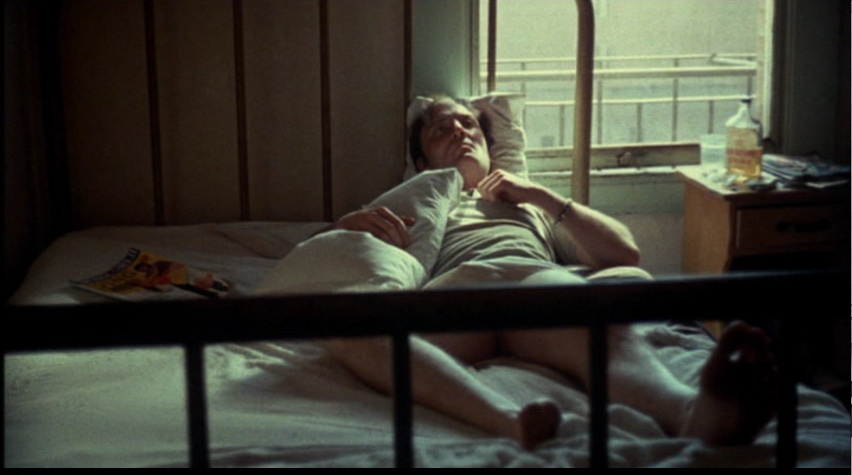
Of the 34 films that I stayed to the end for, only one seemed to have the earmarks of an old-fashioned classic. Curiously enough, this came from neither Hitchcock nor Fellini nor Skolimowski nor Altman, but from john Huston — a director who has remained in limbo for so long that, until Fat City, it was hard to remember he still existed. Fat City may not be a great film, but it has the uncommon virtue of achieving practically everything it sets out to do.
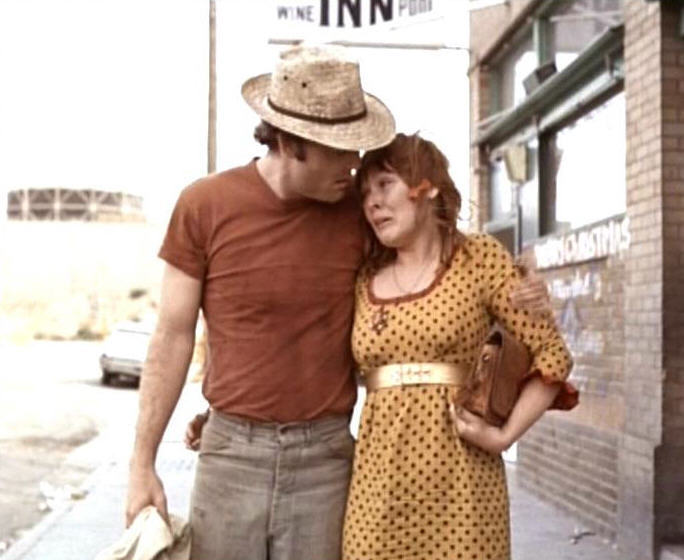
Working in the U.S. for the first time since The Misfits, Huston returned to a milieu of failed boxers in Stockton, California, that he knew intimately as a young man, shot his story (from Leonard Gardner’s novel) in continuity, and wound up with what may prove to be his definitive statement. Read more
This page of festival coverage in The Village Voice (June 17, 1971) appeared (without any photos) after my second trip to the festival; if memory serves, my first trip there, in 1970, yielded no writing at all. One complication about this piece is that Amos Vogel and I jointly discovered after arriving at the festival that a separate editor at the Voice had given each of us the assignment of “covering” the festival. After Amos checked back at the front office about this, it was agreed at the Voice that we both write coverage, about separate films, which we wound up doing for two years in a row.
I think this article manages to convey some of the political flavor of the early 70s, although it’s worth adding that all the films listed here with the exception of Sontag’s Brother Carl are currently either available on DVD [2023 update: Sontag’s film is now available on a Swedish DVD.] or are about to be (e.g., Portabella’s Cuadecuc – Vampir, identified here incorrectly as Vampyr). Indeed, strange as it seems, the most “out of date” detail here is a single shot I describe in Cuadecuc – Vampir (“a ghoulishly made-up actress making a face at someone between takes”), which Portabella inexplicably (and lamentably) has subsequently removed from the film. Read more