This originally appeared in the August 19, 1988 issue of the Chicago Reader. –J.R.
TUCKER: THE MAN AND HIS DREAM
*** (A must-see)
Directed by Francis Ford Coppola
Written by Arnold Schulman and David Seidler
With Jeff Bridges, Joan Allen, Martin Landau, Frederic Forrest, Mako, and Dean Stockwell.
THE LAST TEMPTATION OF CHRIST
*** (A must-see)
Directed by Martin Scorsese
Written by Paul Schrader
With Willem Dafoe, Harvey Keitel, Barbara Hershey, Harry Dean Stanton, David Bowie, Verna Bloom, Randy Danson, and Andre Gregory.
While it might initially seem like a shotgun marriage to consider together movies as different in tone and subject as Tucker: The Man and His Dream and The Last Temptation of Christ, it is worth noting first of all that these films represent comparable watersheds in the careers of their respective directors. Even if we put aside that Francis Ford Coppola and Martin Scorsese are contemporaries (born in 1939 and 1942, respectively) with Italian and Catholic backgrounds, and that both became star directors during the same period — with Coppola’s The Godfather in 1972 and Scorsese’s Mean Streets in 1973 — we are still left with the fact that their latest features are both intensely personal projects, nurtured by their creators over many years and through a number of vicissitudes. Read more
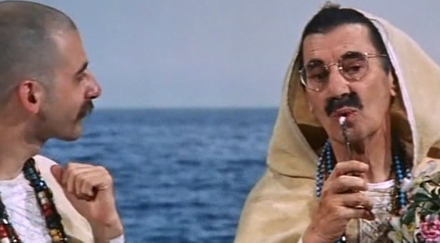
Everybody has their own Laurel and Hardy. A miniature Laurel and Hardy, one on each shoulder. Your little Oliver Hardy bawls you out -– he says, “Well, this is a fine mess you’ve gotten us into.” And your little Stan Laurel gets all weepy -– “Oh, Ollie, I couldn’t help it, I’m sorry, I did the best I could….”
— Groucho Marx on LSD
Living in a garbage can be a lot of fun…. Life is always equal in the can….
— the first and last lines of Skidoo’s Garbage Can Ballet
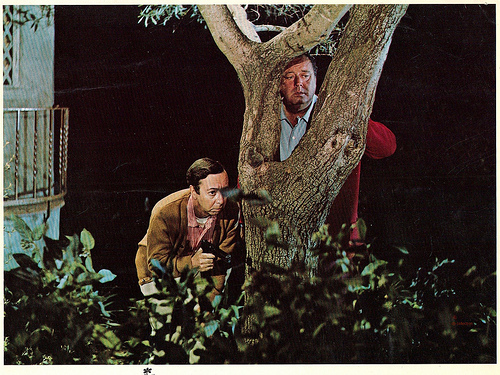
Seeing works of art, including films, in terms of success or failure, smash or flop, can be a form of tyranny, a limiting of options — not to mention a recipe for boredom, especially if one has no monetary stake in the outcome, which is true in most cases. So to say that Otto Preminger’s Skidoo –- which has finally become available on a letterboxed DVD, released by Olive Films -– failed at the boxoffice in 1968 and fails today, as it failed 43 years ago, as a lighthearted comedy, while certainly accurate, may not be the most helpful thing to say about it. Read more
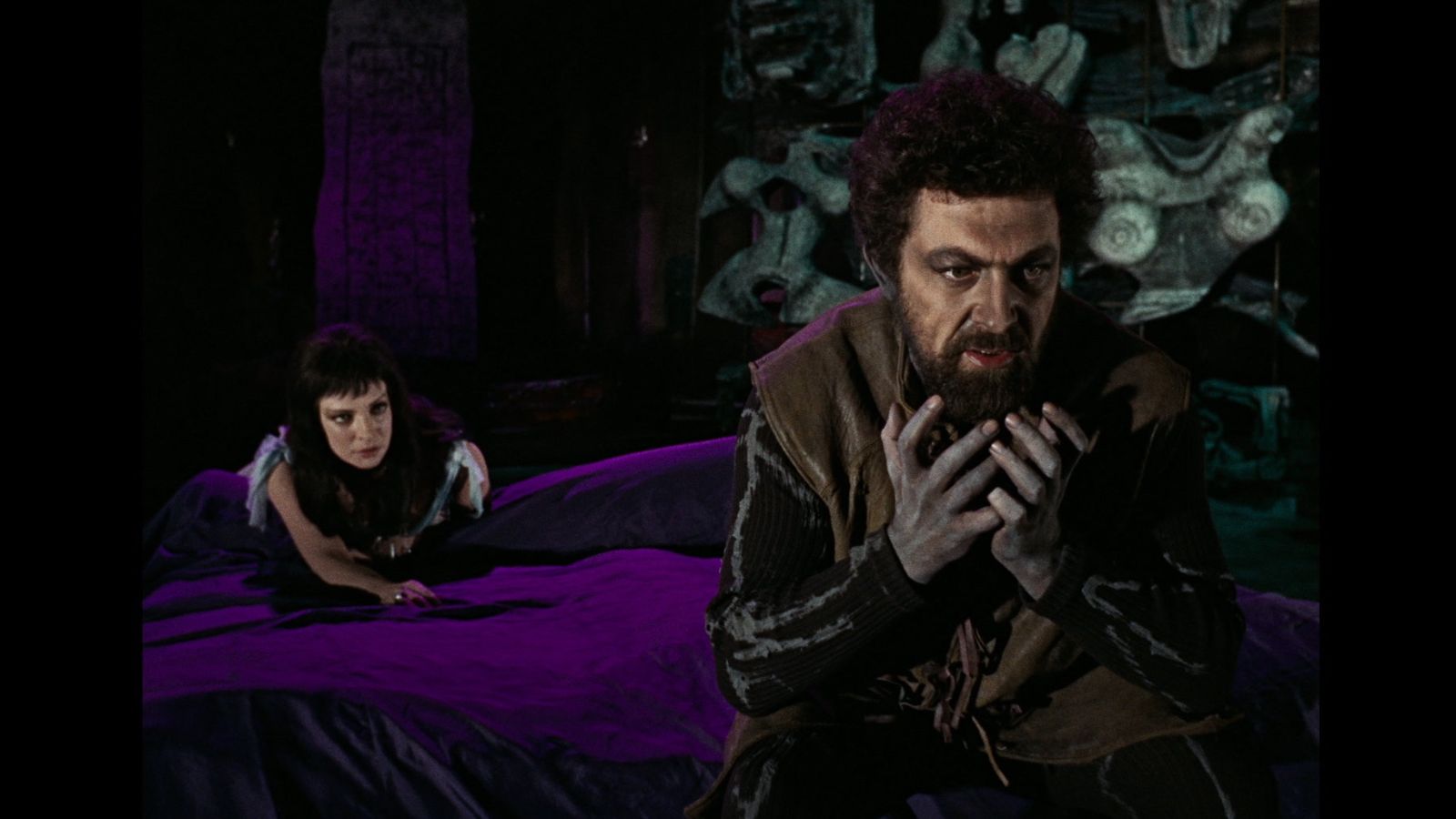
After the hostile reception to his 1960 masterpiece Peeping Tom, Michael Powell was virtually banished from English cinema, and most of his remaining oeuvre is a scattered assortment of TV commissions and Australian features. Made in 1964 for West German TV, this rarely seen one-hour adaptation of Bela Bartok’s only opera, based on a libretto by Bela Balazs (later known as a film theorist and as screenwriter of Leni Riefenstahl’s first feature), is a particular standout, especially for its vivid colors and semiabstract, neoprimitive decor (by Hein Heckroth, who also designed the sets for The Red Shoes and The Tales of Hoffman). The two performers are producer Norman Foster (not to be confused with the Hollywood actor and director) in the title role and Anna Raquel Satre as Bluebeard’s doomed wife, Judith. In accordance with Powell’s wishes, the English subtitles briefly describe and clarify the action but don’t translate the text. (JR)
I wasn’t ready for Susan Sontag’s non-fiction film about the 1973 Yom Kippur War in 1974, and I’m not at all sure that I’m ready for it even now, on the DVD released by Zeitgeist and Kim Stim. But there’s no question that part of my perspective on it has changed. For one thing, this film obviously needs to be cross-referenced with her book of thirty years later, Regarding the Pain of Others. Furthermore, in 1974, when I attended Susan’s private screening of Promised Lands in Paris, I was probably expecting to hear her words and her voice, her writerly badges, and I was surprised that I got neither: the voices and words are mainly those of three unnamed individuals — Yoram Kaniuk (for me the most sympathetic commentator), Yuval Ne’emangood, and a psychiatrist at the end who claims to be offering therapy to a shellshocked Israeli soldier under a drug-induced trance when he contrives to recreate the soldier’s wartime trauma, complete with brutal sound effects. (After the screening, Sontag described the latter aptly and with considerable horror as “Docteur Folamour” — the French name for Dr. Strangelove — and I strongly suspect that it was this sequence that led to the film originally being banned in Israel.) Read more
One way of looking back at the sense of male privilege underlying much of the French New Wave would be to consider Céline and Julie Go Boating (1974) as a belated commentary on it. I’ve long regarded that masterpiece as a late-blooming, final flowering of the New Wave, especially for its referentiality in relation to cinephilia and film criticism. For one thing, it glories in the kind of compulsive doubling of shots and characters that François Truffaut, Jean-Luc Godard, Claude Chabrol, Eric Rohmer, and Jacques Rivette himself all discovered in Alfred Hitchcock’s movies. But it also puts a kind of stopper on the New Wave in the way it both underlines and responds to that movement’s sexism through the services of its four lead actresses, all of whom collaborated on its script: Juliet Berto, Dominique Labourier, Bulle Ogier, and Marie-France Pisier. Every male character, both in the story proper and in the film-with-in-the-film, is viewed as absurd, both as a romantic fop and as a narcissist who ultimately elicits the heroines’ scorn and ridicule: the patriarch (Barbet Schroeder) in the Phantom Ladies over Paris segments, playing his two phantom ladies (Ogier and Pisier) off against one another; and, in the story proper, Julie’s small-town suitor (Philippe Clévenot), Céline’s boss (Jean Douchet), and various male customers at the cabaret. Read more
With Jaglom, Nelly Alard, Suzanne Bertish, Melissa Leo, Daphna Kastner, David Duchovny, and Diane Salinger.
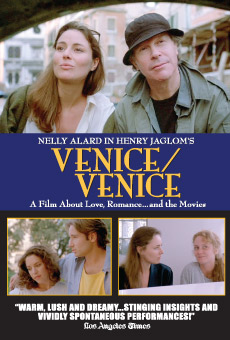
Quite early in Venice/Venice writer-director-actor Dean (Henry Jaglom, transparently standing in for himself) tells an interviewer at the Venice film festival that there are two kinds of narcissists. The bad kind love only themselves, but the good kind use their self-love as a stepping-stone to loving others.
Dean (and Jaglom) obviously regards himself as the good kind of narcissist, and clearly we’re supposed to agree. But what about a third kind of narcissist, a kind Dean doesn’t mention — the narcissist whose self-love is a stepping-stone to loving others but who loves others only because he regards them as versions of himself? This is the universe of Henry Jaglom, a new-age, touchy-feely universe where everyone — everyone who matters, that is — talks and thinks and loves and hangs loose in the same manner.
The giveaway of this kind of narcissism is a series of talking-head montages of real-life interviews with women discussing the ways that movies have affected their fantasies about romance. One such montage begins the picture, and others occur again and again throughout. Read more
With Lu Man San, Tran Nu Yen-khe, Truong Thi Loc, Nguyen Anh Hoa, Vuong Hoa Hoi, and Tran Ngoc Trung.
Until fairly recently, films from the Chinese- and Vietnamese-speaking world have had next to no distribution here; so it’s worth noting that three such movies have been nominated for the foreign-language Oscar: Farewell My Concubine from Hong Kong, The Wedding Banquet from Taiwan, and The Scent of Green Papaya from Vietnam. The first two of these have already opened in Chicago, and the third — in some ways my favorite in the bunch — is starting a run this week at the Fine Arts. What overlapping interests — economic, cultural, artistic, ideological — are being served by this sudden upsurge in attention?
Interestingly enough, none of these Oscar nominees qualifies purely and unambiguously as a movie representing the country officially attached to it. Though Farewell My Concubine was produced in Hong Kong, all its action takes place in mainland China, and it was directed by a celebrated “Fifth Generation” filmmaker, Chen Kaige. The Wedding Banquet, a Taiwanese-American coproduction, has a Taiwanese director, Ang Lee, but it’s set in New York City and much of its dialogue is in English. Read more