From the June 24, 2005 Chicago Reader. — J.R.
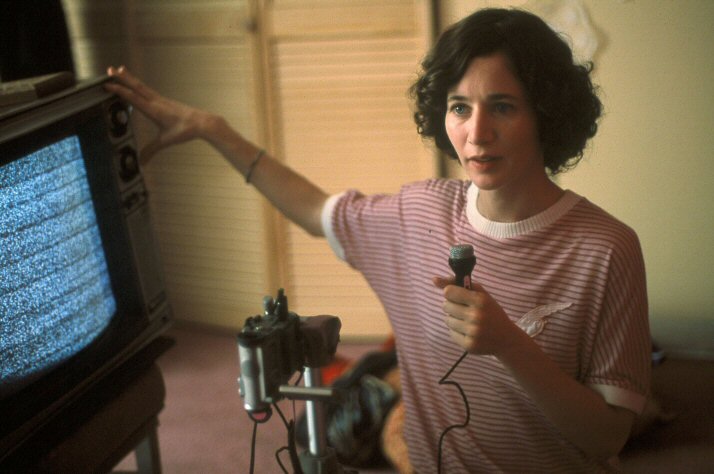
Me and You and Everyone We Know
*** (A must see)
Directed and Written by Miranda July
With John Hawkes, July, Miles Thompson, Brandon Ratcliff, Carlie Westerman, and Natasha Slayton
Or
*** (A must see)
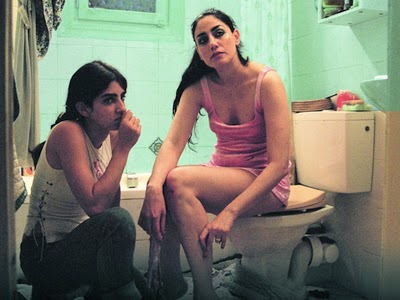
Directed by Keren Yedaya
Written by Yedaya and Sari Ezouz
With Dana Ivgi, Ronit Elkabetz, Meshar Cohen, Katia Zinbris, and Shmuel Edelman
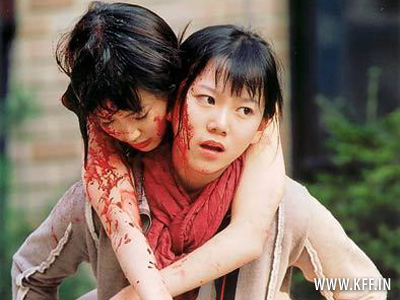
Samaritan Girl
no stars (Worthless)
Directed and written by Kim Ki-duk
With Kwak Ji-min, Seo Min-jeong, Lee Eol, Hyun-min Kwon, and Young Oh
“Sex is Confusing” could serve as an alternate title to these three movies, all high-profile film festival prizewinners. The first is an American woman’s debut feature, the second an Israeli woman’s first feature, and the third is Korean director Kim Ki-duk’s tenth.
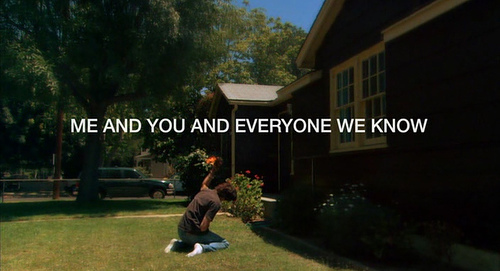
Miranda July’s account of the inspiration for Me and You and Everyone We Know gives an indication of her wistful comedy’s strengths and limitations. “This movie was inspired by the longing I carried around as a child, longing for the future, for someone to find me, for magic to descend upon my life and transform everything,” she writes in the press packet. “It was also informed by how this longing progressed as I became an adult, slightly more fearful, more contorted, but no less fantastically hopeful.” Read more
From the Monthly Film Bulletin, no. 502, November 1975. — J.R.
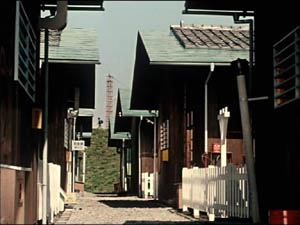
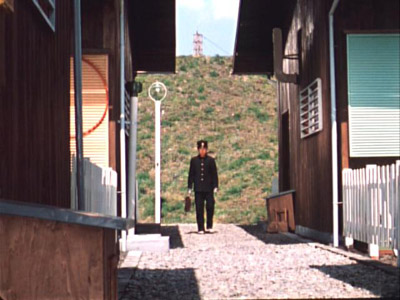
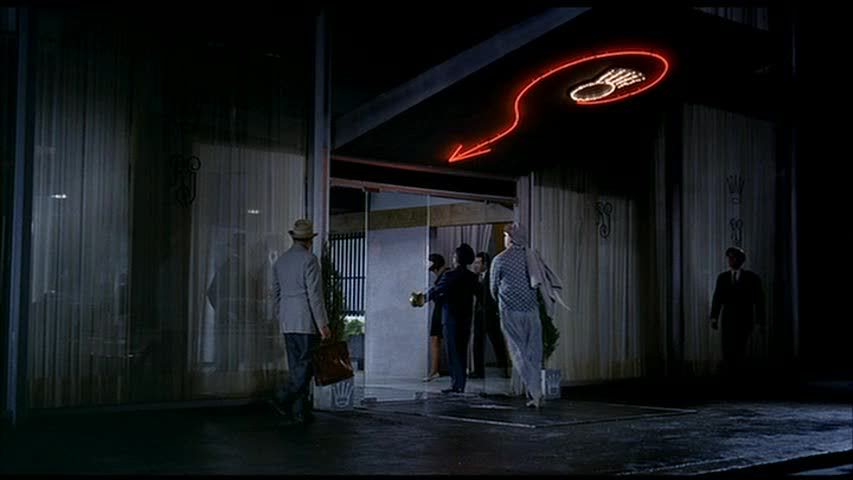
OHAYO (GOOD MORNING)
Japan, 1959
Director: Yasujiro Ozu
Cert — U. dist — Cinegate. p.c — Shochiku/Ofuna. p — Shizuo Yamanouchi. sc — Yasujiro Ozu, Kogo Noda. ph — Yushun Atsuta. col — Agfacolor. ed —Yoshiyasu Hamamura. a.d —Tatsuo Hamada. m — Toshiro Mayuzumi. l.p — Chishu Ryu (Keitaro Hayashi), Kuniko Miyake (Tamiko Hayashi), Yoshiko Kuga (Setsuko Arita, Tamiko’s Sister), Koji Shidara (Minoru Hayashi, Older Son), Masahiko Shimazu (Isamu Hayashi, Younger Son), Keiji Sada (Heichiro Fukui, English Teacher), Haruo Tanaka (Pencil Salesman), Haruko Sugimura (Mrs. Haraguchi), Miyaguchi (Mr. Haraguchi), Eiko Miyoshi (Mrs. Haraguchi’s Mother), Eijiro Tono (Tomizawa), Teruko Nagoako (Tomizawa’s wife), Sadako Sawamura (Mrs. Okubu), Kyoko Izum and Hasabe (Couple with TV Set), Toyo Takahashi. Read more
From Sight and Sound (Autumn 1975).
I was shocked to learn yesterday [in December 2011] of the death of Gilbert Adair, a close friend during the mid-70s (when both of us were living in Paris, and for some time later, after I moved to London ahead of Gilbert). This collaborative article, which I instigated, assigning the middle sections to Gilbert and to Michael Graham (also, alas, no longer alive), is being posted now in memory of our friendship. (With Lauren Sedofsky, Gilbert and I had also already collaborated on an interview with Rivette the previous year, which was posted here yesterday.) And because of the unusual length of this article, I’m running it in two parts; the first half, with sections by me and Gilbert about Duelle, appeared a few hours ago. — J.R.
3

Like any Rivette film, Le Vengeur (2) took shape gradually, drawing on a large number of deliberately chosen ideas and as many fortuitous circumstances. As important as Rivette’s interest in Tourneur’s The Revenger’s Tragedy (drawn to his attention by Eduardo De Gregorio), and the curious traditions surrounding the period of Carnival, was the availability of Geraldine Chaplin and Bernadette Lafont together with that of a group of dancers from Carolyn Carlson’s company. Read more
From Sight and Sound (Autumn 1975).
I was shocked to learn of the death of Gilbert Adair, a close friend during the mid-70s (when both of us were living in Paris, and for some time later, after I moved to London ahead of Gilbert). This collaborative article, which I instigated, assigning the middle sections to Gilbert and to Michael Graham (also, alas, no longer alive), is being posted or reposted in memory of our friendship. (With Lauren Sedofsky, Gilbert and I had also already collaborated on an interview with Rivette the previous year, which was posted here yesterday.) And because of the unusual length of this article, I’ll be running it in two parts; the second half, with sections by me and Michael Graham about Noroît, will appear a few hours from now. — J.R.
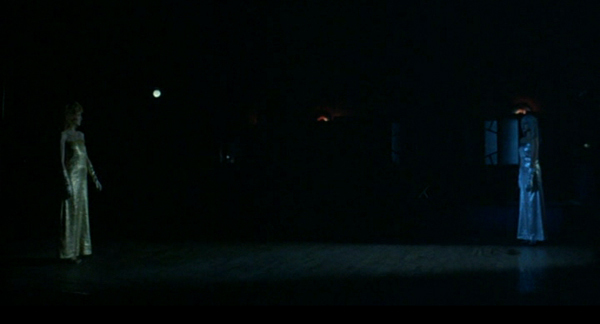
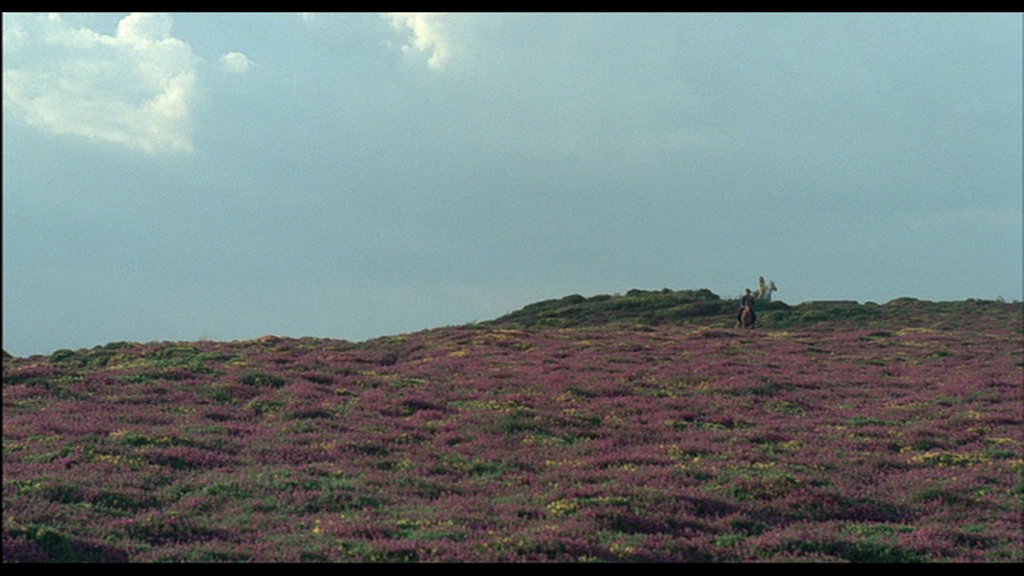
In theory, from the vantage point of early spring, it would go something like this: four movies to be shot consecutively, each one an average-length feature to be filmed in three weeks; editing to begin after the fourth is shot, the four films edited in the order of their successive releases. Read more
From the Chicago Reader (April 25, 1997). — J.R.
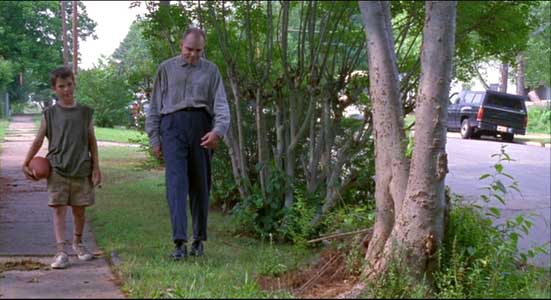
Sling Blade
Rating *** A must see
Directed and written by Billy Bob Thornton
With Thornton, Dwight Yoakam, John Ritter, J.T. Walsh, Natalie Canerday, Lucas Black, James Hampton, Rick Dial, and Robert Duvall.
There is no point in rendering something realistically unless it is to make it more meaningful in an abstract sense. In this paradox lies the progress of the movies. — Andre Bazin
In one of the unfortunate casualties of film history and criticism, writer-director-performers are generally approached as performers and/or directors first and as writers second, yet it’s often the writerly impulse that gives birth to both the performance and the direction. Erich von Stroheim and Charlie Chaplin are seldom regarded as the writers of Foolish Wives and City Lights respectively, but without their scripts neither the performances nor the films themselves would exist. Orson Welles, habitually described as a director and actor, insisted throughout his career that he always started with the written word, not with free-floating ideas for “shots.”
So it was a matter of some satisfaction to me that Billy Bob Thornton wound up getting an Oscar last month not for his lead performance in Sling Blade or for its direction but for his script. Read more
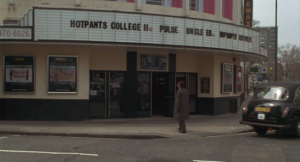
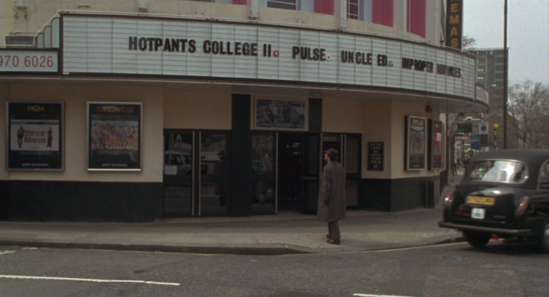
A reclusive, old-fashioned, intellectual novelist and widower living in London (John Hurt) stumbles accidentally into a screening of Hotpants College II at his local multiplex and becomes hopelessly, obsessively enamored of one of its young American stars (Jason Priestley). Fan magazines and the purchase of a VCR fail to satisfy his longings, so he travels to the Long Island town where his beloved resides and plots to encounter him in the flesh. This perfectly realized, beautifully acted, sweetly hilarious 1997 first feature by English writer-director Richard Kwietniowski, adroitly adapted from Gilbert Adair’s short novel of the same name (a comic variation on Thomas Mann’s “Death in Venice”), is a witty, canny meditation on the power of pop culture in general and the rationalizations of cinephilia and film criticism in particular. What makes it perhaps even better than Adair’s clever novel, which is somewhat limited by its first-person narration, is the beautiful balance of humane sympathies Kwietniowski achieves; at no point does the foolishness or vanity of either character wipe out our sense of his dignity, and Fiona Loewi is no less touching as the movie star’s girlfriend. A “small” film only in appearance, this is as solid and confident as any first feature I’ve seen this year. Read more
From the November 10, 1989 Chicago Reader. — J.R.
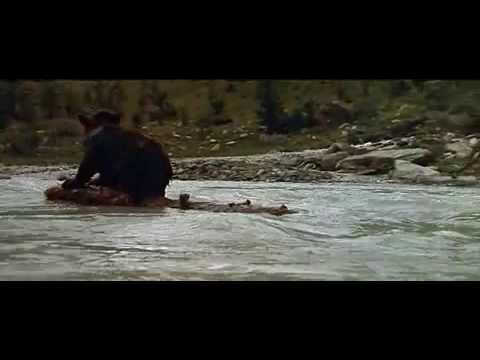
THE BEAR
** (Worth seeing)
Directed by Jean-Jacques Annaud
Written by Gerard Brach
With Douce, Bart, Jack Wallace, Tcheky Karyo, and Andre Lacombe.
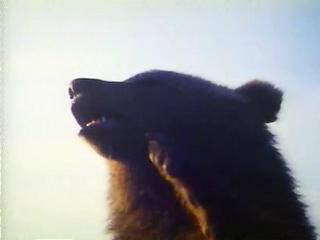
Much of the immediate appeal of Jean-Jacques Annaud’s new feature, apart from its impressiveness as a technical feat, is the attraction of seeing animals more than people, which also means seeing a movie that’s virtually free of dialogue. In theory, at least, there’s something relatively uncorrupted about both experiences. We spend so much time watching actors in the media — people pretending to be what they’re not — that there’s something refreshing about watching animals being animals for a change, even when they are “acting” in a fiction film. Similarly, the sparsity of dialogue — a total of 657 words shared by three actors in 93 minutes — brings us close to the purity of silent film and its strictly visual means of story telling, which produces that primal sense of unfolding narrative that most talkies miss. (Following a belt-and-suspenders principle when it comes to using dialogue and image, the average sound movie puts forth a redundancy of information and effect that leaves less freedom for the spectator’s imagination than the average silent movie.) Read more
This critical memoir originally appeared in the Spring 1983 Sight and Sound; it was subsequently reprinted in my first collection (1995), Placing Movies: The Practice of Film Criticism. — J.R.
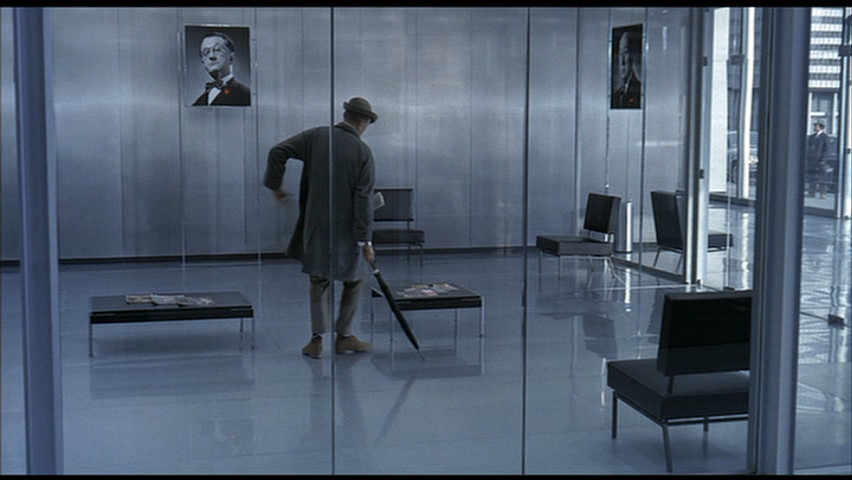
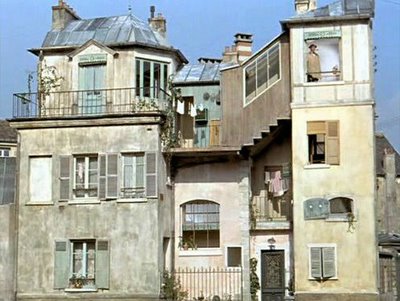
It was about ten years ago, in late November 1972, that I first took the No. 163 bus from Porte de Champerret in Paris to Jacques Tati’s office in la Garenne-Colombes, just around the corner from an unassuming street known as Rue de Plaisance. With his assistant Marie-France Siegler — a French- American in her thirties who, like me, hailed from Alabama, and had set up this interview — Tati occupied two offices in a modern building whose suburban neighborhood bore visible traces of both the contrasting quartiers in MON ONCLE: the chummy old lower-middle-to-working-class district where an unemployed Hulot lives, and the sterile, newly built upper-to-middle-class subdivision where his “successful” brother lives.

The modern building, fronted by a glass door with a disc-shaped brass knob, was no less suggestive of PLAYTIME, and Tati’s office contained other familiar emblems, such as the same synthetic black chairs. In fact, around the period of MON ONCLE (1958), his production company had commanded the entire floor; he had restricted himself to two modest rooms only after investing and then losing practically everything he had on PLAYTIME (1967), his most expensive film, the masterpiece that wrecked his career. Read more
From the Chicago Reader (April 30, 1993). — J.R.
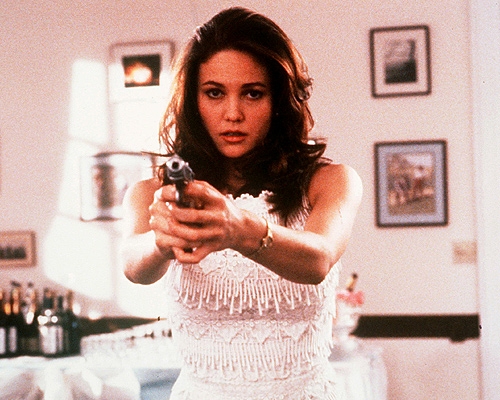
MY NEW GUN
* (Has redeeming facet)
Directed and written by Stacy Cochran
With Diane Lane, James LeGros, Tess Harper, Bruce Altman, Maddie Corman, Bill Raymond, and Stephen Collins.
I finally got to feel that I had to unpack large crates by swallowing the excelsior in order to find at the bottom a few bent and rusty nails, and I began to nurse a rankling conviction that detective stories are able to profit by an unfair advantage in the code which forbids the reviewer to give away the secret to the public — a custom which results in the concealment of the pointlessness of a good deal of this fiction and affords a protection to the authors which no other department of writing enjoys. — Edmund Wilson, “Why Do People Read Detective Stories?”
In the half century that has passed since this famous long sentence was written, it seems that a lot more than detective stories has fallen under the kind of protection Wilson objected to. Miramax’s campaign to protect the “surprise” of The Crying Game has been so vociferous that one feels it may only be a matter of time before the clergy starts inveighing against tattletale reviewers. Read more
From the Chicago Reader (March 5, 1993). –J.R.
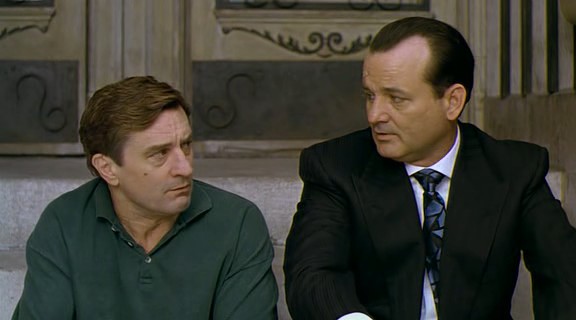
MAD DOG AND GLORY
** (Worth seeing)
Directed by John McNaughton
Written by Richard Price
With Robert De Niro, Bill Murray, Uma Thurman, David Caruso, Mike Starr, Tom Towles, and Kathy Baker.
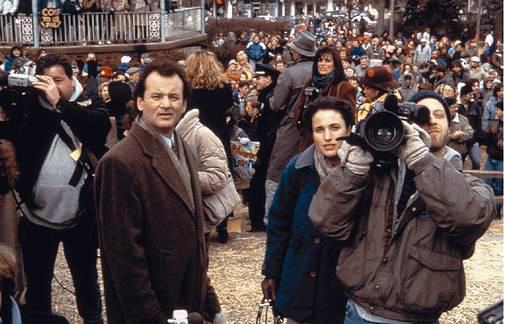
GROUNDHOG DAY
*** (A must-see)
Directed by Harold Ramis
Written by Danny Rubin and Ramis
With Bill Murray, Andie MacDowell, Chris Elliott, Stephen Tobolowsky, Brian Doyle-Murray, and Marita Geraghty.
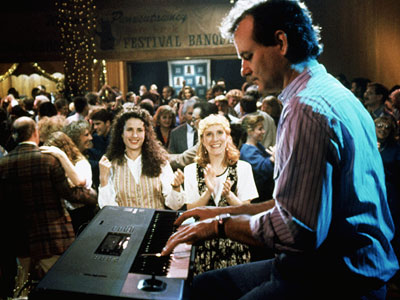
As far as the mainstream is concerned, Martin Scorsese and Robert De Niro are beacons of artistic integrity and originality, while Harold Ramis and Bill Murray are at best unpretentious entertainers; screenwriter Richard Price (The Color of Money, Sea of Love) is a respected pro, and director John McNaughton (Henry: Portrait of a Serial Killer, The Borrower) is a promising maverick. But all of these assumptions are challenged in one way or another by the two latest Bill Murray movies. In Price and McNaughton’s Mad Dog and Glory, produced by Scorsese, artistic integrity, originality, craft, daring, and promise seem in shorter supply than in Ramis’s Groundhog Day.
I may be oversimplifying certain issues here. Groundhog Day, which boasts no interesting characters, is held in place by a narrative premise so shopworn — big-city grouch discovers small-town virtues and the error of his ways — that merely thinking about it makes me want to doze off.
Read more
Written in January 2014 for my 34th bimonthly En movimiento column for Caiman Cuadernos de Cine. — J.R.
Film history can be regarded as a succession of encounters between viewers and films in which particular conditions and contexts (pedagogical, historical, ideological, cultural, and/or circumstantial) tend to shape and even determine the content of what’s seen as well as ignored. This produces many striking discrepancies and disparities when one shifts from one national culture to another.
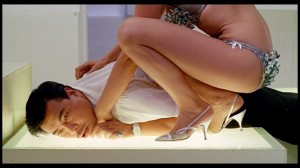
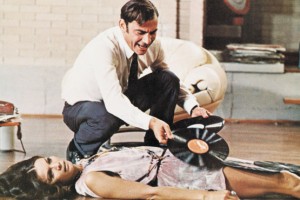
Almost half a century passed between the time I saw my first Elio Petri film (The 10th Victim, 1965) and the time I saw my second (Investigation of a Citizen Above Suspicion, 1970), the latter occasioned by a recent DVD and Blu-Ray release by Criterion. I’m sure that many of the reasons for this are haphazard and without any particular significance. But a feature-length documentary about Petri (1929-1982) included in the Criterion release, revealing that he was a member of the Italian Communist party who consciously avoided making films that would type-cast him as an arthouse director, makes me realize that, as an American — even one who was living in Paris when Investigation came out — I was unconsciously affected by a Cold War context that kept most of Petri’s later films invisible to me. Read more
The following piece appeared in the October 22, 2009 issue of the Chicago Reader. Due to a technical error which was belatedly corrected (in March 2010), the Reader omitted Mehrnaz Saeed-Vafa’s name as coauthor, but I’ve restored it here. — J.R.
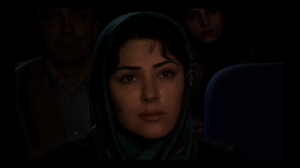
Kiarostami Returns
Jonathan Rosenbaum and Mehrnaz Saeed-Vafa discuss the Iranian master’s first film to screen in Chicago since 2002.
By Jonathan Rosenbaum and Mehrnaz Saeed-Vafa
Introduction
It’s been six years since Mehrnaz Saeed-Vafa and I published Abbas Kiarostami (University of Illinois Press), about Iran’s most famous and most controversial filmmaker. The book combined the perspectives of myself, an American film critic with a Jewish background, and Mehrnaz, an Iranian-American filmmaker and teacher with an Islamic background, on Kiarostami’s films, which are neither narrative features nor documentaries but something in between. Where Is the Friend’s House? (1986), Close-Up (1990), Life and Nothing More . . . (1992), Through the Olive Trees (1994), Taste of Cherry (1997), and The Wind Will Carry Us (1999) keep altering the balance between what’s actually seen in a story and what’s implied or imagined, and this is part of what continues to make Kiarostami such a contested and fascinating figure. Building, perhaps, on his talent as a visual artist (he’s a photographer, painter, and graphic artist) and his interest as a chronicler of Iranian life, he’s been a nearly constant innovator in both form and subject matter. Read more
From the Chicago Reader (June 1, 2002). — J.R.
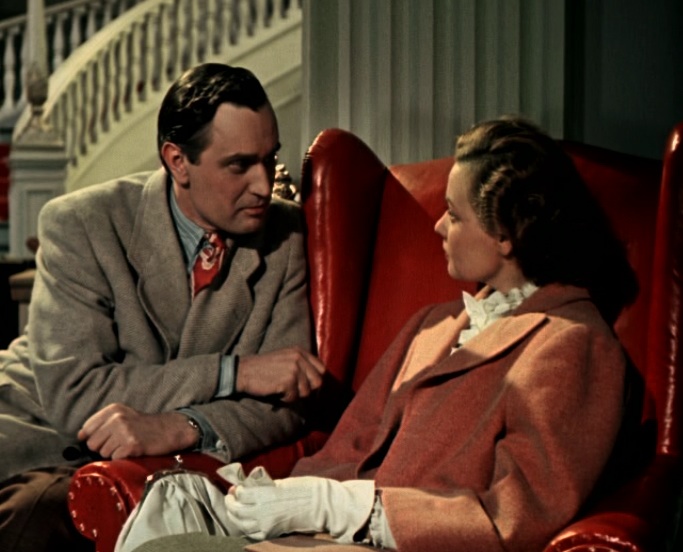
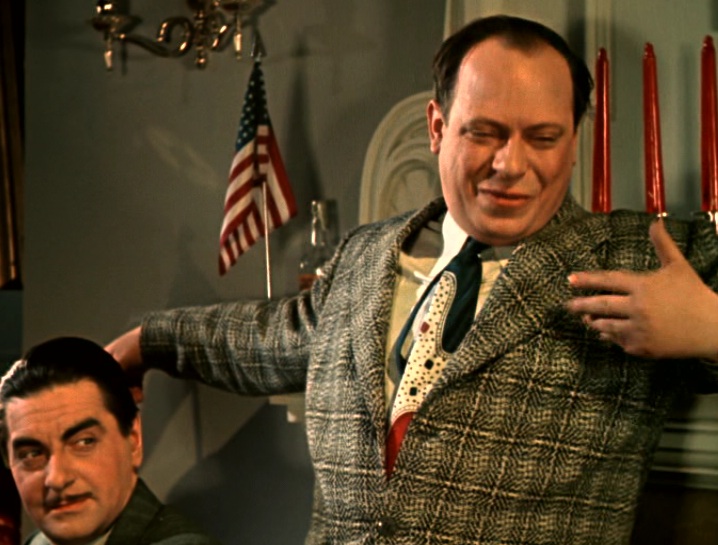
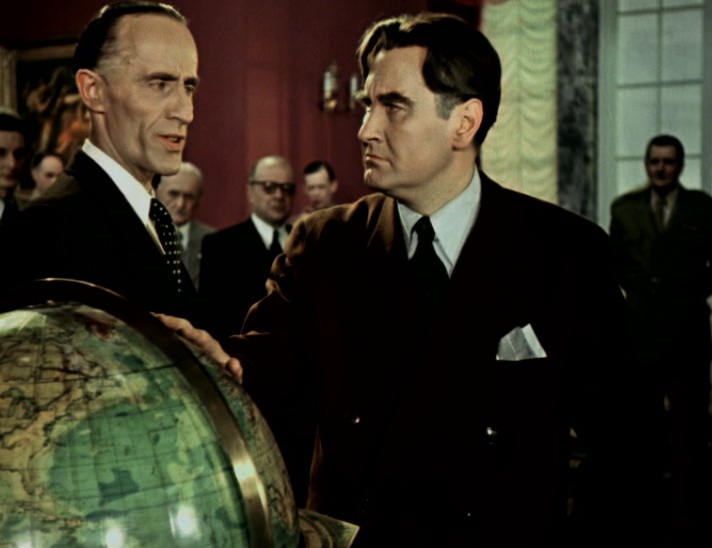
Around 1950, after seeing his own ideas rejected time and again, the great Soviet director Alexander Dovzhenko undertook this grotesque piece of kitsch, which was inspired by the defection of U.S. journalist Annabelle Bucard after she discovered that the U.S. embassy in Moscow, where she worked, was a nest of spies. Dovzhenko’s script went through countless drafts, and when Stalin terminated the project (for reasons that are still obscure), the director learned the news only when the electricity was abruptly shut off on the soundstage where he was working. The film was finally released in 1995, with commentary on the missing pieces and material about its arduous birth, and it’s morbidly fascinating as an example of Stalinist filmmaking (Dovzhenko’s style is nowhere in evidence). Considering the director’s stature, the most depressing aspects of this are that even the commentator isn’t sure whether it’s sincere and that ultimately it doesn’t matter much. In Russian with subtitles. 73 min. (JR)
 Read more
Written for The Unquiet American: Transgressive Comedies from the U.S., a catalogue/ collection put together to accompany a film series at the Austrian Filmmuseum and the Viennale in Autumn 2009. — J.R.
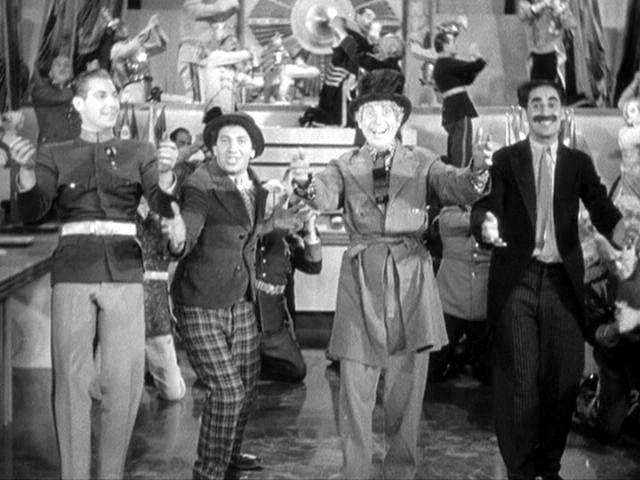
DUCK SOUP (1933)
Many reasons could be cited why this is the best of all
the Marx Brothers features, even though it was a
commercial disappointment when it was first released
in 1933. The last of the Marx Brothers movies in
which Zeppo -– the straight man among the brothers
and the youngest (who replaced Gummo, the one
who fulfilled this role on stage) –- appeared, it is perhaps
the only one whose anarchistic pleasures aren’t
crippled or interrupted by romantic and musical
interludes. (The climactic musical number here,
“Freedonia’s Going to War,” is an integral part of the
action.) Leo McCarey was inarguably the best director
the brothers ever worked with, and the ridiculing
of both nationalism and patriotism is more pointed
than most of their other satires. This comedy
also has the most beautiful (and beautifully abstract)
sequence in any Marx brothers picture, staged in
front of a mirror, developing a gag concept from
Chaplin’s The Floorwalker (1916) and extending it
to hallucinatory proportions. It also includes the
second and possibly best appearance of Margaret
Dumont (Groucho’s ideal foil) in a Marx Brothers
picture, and also features Edgar Kennedy and Louis
Calhern in memorable parts. Read more