From the Chicago Reader (July 13, 2001). — J.R.


John Cassavetes’s galvanic 1968 drama about one long night in the lives of an estranged well-to-do married couple (John Marley and Lynn Carlin) and their temporary lovers (Gena Rowlands and Seymour Cassel) was the first of his independent features to become a hit, and it’s not hard to see why. It remains one of the only American films to take the middle class seriously, depicting the compulsive, embarrassed laughter of people facing their own sexual longing and some of the emotional devastation brought about by the so-called sexual revolution. (Interestingly, Cassavetes set out to make a trenchant critique of the middle class, but his characteristic empathy for all of his characters makes this a far cry from simple satire.) Shot in 16-millimeter black and white with a good many close-ups, this often takes an unsparing yet compassionate “documentary” look at emotions most movies prefer to gloss over or cover up. Adroitly written and directed, and superbly acted — the leads and Val Avery are all uncommonly good (the astonishing Lynn Carlin was a nonprofessional discovered by Cassavetes, working at the time as Robert Altman’s secretary) — this is one of the most powerful and influential American films of the 60s. Read more
My DVD column for the Fall 2015 issue of Cinema Scope. — J.R.
Practically speaking, we should invent our own extras, not necessarily or invariably depend on those that are made on our behalf. To cite four examples of what I mean:

(A) According to normal usage, Icarus Film’s DVD of Frederic Choffat and Vincent Lowy’s 44-minute Marcel Ophuls and Jean-Luc Godard: The Meeting in St-Gervais contains no extras. But according to my own usage, this DVD itself functions as an extra to a 100-page book that I own, Dialogue sur le cinéma: Jean-Luc Godard & Marcel Ophuls, published by Le Bord de l’Eau in 2011. That book, prefaced by short essays by Vincent Lowy and André Gazut and concluded by Daniel Cohn-Bendit’s essay for Le Monde, ‘Mon ami Godard’, transcribes two encounters between Godard and Ophüls, held in 2002 and 2009 (the first of these focusing more on Marcel’s father Max), whereas the DVD includes most (but not all) of the second of these dialogues, and somehow manages to leave out some of the more interesting parts, either through cuts or incomplete subtitles. Which doesn’t mean that Icarus’s release isn’t worth having — only that its contents are worth contextualizing beyond the material offered by Icarus. Read more
From the Chicago Reader (May 4, 1999). — J.R.
The best Spanish film I’ve seen in years, this 1998 feature by Julio Medem (Cows, The Red Squirrel, Earth), attractively shot in ‘Scope, is the story of two young lovers who first encounter one another at the age of eight, told from alternating viewpoints that after 17 years converge in Finland. The romantic style of the film commands attention as much as the story itself, which is shaped — like the names of the two lead characters, Otto and Ana — as a palindrome. The graceful jumping about in time and space may recall the early work of Alain Resnais, but the theme and ambience are Spanish to the core; Medem charts the crisscrossing destinies of the two leads with passion as well as lyricism. With Fele Martinez and Najwa Nimri. In Spanish with subtitles. R, 112 min. (JR)

Read more
From Sight and Sound (Autumn 1976). -– J.R.
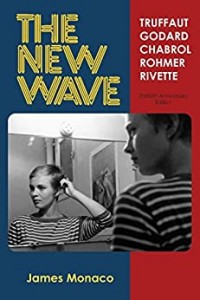
THE NEW WAVE
By James Monaco
OXFORD UNIVERSITY PRESS, £9.95.
A writer whose methods immediately evoke the mood and dynamics of an energetic classroom, James Monaco restricts The New Wave to the five film-making alumni of Cahiers du Cinéma most often identified with that label: Truffaut, Godard, Chabrol, Rohmer and Rivette. Considering the dearth of books in English on the subject (only Peter Graham’s anthology and Raymond Durgnat’s early monograph — both long out of print, and the latter unmentioned in the present book — qualify as predecessors), it is a fertile field for any critic interested in organizing a lot of diverse material, and this task is handled by Monaco with grace and assurance; for its bibliography alone, this over-priced volume is well worth having. Beginning with an evocation of Rivette’s first encounters with Godard and Truffaut (and later Chabrol and Rohmer) at the Avenue de Messine Cinémathèque in 1949 or 1950, he proceeds to the films of each until, some 320 pages later, he has burrowed his way through over a hundred features and shorts.
Lots of grist for the mill; but what kind of product is the Monaco factory manufacturing? Read more