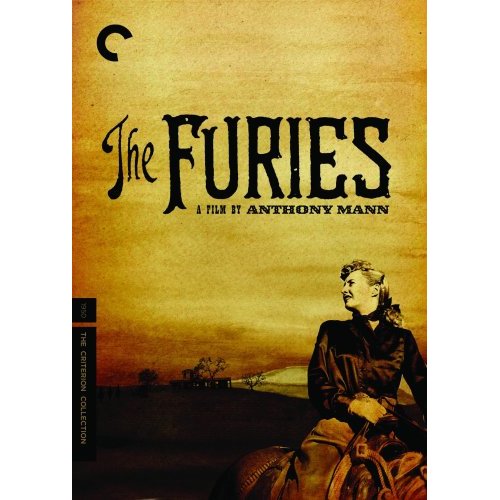
THE FURIES, directed by Anthony Mann (1950, 109 min.), in a Criterion box set.
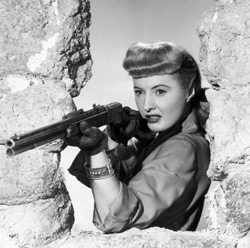
Last night, I saw this grand, exciting, unruly failure, Mann’s first western, for the first time, thanks to the timely arrival of the DVD from Criterion, handsomely boxed with the Niven Busch novel that Charles Schnee (and Mann, uncredited) adapted it from. I haven’t yet sampled the Jim Kitses commentary, but there’s also an excellent new essay by Robin Wood that’s very attentive to both the strengths and weaknesses of the film, cross-referencing KING LEAR in all the right ways. And on the same disc, a Paul Mayersburg interview with Mann shortly before his death that was recorded for British television–the first I’ve ever seen–as well as a no less revealing interview with Mann’s daughter Nina, which introduces me to certain relevant aspects of Mann’s childhood: specifically, growing up mainly without parents in a Theosophical Institute in San Diego where there was an outdoor amphitheater that produced Greek tragedies, among other things.
My only complaint, really, is that there’s no allusion in the booklet to Arthur Hunnicutt’s uncredited appearance in the film––the same year he appeared as Chloroform Wiggins in Jacques Tourneur’s STARS IN MY CROWN. Read more
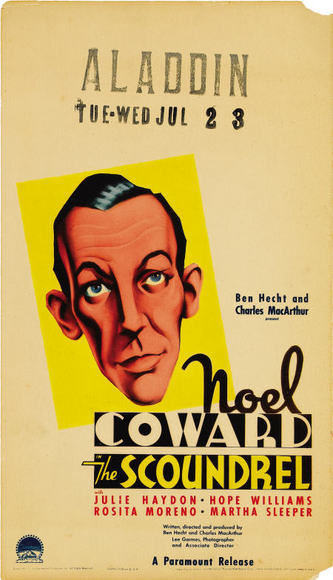
THE SCOUNDREL, written and directed by Ben Hecht and Charles MacArthur, with Noel Coward (1935, 76 min.)
Interesting to discover from Alfred Kazin’s AN AMERICAN PROCESSION -– specifically, from the beginning of his chapter about AN AMERICAN TRAGEDY and THE SOUND AND THE FURY -– that Horace Liveright, the onetime publisher of Dreiser, was “the model for Ben Hecht’s maliciously engaging film THE SCOUNDREL“. Having recently reseen and again hugely enjoyed the second feature codirected as well as cowritten by Ben Hecht and Charles MacArthur, starring Noel Coward in the title role as Anthony Mallare (apparently his first film part, unless one counts his uncredited cameo in Griffith’s 1918 HEARTS OF THE WORLD), I’d been wondering how much of this memorable antihero was attributable to the imaginations of the writer-directors and how much came from life.
Hecht directed or codirected seven features in all, starting with the equally mannerist CRIME WITHOUT PASSION (with its deliriously campy avant-garde prologue) in 1934 and concluding with the rather awful ACTORS AND SIN (codirected by Lee Garmes) in 1952. All of them are difficult to find nowadays, though I’ve managed to track down a few from various Mom and Pop operations on the Internet. Read more
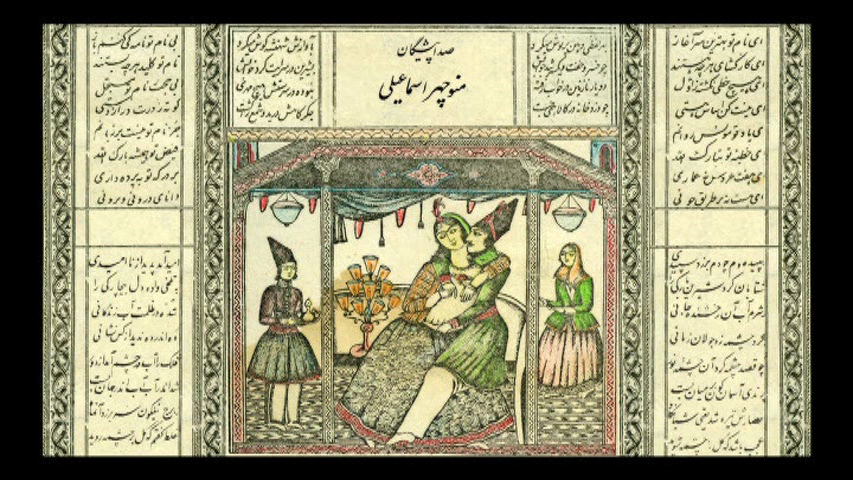
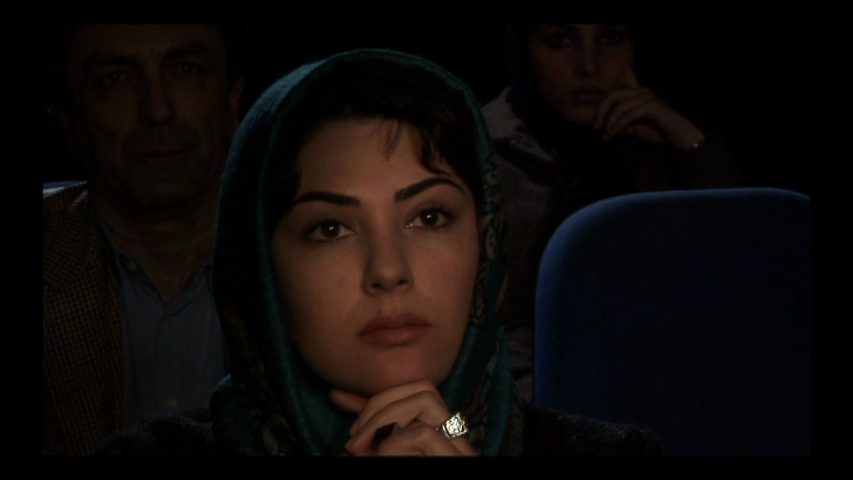
One of Abbas Kiarostami’s trickiest and most radical experimental works, this fascinating 2008 feature focuses on women spectators of a movie that we hear but don’t see—a lush and seemingly action-packed drama adapted from a famous Persian medieval poem by Nazami Ganjavi, “Khosrow and Shirin.” Typical of Kiarostami’s mastery as an illusionist is that he created the offscreen soundtrack himself, but only after he’d shot close-ups of Juliette Binoche and 112 Iranian film actresses watching the fictional film. (The makeshift audience contains some males too, but they’re never featured.) It’s as if Kiarostami had capitulated to the requests of his friendly critics that he make a movie with stars and an easy-to-follow story, then perversely turned the movie into a nonnarrative film. In Farsi with subtitles. 92 min. (JR)
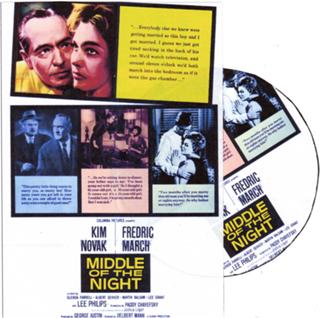
MIDDLE OF THE NIGHT, written by Paddy Cheyevsky, directed by Delbert Mann, with Kim Novak and Fredric March (1959, 118 min.)
Just a brief postscript to my recently posted “Kim Novak as Midwestern Independent”. If memory serves, I hadn’t seen this profoundly depressing piece of New York Chayevsky realism since I was 16, when it came out. Now it comes across, for better and for worse, like another version of Mikio Naruse depicting the shallow rewards and prospects of the urban, aging lower-middle-class. What’s distinctly un-Naruse-like, though, is Kim Novak, who brings a nervous, almost hysterical energy to her part as the divorced, 24-year-old secretary, girlfriend, and fiancée of a middle-aged widower and garment-industry worker (Fredric March), almost as if she were trying her hand at a Method performance. The fact that I can only believe in her character part of the time stems from the fact that I can so easily see her trying. Still, the mood swings of her character are often terrifying and believable in a way that even seems to go beyond the demands of the material –- as if she were constantly trying on the part for size and then immediately changing her wardrobe in a fit of impatience. Read more
KISS ME, STUPID, written by Billy Wilder and I.A.L. Diamond, directed by Wilder, with Dean Martin, Kim Novak, Ray Walston, Felicia Farr, and Cliff Osmond (1964, 126 min.)
A fresh look at one of Billy Wilder’s most underrated films clarifies for me two essential facts about it for the first time: (1) It seems likely that this masterpiece mainly received a C or “condemned” rating from the Legion of Decency because of its scathing portrait of the hypocrisy of American small-town life and the corruption of big-time media, not because of its depiction of sex per se. (2) Wilder’s return to the American Southwest after his earlier Ace in the Hole (1951) is in fact a return to these very same topics, seen with a no less jaundiced eye — something Wilder was apparently fully aware of, as signaled by a virtual quote of a shot from the previous film: Dean Martin in the driving seat of a car being towed replicates Kirk Douglas in the driving seat of his own car being towed.
If Robert Osborne on TCM is to be believed, the previous C rating bestowed by the Legion of Decency prior to Kiss Me, Stupid was eight years before — which would make it Baby Doll (1956). Read more
HONEYDRIPPER ***
DIRECTED AND WRITTEN BY JOHN SAYLES
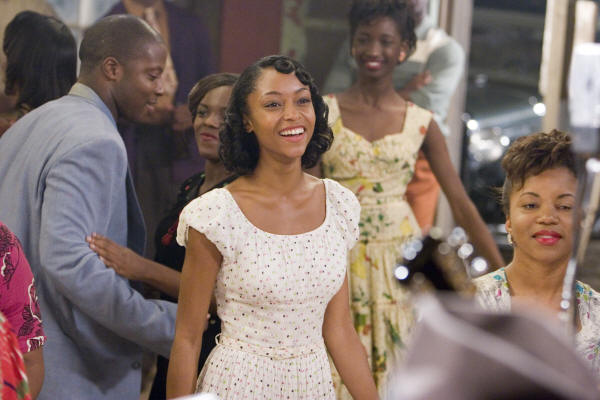
It may seem like dirty pool to begin a discussion of one of my favorite John Sayles movies by zeroing in on its weak points. But writing about Honeydripper recently in the New Yorker, David Denby noted that “moviemaking seems to have become almost magically easy for this independent writer-director,” and that’s absurd, since Sayles himself wrote in the introduction to his story collection Dillinger in Hollywood that “getting a movie made resembles the passage of a bill through Congress.”
Denby concedes that Sayles’s virtuosity as a writer-director “is rhetorical rather than visual.” And Sayles himself says that when he gets a story idea that “seems best expressed in fiction, I feel it in words, not pictures.”
The brief flashback in the middle of Honeydripper’s climactic sequence is a good indication of how labored Sayles’s treatment of images continues to be. The flashback — it comes when Tyrone “Pine Top” Purvis (Danny Glover) is about to break up a fight between a couple of angry customers in his Honeydripper Lounge — isn’t just clunky as visual storytelling and phony in its florid, bloody action and garish setting, it’s seriously underimagined. Read more
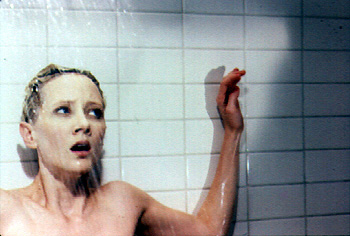
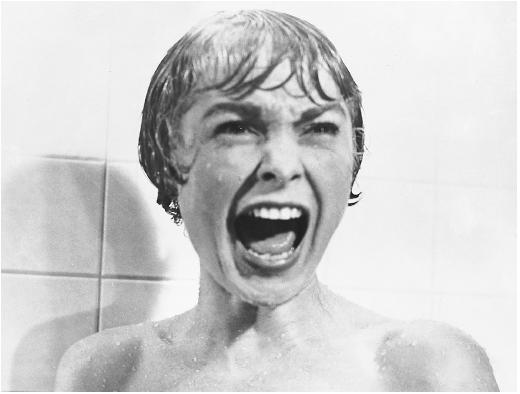
There are few films of the past decade that have irritated me quite as much as Van Sant’s idiotic remake of Psycho, and in some ways I was irritated even more by the rationalizations some cinephiles came up with in their tortured efforts to justify it. I tried my best to behave like a gentleman towards Lisa Alspector, the Reader film reviewer whose capsule sparked my longer review in the December 25, 1998 issue, but I don’t know whether or not I succeeded. — J.R.
Psycho
Rating — Worthless
Directed by Gus Van Sant
Written by Joseph Stefano
With Vince Vaughn, Anne Heche, Julianne Moore, Viggo Mortensen, William H. Macy, Robert Forster, Philip Baker Hall, Ann Haney, and Chad Everett.
Psycho has never been one of my favorite Alfred Hitchcock pictures. The first time I saw it, during its initial release in 1960, I’d already read the Robert Bloch novel it’s based on, a fairly routine horror thriller, so the surprise ending was anything but surprising. I saw the movie back-to-back with Let’s Make Love, which I liked a lot more. Yves Montand spoke English awkwardly, but Marilyn Monroe was irresistible — for practically the only time in her late career, she played a character who was smart and feisty. Read more
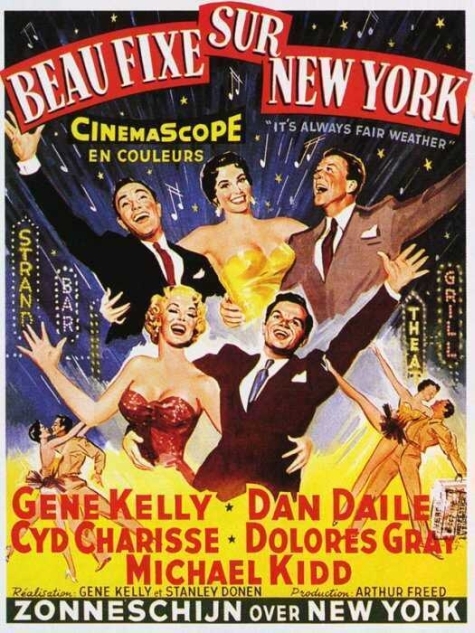
IT’S ALWAYS FAIR WEATHER, directed by Stanley Donen and Gene Kelly, written by Betty Comden and Adolph Green, with Kelly, Cyd Charisse, Dan Dailey, Michael Kidd, and Dolores Gray.
Has there ever been a more deceptive title and ad for a movie than this Belgian poster for the depressive 1955 musical IT’S ALWAYS FAIR WEATHER? Not that the original title or the strained happy ending are exactly apt either. [I resaw this movie yesterday, on my last day at Il Cinema Ritrovato, and might have written about this sooner -– i.e., before I returned to Chicago -– if I’d been able to figure out a way to paste in photos on my laptop.] But in fact it expresses more negative feelings about American culture at mid-century than anything by Frank Tashlin. Tashlin, after all, always seems to love his characters, but what mainly typifies the satirical feelings here about television, advertising, and other forms of corruption are disgust, disillusionment, self-hatred, and anger. It seems characteristic that Kelly and Charisse, the romantic leads, never even get to dance together, and that Dolores Gray’s climactic number, “Thanks a Lot, but No Thanks” (see still), registers as a conscious ripoff of Monroe’s glacially bitter “Diamonds Are a Girl’s Best Friend” in Gentlemen Prefer Blondes. Read more
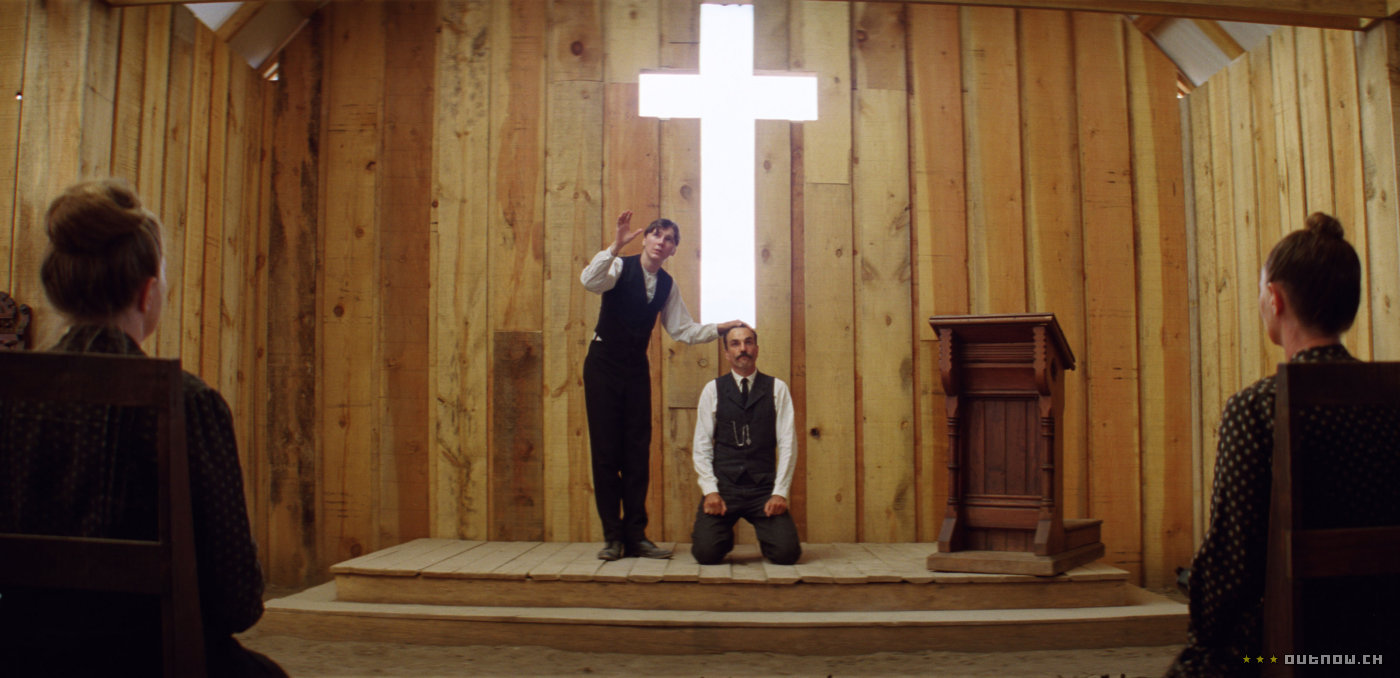
From the Chicago Reader (January 3, 2008). I much prefer this film to Paul Thomas Anderson’s next feature, The Master, an incoherent mess with fewer compensations (despite the heavy breathing from some of my colleagues, who have compared it to Herman Melville); but for my money, neither film holds a candle to Magnolia. — J.R.
Paul Thomas Anderson’s fifth feature, a striking piece of American self-loathing loosely derived from Upton Sinclair’s Oil!, is lively as bombastic period storytelling but limited as allegory. The cynical shallowness of both the characters and the overall conception — American success as an unholy alliance between a turn-of-the-century capitalist (Daniel Day-Lewis) and a faith healer (Paul Dano), both hypocrites — can’t quite sustain the film’s visionary airs, even with good expressionist acting and a percussive score by Radiohead’s Jonny Greenwood. Day-Lewis, borrowing heavily from Walter and John Huston, offers a demonic hero halfway between Thomas Sutpen in Faulkner’s Absalom, Absalom! and James Dean’s hate-driven tycoon in Giant (shot on the same location as this movie), but Kevin J. O’Connor in a slimmer part offers a much more interesting and suggestive character. This has loads of swagger, but for stylistic audacity I prefer Anderson’s more scattershot Magnolia. Read more
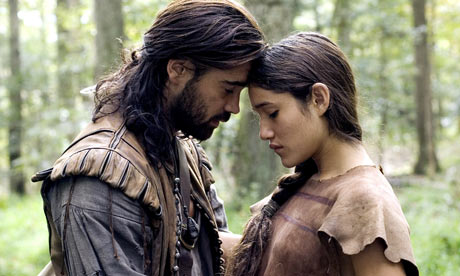
No important American filmmaker in recent years has divided audiences more than writer-director Terrence Malick (The Thin Red Line), and his fourth feature in 35 years pushed me for the first time into the skeptics’ corner. The subject matter is partly to blame: after four centuries of Anglo denial about the genocidal conquest of America, I was hoping for something a little more grown-up and educational about John Smith (Colin Farrell) and Pocahontas (the striking Q’Orianka Kilcher). Malick still has an eye for landscapes, but since Badlands (1973) his storytelling skill has atrophied, and he’s now given to transcendental reveries, discontinuous editing, offscreen monologues, and a pie-eyed sense of awe. All these things can be defended, even celebrated, but I couldn’t find my bearings. With Christopher Plummer, David Thewlis, and Christian Bale. PG-13, 135 min. (JR)
This review of was commissioned by its writer-director-producer-editor, Drew Hanks. The Made Man’s trailer can be accessed here: https://youtu.be/rPH9HbveDRk – J.R.
One striking trait shared by the United States and the Catholic Church is a taste for symbolism that overtakes material reality. The same mentality that converts wine into blood can also turn racial differences into graphic abstractions that replace facts so that pinkish brown individuals are called “white” and slightly darker brown individuals can be called “black”.
One of the more eloquent descriptions of this taste for metaphysics over material reality comes from Mary McCarthy, a lapsed Catholic and an American, who argues in her 1947 essay “America the Beautiful: The Humanist in the Bathtub” that “the virtue of American civilization is that it is unmaterialistic”:
“It is true that America produces and consumes more cars, soap, and bathtubs than any other nation, but we live among these objects rather than by them….When an American heiress wants to buy a man, she at once crosses the Atlantic. The only really materialistic people I have ever met have been Europeans….The strongest argument for the unmaterialistic character of American life is the fact that we tolerate conditions that are, from a materialistic point of view, intolerable.” Read more
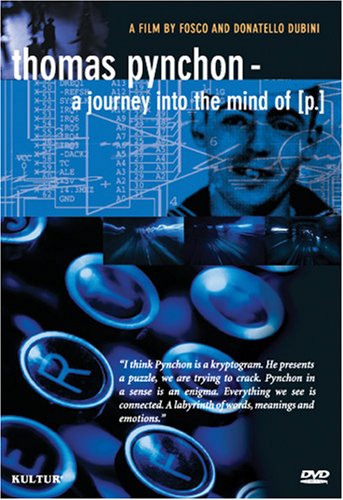
Pynchon freaks can be divided into two categories: those fascinated by his work, who respect his wish to be known through it, and those fascinated by his life, who see his writing as an illustration of his experiences. Aimed at the latter group, this 2001 Swiss documentary by Fosco and Donatello Dubini begins by enlisting a former Pynchon squeeze to show us his LA digs from the early 70s (she’s identified as Bianca from Gravity’s Rainbow, which discounts whatever art he brought to his experiences) and goes mostly downhill from there. Pynchon groupies weigh in while significant critics like Edward Mendelson are omitted, and even as gossip the movie reflects poorly on some of the author’s old friends. But the archival footage does include Lee Harvey Oswald (who may have been in Mexico City at the same time as Pynchon) and a cat freaking out on mescaline. 90 min. (JR) Read more
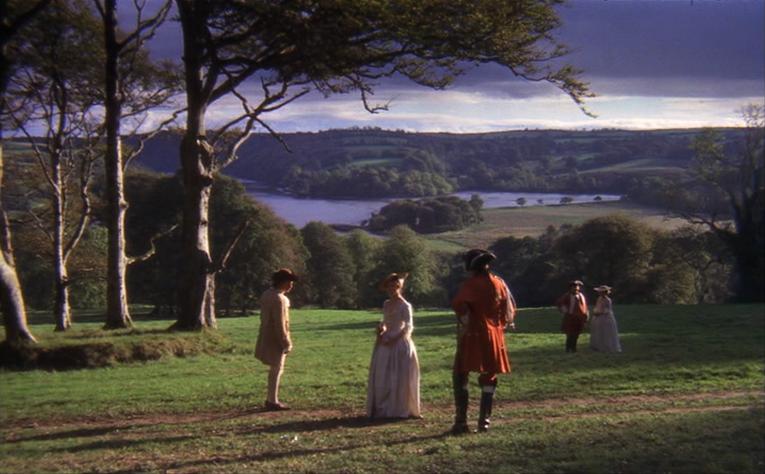
With the possible exceptions of Killer’s Kiss and A Clockwork Orange all of Stanley Kubrick’s features look better now than when they were first released, and Barry Lyndon, which fared poorly at the box office in 1975, remains his most underrated (though Eyes Wide Shut is already running a close second). This personal, idiosyncratic, and melancholy three-hour adaptation of the Thackeray novel may not be an unqualified artistic success, but it’s still a good deal more substantial and provocative than most critics were willing to admit. Exquisitely shot in natural light (or, in night scenes, candlelight) by John Alcott, it makes frequent use of slow backward zooms that distance us, both historically and emotionally, from its rambling picaresque narrative about an 18th-century Irish upstart (Ryan O’Neal). Despite its ponderous pacing and funereal moods, the film is highly accomplished as a piece of storytelling, and it builds to one of the most suspenseful duels ever staged. It also repays close attention as a complex and fascinating historical meditation, as enigmatic in its way as 2001: A Space Odyssey. The Music Box’s weeklong Kubrick retrospective includes a new print of this and several other films, and it offers an excellent opportunity to reevaluate a filmmaker whose work continues to deepen after his death. Read more
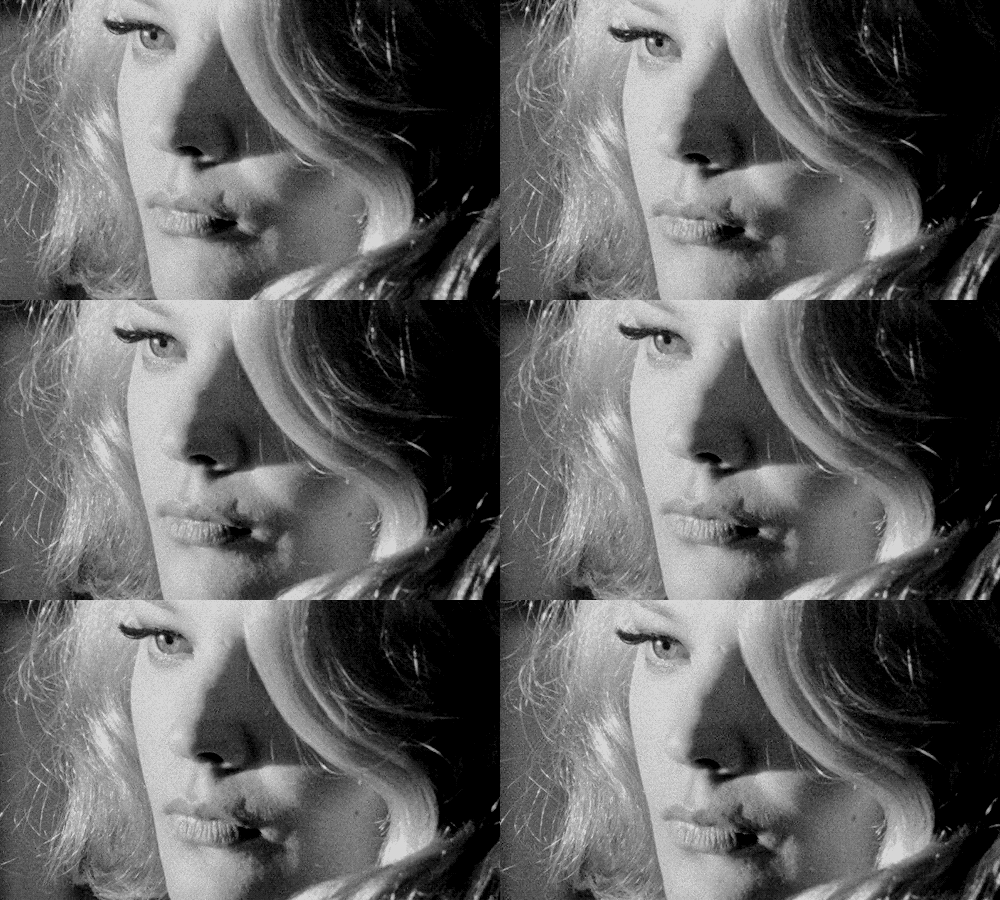
John Cassavetes’s galvanic 1968 drama about one long night in the lives of an estranged well-to-do married couple (John Marley and Lynn Carlin) and their temporary lovers (Gena Rowlands and Seymour Cassel) was the first of his independent features to become a hit, and it’s not hard to see why. It remains one of the only American films to take the middle class seriously, depicting the compulsive, embarrassed laughter of people facing their own sexual longing and some of the emotional devastation brought about by the so-called sexual revolution. (Interestingly, Cassavetes set out to make a trenchant critique of the middle class, but his characteristic empathy for all of his characters makes this a far cry from simple satire.) Shot in 16-millimeter black and white with a good many close-ups, this often takes an unsparing yet compassionate “documentary” look at emotions most movies prefer to gloss over or cover up. Adroitly written and directed, and superbly acted — the leads and Val Avery are all uncommonly good (the astonishing Lynn Carlin was a nonprofessional discovered by Cassavetes, working at the time as Robert Altman’s secretary) — this is one of the most powerful and influential American films of the 60s. Read more
Practically speaking, we should invent our own extras, not necessarily or invariably depend on those that are made on our behalf. To cite four examples of what I mean:
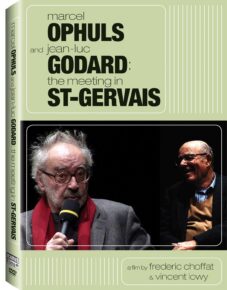
(A) According to normal usage, Icarus Film’s DVD of Frederic Choffat and Vincent Lowy’s 44-minute Marcel Ophuls and Jean-Luc Godard: The Meeting in St-Gervais contains no extras. But according to my own usage, this DVD itself functions as an extra to a 100-page book that I own, Dialogue sur le cinéma: Jean-Luc Godard & Marcel Ophuls, published by Le Bord de l’Eau in 2011. That book, prefaced by short essays by Vincent Lowy and André Gazut and concluded by Daniel Cohn-Bendit’s essay for Le Monde, ‘Mon ami Godard’, transcribes two encounters between Godard and Ophüls, held in 2002 and 2009 (the first of these focusing more on Marcel’s father Max), whereas the DVD includes most (but not all) of the second of these dialogues, and somehow manages to leave out some of the more interesting parts, either through cuts or incomplete subtitles. Which doesn’t mean that Icarus’s release isn’t worth having — only that its contents are worth contextualizing beyond the material offered by Icarus. Read more