Christopher Hampton’s grim and dank 1996 adaptation of the 1907 Joseph Conrad novel, set in London during the late 19th century, is closer in many ways to the original than Alfred Hitchcock’s updated 1936 version, Sabotagebut that doesn’t make it better. Bob Hoskins plays the central figure, a middle-aged anarchist with a younger wife (Patricia Arquette) who plots to bomb Greenwich Observatory, accidentally killing his feebleminded young brother-in-law in the process. Fairly strong on period atmospherics, but it mainly adds up to yet another pointless adaptation of a literary standby (arguably not one of Conrad’s best)one of the countless examples of dubious middlebrow fodder that keeps foreign-language pictures off our screens. With George Spelvin, Jim Broadbent, Christian Bale, and distracting turns by Gerard Depardieu and an uncredited Robin Williams. (JR) Read more
Losing Chase
Kevin Bacon’s directorial debut, with a script by Anne Meredith and a Martha’s Vineyard setting, describes the recovery of a middle-aged housewife (Helen Mirren) from a nervous breakdown. Her husband (Beau Bridges) hires a young woman (Kyra Sedgwick) to take care of her and their two children while he’s away on business; a friendship between the two women develops, and the older woman begins to fall in love with her friend (who has a schizophrenic sister she periodically visits). For all the sincerity and able acting on view here, I never fully believed either the story or the behavior of the characters (the two women and two children especially)a problem that seems attributable mainly to the script, though the direction suffers as a consequence. (JR) Read more
Paris Was A Woman
A fascinating lesbian literary guide to Americans in Paris during the first decades of the 20th century, with particular emphasis on the salons, long-term romances, and careers of Gertrude Stein and Alice B. Toklas, Sylvia Beach and Adrienne Monnier, Janet Flanner, Natalie Barney, Colette, and Djuna Barnes. Included are precious glimpses of Germaine Dulac’s seldom seen L’Invitation aux Voyages (1927), home-movie and archival footage, as well as many audio recordings and still photographs. There’s more high-level gossip here than literary history and analysis, and I would have liked some discussion of Paris’s special brand of conservative tolerance for lesbians. But this 1995 documentary is a welcome survey of an important and neglected subject. Greta Schiller directed a script by Andrea Weiss, author of a book on the subject. 75 min. (JR) Read more
The Evening Star
A belated 1996 sequel to 1983’s Terms of Endearment, this takes up the story of Aurora Greenaway (Shirley MacLaine) 15 years after the death of her daughter. Based, like its predecessor, on a Larry McMurtry novel, the film is written and directed by Robert Harling (the author of Steel Magnolias, making his directorial debut). Moments of honest sentiment alternate with moments of strained sitcom; the film doesn’t have much rhythm, but the actors keep it watchable. With Bill Paxton, Juliette Lewis, Miranda Richardson, Ben Johnson, Scott Wolf, George Newbern, Marion Ross, Mackenzie Astin, Donald Moffat, and a cameo by Jack Nicholson. (JR) Read more
Thieves
Writer-director Andre Techine was on a roll: after My Favorite Season (1993) and Wild Reeds (1994) came this picture, which in some ways was even more exciting and serious (1996, 117 min.) The story, which involves a family of thieves based in a mountainous region of southeast France, jumps between characters so as to frame the same events from different vantage points, as in a Faulkner novel. The plot centers on an abortive car heist, but the thriller elements are secondary to the explorations of character. The younger brother (Daniel Auteuil), rebelling against his older brother (Didier Bezace) and his father, has become a cop in Lyons, where he becomes sexually involved with the troubled sister (Laurence Cote) of a thief (Benoit Magimel) who’s in league with his brother. To complicate matters further, the sister is a former mistress of the older brother and is also involved with a philosophy teacher (Catherine Deneuve). Auteuil and Deneuve costarred as brother and sister in My Favorite Season, and it’s remarkable how different they are here. Cotebest known in this country for her work with Rivette (The Gang of Four, Up Down Fragile) and Godard (Nouvelle vague)is equally sensational. An exquisite, haunting movie for grown-ups about love and family ties. Read more
My Fellow Americans
An appalling piece of junk (1996) that tries to redo The Odd Couple and Grumpy Old Men in presidential terms, starring Jack Lemmon and James Garner as former U.S. presidents who hate each other but find themselves fleeing cross-country together from a scandal that implicates them both. This painfully formulaic, laughless comedy contrives to solve the problems of the homeless and the jobless in the space of a sound bite; it also patronizes gays and lesbians at every opportunity. Peter Segal directed from a script by E. Jack Kaplan, Richard Chapman, and Peter Tolan; with Dan Aykroyd, John Heard, Wilford Brimley, Everett McGill, Bradley Whitford, and Lauren Bacall. (JR) Read more
The Suicide
This fascinating independent feature by Gregg Bordowitz (Fast Trip, Long Drop) is a production of a banned blackly comic 1932 Russian play by Nikolai Erdman about an unemployed man who threatens suicide, only to be plagued by individuals who want him to kill himself on their behalf, directed in the style of American live TV dramas of the 50s such as Playhouse 90 and Studio One. But Bordowitz’s ultimate concern is cold-war ideology, and he takes revenge on both sides by making a suppressed work live in terms that would have been historically impossible. To make the concoction still more pungent, he throws in Soviet archival footage and mordant asides about the story that’s unfolding. The idea of this film is at times more alluring than the execution; but the castwhich includes Lothaire Bluteau, Brooke Smith, and Elina Lowensohnis energetic, and the original score by Lorin Sklamberg that includes a klezmer production number also keeps things hopping. (JR) Read more
Mars Attacks!
Tim Burton’s attractive and funny 1996 SF extravaganza, about little green men in flying saucers who threaten the planet, was inspired by a series of Topps trading cards. Written by English playwright Jonathan Gems, who collaborated on the script of Michael Radford’s Nineteen Eighty-Four, the film’s been described as satire, but whether its target is the present, the taste of SF fans in the 50s and 60s, or some combination thereof isn’t entirely clear. Jack Nicholson plays both the president of the United States and a real estate salesman, bringing a lot of brio to both parts but especially the latter; Glenn Close is the first lady; and Natalie Portman is first daughter. A large segment of the American population gets wiped out during the movie, but Burton and company play it all for laughs, finding derisive humor in pacifists as well as warmongers, ecologists as well as capitalists, media types as well as gun-toting hillbillies. The movie reserves most of its respect for a couple of youngsters (Portman and Lukas Haas), a partially senile grandmother (Sylvia Sidney), and a splintered black family (including Pam Grier and Jim Brown). I’m not sure what it all means, but, as in Ed Wood, Burton’s visual flair and affection for the characters make it fun. Read more
Lumiere & Company
To celebrate the centenary of Louis and Auguste Lumiere’s first film program in 1895, the Lyons Cinema Museum restored one of the brothers’ hand-cranked cameras, reconstructed their original film stock, and got 40 directors from all over the world to make a film under roughly the same conditions the Lumieres had: one sequence lasting 52 seconds, no sync sound or artificial lighting, and a maximum of three shots. Predicatably, the results are all over the place and fascinating. My favorite is Abbas Kiarostami’s lyrical contribution, though David Lynch’s also commands attention. Among the others who play the game are Theo Angelopoulos, John Boorman, Costa-Gavras, Peter Greenaway, James Ivory, Andrei Konchalovsky, Spike Lee, Claude Miller, Arthur Penn, Jacques Rivette, Jerry Schatzberg, Liv Ullmann, Wim Wenders, and Zhang Yimou. There’s some long-winded wraparoundinvolving mainly footage of the directors at work or speaking about their assignments, photographed and directed by Sarah Moonbut you’re not likely to be bored. (JR) Read more
Sling Blade
Billy Bob Thornton wrote, directed, and stars in this impressive first feature (1996), a Faulknerian parable about a semiretarded misfit from a small southern town who emerges from prison 25 years after killing his mother and her lover. Perhaps the most remarkable thing here is Thornton’s nuanced performance, but the film has other rare virtues: all the characters are fully and richly fleshed out (with some unexpected turns by John Ritter and singer Dwight Yoakam), and the story’s construction is carefully measured. Basically it’s a movie about goodness, which makes it both old-fashioned and unexpected (according to Thornton, one of the main influences was Frankenstein). The secondary cast includes J.T. Walsh and Robert Duvall. Cut by nine minutes by Miramax from its original festival running time. (JR) Read more
Breaking The Waves
A breakthrough feature by Lars von Trier — the postmodernist Danish director of The Element of Crime, Zentropa, and The Kingdom — this all-stops-out melodrama set on the remote north coast of Scotland in the early 70s produces some waves of its own. The plot concerns a naive young woman (a galvanizing performance by Emily Watson) who falls in love with a worldly oil-rig worker (Stellan Skarsgard) and marries him despite some opposition from her tightly knit Calvinist community. When the husband is paralyzed by an explosion, he persuades her to find a lover and describe her sexual experiences to him. Shot by the great Robby Müller, the film shifts powerfully between dizzying handheld footage (given an unusual texture by having been transferred to video and then back to film) recounting the harrowing story and gorgeous, digitally doctored chapter headings that linger meditatively over landscapes to the accompaniment of pop songs of the period. Improbably combining elements from Carl Dreyer and Federico Fellini, this 159-minute feature shamelessly pushes the audience’s emotions to the breaking point — you won’t come out of it indifferent, and even if it winds up enraging you (I could have done without most of the ending myself), it nonetheless commands attention. Read more
Hamlet
From the Chicago Reader (December 1, 1996). — J.R.
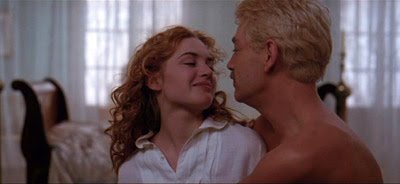
Kenneth Branagh’s elephantine 70-millimeter adaptation of virtually the entire text of the Shakespeare play doesn’t seem to have an idea in its head (apart from a bad one, setting the action in the 19th century) though it tends to be lively, if scattershot, in some of its performances. If one can get past the painful miscasting of Jack Lemmon (as Marcellus), most of the performances are good or better than good (for me, Branagh’s Hamlet, Julie Christie’s Gertrude, and Billy Crystal’s grave digger take the top honors), and the palace decor swarms with odd afterthoughts. But too much music and too many gratuitous camera movements distract from these pleasures, and Branagh rarely has a firm sense of where to place the camera. (He awkwardly cuts away from Crystal’s Yorick speech, for instance.) Ophelia is the character Branagh seems to have the least feeling for, and Gertrude’s account of her death, which cries out for illustration, gets it only when it’s too late to make much of an impact. If you elected instead to see Orson Welles’s Othello twice in succession, you’d not only have more than an hour to spare but be making better use of your time. Read more
The English Patient
What’s the big deal? I haven’t read Michael Ondaatje’s novel, but I suspect it’s better than this streamlined (if still long-winded) 1996 adaptation by writer-director Anthony Minghella (Truly Madly Deeply). A good old-fashioned love story and tearjerker with more than a touch of David O. Selznick, it’s reasonably well told and well mounted but little more. The intricate flashback structure at times recalls Marguerite Duras (though this is slicker); it moves between the Italian front near the end of World War IIwhere a French-Canadian nurse (Juliette Binoche) cares for a seriously burned patient (Ralph Fiennes) who claims he doesn’t know who he isand North Africa during the late 30s, when the patient, revealed as a Hungarian count and mapmaker, fell in love with a married woman (Kristin Scott Thomas). Memories of better movies ranging from Casablanca to Bitter Victory aren’t inappropriate here, but for all the film’s effectiveness as a love story, I often felt I was being hurried through a busy itinerary; some of the secondary characters (notably the nurse, a former thief played by Willem Dafoe, and a Sikh bomb detector played by Naveen Andrews) never get enough of the movie’s attention. With Colin Firth and Jurgen Prochnow. (JR) Read more
Shine
Directed by Scott Hicks from a script by Jan Sardi, this hyperbolic but undeniably effective 1996 Australian feature recounts the unorthodox career of classical pianist David Helfgotta gifted musician driven so fanatically to succeed by his ambitious Polish-Jewish emigre father (Armin Mueller-Stahl) that he wound up insane. (It’s a story that sometimes recalls Fear Strikes Out, the 1956 biopic about baseball star Jim Piersall.) Even if the film’s closing act seems too hasty to be fully believable (a common failing in biopics about living people), the high-powered drive of both the storytelling and the music is riveting. Helfgott is played at separate ages by Geoffrey Rush, Noah Taylor, and Alex Rafalowicz; others in the cast include Lynn Redgrave, John Gielgud, and Googie Withers. Among the highlighted composers are Chopin, Liszt, and Rachmaninoff, whose works are performed offscreen by Helfgott himself. (JR) Read more
Ridicule
A dry, jaundiced, and quirky 1996 look at the court of Louis XVI, seen from the vantage point of an engineer (Charles Berling) hoping to persuade the king to allow him to dam a river and thereby control a malaria epidemic in his home province. Directed by Patrice Leconte (Monsieur Hire), from a thoughtful if less than profound script by Remi Waterhouse, Michel Fessler, and Eric Vicaut, this holds one’s interest, at least as an alternative to the greeting-card idealism of most period art movies. (Judith Godreche is a particular standout as the daughter of a physician, played by Jean Rochefort, who takes the engineer under his wing.) With Bernard Giraudeau and Fanny Ardant. 102 min. (JR) Read more