This was published in the September-October 1995 issue of Film Comment, as a sidebar to https://jonathanrosenbaum.net/2024/06/ambiguous-evidence-cozarinskys-cinema-indirect-tk/– J.R.
Partisan
by Jonathan Rosenbaum
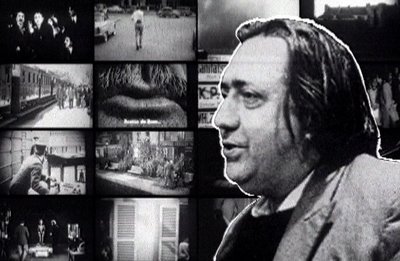
As a member of the FIPRESCI jury at Berlin that gave this year’s Forum prize to Edgardo Cozarinsky’s 68-minute Citizen Langlois, I’d like to quote our citation: “For a brilliant essay revealing a multifaceted grasp of a major pioneer for whom cinema was the ultimate nationality.”
Indeed, at a time when much of what passes for film history is being regulated nationalistically, by state bureaucrats — a process observable in such projects as the British Film Institute’s “A Century of Cinema” series (which stepped off in Berlin with Edgar Reitz’s Night of the Directors), and in the blatantly pro-industry PBS miniseries calling itself American Cinema -– Cozarinsky’s film carries a distinct polemical charge. For Henri Langlois, the unruly and passionate founder/gatekeeper of the Cinémathèque Française spent his life railing against state bureaucracies, and most of his legacy would be unthinkable without this sustained resistance. His eclectic partisanship is more than adequately matched in a personal essay that is as much about exile as Cozarisnky’s One Man’s War and Sunset Boulevards.
Viewers looking for a comprehensive dossier may be as disappointed as the Gaullist bureaucrats were when they demanded strict accounts and an orderly catalog from Langlois. Read more
Manny Farber, one of his earliest critical defenders, once described Michael Snow to me as “a prince”, and there’s no question that he was a proud bohemian who carried his own sense of royalty within the art world with grace and style. European fans such as Jacques Rivette who mistook him for an “American” (he was born and died in Toronto) may not have understood that the state funding that allowed Snow to flourish in Canada wouldn’t have been as feasible in the U.S. It’s even been speculated that if Snow hadn’t filmed his 1967 Wavelength in a Manhattan loft during his extended New York sojourn, many of us might never have heard of him. It was basically the enthusiasm of New York critics—Farber, Jonas Mekas, Annette Michelson, and, perhaps most of all, P. Adams Sitney and his term “structural film”—that placed Snow on the map, even while such reference sources as Ephraim Katz’s A Film Encyclopedia and David Thomson’s A Biographical Dictionary of the Cinema failed to acknowledge his existence.
Starting out as a self-taught jazz pianist who evolved from Dixieland to bebop (and later, to free jazz), Snow turned next to painting, sculpture, instillations, photography, film (starting in animation), video, holography, audio, and conceptually shaped books such as Cover to Cover (1975) and High School (1979).Read more
My fourth bimonthly column for Cahiers du Cinéma España, this ran in their December 2007 issue (no. 7). — J.R.
I’ve been reflecting lately about the attractions and perils of internationalism, which bring up the matter of the attractions and perils of nationalism as well. As a child of the Paris Cinématheque (1969-74) who had to see most silent films there without intertitles, following Henri Langlois’ vision of cinema as a universal language, I was both charmed and awed when I met an Argentinian schoolteacher, in Mar del Plata in 2005, who told me about the network of small-town ciné-clubs in Córdoba he helped to run that projected DVDs of such films as Forugh Farrokhzad’s The House is Black (1962) and Kira Muratova’s Chekhov’s Motifs (2002) with Spanish subtitles for 800 or more viewers per week. A utopian undertaking in which quintessential Iranian and Russian films became available to rural Argentinians, this conjured up for me Langlois’ notion of cinema as a separate nation in its own right. So when several Chilean journalists at the Valdivia International Film Festival asked me last October what I thought of the Chilean film industry, the question sounded as weird as my asking a Chilean visiting Chicago what he or she thought of the American postal system. Read more
This phone interview (see link below) with Douglas Storm in Bloomington, Indiana aired yesterday. Given all the Buddy Rich extracts, I’m sorry that there wasn’t time to discuss Welles’ own jazz taste (which was oriented more towards Dixieland, at least during the 40s). The clips from the film that are heard, which may be hard to follow in spots, testify to how much the art of Welles as a filmmaker is based on his editing, which obviously can’t be perceived in sound bites. [11/28/18]
This final chapter in my book Discovering Orson Welles is a lecture delivered in Valencia, Spain, on November 17, 2005, at a conference, “Don Quixote and the Cinema,” held at San Miguel de los Reyes, a convent built during the seventeenth century, making it roughly contemporary with Cervantes’s novel. The same building was used as a prison during the Franco era and functions today as a municipal library, Biblioteca Valenciana.
Given my virtually nonexistent grasp of spoken Spanish, I regretted that the event wasn’t more international; as far as I know, my paper was the only one requiring the services of a translator. The only other non-Spanish participants in the three-day event were a French man and an Italian woman, both of whom seemed to be fluent in the language.
Thanks to the generosity of the conference’s organizer, Carlos F. Heredero (the cowriter of Orson Welles en el País de Don Quijote, cited in my introduction to chapter 15, and an academic scholar and critic whose specialties include Spanish cinema and Wong Kar-wai), I was able to route my trip to Spain through Madrid before the conference and then briefly through Barcelona afterwards. In Madrid I made arrangements to spend three days at the Filmoteca Española looking at the Quixote material mentioned in chapters 19 and 20, but I was severely disappointed to discover that the ten hours I’d arranged to see mainly consisted of material from the TV series Nella Terra di Don Chisiotte and/or bits and pieces of what might be called the wreckage left by Jesus Franco’s disposal of the other footage, not including anything shot in Mexico.Read more
Commissioned by the Lima Film Festival in Peru in 2018. — J.R.
Whenever someone tells me that it’s impossible for films to change the world, I like to point out that only half a year after Luc and Jean-Pierre Dardenne’s Rosetta won the Paume d’or at the Cannes Film Festival in 1999, a new Belgian law known as “Plan Rosetta,” which prohibited employers from paying teenage workers less than the minimum wage, was passed. And one could further point out that Rosetta “changed the world” in several other ways: it launched the substantial acting career of its eponymous, 18-year-old lead actress, Émilie Dequenne, it greatly enhanced the careers of its writers-directors, and it deeply affected a good many spectators, myself included — viscerally, aesthetically, spiritually, and politically.
The visceral impact came first: From its opening seconds, Rosetta makes it clear that its heroine is angry — before it tells us who she is or what she’s angry about. Alain Marcoen’s virtuoso handheld camera, which stays close to her throughout the film, follows as she slams a door, strides through the industrial workplace where she’s just been laid off, and then assaults her boss when he insists that she leave. After taking the bus back to the trailer park where she lives with her alcoholic mother, Rosetta stops briefly in the woods and methodically takes off her shoes and puts on a pair of boots hidden behind a large rock in a drainpipe. Read more
From the Chicago Reader (October 9, 1987). 2018: Criterion has a delightful digital edition of this.– J.R.
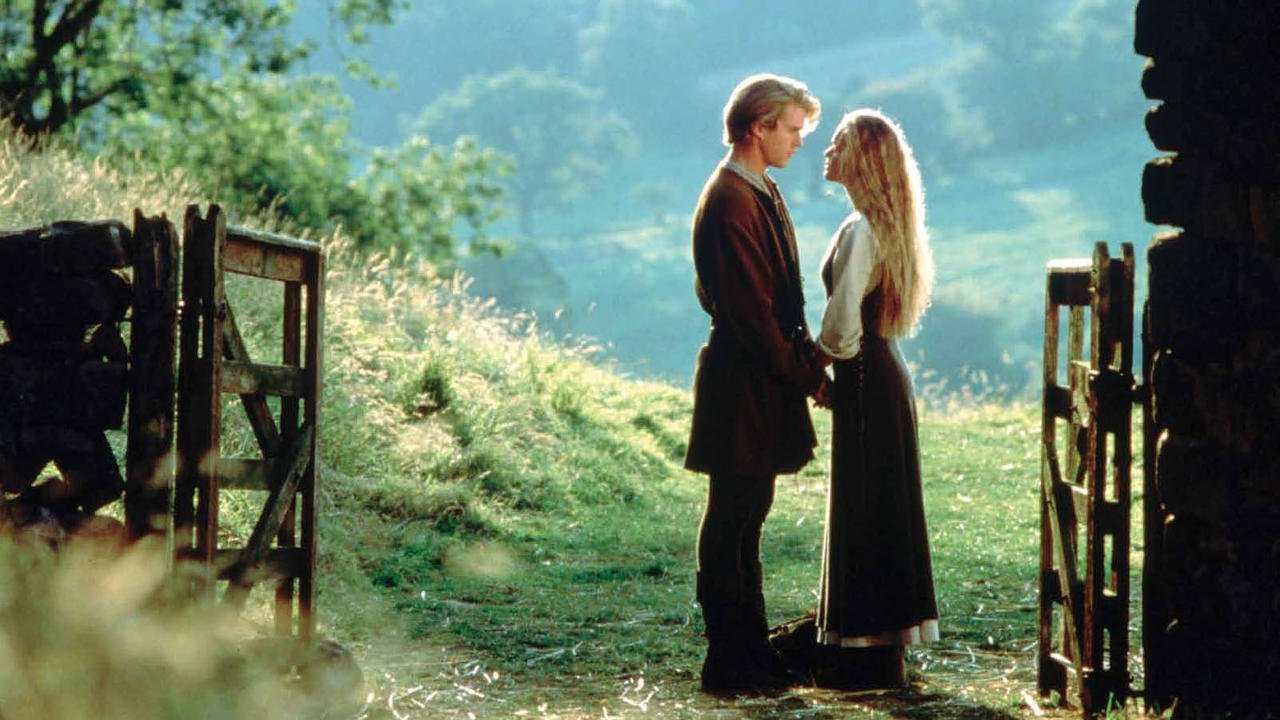
The nice thing about Rob Reiner’s friendly fairy tale adventure, with a script by William Goldman adapting his own novel, is how delicately it works in irony about its brand of make-believe without ever undermining the effectiveness of the fantasy. The framing device is a grandfather (Peter Falk) reading a favorite book aloud to his skeptical grandson (Fred Savage), and it’s the latter’s initial recalcitrance that the movie uses both as a challenge and as a safety net. In the imaginary kingdom of Florin, the beautiful Buttercup (Robin Wright) gets separated from the farmhand whom she loves (Cary Elwes) and betrothed to the evil Prince Humperdinck (Chris Sarandon), until the nefarious Vizzini (Wallace Shawn) sprints her away. The colorful characters and adventures that ensue are, at their best, like live-action equivalents to some of the Disney animated features, with lots of other fond Hollywood memories thrown in: Andre the Giant is like a cross between Andy Devine and Lumpjaw the Bear, while Mandy Patinkin’s engaging Inigo Montoya conjures up Gene Kelly in The Pirate. Every character, in fact, is something of a goofball, and while the film is inexplicably saddled with a PG rating, it delightfully cuts across age barriers to keep everyone charmed. Read more
My column for the March 2020 issue of Caimán Cuadernoas de Cine… — J.R.
Greasing the wheels of commerce is usually the chief reason for end-of-the-year movie polls, which, like the Academy Awards, only intensifies our ongoing cultural confusion of film criticism with advertising. This helps to explain why (and how) Harvey Weinstein became Janet Maslin’s favourite film critic in her 1999 Cannes coverage for the New York Times, devoting far more space to his (negative) opinions about the prizes than anyone else’s, including the jury’s. (The fact that his own films in the festival hadn’t won prizes was of course crucial.) Perhaps because the head of that jury was David Cronenberg, an intellectual, the need for anti-intellectual cultural arbiters to drown out such controversial choices was as pressing two decades ago as it is today. We all need to be told not once, but repeatedly, why Once Upon a Time…in Hollywood is more important to the state of our civilization, our lives, our senses, and even our ethics than Vitalina Varela, and whereas this sort of gatekeeping function was once reserved for the Times and its consumerist equivalents, today its counterparts have included, among others, Sight and Sound, Film Comment, the New York Review of Books, the London Review of Books, Cahiers du Cinéma, Positif, and, alas, even Caimán Cuadernos de Cine. Read more
An essay written for Toronto’s Cinematheque Ontario program guide (February 2007). –- J.R.
For better and for worse, and principally the latter, Jacques Rivette has been singled out as the former Cahiers du Cinema film critic who makes the least commercial films, as well as the longest ones. But for the record, the films of the always-neglected Luc Moullet [screened in Cinematheque Ontario’s Spring 2006 season –- ed.] are generally less commercial than those of Rivette. And even what we mean when we say “longest films” is open to some debate. (After all, the over twelve-hour OUT 1: NOLI ME TANGERE was conceived as a TV serial, and Jean-Luc Godard’s own first TV series, made a few years later, was just as long.)
The problem with such caricatures is they generally function as excuses for why some spectators won’t deal with Rivette’s films rather than as viable descriptions of what they offer. Yes, his features tend to be long and they work with duration. Furthermore, when two versions have been made of some of them –- unauthorized in the case of L’AMOUR FOU, authorized in the cases of L’AMOUR PAR TERRE and LA BELLE NOISEUSE/ DIVERTIMENTO – the longer version is almost always superior. Read more
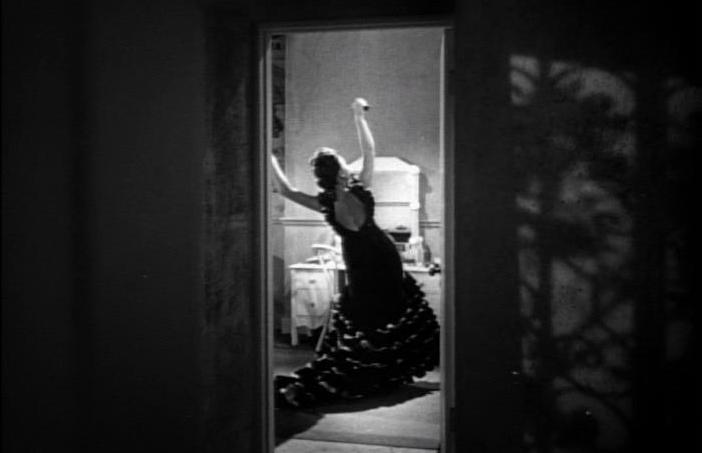
Rear Window, The Leopard Man [see first two photos above], Phantom Lady, The Window, The Bride Wore Black, Mississippi Mermaid. Considering that almost 30 features have been Cornell Woolrich adaptations, it seems a genuine anomaly that he should remain so shadowy a figure. He is as central to the thriller as Olaf Stapledon is to science fiction, and has been comparably eclipsed by a singularity that exceeds and surpasses some genre expectations while grievously falling short of certain others. Despite all the purple prose, tired rewrites, and preposterous plots that crop up in his fiction, perhaps no other writer handles suspense better, or gives it the same degree of obsessional intensity. More soft-boiled than hard-boiled in the depiction of his heroes and heroines, Woolrich nonetheless seems central to the overall pessimism of film noir in the violent contrasts of his moods and the dark tempers of his villains.
Webster’s New Collegiate gives three definitions of dreadful: “(1) (adjective) inspiring fear or awe, (2) (adjective) distressing, shocking; very distasteful, (3) (noun) a morbidly sensational story or periodical; as, a penny dreadful.” Woolrich assumes all these meanings and invents a few more of his own. Read more
Written for the Kino Lorber Blu-Ray of this film, released in September 2019. — J.R.
Let me start with a confession about the ways that both fashion and one’s age can affect one’s taste. My first acquaintance with writer-director Claude Sautet (1924-2000) came when I was a hippie and cinephile in my late 20s living in Paris in the early ‘70s, a follower of Cahiers du Cinéma in my viewing preferences more than a follower of its leading monthly competitor, Positif, although I usually purchased both magazines. Back then, Sautet’s The Things of Life (1970), and César and Rosalie (1972) struck me as the epitome of well-crafted, genteel yuppie navel gazing, especially for what I took to be their uncritical embrace of the upper middle class. He was clearly a skilled director of actors, but the overall whiff of his milieu seemed complacent to a fault. Consequently, I steered clear of his 1974 Vincent, Francois, Paul and the Others, one of his biggest hits, and when, five years later, back in the U.S., I wrote an article about Chantal Akerman, Jean-Luc Godard, and the team of Jean-Marie Straub and Danièle Huillet for the mainstream and middlebrow American Film, I was mortified when my editors condescendingly changed my title to “Jean-Luc, Chantal, Danièle, Jean-Marie, and the Others,” which led Akerman herself to reproach me for the piece, assuming that I’d dreamed up that title myself. Read more
From the March 2019 issue of Found Footage. — J.R.
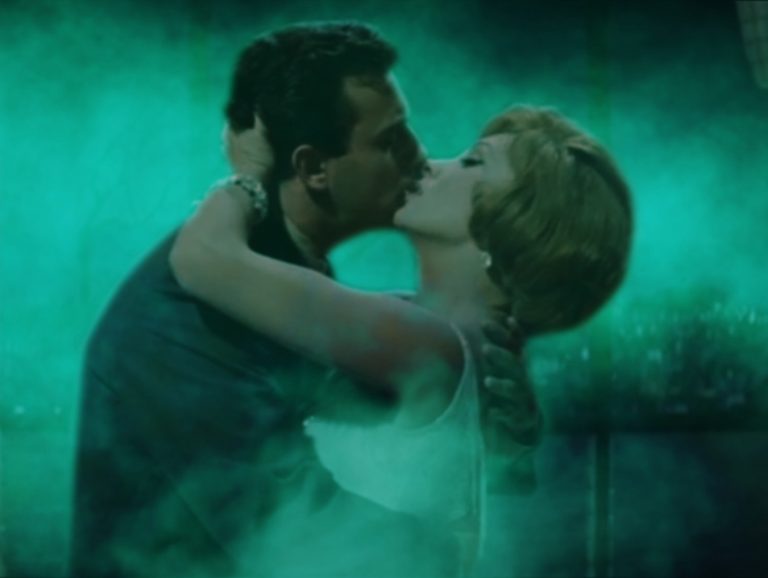
As a critical commentary on cinematic depictions of San Francisco, Guy Maddin’s The Green Fog, conventional match cuts that approximates Scotty’s tailing of Madeleine as various cars follow various other cars down assorted San Francisco streets, sometimes passing locations that are familiar from Vertigo or other movies, we’re getting the bare bones of thriller and mystery mechanics without any of the thrills or mysteries, in contradistinction to all the musical signals. And when we see Karl Malden enter a florist shop, and converse (again wordlessly) with the florist, it seems appropriate that the piece of paper that the florist shows to him shows us the green fog yet again, Maddin’s signifier of the genre’s rhetoric of mystification.
For some of the Hitchcock aficionados who helped to replace Citizen Kane with Vertigo in the last ten-best poll of Sight and Sound, the affectionate ridicule of The Green Fog may seem like an act of sacrilege, especially when we get a panoply of San Francisco cathedrals that are treated as interchangeably as all the cars and streets. But it might also be argued that Maddin’s apparent scorn is in fact a kind of impious critical appreciation for all the tricks of romantic mystification that he and Hitchcock have in common. Read more
This is a very short and very early article by Roland Barthes, one of his “Mythologies” that remains uncollected in English, that I translated in 1982, originally so it could be run with an article of mine, “Barthes & Film: 12 Suggestions,” that I published in Sight and Sound — although it wound up not appearing there due to a lack of space. (I did, however, use some extracts from it in an article I did for the same magazine two years later about Gentlemen Prefer Blondes; both of these articles are reprinted in my first collection, Placing Movies: The Practice of Film Criticism.) Many years later, in 1999, James Morrison asked me if he could post it on the Internet, and you can still access it, along with an essay of his about it,here. — J.R.
If, for lack of the proper technical background, I can’t define Henri Chrétien’s [anamorphic] process, at least I can judge its effects. They are, in my opinion, surprising. The broadening of the image to the dimensions of binocular vision should fatally transform the internal sensibility of the filmgoer. In what respect? The stretched-out frontality becomes almost circular; in other words, the ideal space of the great dramaturgies.
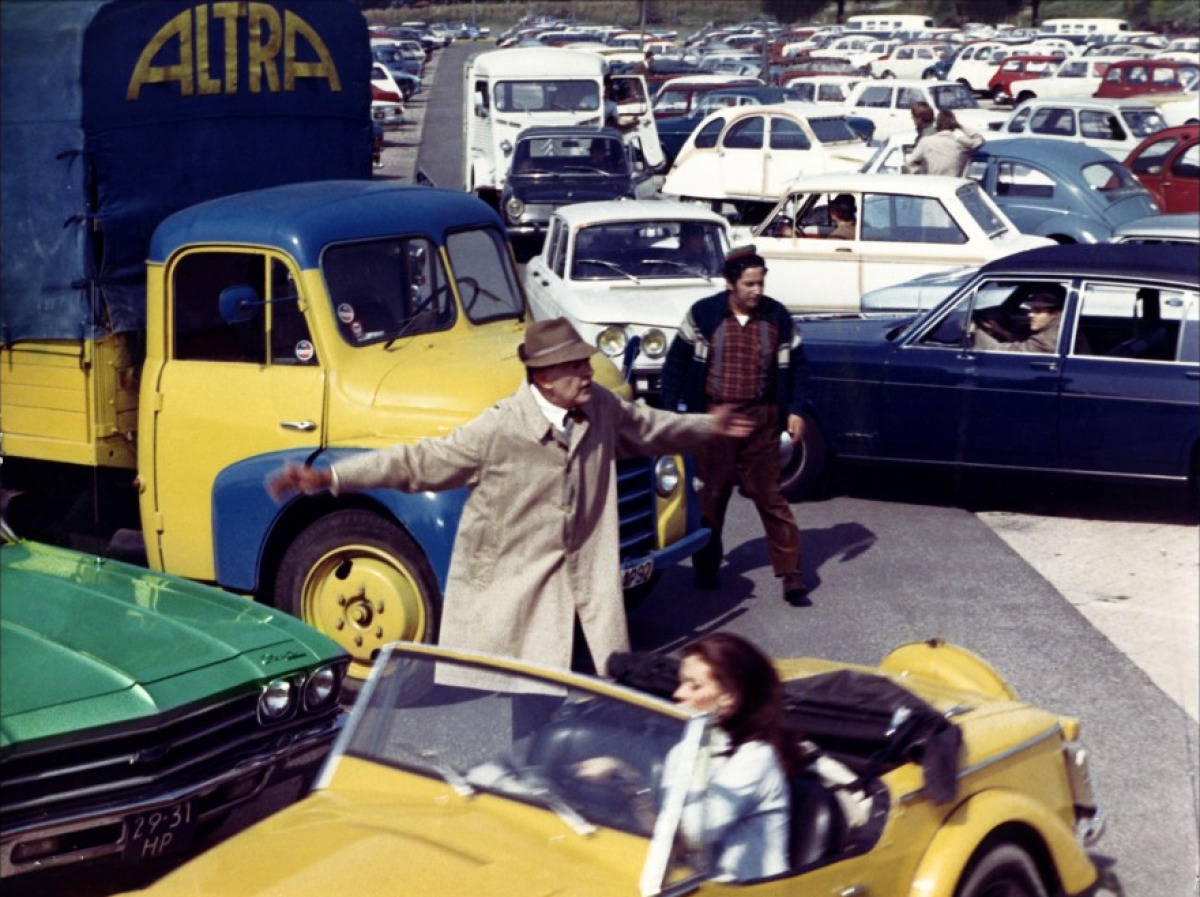
“On the basis of my intentions, Trafic could have been shot before PlayTime,” Tati said to me in late 1972, when I met him for the first time, only a couple of weeks before Trafic opened in the U.S. And the reason why he felt that way about his fifth feature was directly related to his most famous character, Monsieur Hulot.
As far as his own intentions were concerned, Hulot was a character he had invented strictly for the purposes of a single feature, Les Vacances de Monsieur Hulot. The main reason why he reappeared in Tati’s next three features was public demand. If it had been left up to Tati and his own inclinations, Hulot would have vanished after that one film, but the audience’s affection for that figure wouldn’t allow it; Hulot, after all, was better known and more familiar to the public than Tati himself was. So his creator reluctantly brought him back in Mon Oncle, and even gave him the title role a second time. But on this second occasion, one might say that Hulot existed again only as a function and contrast to the other characters — an eccentric relative of the Arpel family, and in some ways an alternative father figure for a little boy. Read more
Written for the Australian journal Screen Education 91 in 2018. — J.R.
What I say, I do not say with words. I do not say it with images either, with all due respect to the partisans of pure cinema, who would speak with images as a deaf-mute does with his hands. After all, I do not say, I show. I show people who move and speak. That is all I know how to do, but that is my true subject. The rest, I agree, is literature. – Éric Rohmer
The least typical film by central French New Wave figure Éric Rohmer, Perceval (1978) offers a wonderfully strange and evocative version of Chrétien de Troyes’ twelfth-century poem – set to music and translated into contemporary French by Rohmer himself – about the adventures of the title character (Fabrice Luchini), a callow and innocent youth who becomes the Red Knight. It captures the essence of its medieval trappings like no other film, yet it does so without ever presuming or pretending to re-create a historical period about which we know relatively little. Thus, it might be seen – and in fact was seen when it first appeared – as a bizarre exercise in literal literary adaptation, an odd experiment in representation itself. Read more