Jurors: Lorenzo Codelli, Alexander Horwath, Lucien Logette, Mark McElhatten, Paolo Mereghetti (chairman), and Jonathan Rosenbaum. (Although Mark McElhatten wasn’t able to attend the festival this year, he has continued to function as a very active member of the jury.)
1. BEST SPECIAL FEATURES:
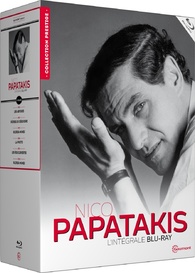
NICO PAPATAKIS BOX SET (France, 1963-1992) (Gaumont Vidéo, DVD)
A comprehensive and cogent presentation of a neglected filmmaker from Ethiopia and a singular cultural figure in postwar France who ran an existentialist cabaret, produced major films by Jean Genet and John Cassavetes, gave the German singer Nico her name, and made many striking films over four decades. (JR)
2. BEST DVD SERIES:
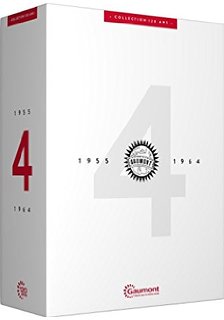
COLLECTION 120 ANS N.1 1885-1929 (France, 1885-1929) (Gaumont Vidéo, DVD)
To celebrate its 120 years of activity in the film industry, Gaumont has published a series of nine beautiful box sets that summarize the whole history of cinema. Divided by decades, the box sets consist of twenty to thirty-five DVDs with the most representative films marked with a daisy symbol. The editions include films made by Alice Guy, Louis Feuillade, Dreville, Duvivier, Gabin, Louis de Funès, Pialat and Deville but also masterpieces made by Losey, Fellini or Bergman that the French company co-produced. Read more
Written for the Pesaro International Film Festival (July 2016). Most of this piece is made up of earlier articles on the same general subject, so the reader should bear in mind that some of my positions and opinions (such as my estimation of Godard’s Histoire(s) du cinéma) have changed over the years. — J.R.
Criticism on Film
From Sight and Sound (Winter 1990/91):
It’s no secret that serious film criticism in print has become an increasingly scarce commodity, while ‘entertainment news’, bite-size reviewing and other forms of promotion in the media have been steadily expanding. (I’m not including academic film criticism, a burgeoning if relatively sealed-off field which has developed a rhetoric and tradition of its own — the principal focus of David Bordwell’s fascinating bookMaking Meaning). But the existence of serious film commentary on film, while seldom discussed as an autonomous entity, has been steadily growing, and in some cases supplanting the sort of work which used to appear only in print.
I am not thinking of the countless talking-head ‘documentaries’ about current features — actually extended promos financed by the studios or production companies — which include even such a relatively distinguished example as Chris Marker’s AK (1985), about the making of Kurosawa’sRan. Read more
Although Jacques Rivette was the first of the Cahiers du Cinéma critics to embark on filmmaking, he differed from his colleagues—Claude Chabrol, Jean-Luc Godard, Eric Rohmer, François Truffaut—in remaining a cult figure rather than an arthouse staple. His career was hampered by various false starts, delays, and interruptions, and then it abruptly ended in 2009 with the onset of Alzheimer’s disease, six years before his recent death. But his legacy is immense.
His career can easily be divided into two parts, although it’s not so easy to pinpoint a precise dividing line between them. And for those who knew him well or even casually, as I did, it’s hard to prefer the first portion to the second without feeling somewhat guilty.
Common to both parts is a preoccupation with mise-en-scèneand the mysterious aspects of collective work, offset by the more solitary and dictatorial tasks of plotting and editing. Rivette’s own collective work was frequently enhanced by improvisation—with actors, with onscreen or offscreen musicians, or with dialogue written just prior to shooting (either by actors or screenwriters)—while the more solitary work of plotting and editing emulated the Godardian paradigm of converting chance into destiny. Read more
The following interview with Alessandro Stellino appeared, in Italian, in filmidee #15, along with Italian translations of three of my essays –- “Entertainment as Oppression,” “In Defense of Non-Masterpieces,” and “Work and Play in the House of Fiction”. What follows is an imperfect and approximate version of this interview in its original English — respecting the structure of the Italian version, although in a few cases reconstructing my answers when I managed to lose the original emails. The interview was conducted over many emails, and I brought it to a close when I declined to reply to the question, “If you could teach a course on film history with the most possible freedom in rewriting the canon, how would your program be?”, which effectively would have obliged me to create an entire syllabus. -– J.R.
In the introduction to Goodbye Cinema, Hello Cinephilia, a book that has been particularly relevant for the founding of our magazine, you state: “It’s a strange paradox that about half of my friends and colleagues think that we’re currently approaching the end of cinema as an art form and the end of film criticism as a serious activity, while the other half believe that we’re enjoying some form of exciting resurgence and renaissance in both areas”. Read more
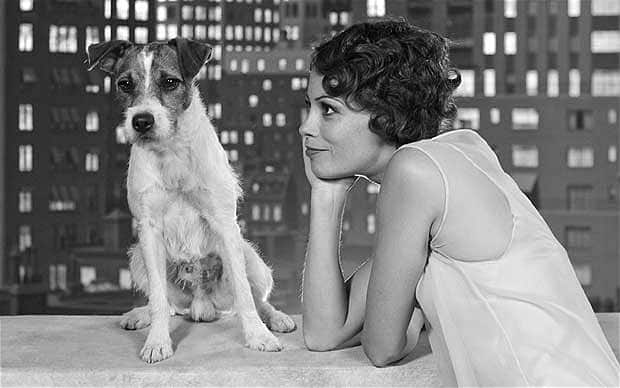
Okay, even though I’ve refused to place The Artist on any of my lists of end-of-the-year favorites, I’ve just finished reseeing it, and I have to admit that if I were a member of the Academy and could offer write-ins, Uggie the dog would be somewhere near the top.
Let’s be frank: we all have different thresholds when it comes to shameless bids for our affection, and these thresholds are invariably matters of taste. While I haven’t been able to forgive The Artist for pilfering and then brandishing a sizable chunk of Bernard Herrmann’s Vertigo score near its closing stretches to impart a sense of tragedy — even after I’ve forgiven Michel Hazanavicius for all his other outrageous breaches of period and silent movie syntax (in short, his diverse and mutifaceted ahistorical outrages), not to mention his abject appropriations of diverse narrative chunks from Singin’ in the Rain, A Star is Born, and Citizen Kane — I’m still periodically won over by some of his audiovisual ideas as acts of audacity and stylistic flourishes in their own right.
Above all, I’m flabbergasted by the performance of Uggie the dog, mutt extraordinaire, which has got to be one of the best canine turns in the history of cinema. Read more
The following was written as my second planned monthly column for the Chicago Reader, after the first of these (https://chicagoreader.com/film-tv/moving-places/against-targeting-advertising-language-trump/) ran in their March issue. The paper decided it wasn’t currently equipped to handle editing articles by freelancers so they paid me for this piece but decided not to run it or to run any future columns of mine, at least for the time being. They also emphasized that they would be open to future “pitches” of mine, assuming that I would want to offer any.
I’m posting this column in two parts.
— J.R.
To speak about cinema is to not be alone. It is being in society, but in a congenial manner, with companions who have had an experience similar to yours — not identical, but similar, and this, precisely, is what makes conversation possible. [André] Bazin said over and over that he much preferred leading a ciné-club discussion to writing a film review. Jacques Aumont
Does film criticism still exist? Ask people my age or thereabouts (I’ve just turned 83) and they will probably say no. Certainly the number of reviewers who’ve lost their jobs in recent years suggests a profession in its death throes.Read more
A contemporary western with political overtones and acerbic gallows humor, Tommy Lee Jones’s first theatrical feature as director (2005) is impressive. Inspired by the unpunished 1997 killing of 18-year-old Ezequiel Hernandez Jr., the script by Guillermo Arriaga (Amores Perros) concerns the accidental and unpunished shooting of the title character, a Mexican ranch hand (Julio Cesar Cedillo) working in west Texas. Jones plays the ranch hand’s foreman and friend, who kidnaps the border patrolman responsible (Barry Pepper) and drags him and Estrada’s corpse across the border, determined to fulfill his friend’s wish to be buried in his remote hometown. A very capable piece of storytelling, clearly showing the influence of Sam Peckinpah and beautifully shot in ‘Scope by Chris Menges, this recaptures some of the grandeur of the classic western while adding modernist and absurdist ironies. With Dwight Yoakam, January Jones, and Melissa Leo. R, 121 min. Reviewed this week in Section 1. Century 12 and CineArts 6, Landmark’s Century Centre, River East 21. Read more
Pretty Woman proved that the Disney peopleor Julia Roberts’s smilecould sell just about anything, including a misogynistic celebration of big business and prostitution. This romantic comedy from Paramount (1999, 116 min.), which reunites Roberts and Richard Gere with director Garry Marshall, presumes we’re so ready to love them all over again that we’ll accept the characters’ sudden shift from loathing to doting when Marshall says abracadabra. But I wonder. Gere plays a male-chauvinist New York newspaper columnist who ridicules Roberts’s character for her habit of backing out of weddings at the last minute; when he’s fired for flubbing some facts he hunts her down in rural Maryland to write one more story. And guess what? Maybe writers Josann McGibbon and Sara Parriott were thinking of Tracy and Hepburnassuming they were thinking of anythingbut not even Roberts’s smile can put this one over. With Hector Elizondo, Joan Cusack, Rita Wilson, and Paul Dooley. (JR) Read more
Written for the Japanese literary magazine Eureka‘s special issue devoted to Shigehiko Hasumi in early 2017. — J.R.
14 December 2016
Dear Shigehiko,
I’m indebted to you for a good many things, including my very first visit to Japan. This was eighteen years ago, in December 1998, to participate in a panel about Ozu that you organized for Shochiko in Tokyo, significantly titled “Yasujiro Ozu in the World,” along with Jean Douchet, Hou Hsiao-hsien, Thierry Jousse, and Tien-wen Chu. Undoubtedly the most luminous moment of that event for me was being approached in the lobby immediately afterwards by an elderly gentleman who spoke in Japanese to Hou and myself, shook our hands, and then walked away — a puzzling encounter that immediately (and appropriately) became explained to me via mime, as soon as Hou imitated for me the signature comic gesture of Tomio “Tokkankozo” Aoki, the younger son in I Was Born,But… — thus identifying the child actor discovered by Ozu who went on to enjoy a screen career that would eventually last seventy-five years, encompassing even Suzuki’s Pistol Opera. All of which made up for the disturbing fact that apparently none of the film students I spoke with at Tokyo University had seen any of Ozu’s silent films, even though all of the surviving ones were available on VHS. Read more
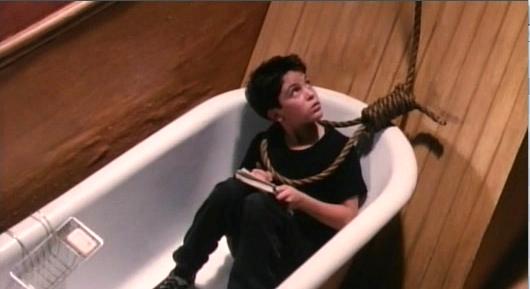
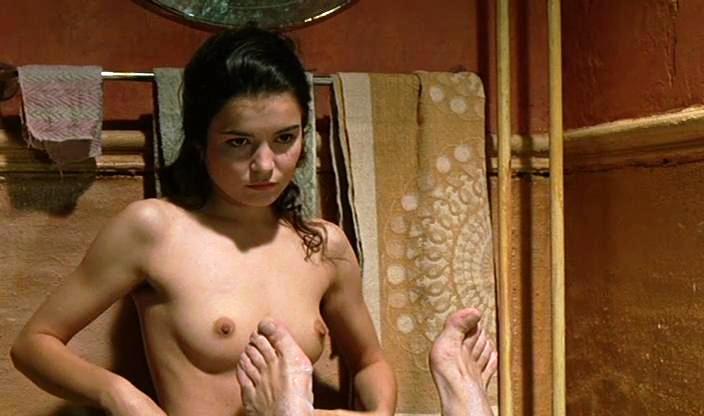
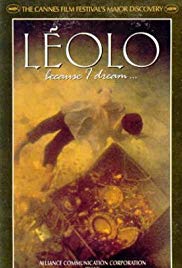
A conclusive demonstration that it’s possible to speak French, be obsessed with excretion, vomit, masturbation, obesity, and broken noses, treat the viewer to glimpses of a dead dog, dead flies, and an abused cat, and still not have an ounce of poetry in your soul. But if you’re sufficiently cowed by the relentless will to poetry of French Canadian filmmaker Jean-Claude Lauzon (Night Zoo), you may wind up acceding to his self-definition if only through exhaustion; once you’ve learned to expect the unexpected and unpleasant you won’t find much to keep you interested in this 1992 look at the fantasies of a 12-year-old boy (Maxime Collin) as recalled by his offscreen narrating adult counterpart (Gilbert Sicotte). The fantasies include the boy and his grandfather trying to murder each other and the boy’s descent from a Sicilian tomato sprayed with sperm. Maybe if you’re in the right frame of mind you’ll find the spirited ugliness and cruelty enjoyable for its audacity; I couldn’t wait for the damn thing to be over. (JR)
A surprising consequence of my posting “My 25 Favorite Films of the 2000s (so far)” on this site on June 21 was that visits to my site suddenly quadrupled, going from about a thousand per day to well over 4,000. This was encouraging — and for me a good response to Robert Koehler’s charge that such list-making was pointless (because the need for viewing suggestions in a context where there are too many choices strikes me — and apparently many others — as self-evident).
Yet the haste with which I put together my original list also led to some subsequent second thoughts and demurrals. So with this in mind, I’ve come up with a new list of 50 instead of 25, substituting one title in the original list after my friend Janet Bergstrom persuaded me that Chantal Akerman’s From the Other Side was a much worthier example of Akerman’s work than Down There (which I’d listed partially as a provocation, without a sufficient amount of reflection). As with my original list of titles, I’ve stuck to the same rule of including only one film by each filmmaker, and the order is alphabetical. And again, with very few exceptions (e.g., Read more
An Iranian tearjerker about an eight-year-old blind boy whose father, a widowed coal worker, belatedly collects him from a school for the blind in Tehran, takes him to the family farm, and then tries to send him to become an apprentice. I haven’t seen any earlier films by Majid Majidi, director of the Oscar-nominated Children of Heaven, but if this 1999 drama is any indication, he’s an utterly conventional sentimental humanist, providing better-than-average storytelling skills, an eye for landscapes that would make him a pretty good calendar artist, but none of the challenges offered by Kiarostami or Makhmalbaf. If you aren’t looking for anything of artistic or social interest but are nonetheless attracted by Iranian cinema’s relative lack of obvious cynicism, this may be just what the doctor ordereda Middle Eastern counterpart to Disney or Spielberg. In Farsi with subtitles. 90 min. (JR) Read more