From the Chicago Reader (October 26, 1987). — J.R.
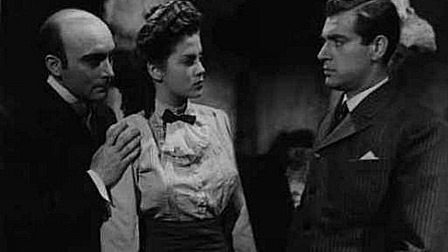
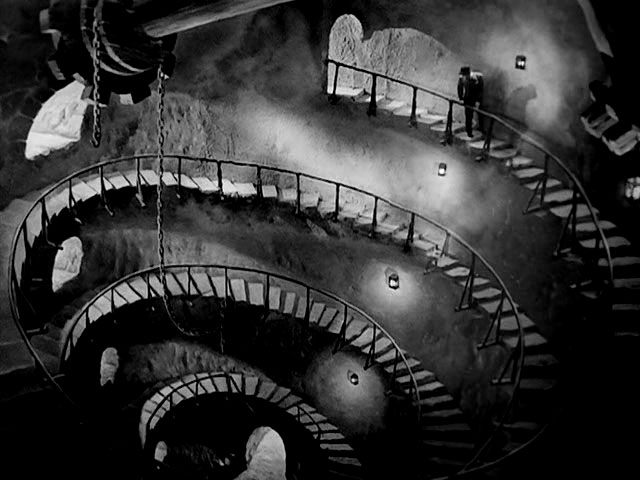
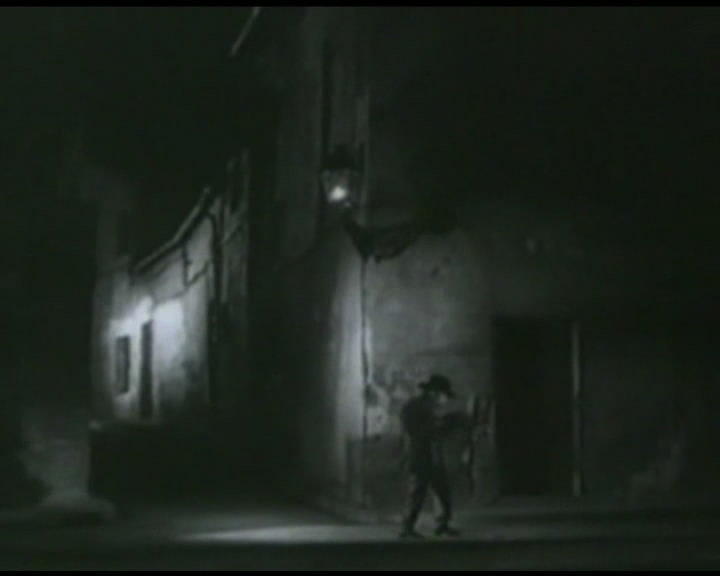
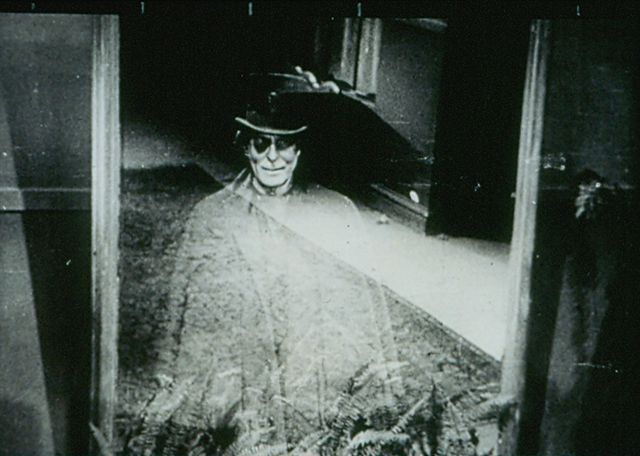
Edgar Neville — an aristocratic Republican filmmaker and writer who was friends with everyone from Lorca and Chaplin to Ortega y Gasset and Lacan — is one of the great undiscovered auteurs of the Spanish cinema. This remarkable turn-of-the-century fantasy, which suggests an eerie encounter between the tales of Borges and the early melodramas of Feuillade and Lang, starts off as a supernatural mystery as the hero (Antonio Casal) is persuaded by a one-eyed ghost to solve the case of his murder. This leads him first to the ghost’s niece (Isabel de Pomes) and eventually to a hidden underground city beneath the old section of Madrid that contains an ancient synagogue and is presided over by hunchbacked counterfeiters. Based on a novel by Emilio Carrere, this hallucinatory fiction ends rather abruptly and never manages to account for all the mysteries it uncovers, but as pure, primal storytelling it is as creepy a spellbinder as one could wish for (1944). (JR)
On November 27, 2017 I received the following email, sent from Spain:
You refer to Edgar Neville in your online review of TOWER OF THE SEVEN HUNCHBACKS as a “Republican”. He was actually one of the other guys, if you know what I mean.
Written in November 2017 for my “En movimiento” column in Caimán Cuadernos de Cine. — J.R.
En movimiento: The Crimes of Harvey Weinstein
Although we routinely assume that social trends have a rational basis, the processes by which irrational forms of displacement also affect those trends are no less routinely ignored. For instance, it’s commonly thought that the Watergate scandal leading to Richard Nixon’s resignation as U.S. President was merely a matter of exposing his crimes, but it could also be argued that many of these crimes were already evident to U.S. citizens before Nixon won his last Presidential election. As Mary McCarthy would later theorize, it was because the public needed a scapegoat for the U.S. debacle in Vietnam that the Watergate crimes belatedly became important. And one might similarly theorize that the recent public exposure and condemnation of producer-distributor Harvey Weinstein as a sexual predator, which has led to many similar exposures of predatory sexual behavior by others in the film world (such as James Toback and Kevin Spacey) as well as in separate fields, has been a displaced response to the debacle of Donald Trump’s Presidency, not to mention his own primitive sexual politics, which were exposed by the release of a private tape during the Presidential campaign. Read more
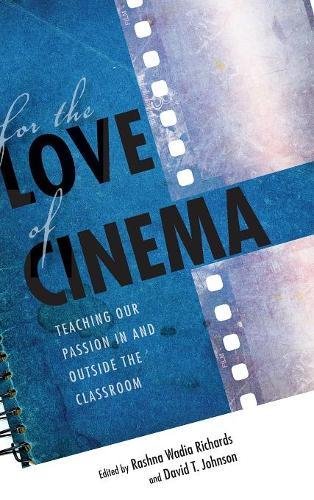
For the Love of Cinema: Teaching Our Passion In and Outside the Classroom. Edited by Rashna Wadia Richards and David T. Johnson. Bloomington: Indiana University Press, 2017. 244 pp., illus. Hardcover: $80.00 and Paperback: $32.00.
As a cinephile who periodically teaches film courses, I might be considered an ideal reader of this collection of essays, but in fact I’m not. In order to fully qualify, I’d also have to be an academic. Being a confirmed outsider to that world, however, without the sort of degrees to ensure my survival there, I have to approach this volume more as a scavenger, looking for what I think I can use, rather than as a member of the particular community that this book addresses, someone speaking their language and sharing their issues. More specifically, my best and most recent teaching experience has been four two-week stints at Béla Tarr’s Film Factory between 2013 and 2015, when the academic Sarajevo Film Academy still allowed it to function and before it withdrew its financial support for a school, as well as a training ground and production facility for young filmmakers. At the Film Factory, cinephilia was most often a given rather than a desired condition to be generated or propagated, and films more than grades or diplomas were the desired objectives. Read more
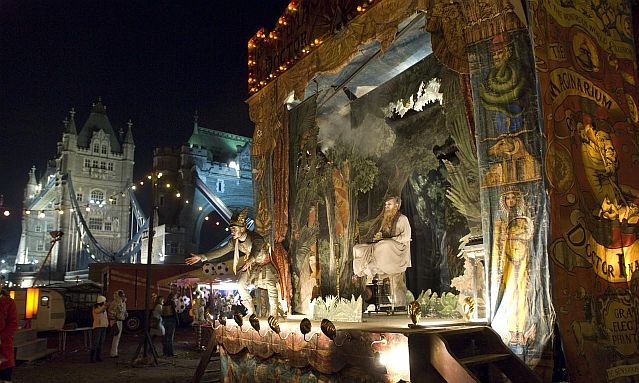
The following review of Lost in La Mancha appeared in the February 21, 2003 issue of the Chicago Reader. Seeing the newer Terry Gilliam film, The Imaginarium of Dr. Parnassus (see above), last Saturday (November 7), on my last evening in St.. Andrews, Scotland, I was sufficiently blown away by the visual invention and surrealist imagination on display here to rethink some of my estimation of his films. (The film wouldn’t open in the U.S. until Christmas, but I was told that it was already something of a monster hit in Europe.) Even though I couldn’t always follow what was going on in terms of plot (probably my fault more than the film’s), the way Gilliam solved the seemingly insoluble problems posed by the death of Heath Ledger in the middle of shooting — arriving at a form of multiple casting (see below) that I’ve formerly associated mainly with experimental filmmakers such as Yvonne Rainer — is only one example of his nonstop ingenuity. I was also impressed by both his digital mastery and his arsenal of references — including The 5,000 Fingers of Dr. T., which I believe he quotes from in one image of the hero climbing a ladder that rises into seeming infinity.Read more
My column for the Spring 2017 issue of Cinema Scope. –– J.R.
Probably the most important DVD release of last year, inexplicably overlooked by me when I made out my lists for Sight and Sound and DVD Beaver, is Josef von Sternberg: The Salvation Hunters (1925) and The Case of Lena Smith (fragment, 1929), a single all-region disc from www.edition-filmmuseum.com for 19.95 Euros. It includes a wonderful new 32-minute audiovisual essay on The Salvation Hunters by Janet Bergstrom, and a new score to Sternberg’s first feature by Siegfried Friedrich, but the real pièce de résistance here is the dazzling four-minute fragment from the otherwise lost The Case of Lena Smith, discovered by Japanese film historian Komatsu Hiroshi in a Chinese junk shop in Dalian in 2003. (See the Filmmuseum’s exhaustive 2007 book about The Case of Lena Smith for more details.) In Edgardo Cozarinsky’s 1995 Citizen Langlois, Langlois’ companion Mary Meerson is quoted as saying, “TheCase of Lena Smith will reappear one day when mankind deserves it.” In the meantime, here is a fragrant glimpse of what undeserving mankind is missing.
Although most of the recent Blu-Ray releases of Olive Films have tended to steer clear of their previous auteurist commitments, Otto Preminger’s underrated if sometimes problematic 1969 Tell Me That You Love Me, Junie Moon is a very welcome exception.Read more
How we evaluate films obviously depends on how we watch them. Some viewers identify with one or more characters, and others identify with one or more artists who made the film. Recalling three recent Chicago moviegoing experiences — Erich von Stroheim’s silent Queen Kelly (1929) at the Siskel, Noah Baumbach’s Jay Kelly at Webster Place, and The Enchanted Cottage (1945) on TCM — I realize that they all depended on my selected vantage points.
Stroheim, a Viennese middle-class Jew and army deserter, became a Jew in hiding once he entered the U.S., persuaded almost everybody that he had an aristocratic background, and became a devout Catholic. Because “Kelly” signifies “Irish”—another non-aristocratic outsider identity –the very title Queen Kelly points to Stroheim’s secret self as a writer-director and sometimes as a lead actor. In his Foolish Wives (1922), he hid in plain sight by playing a swindler pretending to be an aristocrat, and in Greed (1924), where he didn’t appear as an actor, he was again praised for his fanatically detailed Naturalism, this time related to working-class Americans. Yet by the time he wrote and directed Queen Kelly — a delirious fantasy set in a mythical kingdom about a convent student named Kitty Kelly (Gloria Swanson) abducted by a playboy prince (Walter Byron) the night before he’s been ordered to marry an insanely jealous queen (Seena Owen) — Stroheim has abandoned Naturalism for a kind of crazed Catholic pornography that seems to double as a nightmarish personal psychodrama in which he identifies obsessively with all his characters, victims and predators alike.Read more
Recently reseeing George Cukor’s scandalously neglected Travels with My Aunt (1972) helps to clarify how central self-images and sensual discoveries are to his best as well as his most personal films. Travels with My Aunt isn’t on the same level as Sylvia Scarlett (1935), A Star is Born (1954), and Bhowani Junction (1955), probably my favorites, but it often seems just as personal, and it does have some of the superbly intricate and dispersed ‘Scope compositions that one often finds in the latter two, as well as in Les Girls (1957) and Let’s Make Love (1960), with their own mottled lighting schemes.
(Too bad that Les Girls, also recently reseen, is so unpleasant apart from its choreography and compositions. All the characters are monstrous and the plot is absurd. Why does the Rashomon theme, both here and in Kurosawa’s Rashomon, depend mainly on odious people and motives — unlike Jarmusch’s Ghost Dog, which uses a modified version of the same theme and is much kinder to its characters?)
Travels with My Aunt can also be read as a kind of response to the free-wheeling 60s and early 70s, much as Sylvia Scarlett celebrated certain aspects of the free-wheeling and footloose 30s. Read more
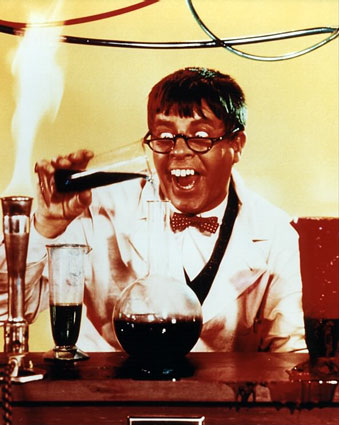
“Why are the French so crazy about Jerry Lewis?” is a recurring question posed by film buffs in the United States, but, sad to say, it is almost invariably asked rhetorically. When Dick Cavett tried it out several years ago on Jean-Luc Godard, one of Lewis’s biggest defenders, it quickly became apparent that Cavett had no interest in hearing an answer, and he immediately changed the subject as soon as Godard began to provide one. Nevertheless it’s a question worth posing seriously, along with a few related ones — even at the risk of courting disbelief and giving offense.
Why are American intellectuals so contemptuous of Jerry Lewis and so crazy about Woody Allen? Apart from such obvious differences as the fact that Allen cites Kierkegaard and Lewis doesn’t, what is it that gives Allen such an exalted cultural status in this country, and Lewis virtually no cultural status at all? (Charlie Chaplin cited Schopenhauer in MONSIEUR VERDOUX, but surely that isn’t the reason why we continue to honor him.) Read more
I’ve spent most of my life in search of communities I can join without compunction—decidedly not the small town in Alabama where I grew up, and at most only two of the schools I chose to attend as a student: Highlander Folk School in Tennessee (summer 1961), cradle of the civil rights movement in the U.S., and Bard College in New York (1962-66), where my professional and vocational involvements in film and literature took shape. But the only such community that I was invited to join, as a teacher, was film.factory in Sarajevo (over four two-week periods, 2013-2015), and this was entirely due to Béla Tarr (1955-2026), a Hungarian filmmaker I discovered in Chicago via Almanac of Fall (1984) and Damnation (1988) in 1990, who became a friend around the time of the international premiere of Sátántangó (1994). I had been on the New York Film Festival’s selection committee that had chosen the film, had arranged for its showing at the Chicago International Film Festival as a “critic’s choice” of mine, and had found its first American distributor. (I copied my own video of the film and sent this copy to my friend Rob Tregenza, a remarkable filmmaker and cinematographer who ran Cinema Parallel—a small company that distributed films by Godard and Haneke, among others—correctly guessing that he would want to distribute Sátántangó.)Read more
Here is another one of my Paris Journals for Film Comment — the first one, I believe, after the magazine shifted from being a quarterly to a bimonthly publication. Once again, I think part of the reason for reproducing this now is its value as a period piece.
2019: A fascinating footnote about Solntseva: at a film festival in Spain a few years ago, Sergei Loznitsa told me that thanks to an opening of some of the KGB’s old files for public scrutiny, it was revealed that she had been a longtime member. Most of us know far too little about the Russian and Soviet past to begin to understand the reasons for this, but it seems possible that Solntseva may have actually joined the KGB in order to help protect her Ukrainian husband, who was reportedly under Soviet surveillance for most of his life. It does help to explain, in any case, how, after Dovzhenko failed to get so many of his own personal projects like Desna produced, Solntseva was able to direct three of them with lavish budgets and immense technical resources after his death.
For a link toThe Enchanted Desnawith English subtitles,
From the July-August 2005 issue (NLR 34) of New Left Review.
An English translation of the first Daney collection cited below came out this year. — J.R.
Serge Daney, La Maison cinéma et le monde, Volume 1: Le Temps des Cahiers, 1962-1981
P. O. L.: Paris 2001
Serge Daney, La Maison cinéma et le monde, Volume 2: Les années Libé, 1981-1985
P. O. L.: Paris 2002
We could postulate three periods for the extraordinary flourishing of film culture brought about by the French New Wave: Before, During and After. André Bazin, of course, epitomized the first, as a founding editor of the Cahiers du Cinéma in 1951, a crucial contributor to auteur theory, and champion of postwar American films and Italian neo-realism against a stale French ‘quality cinema’. The Young Turks whom Bazin nurtured at the Cahiers — Jean-Luc Godard, Jacques Rivette, Claude Chabrol, Eric Rohmer, François Truffaut, and the somewhat younger Luc Moullet — mainly defined the second period: teenage iconoclasts who picked up the camera to become the stellar practitioners of the following decades.
Serge Daney (1944–92), who started out as a disciple of the New Wave crowd and described himself as a Bazinian early on, stands as the most original commentator of the third period, which he helped to usher in and continued to redefine up until his death from aids in 1992.
It’s disconcerting that the collected writings in English of one of the world’s greatest filmmakers currently sells for $852 on Amazon — or a whopping $980, if you opt for the paperback — while the only American book about him downgrades his work’s artistic value in its very title (Vance Kepley’s 1985 In the Service of the State: The Cinema of Alexander Dovzhenko). Look him up on Wikipedia, and you find that his name is shared by a poker player and a psychiatrist — hardly fit company for the epic, poetic Alexander Dovzhenko (1894-1956), a pagan mystic whose masterful films look as wildly experimental, as dreamlike, as hysterically funny, as fiercely tragic, and as beautiful today as they did a century ago.
A Cold War casualty, often defined in the West as a Russian Communist and in Russia as a turncoat, this Ukrainian nationalist lived under KGB surveillance for most of his life — which may help to explain why his devoted second wife Julia Solntseva, who filmed many of his unrealized scripts after his death, had joined the KGB herself, possibly in order to protect her husband. And as one of his better Western explicators, Ray Uzwyshyn, has pointed out, “With regard to the non-Russian republics (i.e. Read more
Whether you like this or not — and it’s quite possible that you won’t — this has got to be one of the weirdest and most original movies around. Written and directed by former film critic and scriptwriter-turned-director Paul Mayersberg (The Man Who Fell to Earth), whose previous solo feature never hit these shores, this is produced by Julie Corman, wife of Roger, and harks back to a lot of 60s Corman productions in various ways, for better and for worse; it also may be the first U.S. exploitation film to show the influence of Raul Ruiz in its striking use of colors and color filters, and Jasper Johns springs to mind in relation to some of the set painting. Mayersberg’s starting point and putative focus is Isaac Asimov’s famous SF story, set on the planet Lagash, where it is always daylight, shortly before its civilization collapses; David Birney, Sarah Douglas, Andra Mylian, and Alexis Kanner head the cast, and much of the action and decor reflect a series of interesting solutions for representing an alien culture as cheaply as possible. If you’re looking for something different, make sure to catch this oddity. Read more
American Masters: Mike Nichols (Elaine May). The only film on my list by an old master — hence the only one not concerned to some degree with the morality of solipsism — this TV documentary, like May’s four previous fiction features, shows an exquisite balance between personal appreciation and criticism, which is another way of saying that her films are populated exclusively by monsters whom she adores. (Note: This was erroneously listed here as Becoming Mike Nichols until Adrian Martin alerted me to the error. My apologies to everyone!)
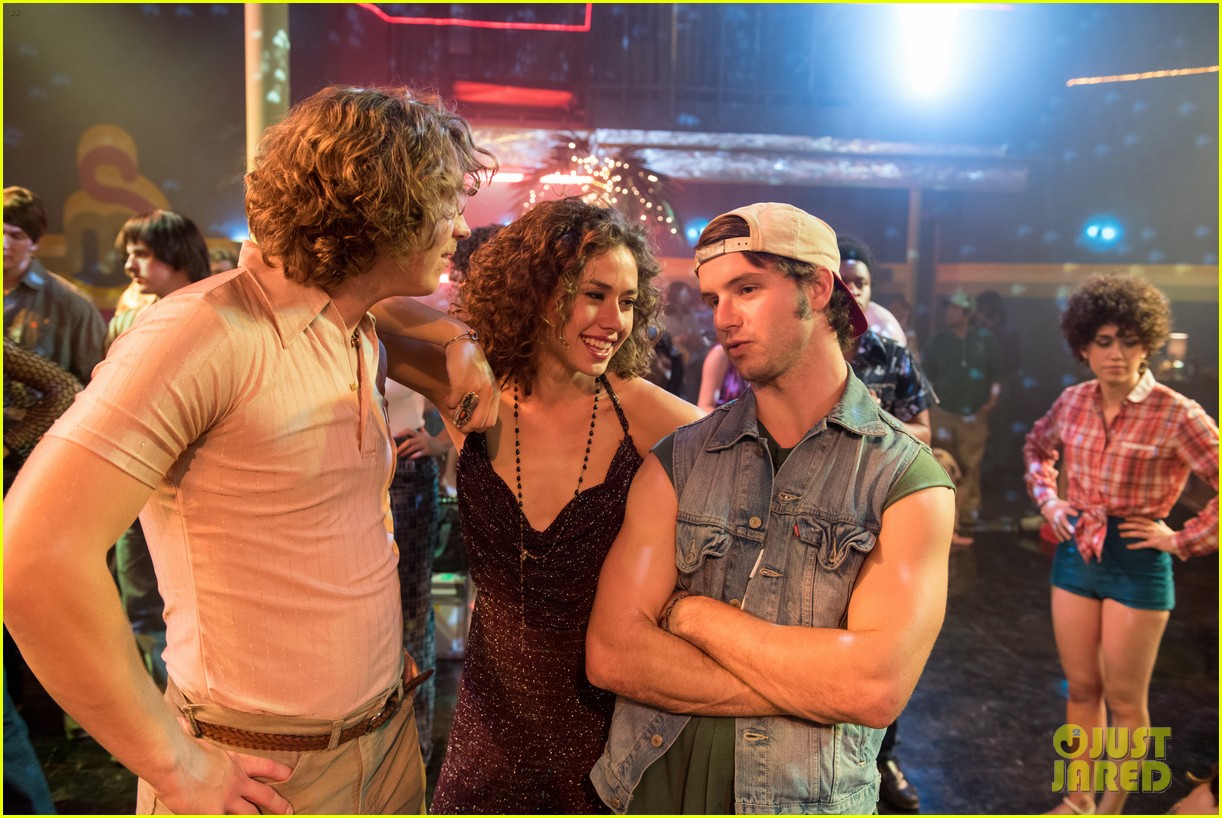
Everybody Wants Some!! (Richard Linklater). If that second exclamation point seems immoderate, this is Linklater’s very Texan way of informing us that immoderation is something to be celebrated, even from a moderate point of view.
Fire at Sea/Fuocoammare (GianfrancoRosi). Like La La Land, I caught up with this too late to have included it on my end-of-the-year lists for Film Comment, Indiewire, and Sight and Sound, which also suggests I’m still in the process of sizing it up. The coexistence of everydayness and disaster on a Sicilian island is what makes this Italian documentary seem most contemporary.