Program notes for this double feature at Manhattan’s Public Theater, March 8-13, 1983. A few of the arguments here, such as the comparison of Driver with Straub, strike me now as forced, but when I recall that students in the Downtown Whitney program during the same period compared You Are Not I abusively to The Twilight Zone (and were equally reluctant to regard John Ford as a serious artist when Straub praised him), I think my polemics were warranted….A happy postscript: both films are now available in excellent digital restorations (see below). -– J.R.
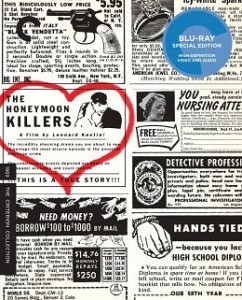
Slow yet relentless in their narrative progressions, deliberately nonspecific in their period settings, and equally unimaginable in anything but black and white, YOU ARE NOT I (1981) and THE HONEYMOON KILLERS (1969) are both startling and achieved first films about the triumphs of inexorable wills — each made with a kind of rigor and passion that seem oblivious to the whims of fashion. Small wonder that François Truffaut should be enthusiastic about the earlier film, with its accelerating montage of breathless love letters, its flighty camera movements and implacable bursts of Mahler; or that Jean-Marie Straub should be enthusiastic about the later one (“I liked your film ten times better than Roger Corman’s Edgar Allen Poe movies”), with its integral use of dialectics in conception and treatment alike. Read more
A program note for the 1997 San Francisco International Film Festival. — J.R.
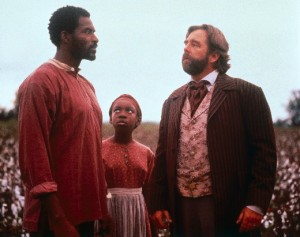
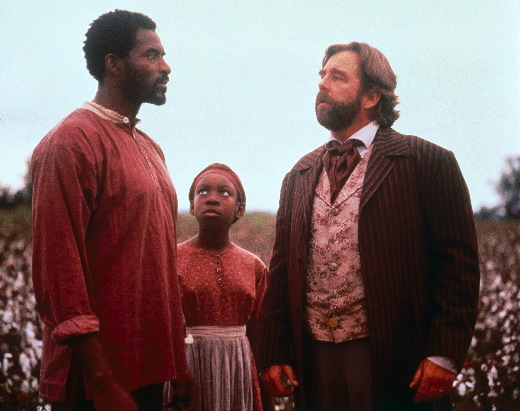
In this intense drama of courage and humanity in the face of the brutality of slavery, a plantation slave named Nightjohn (Carl Lumblv) defies the law by teaching another slave, a l2-year-old girl named Sammy (Allison Jones), how to read and write. The only other slave on the plantation who even knows the alphabet had a thumb and forefinger chopped off as punishment. Working with a theme akin to that of Ray Bradbury’s novel (and François Truffaut’s film) Fahrenheit 451 — though it’s given a substantially different edge by being set in the past rather than the future — Nightjohn views illiteracy as a central adjunct of slavery. The film isn’t merely a history lesson about people who lived some 165 years ago but a story with immediate relevance. Part of what’s so wonderful about it is its use of fairy-tale feeling to focus on real-life issues, not to evade or obfuscate them. Nightjohn’s ambience is placed at the service of myth — myth that embodies a lucid understanding of both slavery and literacy. Sammy and Nightjohn may sometimes come across as superhuman, but the world they inhabit and seek to change is in no sense fanciful. Read more
From the Chicago Reader (January 12, 1990). — J.R.
American TV watchers, eat your hearts out! These four selections from “Ten to Eleven” — a series of short, experimental “essay” films made for German television by the remarkable German filmmaker Alexander Kluge, to be shown here on video — are not always easy to follow in terms of tracing all their connections, but they’re the liveliest and most imaginative European TV shows I’ve seen since those of Ruiz and Godard. Densely constructed out of a very diverse selection of archival materials, which are manipulated (electronically and otherwise) in a number of unexpected ways, these historical meditations often suggest Max Ernst collages using the cultural flotsam of the last 100 years. Why Are You Crying, Antonio? relates fascism, opera, and domesticity; Articles of Advertising historicizes ads in a number of novel ways; Madame Butterfly Waits offers a compressed history of opera and its kitschy successors in pop culture; and the self-explanatory The Eiffel Tower, King Kong, and the White Woman makes use of comics, movies in the 1890s, a quote from Heidegger, and multiple images of the famous ape and tower. These are apparently fairly recent works. A Chicago premiere. (Randolph St. Read more
Written for Chantal Akerman: Four Films, a DVD box set released by Icarus Films on March 29, 2016. — J.R.



“When you try to show reality in cinema, most of the time it’s totally false. But when you show what’s going on in people’s minds that’s very cinematic.”
Chantal Akerman
If I had to describe the art of Chantal Akerman (1950-2015) in a single word, I think I’d opt for “composition”. This is a term that needs to be understood in its plastic as well as its musical meanings: a visual object that has to be framed in space, a musical object that has to be composed in time. And if we factor in the implied definitions offered above by Akerman regarding what’s reality and what’s cinematic, what’s going on in people’s minds and what’s going on in front of a camera and microphone, then we have to acknowledge that what she chooses to compose represents a kind of uneasy truce between all four elements (or five elements, if we regard sound and image as separate). How much she and we privilege mind over matter and cinema over reality — or vice versa — has a lot of bearing on what’s derived from the encounter. Read more
From Omni (September 1983). — J.R.
For a conceptual artist who’s more often concerned with representation than with straight entertainment, Canadian filmmaker Michael Snow can be a pretty jokey fellow. In fact, of all the avant-garde artists I know, he may well be the one who laughs the most and the hardest. His longest and craziest movie — the 260-minute, encyclopedic “Rameau’s Nephew” by Diderot (Thanx to Dennis Young) by Wilma Schoen — contains a grab bag of assorted puns, puzzles, and adages, from lines like “eating is believing” and “hearing is deceiving” to a mad tea party where words and sentences recited backward are then reversed to sound vaguely intelligible. Even “Wilma Schoen” in the title is an anagram for Snow’s name. One of his shortest works, the eight-minute Two Sides to Every Story, is projected on two back-to-back screens, simultaneously showing the same events in the same room from opposite angles.
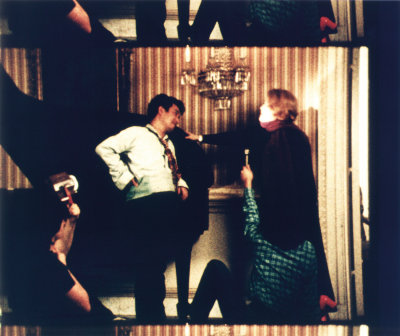
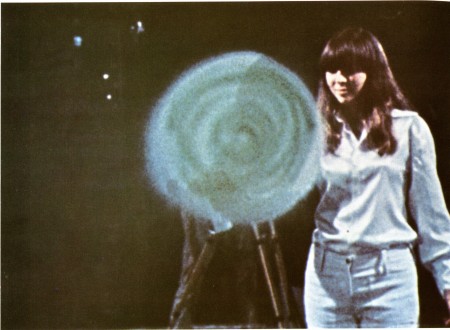
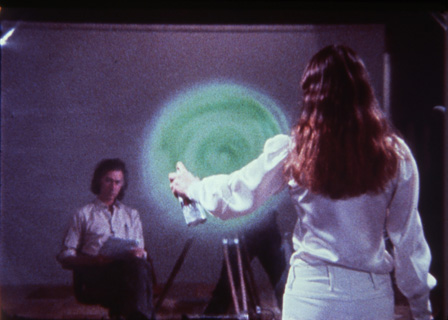
Just as typical, in the living room of Snow’s house in Toronto, where I recently interviewed him, is a front door that isn’t in use — or rather is in use, but not as a front door. Over the side facing inside the room is a life-size color photograph of a painting of the same door. Read more
From the Chicago Reader (March 9, 1990); revised in October 1995 for my collection Movies as Politics. — J.R.
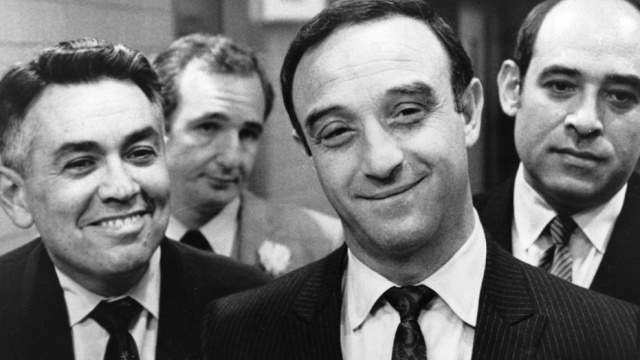
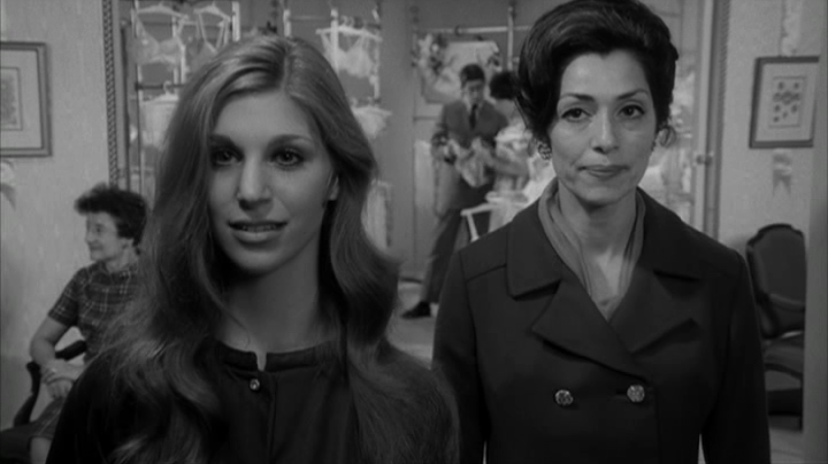
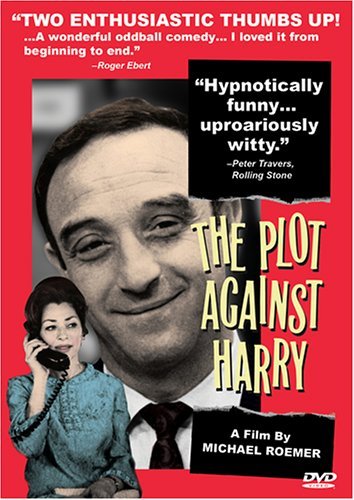
THE PLOT AGAINST HARRY *** (A must-see)
Directed and written by Michael Roemer
With Martin Priest, Ben Lang, Maxine Woods, Henry Nemo, Jacques Taylor, Jean Leslie, Ellen Herbert, and Sandra Kazan.
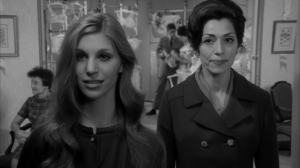
I hate stars. There’s a part of our culture that devotes itself ceaselessly to producing, promoting, and consuming them, and a lot of people would have you believe that they rule our consciousness — our politics, our fantasies, our ideas, our conversation, our art and entertainment. But one of our best-kept and most precious secrets is that a great deal goes on in our culture and in our lives that has nothing, absolutely nothing, to do with stars and everything to do with ordinary people.
Insofar as we can distinguish between illusion and reality — and the popularity of someone like Reagan suggests that we neither can nor want to very much — ordinary people, not stars, form the fabric of our daily existence; and most movies, simply by virtue of the fact that they have stars, ignore, deny, and impugn that fabric. An inordinate amount of energy in our society is devoted to proving that stars (Reagan or Bush, Cruise or Streep, Madonna or Jagger, Trump or Warhol, Spielberg or Sontag) are ordinary people just like you and me, when it might be more useful to prove that ordinary people — the people we live with — are the stars that actually belong in our constellations. Read more
From the Chicago Reader (September 22, 2000). — J.R.

Almost Famous
Rating ** Worth seeing
Directed and written by Cameron Crowe
With Patrick Fugit, Billy Crudup, Frances McDormand, Kate Hudson, Philip Seymour Hoffman, and Zooey Deschanel.
Duets
Rating ** Worth seeing
Directed by Bruce Paltrow
Written by John Byrum
With Maria Bello, Andre Braugher, Paul Giamatti, Huey Lewis, Gwyneth Paltrow, Scott Speedman, Kiersten Warren, and Angie Dickinson.
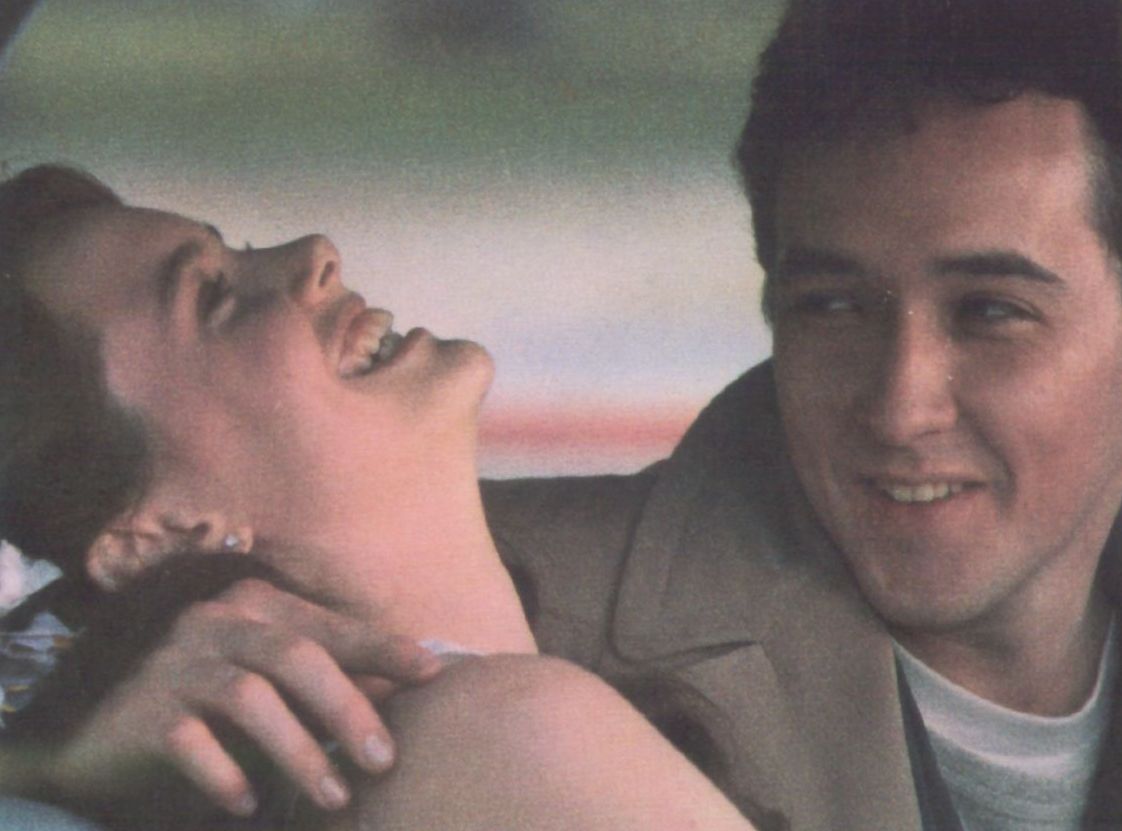

Cameron Crowe’s first feature as writer-director, Say Anything… (1989), lost money, which broke my heart. His third feature, Jerry Maguire (1996), cleaned up, which broke my spirit. (In between was another romantic comedy, the 1992 Singles, which I barely remember.) You might conclude that I was out of step with the audiences that passed on Say Anything… — though I was hardly the only reviewer who fell for it — and with those who went to Jerry Maguire in droves. I prefer to believe that I was out of step with the publicity for each movie. Say Anything… didn’t get much. But Jerry Maguire was pushed hard, as a Tom Cruise movie rather than anything created by a mere writer-director, and much of it struck me as transparent Oscar mongering — with the film’s “Show me the money!” Read more
Here are some links to some pieces of mine that are available online elsewhere, in chronological order. Many of them include various lists of their own. — J.R.
10 Favorite Offbeat Musicals (March 2006):
http://www.dvdbeaver.com/film/articles/10_offbeat_musicals.htm
Ten Overlooked Noirs (April 2006):
www.dvdbeaver.com/film/articles/noir.htm
A Dozen Eccentric Westerns (June 2006):
http://www.dvdbeaver.com/film/articles/westerns.htm
Ten Neglected Science Fiction Movies (August 2006):
http://www.dvdbeaver.com/film/articles/sci-fi.htm
Ten Overlooked Fantasy Films on TV (and Two That Should be Available) (October 2006):
www.dvdbeaver.com/film/articles/fantasy.htm
A Dozen Undervalued Movie Satires (January 2007):
http://www.dvdbeaver.com/film/articles/dozen_undervalued_movie_satires.htm
Eleven Treasures of Jazz Performance on DVD (April 2007):
http://www.dvdbeaver.com/film/articles/eleven_treasures_of_jazz_on_dvd.htm
18 Thrillers You Might Have Missed… (July 2007):
www.dvdbeaver.com/film/articles/18_thrillers_you_might_have_missed.htm
Ten Underappreciated John Ford Films (December 2007):
www.dvdbeaver.com/film/articles/ten_underappreciated_john_ford_films.htm
My Dozen Favorite Non-Region-1 Box Sets (June 2008):
www.dvdbeaver.com/film/articles/dozen_favorite_nonR1_boxsets.htm
My Dozen Favorite Non-Region-1 Single-disc DVDs (November 2008):
www.dvdbeaver.com/film/articles/dozen_favorite_nonR1_single-disc.htm
Trial and Era (on Jim McBride’s early films) (posted April 3, 2009):
http://www.artforum.com/film/id=22423
The Consequences of Fame (on Roman Polanski’s arrest, posted Sept. 19, 2009):
http://roomfordebate.blogs.nytimes.com/2009/09/29/the-polanski-uproar/#jonathan
Tony Tony Tony (on The Imaginarium of Dr. Parnassus, posted December 23, 2009):
http://www.artforum.com/film/id=24395
Great 30s Movies on DVD (…and a few more that should be available) (February 2010):
www.dvdbeaver.com/film/articles/great_30s_movies_on_dvd.htm
Too Many Greats Ignored (on the Oscars, posted March 4, 2010):
http://roomfordebate.blogs.nytimes.com/2010/03/04/do-the-oscars-undermine-artistry/#jonathan
Gertrud and Light in August (posted October 26, 2010):
www.criterion.com/current/posts/1635-gertrud-and-light-in-august Read more
From the Chicago Reader (September 26, 2003). — J.R.
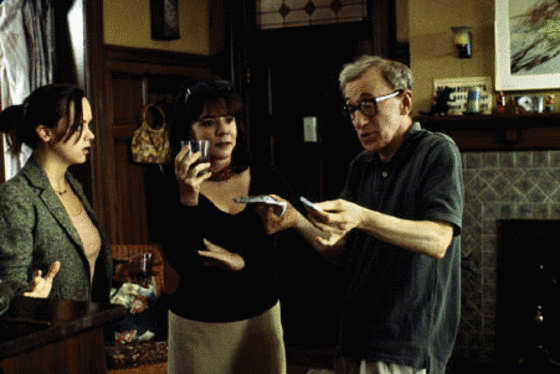
Anything Else
* (Has redeeming facet)
Directed and written by Woody Allen
With Jason Biggs, Christina Ricci, Allen, Stockard Channing, Danny DeVito, Jimmy Fallon, and Diana Krall.
The least valuable criticism we have of Charlie Chaplin maintains that he was a tremendously gifted comic until he started taking himself too seriously. My quarrel starts with the underlying assumption that the greatness of any comic artist can be measured with a laugh meter. I’ll readily grant that there’s more to laugh at in The Circus (1928) than in Monsieur Verdoux (1947), Limelight (1952), or A King in New York (1957), but that doesn’t make it a better movie. The other three offer some of the richest experiences in the history of cinema, and if quality of emotion counts for more than quantity, especially in comic works, they’re remarkable for their sharpness, depth, and complexity. They are all narcissistic reveries, yet none of them can be reduced to Chaplin assessing his own persona — though this is undoubtedly one reason they’re of interest.
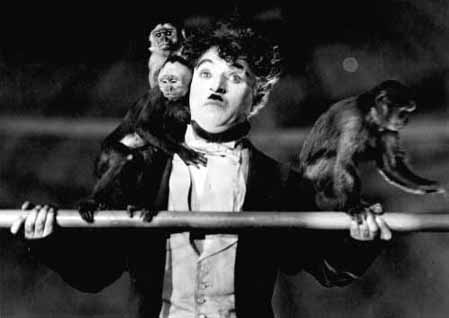
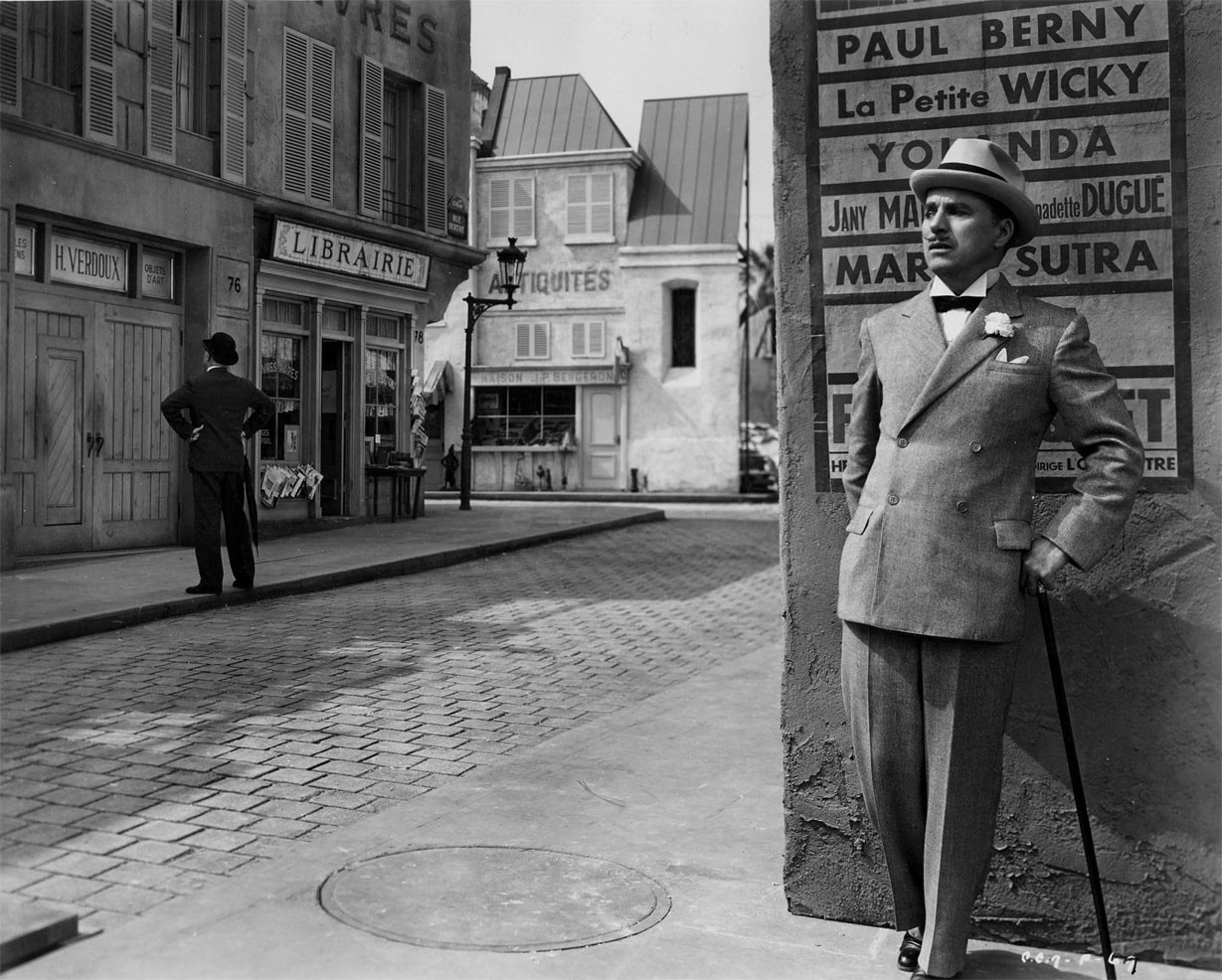
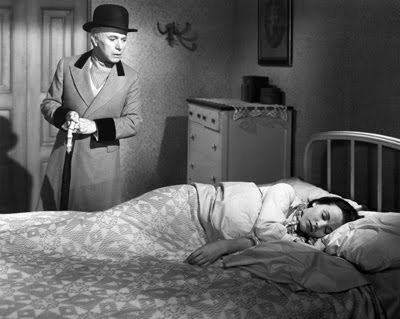

I’d be prepared to make a similar case for the virtually impossible to find last feature of Preston Sturges, an independent effort known in French as Les carnets du Major Thompson and in English as The French They Are a Funny Race (1955). Read more
From the Chicago Reader (February 9, 1990). — J.R.
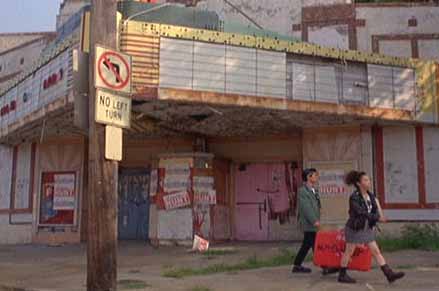
MYSTERY TRAIN
** (Worth seeing)
Directed and written by Jim Jarmusch
With Youki Kudoh, Masatoshi Nagase, Screamin’ Jay Hawkins, Cinque Lee, Nicoletta Braschi, Elizabeth Bracco, Joe Strummer, and Rick Aviles.
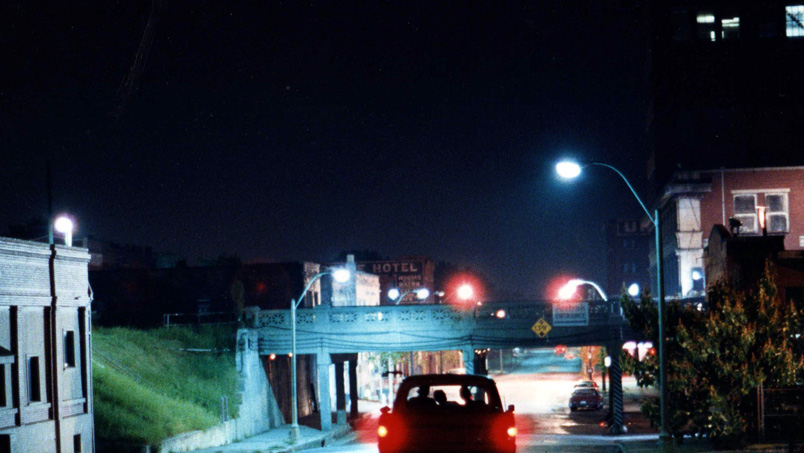
Mastery is a rare commodity in American movies these days, in matters both large and small, so when a poetic master working on a small scale comes into view, it’s reason to sit up and take notice. Jim Jarmusch’s second feature, Stranger Than Paradise, won the Camera d’Or at Cannes in 1984 and catapulted him from the position of an obscure New York independent with a European cult following — on the basis of his first feature, Permanent Vacation (1980) — to international stardom.
As the first — and so far only — filmmaker informed by the New York minimalist aesthetic to make a sizable mainstream splash, Jarmusch had a lot riding on his next films, and he has acquitted himself admirably. He hasn’t sold out to Hollywood or diluted his style, and, unlike most of the few other contemporary American independents to make it big, he has managed to maintain rigorous control over every aspect of his work, from script to production to distribution. Read more
From the Chicago Reader (March 23, 2001). — J.R.
15 Minutes ***
Directed and written by John Herzfeld
With Robert De Niro, Edward Burns, Kelsey Grammer, Avery Brooks, Melina Kanakaredes, Karel Roden, and Oleg Taktarov.
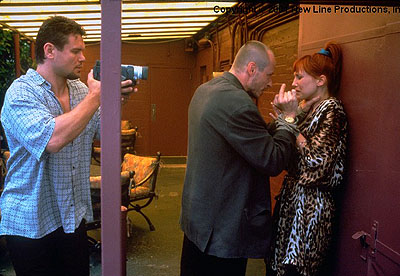
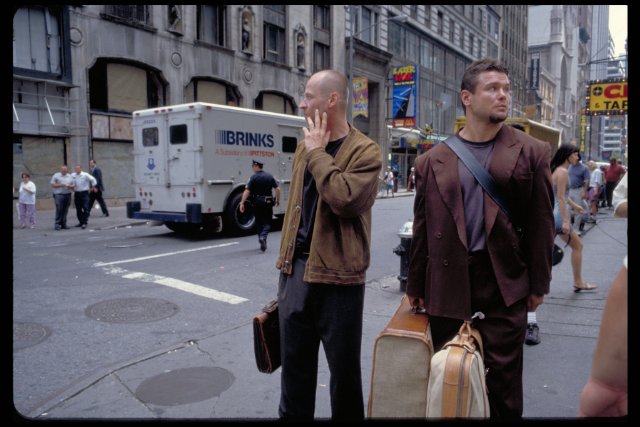
A first-rate Hollywood entertainment, 15 Minutes is more than a little schizophrenic, a shotgun wedding between two seemingly irreconcilable genres — the buddy/cop action thriller and the angry social satire. It can’t even be unambiguous about the reason for its title. Presumably to placate the action-thriller buffs — some of whom are bound to be pissed off because satire is what closes in New Haven — there’s a throwaway line toward the end of the movie in which a vengeful cop is told he’ll have custody of the killer of his slain colleague for 15 minutes. Far more important is the satirical reference the movie bothers to cite only in the press notes: Andy Warhol’s 1968 assertion that “In the future everyone will be world-famous for 15 minutes.”
I’m a satire buff, but I have to confess that I do like at least a couple of the straight-ahead and relatively mindless action sequences: several cops chasing a Czech killer through busy midtown Manhattan traffic, while the killer, Emil, and his simpleminded Russian sidekick, Oleg (who videotapes everything and whose hero is Frank Capra), flee toward Central Park; and a fire marshal and a murder witness trying to escape from her apartment after it explodes in flames. Read more
From the Chicago Reader (June 22, 1990). — J.R.
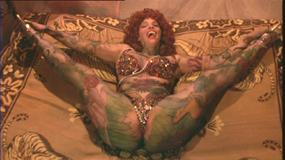
THE GANG OF FOUR
*** (A must-see)
Directed by Jacques Rivette
Written by Rivette, Pascal Bonitzer, and Christine Laurent
With Bulle Ogier, Benoit Regent, Laurence Cote, Fejria Deliba, Bernadette Giraud, Ines de Medeiros, and Nathalie Richard.
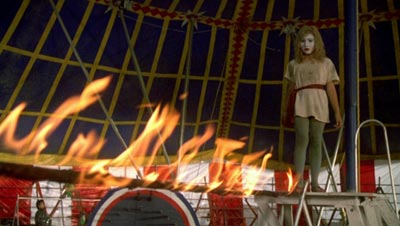
SANTA SANGRE
* (Has redeeming facet)
Directed by Alejandro Jodorowsky
Written by Jodorowsky, Roberto Leoni, and Claudio Argento
With Axel Jodorowsky, Blanca Guerra, Guy Stockwell, Thelma Tixou, Sabrina Dennison, Adan Jodorowsky, and Faviola Elenka Tapia.

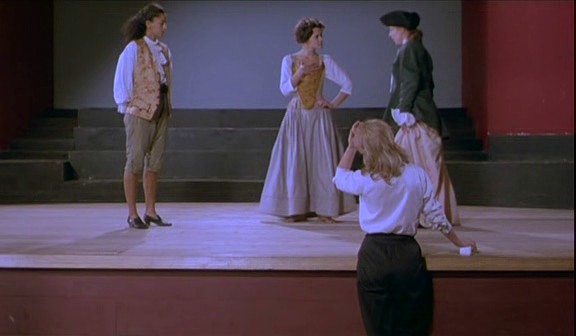
In nearly half his films, 6 features out of 13, Jacques Rivette allows his characters only two possibilities. One is work in the theater, specifically rehearsals — an all-enveloping, all-consuming activity that essentially structures one’s life and assumes many of the characteristics of a religious order. The other, more treacherous possibility is involvement in a real or imagined conspiracy outside the theater — a plot or (the French term is more evocative) complot that is hard to detect yet seemingly omnipresent, sinister yet seductive for anyone who strays from the straight and narrow path offered by the rehearsals. Art versus life? Not exactly; a bit more like two kinds of art, or two kinds of life.
Both possibilities convey a sense of forging a fragile meaning over a gaping void. Read more
From the Chicago Reader (November 19, 2004). — J.R.
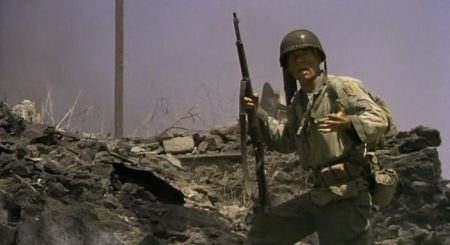
The Big Red One: The Reconstruction
**** (Masterpiece)
Directed and Written by Samuel Fuller
With Lee Marvin, Mark Hamill, Robert Carradine, Bobby Di Cicco, Stephane Audran, Christa Lang, Kelly Ward, Siegfried Rauch, and Fuller
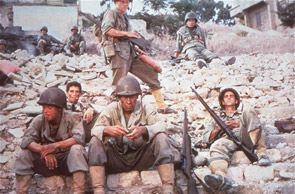
“When I enter his suite at the Plaza, he’s finishing lunch, expressing his regret about missing Godard in Cannes, remarking on the absurdity of prizes at film festivals, asking me what Soho News and Soho are. (The one he knows about is in London — he fondly recalls a cigar store on Frith Street.)
“It isn’t hard to figure out why Mark Hamill affectionately calls him Yosemite Sam, or why Lee Marvin simply says he’s D.W. Griffith. Bursting with the same charismatic, comic book energy that skyrockets through most of his movies, old crime reporter, novelist, war hero, writer-director and sometime producer Samuel Fuller, almost 69, still moves and talks like his daffy action flicks — like the wild man from Borneo — in quick, short, blocky punches, like two-fisted slabs of socko headline type.”
The purple prose was mine, the year was 1980. Fuller was promoting his semiautobiographical war picture The Big Red One, even though the studio had just cut half of it — something he wasn’t making any effort to hide. Read more
From the Chicago Reader (April 11, 2003). — J.R.

10
*** (A must-see)
Directed by Abbas Kiarostami
With Mania Akbari, Amin Maher, Roya Arabshahi, Katayoun Taleidzadeh, Mandana Sharbaf, Amene Moradi, and Kamran Adl.
In my mind, there isn’t as much of a distinction between documentary and fiction as there is between a good movie and a bad one. — Abbas Kiarostami in an interview

One way to identify the world’s greatest filmmakers is to determine which ones have found it necessary to reinvent the cinema from the ground up. The names that quickly come to my mind are Antonioni, Bresson, Chaplin, Dreyer, Eisenstein, Godard, Griffith, Kubrick, Mizoguchi, Renoir, Tati, and Welles — a far from exhaustive list of mercurial artists who rethought the nature of the medium not once but repeatedly, most often to their commercial disadvantage.
Not all of these figures qualify as “difficult,” though even such crowd pleasers as Chaplin, Griffith, and Kubrick were called that at some points during their careers. Whether people wound up seeing them as old-fashioned or unfashionable, these artists refused to turn themselves into commodities, alienating even their most passionate fans by confounding expectations and changing the rules of the game, and at times scaring off potential investors. Read more
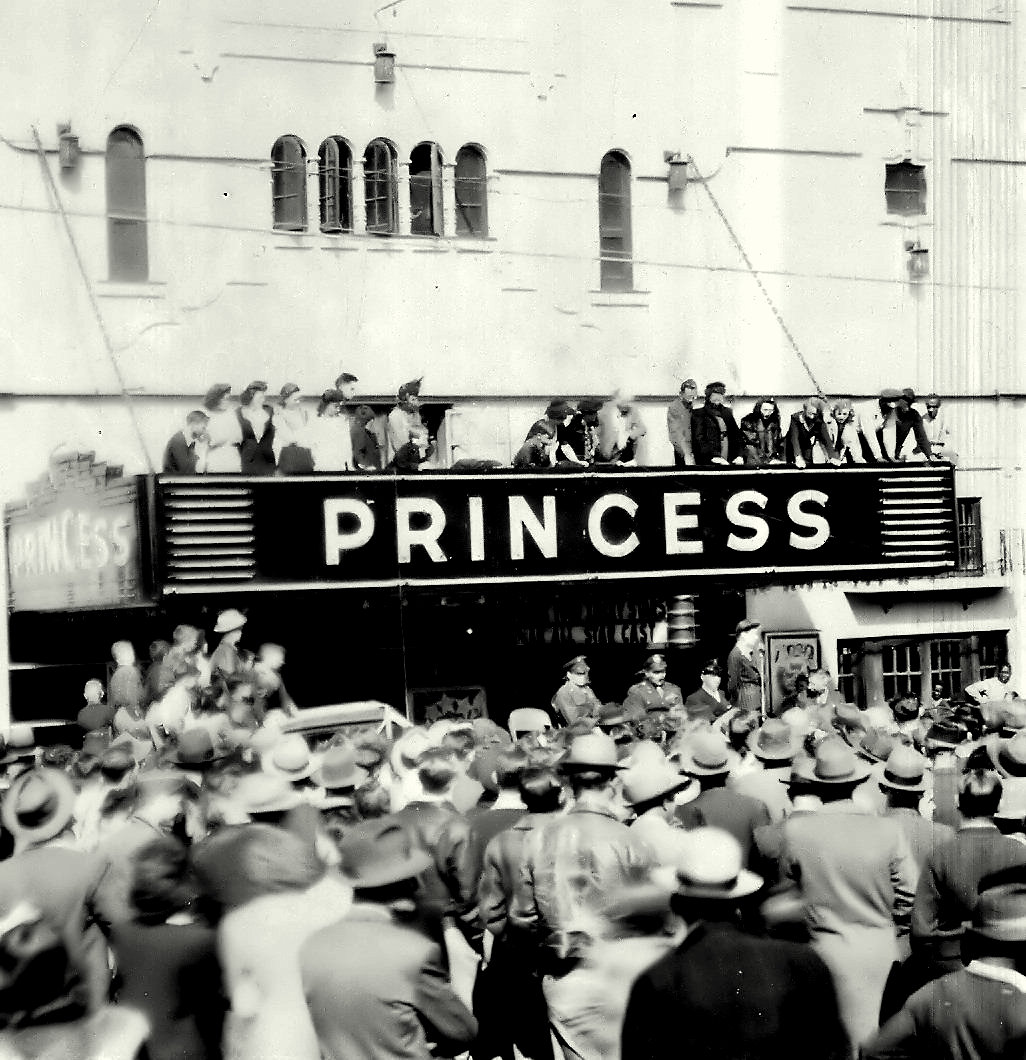
One more photo of a family theater, this one taken at a war bond rally and furnished to me by my brother Alvin. My parents, standing on top of the marquee, are just above the letter E; my grandfather, on the ground, can be seen under the second S, in front of the one-sheet advertising the current attraction, Thank Your Lucky Stars. [2/17/11]

 Read more