From the Chicago Reader (December 11, 1992); also reprinted in Movies as Politics. — J.R.
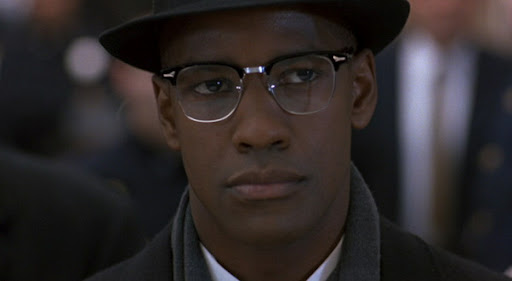
MALCOLM X
** (Worth seeing)
Directed by Spike Lee
Written by Arnold Perl and Spike Lee
With Denzel Washington, Angela Bassett, Albert Hall, Al Freeman Jr., Delroy Lindo, and Spike Lee.
“At the top of 1968, over the vehement protests of my family and my friends, I flew to Hollywood to write the screenplay for The Autobiography of Malcolm X. My family and my friends were entirely right; but I was not (since I survived it) entirely wrong. Still, I think that I would rather be horsewhipped, or incarcerated in the forthright bedlam of Bellevue, than repeat the adventure — not, luckily, that I will ever be allowed to repeat it: it is not an adventure which one permits a friend, or brother, to attempt to survive twice. It was a gamble which I knew I might lose, and which I lost — a very bad day at the races: but I learned something.” — James Baldwin, The Devil Finds Work (1976)
“If the complexity that was Malcolm X survives this moment as only a T-shirt or a trademark, then it is no wonder that Clarence Thomas has emerged as the perfect cooptive successor–an heir-transparent, a product with real producers; the new improved apparition of Malcolm, the cleaned-up version of what he could have been with a good strong grandfather figure to set him right.Read more
This appeared in the November 18, 1988 Chicago Reader. I’d probably rank this film higher now. — J.R.
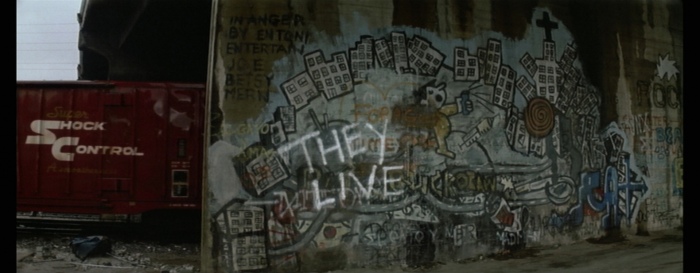
THEY LIVE
** (Worth seeing)
Directed by John Carpenter
Written by “Frank Armitage” (John Carpenter)
With Roddy Piper, Keith David, Meg Foster, George “Buck” Flower, Peter Jason, and Raymond St. Jacques.
John Carpenter has managed to remain one of the few genuinely personal writer-directors left in genre moviemaking, having returned to relatively low-budget features with last year’s Prince of Darkness after the debacle of Big Trouble in Little China. From his clean ‘Scope compositions to his throbbing minimalist scores, he projects a simplicity of conception and a usually deft approach to story telling and straight-ahead action that are both refreshing and reassuring in an era of filmmaking when these modest virtues can no longer be taken for granted. As a disciple of Howard Hawks, he might even be said to preserve a scaled-down version of some of the familiar Hawks trademarks: cranky individualist heroes, flaky male/female relationships, camaraderie among professionals, confined spaces, and usually clear lines of demarcation between friends and foes.
All of these qualities are present to some degree in They Live, a paranoid science-fiction thriller about alien invaders loosely based on a short story by Ray Nelson. Read more
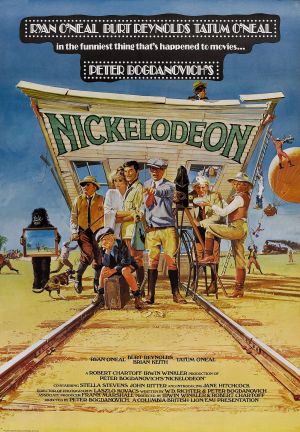
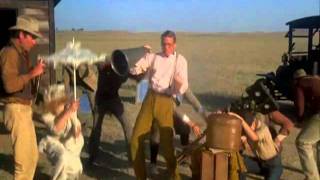
From Monthly Film Bulletin, February 1977 (Vol. 44, No. 517). Over 30 years later, in my DVD column for Cinema Scope, I wrote, “Is it possible to find a picture acceptable only with its director’s commentary? Yes, if it’s Peter Bogdanovich’s clunky but interesting comedy about American moviemaking during the patent wars (1910-1915), prior to The Birth of a Nation, now that he’s finally had a chance to release it in black and white, as he originally intended, and recut it as well. Reviewing this when it came out…, I found its slapstick mainly irksome — not offensive, as it was to me in What’s Up, Doc?, where so many of the pratfalls, collisions, and smashups seemed to be about fatuous, narcissistic yuppies humiliating servants and carpenters, but pretty academic none the less…. It still looks academic, but hearing Bogdanovich explain where all the stories come from (mostly from Dwan, Ford, McCarey, and Walsh, with a curtain-closer from James Stewart) makes it somewhat more absorbing.” — J.R.
Nickelodeon
U.S.A./Great Britain, 1976
Director: Peter Bogdanovich
Chicago, July 30, 1910. Fleeing from a divorce court when he discovers that his client has an indefensible case, lawyer Leo Harrigan stumbles into H. Read more
With Catherine Deneuve, Nino Castelnuovo, Anne Vernon, Marc Michel, Ellen Farner, Mireille Perrey, and Harald Wolff.
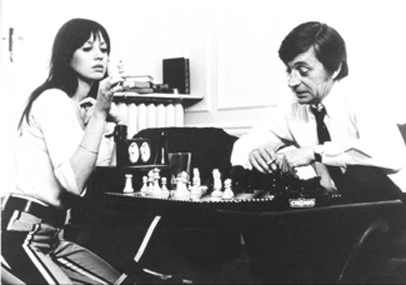
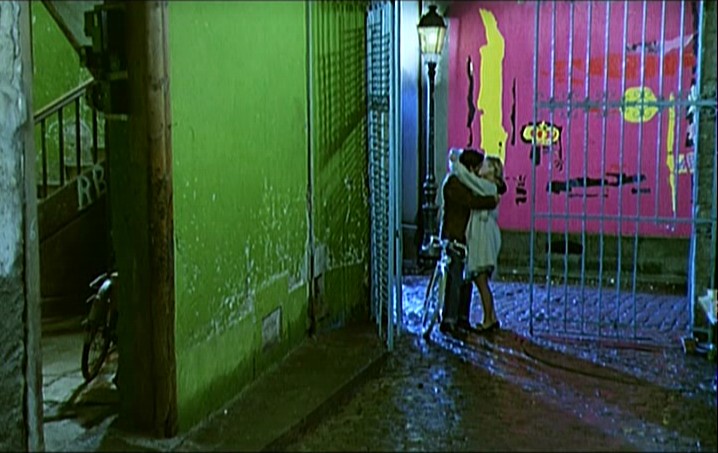
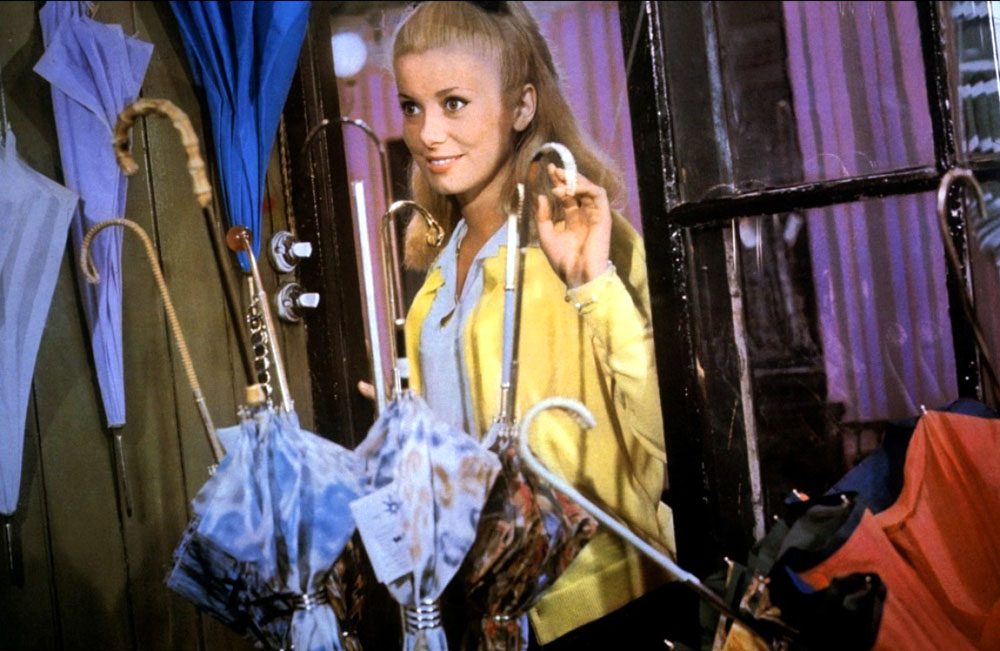
Let’s put it this way: It’s 1957, and a 20-year-old garage mechanic in Cherbourg knocks up his girlfriend just before he leaves for two years of military service in Algeria. Guy Foucher and Geneviève Emery — the daughter of a middle-class widow who helps her mother run a chic umbrella shop — make a handsome and devoted couple, and they swear eternal love to each other before he leaves, but he writes to her only infrequently. When Geneviève finds herself pregnant, her financially strapped mother, who’s never approved of her relationship with Guy, virtually stage-manages a proposal from a visiting diamond merchant who’s already helped her out of a financial crisis. By the time Guy returns from Algeria with a pronounced limp (the reason he didn’t write), Geneviève has married the diamond merchant and moved to Paris, and the umbrella shop has closed, to be replaced by a store selling washing machines.
As luck would have it, I first saw Les parapluies de Cherbourg (1964) about two years too early — before my first trip to France. Read more
If my 20 best list for the past year could have been based purely on artistic criteria rather than on packaging and marketing categories, Spike Lee’s When the Levees Broke: A Requiem in Four Acts — which premiered on HBO on two consecutive nights in late August, a year after the tragedy in New Orleans—would have belonged somewhere near the top. Although I missed the third act at the time, I’ve recently watched the whole thing on the recently released three-disc DVD box set — which adds a fifth act called “Next Movement” as well as a slide show of photographs called “Water Is Rising,” accompanied (like the documentary itself) by a Terence Blanchard jazz score—and the experience as a whole is so powerful that I’m tempted to call this over four-hour documentary Lee’s masterpiece to date. For its remarkable cast of characters, its comprehensive and even epic treatment of a major catastrophe in all its multidimensional aspects, for its political and ethical clarity (as well as its focused and wholly justifiable anger), and above all, for its soul, it shows a maturity and balance that may be unparalleled in Lee’s work.
From the Chicago Reader (July 3, 1992). This marks my first encounter with Lars von Trier. — J.R.
ZENTROPA
*** (A must-see)
Directed by Lars von Trier
Written by von Trier and Niels Vorsel
With Jean-Marc Barr, Barbara Sukowa, Udo Kier, Ernst-Hugo Jaregard, Erik Mork, Jorgen Reenberg, Henning Jensen, Eddie Constantine, and the voice of Max von Sydow.
Lars von Trier’s Zentropa is the most exciting failure to come along in ages. This Danish-French-German-Swedish coproduction (known as Europa outside the United States), turning up here over a year after it received both the Jury Prize and the Technical Prize at Cannes, addresses so many fundamental contemporary questions about postmodernism, language, colonialism, the Common Market, coproduction, the future of European cinema, and our collective memory of World War II that one may feel a mite churlish pointing out that its technique ultimately overwhelms the themes and characters. After all, exercices de style worthy of the name are not exactly plentiful these days, and Zentropa is an especially dazzling example — vastly more impressive than Barton Fink or Kafka or Shadows and Fog, to cite only the first rough counterparts that come to mind. It has so much to say and do, in fact, that its failure to get everything said and done has to be weighed against the failure of most other recent movies to say or do anything at all beyond the barest commercial minimum. Read more
As the son and grandson of small-town exhibitors — a legacy explored in detail in my first book, Moving Places: A Life at the Movies (1980/1995) — I find it difficult to pinpoint with any exactitude when my film education started. But I can recall two pivotal early steps during my freshman year at New York University in 1961, when I was an English major still aspiring to become a professional novelist: taking the first and only film course I’ve ever had in my life and purchasing my first film magazine.
The course was an introductory survey taught by the late Haig Manoogian, who was serving as Martin Scorsese’s mentor in production courses around the same time. For me, it mainly afforded me my first opportunity to see The Birth of a Nation, The Last Laugh, and a few other film history staples; since I had no interest in making movies — or at this point in writing about them — I couldn’t work up much enthusiasm for such matters as “story values” that Manoogian tended to emphasize. Read more
From the Chicago Reader (October 4, 1996); also reprinted in my collection Essential Cinema. — J.R.
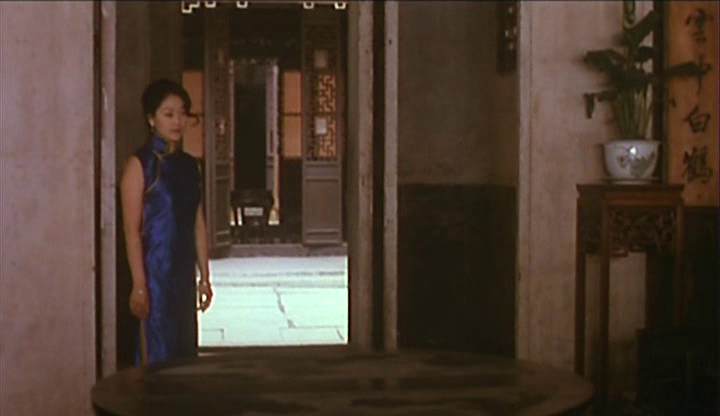
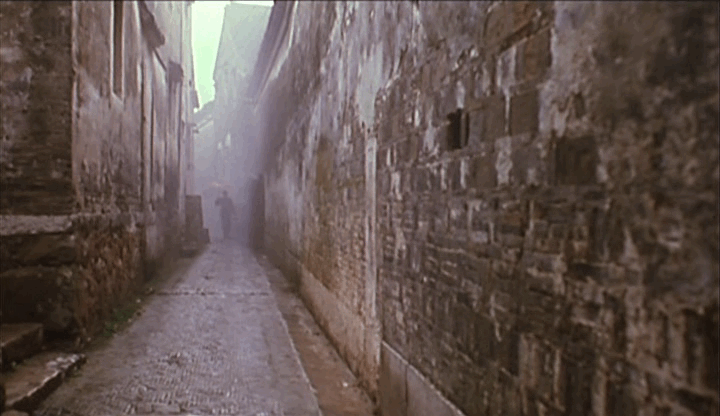
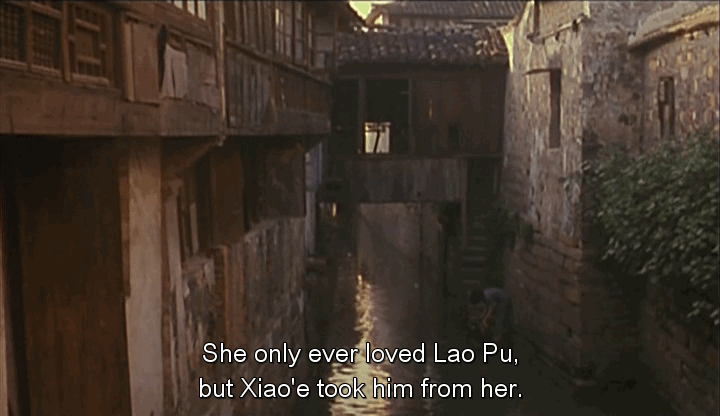
Blush
Rating **** Masterpiece
Directed by Li Shaohong
Written by Ni Zhen and Li
With Wang Ji, Wang Zhiwen, He Saifei, Zgang Liwei, Wang Rouli, Song Xiuling, Xing Yangchun, Zhou Jianying, and Cao Lei.
The use of multiple perspectives in Chinese painting was not for the purpose of making a hologram, nor was the use of parallel perspectives for the purpose of retaining the true dimensions of the objects represented. What was desired was rather a point of view which transcended that of the individual. The apparent horizon and vanishing point employed by Renaissance perspective made the image seem concrete, but demanded substantial identification with a particular viewer. Such images were perceived as both individual and momentary, seen by a particular person at a particular time. Chinese painting strove for a timeless, communal impression, which could be perceived by anyone, and yet was not a scene viewed by anyone in particular.
Chinese paintings did not portray reality; the world which the viewer entered was the realm of literature or philosophy, a realm which transcended nature. To enjoy a long tableau with small figures, one must shift one’s line of sight left and right, or up and down, a necessary condition for the appreciation of Chinese visual representation.Read more
From the Chicago Reader (September 1, 1988). — J.R.
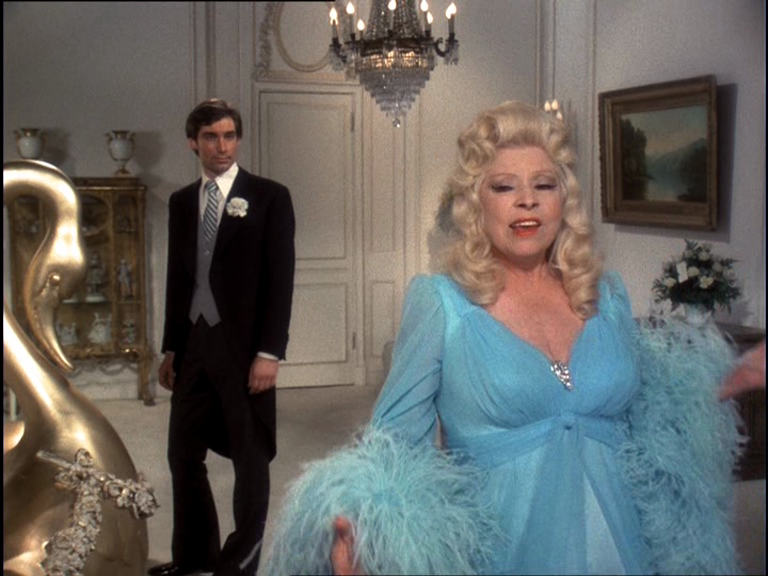
Mae West’s swan song to cinema at age 86 is one of the world’s all-time worst movies, but that doesn’t detract at all from its immense charm and lewd fascination. Based on West’s own play, produced by two wealthy English fans in their early 20s, directed after a fashion by Ken Hughes (reportedly many hands were involved), and including such standbys as Timothy Dalton, Tony Curtis, Dom DeLuise, Ringo Starr, George Hamilton, Alice Cooper, Keith Moon, Walter Pidgeon, Rona Barrett, and George Raft, this inept but heartfelt 1978 tribute to West’s talent and worldview often defies description. It’s amateur filmmaking at its most delirious, complete with a rousing production-number version of “Hooray for Hollywood”; West herself remains visibly sedated but indefatigably game throughout. 91 min. (JR)