From the Chicago Reader (September 1, 1992). — J.R.

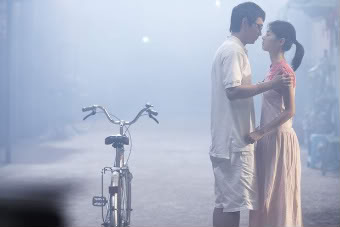
Lee Myung-sei’s delightful Korean comedy about the trials and tribulations of a young married couple (Park Joong-hoon and Choi Jin-sii, both charming and resourceful actors) offers eloquent testimony to the stylistic importance of Frank Tashlin (The Girl Can’t Help It, Artists and Models, Will Success Spoil Rock Hunter?) as an international legacy. Tashlin’s background as an animator — his graphic talent, his formal ingenuity, his taste for bright primary colors — and his flair for satire of contemporary lifestyles both seem fully present in this lively and inventive feature. It isn’t that Lee has necessarily seen or studied Tashlin’s work, but Tashlin’s bag of tricks has become an automatic part of everyone’s resources, and this comedy fully exploits it (1991). (JR)
 Read more
From the February 5, 1988 Chicago Reader. — J.R.
RADIUM CITY
Directed by Carole Langer
Thanks largely to the influence of auteur criticism, most of our aesthetically oriented writing about film since the 60s has been concerned with style. But one could argue that such an emphasis has tended to divert attention from what might be considered even more important — namely, form and content. “Whatever its sophistication,” Roland Barthes wrote in Writing Degree Zero, “style always has something crude about it: it is a form with no clear destination, the product of a thrust, not an intention. . . . Its frame of reference is biological or biographical, not historical . . . it rises up from the writer’s myth-laden depths and unfolds beyond his area of control.”
Perhaps only in an area like Hollywood moviemaking, where the artist seldom has final control over either the form or the content, can style be raised to the level of an ultimate principle. Yet because Hollywood continues to dominate our screens as well as the ways that we think about movies in general, the notion of style is also routinely applied to Bresson, Godard, Kubrick, and Tarkovsky, when surely form and content, not style, is what their best films are about. Read more
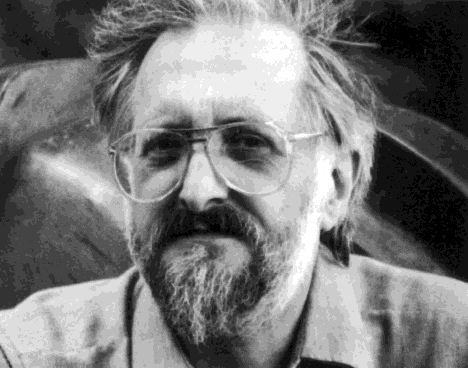
While eagerly awaiting the publication of the aptly named Images of the Mind: The Essential Raymond Durgnat, a definitive collection edited by Henry K. Miller that the British Film Institute will apparently publish later this year, I’ve just found time to experience the pleasure of a remarkable 1992 documentary with half of the same title, Jarmo Valkola’s 45-minute Images of the Mind: Cinematic Visions by Raymond Durgnat — a film now available at newly revamped Durgnat web site that manages to be both a wonderful portrait of the greatest of all English film critics (1932-2002), speaking as both a fan and as a friend over the last three decades of his life (as well as one-time house mate, circa 1977-78), and a brilliant lecture by Ray about the nature of film, the history of the English character in the 20th century, and the art of Michael Powell. Indeed, the only thing that can be said to be dated about this remarkable film is the fact that it cites Durgnat’s still-unpublished book about Powell as one of his publications. Otherwise, it impressively predates the recent film criticism on film that can be found in the work of Kevin Lee and Volker Pantenburg, among many others. Read more
From Scenario, Vol. 4, No. 1, Spring 1998. –- J.R.
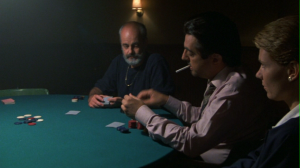
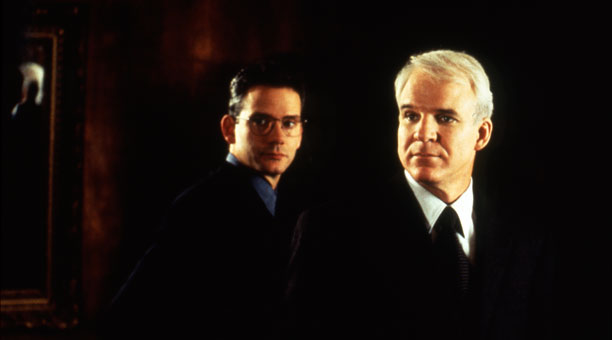
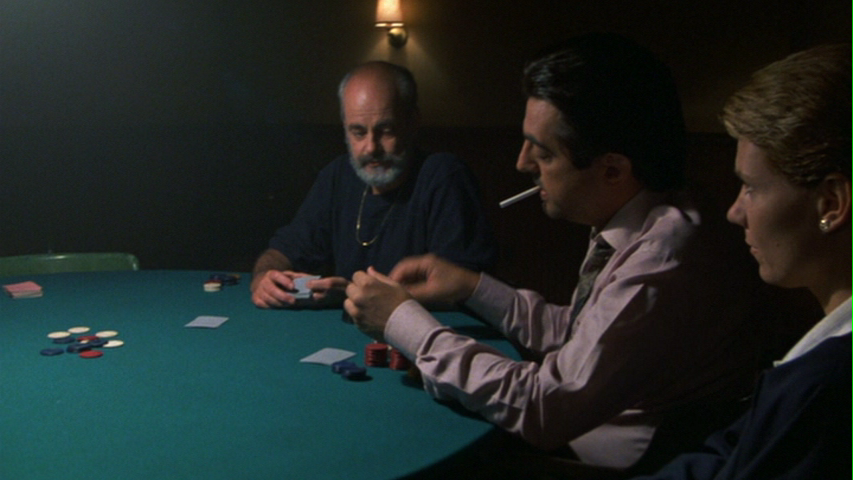
“Hitchcock lives!” I was inspired to write at the head of my review of House of Games, David Mamet’s first feature, in 1987. Ten years later, Mamet’s fifth feature, The Spanish Prisoner, boasts plenty of Hitchcockian elements of its own. But this time I’m not as prone to employ the same assertion.
The difference has less to do with Hitchcockian influence than with the use of that influence — the issue of whether Mamet is borrowing something substantive from the Master of Suspense, or drawing upon Hitchcock only when it suits his strategies. But one of the salient differences I find between reading the script of The Spanish Prisoner and seeing it realized is the difference between finding a Hitchcockian thriller on the page and not quite seeing one on the screen. Both are clearly Mamet creations, but the first comes closer to showing Hitchcock’s special qualities in tandem with Mamet’s, whereas the second shows them shooting off in separate directions.
Put somewhat differently, the distinction has a lot to do with issues that seem central to any evaluation of Hitchcock as well as Mamet -– namely, the ethics and aesthetics of deception, which are intimately tied to the ethics and aesthetics of representing a real world where deception becomes possible. Read more
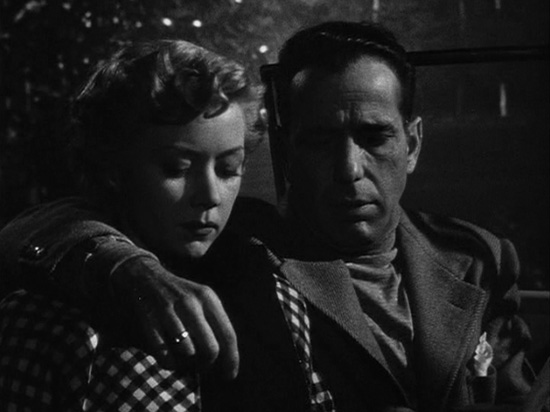
Recommended Reading: An excellent piece about In a Lonely Place, and Nicholas Ray more generally, by J. Hoberman in this week’s Village Voice. My only (minor) quarrel is with the following phrase: “An ex-Communist who was never persecuted, and must have wondered why…” From Bernard Eisenschitz’s definitive biography, one can pretty clearly surmise that Ray was protected from the Blacklist by Howard Hughes, for whom he was a sort of patch-up man, semipermanently on tap — something he must have been perfectly aware of. [7/17/09] Read more
VINCENTE MINNELLI: THE ART OF ENTERTAINMENT, edited by Joe McElhaney, Detroit: Wayne State University Place, 2009, 458 pp.
In spite of my disappointment that Mademoiselle — Minnelli’s extraordinary centerpiece in The Story of Three Loves and surely one of his greatest films — gets virtually ignored here, this is a terrific critical collection, so I’m very grateful to Girish Shambu’s blog for calling my attention to it. Among the many treasures to be found here are what appears to be the very best French criticism about Minnelli, expertly translated by Bill Krohn, Jean-Pierre Coursodon, and Brian O’Keefe, including Raymond Bellour (on Brigadoon), Serge Daney (separate pieces on The Pirate and The Cobweb as they each appear on French TV), Jean Douchet (separate pieces on The Four Horsemen of the Apocalypse and Two Weeks in Another Town), Emmanuel Burdeau (who also has two pieces), and Jean-Loup Bourget. There are also sturdy contributions by, among others, Krohn himself, Scott Bukatman, Thomas Elsaesser, Adrian Martin, James Naremore, Dana Polan, Robin Wood, and two essays apiece by Geoffrey Nowell-Smith, David A. Gerstner, and the editor, Joe McElhaney.
Back in the mid-1980s, I published a survey about Minnelli’s work on video, titled (I believe) “In Dreams Begin Responsibilities,” which I seem to have misplaced — something I’m mentioning now only because I’ve often thought that this particular phrase from William Butler Yeats perfectly describes Minnelli’s auteurist thematics. Read more
Recommended Reading: “When Jews Attack” by Daniel Mendelsohn, a two-page spread in the August 24 & 31 issue of Newsweek, begins to help me account for what I find so deeply offensive as well as profoundly stupid about Inglourious Basterds [sic sic — or maybe I should say, sic, sic, sic]. A film that didn’t even entertain me past its opening sequence, and that profoundly bored me during the endlessly protracted build-up to a cellar shoot-out, it also gave me the sort of malaise that made me wonder periodically what it was (and is) about the film that seems morally akin to Holocaust denial, even though it proudly claims to be the opposite of that. It’s more than just the blindness to history that leaks out of every pore in this production (even when it’s being most attentive to period details) or the infantile lust for revenge that’s so obnoxious. When Mendelsohn asks, “Do you really want audiences cheering for a revenge that turns Jews into Nazis, that makes Jews into `sickening’ perpetrators?”, he zeroes in on what’s so vile about this gleeful celebration of savagery. He also clarifies the ugly meaning of Tarantino’s final scene when he points out that Nazis carved Stars of David into the chests of rabbis before killing them — a fact I either hadn’t known before or had somehow managed to suppress. Read more
The following was written for the May 1976 issue of Monthly Film Bulletin. —J.R.
Screwball Squirrel
U.S.A., 1944
Director: Tex Avery
Cert—U. dist—Ron Harris. p.c—MGM. p—Fred Quimby. story—Heck Allen. col—[originally made in Technicolor]. anim—Preston Blair, Ed Love, Ray Abrams. m—Scott Bradley. 248 ft. 7 min. (16 mm.).
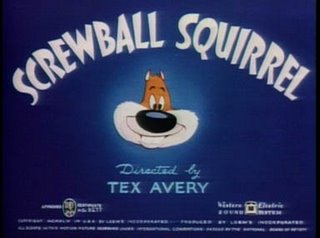
After beating up Sammy Squirrel — an effeminate Disney-like creature who purports to be the hero of the cartoon — Screwy Squirrel enters a phone booth and calls Meathead the dog to get another plot going. After an extended chase, Meathead tries to end the cartoon, but Screwy offers him one more chance to catch him. The results are immediately complicated by the fact that both confess to have been twins all along; a revived Sammy joins the group.


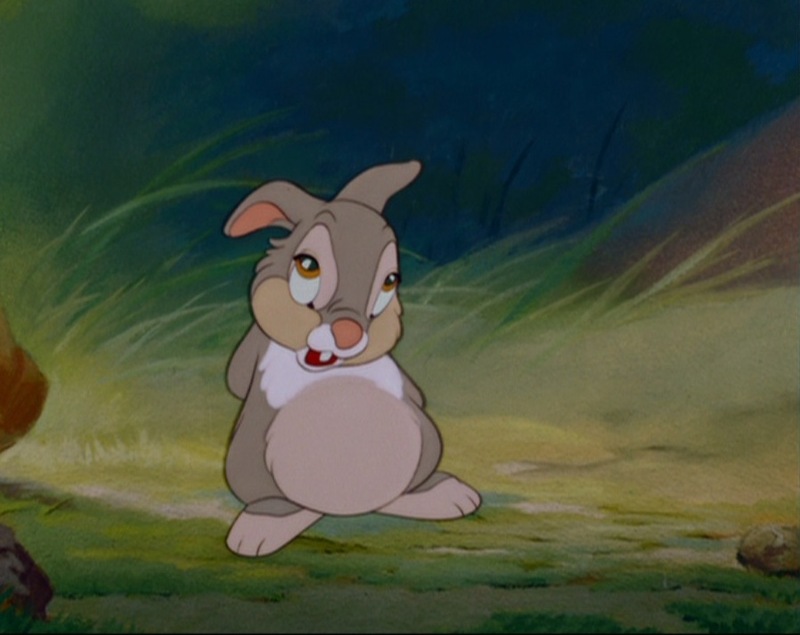
As Joe Adamson had ungrammatically but aptly noted, “Screwy Squirrel is Daffy Duck taken one step further that he absolutely has to.” A thoroughly demented character who lasted through five cartoons in the mid-Forties (Screwball Squirrel, Happy-Go-Nutty, Big Heel-Watha, The Screwy Truant, and Lonesome Lenny), he seems important in Avery’s career not so much for his own intrinsic qualities — monotonously aggressive mania and not much else — as for the wild bouts of anti-illusionist high jinks and comparable assaults on the audience that he provoked in his creators. Read more
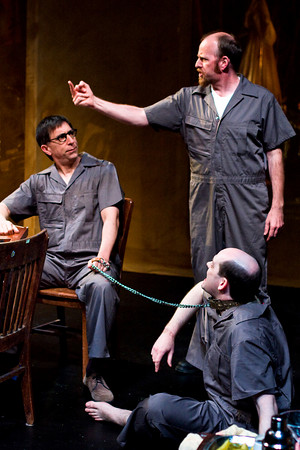
As a fan of the directorless Theater Oobleck dating all the way back to its second show in Chicago (David Isaacson’s riotous Three Who Dared: A Play on the Movies, in June 1988), with particularly fond memories of Jeff Dorchen’s The Slow and Painful Death of Sam Shepard (December 1988) and Ugly’s First World (October 1989) as well as Mickle Maher’s When Will the Rats Come to Chew Through Your Anus? (January 1990), I regret having somehow lost touch with their singular repertory of literary and political shotgun marriages in recent years. A recent visit to Dorchen’s brilliantly excessive Strauss at Midnight at the the Chicago DCA Theater (66 E. Randolph), which runs through July 19, reminded me of how much heat and liberating anger and laughter they can generate.
This play has something to do with Saul Bellow (Isaacson), posthumously still tainted by his former association with Allan Bloom (Troy Martin), and, through Bloom, with Leo Strauss (David Shapiro), condemned to a hell in which he has inhabit the same quarters as Neil Simon’s Odd Couple (Brian Nemtusak and H.B. Ward doing fine, surreal spinoffs of Jack Lemmon and Walter Matthau), not to mention Niccolo Machiavelli (Scott Hermes) and In the Heat of the Night‘s Virgil Tibbs (D’wayne Taylor). Read more
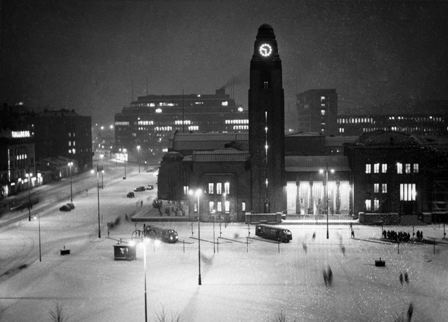
An unexpected gift arrives in the mail: a subtitled preview of Peter von Bagh’s fabulous and rather Markeresque documentary (2008)—a lovely city symphony which is also a history of Helsinki (and incidentally, Finland, Finnish cinema, and Finnish pop music) recounted with film clips and paintings by three voices (two male, one of them von Bagh’s, and one female—each one reciting what seems to be a slightly different style of poetic and essayistic discourse). There are no chapter divisions on this DVD, and the continuity is more often geographical than chronological, although there’s also a lot of leaping about spatially as well as temporally. At separate stages we’re introduced to the best-ever Finnish camera movement and the best Finnish musical, are invited to browse diverse neighborhoods and eras (and to ponder contrasts in populations and divorce rates), and are finally forced to admit that a surprising amount of very striking film footage has emerged from this country and city.
Peter von Bagh—prolific film critic, film historian, and professor, onetime director of the Finnish Film Archive and current artistic director of two unique film festivals, the Midnight Sun Film Festival (held in Sodankylä, above the Arctic Circle, during what amounts to one very long day in the summer, when there’s no night) and Il Cinema Ritrovato (held soon afterwards, in Bologna)—is the man who convinced me to purchase my first multiregional VCR in the early 80s. Read more
This originally appeared in the June 24, 1994 issue of the Chicago Reader, with a slightly different title (“Can Film Be Fascist?”) —J.R.

** THE WONDERFUL HORRIBLE LIFE OF LENI RIEFENSTAHL
(Worth seeing)
Directed and written by Ray Muller.
*** THE EYE OF VICHY
(A must-see)
Directed by Claude Chabrol
Written by Jean-Pierre Azema and Robert O. Paxton.
Last year, about the time that Ray Muller’s mediocre if watchable three-hour documentary about Leni Riefenstahl was getting widespread coverage in New York, a European friend thoughtfully sent me a tape of Looking at “Triumph of the Will”, an excellent 45-minute BBC program designed to introduce Riefenstahl’s famous Nazi propaganda film to a contemporary audience. Interviewing such commentators as Hugh Hudson, Annette Insdorf, Claude Lanzmann, George Steiner, Hans-Jurgen Syberberg, Budd Schulberg, and Brian Winston, the program offered diverse historical, ideological, and aesthetic perspectives without privileging any single point of view. Riefenstahl herself refused to be interviewed, yet her own self-serving interpretation of her career was included, as well as that of one of her American apologists — David Hinton, the author of a book about her, who argues, as Riefenstahl does, that Triumph of the Will should not be regarded as propaganda. Read more
Posted on Artforum‘s web site (March 12, 2009). — J.R.
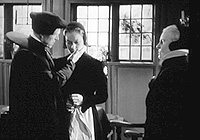
One reason why it never seems like an inappropriate time to have a Carl Theodor Dreyer retrospective is that most of his films haven’t dated, even though reactions to his works have fluctuated quite a bit over the years. Based on my own experiences in recently showing his 1943 Day of Wrath to students, I would venture that fewer spectators nowadays are likely to regard the film’s slow tempo as intolerable the way that the New York Times’s Bosley Crowther did over sixty years ago. (“Dreyer has kept his idea so obscure and the action so slow and monotonous that the general audience will find it a bore,” he claimed.)

One might go further and argue that unlike most other film masters who started out in the silent era, Dreyer’s major works were not only cinematically ahead of their own times; without ever becoming quite contemporary, they’ve even remained slightly ahead of ours. There are multiple reasons for this, including his penchant for making highly personal adaptations of preexisting works, most of them period films; his dialectical camera movements, in which he simultaneously pans and tracks in opposite directions; and, during the sound era (when he was generally able to make only one feature per decade), his unorthodox preference for using direct sound inside studio settings. Read more
This appeared in the April 4, 1997 issue of the Chicago Reader. –J.R.
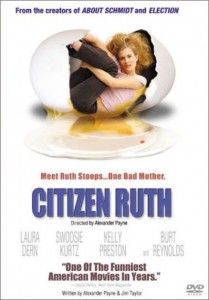
Citizen Ruth
Rating * (Has redeeming facet)
Directed and written by Alexander Payne
With Laura Dern, Swoosie Kurtz, Kurtwood Smith, Mary Kay Place, Kelly Preston, M.C. Gainey, Burt Reynolds, and Tippi Hedren.
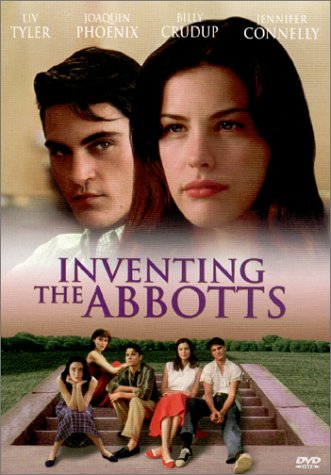
Inventing the Abbotts
Rating *** (A must see)
Directed by Pat O’Connor
Written by Ken Hixon
With Joaquin Phoenix, Billy Crudup, Will Patton, Kathy Baker, Jennifer Connelly, Liv Tyler, Joanna Going, Barbara Williams, and Michael Sutton.
By Jonathan Rosenbaum
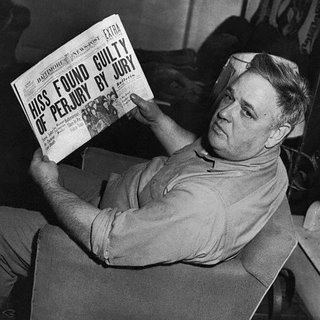
The best insight into 20th-century repression I’ve encountered recently is contained in Sidney Blumenthal’s piece about Whittaker Chambers in the March 17 issue of the New Yorker. Chambers “lived in a time when it was easier to confess to being a [communist] spy than to confess to being a homosexual,” Blumenthal notes. He also remarks that Chambers’s behavior as a spy — “furtive exchanges, secret signals, false identities” — resembled his behavior as a homosexual, and that he “and a pantheon of anti-Communists for whom conservatism was the ultimate closet — J. Edgar Hoover, Roy Cohn, and Francis Cardinal Spellman — advanced a politics based on the themes of betrayal and exposure, ‘filth’ (as Hoover called it) and purity. Read more
Here are my reviews of two Malick films that I like much more than The Tree of Life, written almost a quarter of a century apart.
First, my review of Badlands from the November 1974 issue of Monthly Film Bulletin:
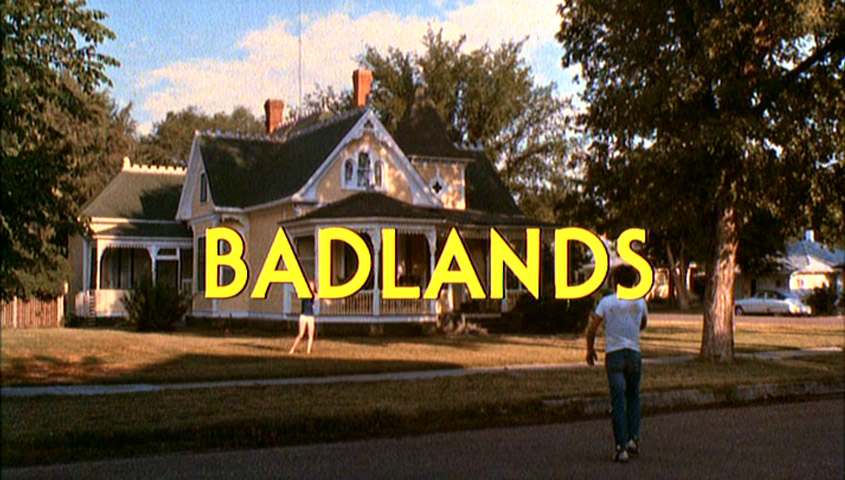
U.S.A., 1973
Director: Terrence Malick
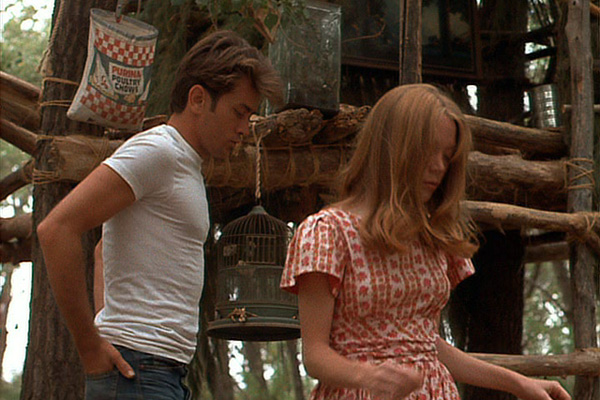
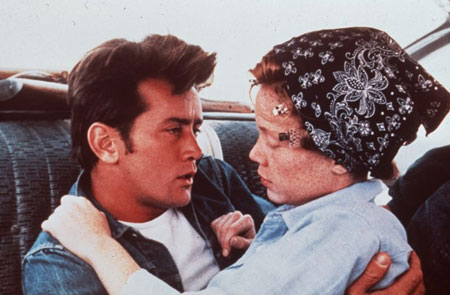
It would hardly be an exaggeration to call the first half of Badlands a revelation -– one of the best literate examples of narrated American cinema since the early days of Welles and Polonsky. Compositions, actors, and lines interlock and click into place with irreducible economy and unerring precision, carrying us along before we have time to catch our breaths. It is probably not accidental than an early camera set-up of Kit on his garbage route recalls the framing of a neighborhood street that introduced us to the social world of Rebel Without a Cause: the doomed romanticism courted by Kit and dispassionately recounted by Holly immediately evokes the Fifties world of Nicholas Ray -– and more particularly, certain Ray-influenced (and narrated) works of Godard, like Pierrot le fou and Bande à part. Terrence Malick’s eye, narrative sense, and handling of affectless violence are all recognizably Godardian, but they flourish in a context more easily identified with Ray. Read more
I haven’t much cared for any of the Gaspar Noé films I’ve seen so far except for I Stand Alone, but I persist in finding this one a corrosive masterpiece. This review appeared in the July 9, 1999 Chicago Reader. –J.R.
I Stand Alone
Rating **** Masterpiece
Directed and written by Gaspar Noe
With Philippe Nahon, Blandine Lenoir, Frankye Pain, Martine Audrain, and Roland Gueridon.
By Jonathan Rosenbaum
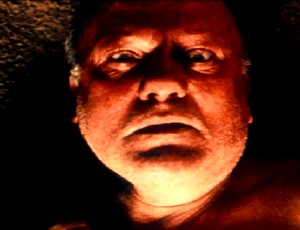
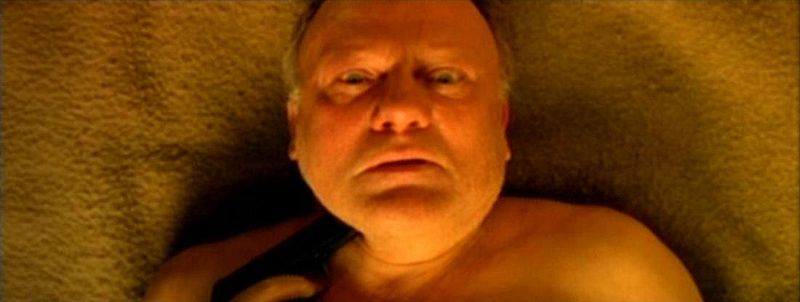
Gaspar Noé’s first full-length feature is a genuine shocker. It’s a sequel to his 40-minute Carne, a film that didn’t do much for me when it played the film-festival circuit in the early 90s, though I wouldn’t mind seeing it again now. This feature is called Seul contre tous, which translates literally as “alone against everybody”; I Stand Alone is cornier but rolls more easily off the tongue.
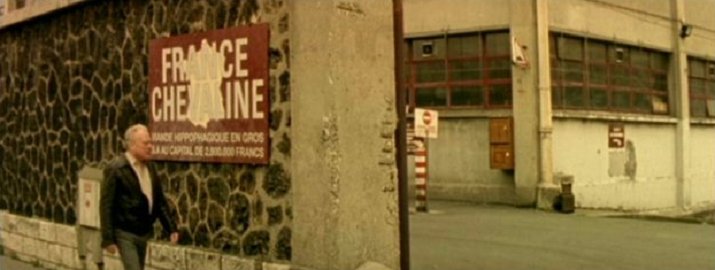
You don’t need to know anything about Carne to follow or appreciate I Stand Alone — which thoughtfully provides a precis of Carne in its opening minutes — but some familiarity with Taxi Driver or any of its spin-offs might help you experience its full wallop. Like Martin Scorsese’s film, I Stand Alone centers on an armed and enraged loner who spews macho, racist, and homophobic bile — most of which he mutters to himself –a nd is ready to mow down everyone in sight. Read more