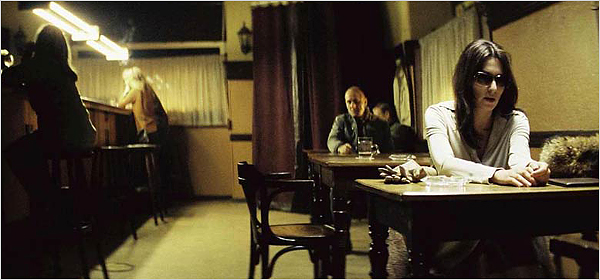
Inspired by Howard Zinn’s A People’s History of the United States, this beautiful documentary by John Gianvito (The Mad Songs of Fernanda Hussein) documents not only graves and memorials across the U.S. for people (both famous and unknown) who died in political struggles, but also the surrounding landscapes that nestle and sometimes hide these largely unremarked sites. The casual way Gianvito introduces us to these settings via sound and image, the varying cinematic means employed (including stretches of animation), and the powerful maximal effects he achieves from his supposedly minimalist agenda are all essential facets of the film’s haunting poetry. This was named best experimental film of 2007 by the National Society of Film Critics, but it also displays a strong passion for history–including film history, from Griffith, Stroheim, and Dovzhenko to Straub-Huillet. 58 min. a Gene Siskel Film Center. —Jonathan Rosenbaum Read more
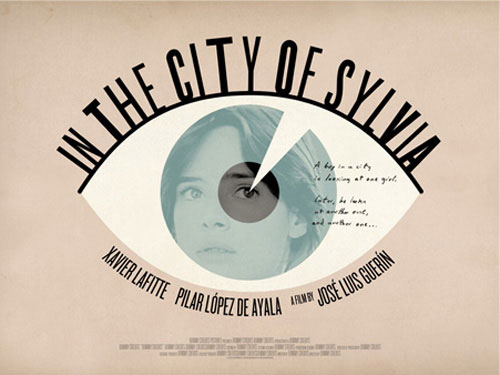
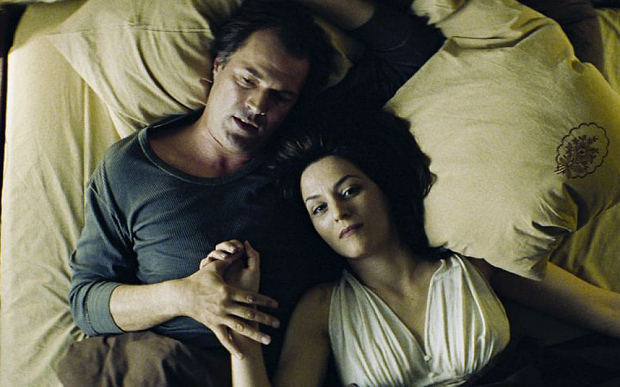
Two hypnotic and haunting 2007 features by Spanish experimental filmmaker Jose Luis Guerin, about the same romantic obsession. (The reference points are W.G. Sebald’s novel Vertigo and Alfred Hitchcock’s film of the same title.) The silent Some Photos in the City of Sylvia (65 min.) uses black-and-white stills with English intertitles to recount an unseen artist’s return to Strasbourg to search for a young woman he met briefly 22 years earlier while making a Goethe-related literary pilgrimage. The far more elliptical In the City of Sylvia (84 min.) tells the same story with color, carefully articulated sound, and minimal, subtitled French dialogue; in this film the artist returns only six years after his pilgrimage. Both works are mysterious, beautiful, and primal. It’s a pity the first, an intimate study and scenario for the second, is being shown after only one screening of its more languid successor. (JR)
Read more

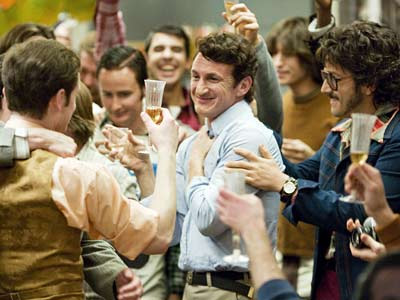
Now that it’s winter, it shouldn’t be surprising that a large part of the American populace seems locked into some sort of hibernation mode–a state of mind that suggests that virtually all of the country’s problems can be blamed on George W. Bush and virtually none of them can be blamed on the people who voted for George W. Bush. But a more immediate problem is one that involves adjusting to the fact that the very long and recently concluded presidential campaign is no longer in operation. Milk addresses a mindset I would associate with campaign agitprop mode, a mindset that forsakes nuanced and complex analysis for the sake of immediate uplift; The Order of Myths addresses us in a more analytical mode. Of course, given the outlawing of same-sex marriage in California in the last election, an election-mode form of agitprop may be more functional at the moment, at least where homophobia is concerned, but this doesn’t necessarily entail more thoughtful filmmaking.
As nearly as I can remember, Mobile is the only city in Alabama of any significant size that I never visited during the first 16 years of my life, when I was growing up in that state—nor have I ever made it to Mobile since. Read more

Ahmad Jamal Complete Live at the Spotlite Club 1958 (2-CD set, Gambit Records 69265).
You may have to be an Ahmad Jamal completist like myself to take notice of this 2007 expanded edition, which adds three 1958 Chicago studio cuts, totaling about eight minutes, to the 25 live ones that have already been available. The latter tracks appeared on two well-known Jamal LPs, Ahmad Jamal and the two-disc Portfolio of Ahmad Jamal, both recorded in September 1958 at Washington, D.C.’s Spotline Club in September 5 and 6, 1958.
If memory serves, the first of these was the first Jamal record I ever bought, when I was 15 or 16, and it’s never gone stale for me —- despite the scorn heaped on Jamal by sophisticated jazz critics such as Martin Williams in Downbeat. There’s always been a curious split between the Jamal idolatry of Miles Davis –- who joined forces with Gil Evans on their first joint album to virtually steal (rather than simply play homage to) two tracks from Jamal’s 1955 Chamber Music of the New Jazz, “New Rumba” and “I Don’t Wanna Be Kissed,” and based his Quintet’s arrangement of “All of You” in ‘Round Midnight on Jamal’s on the same LP —- and the disdain of most jazz critics, who seemed to regard Jamal’s popularity with seething resentment, much as they resented Dave Brubeck during the same period. Read more
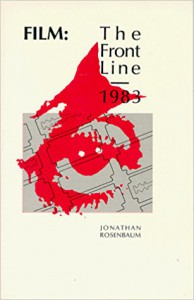
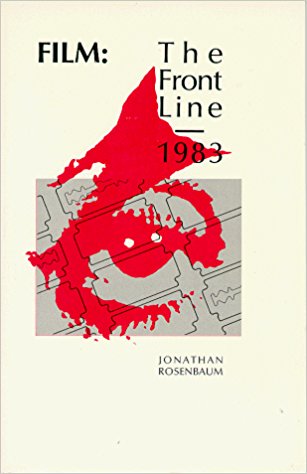
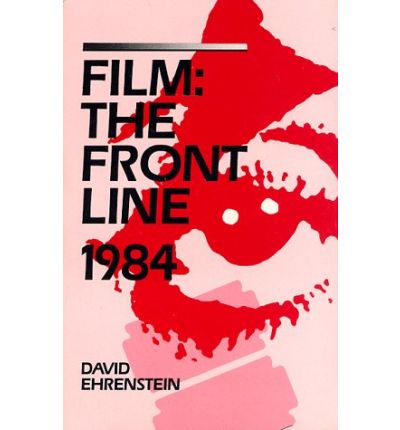
Last month, roughly thirty-five years after its publication, the small, Denver-based publisher Arden Press finally declared my book Film: The Front Line 1983 out of print, with 192 copies remaining in stock. A commissioned work designed to launch an annual series surveying independent and experimental filmmaking, it yielded only one other volume after my own, David Ehrenstein’s equally useful Film: The Front Line 1984— which, like my book, can still be readily found at bargain prices at Amazon and elsewhere.
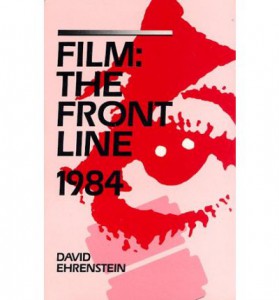
I have somewhat mixed feelings about some of the disgruntled patches of score-settling and related polemics in my book, although there are other patches that I still like. A few chapters have already been posted on this site, and I expect that others will follow.
To the best of my recollection, I found copies of this book on the shelves of only two bookstores: the long-gone Coliseum Books (1974-2007) just below Columbus Circle in New York, the same year (1983) it was published, and the first bookstore I ever walked into, quite at random, in Melbourne–still recovering from jetlag, and not quite believing my eyes–on the first of my three visits to Australia, in 1996. I’m sorry that I no longer remember the name of that store, because it certainly made my day. Read more
From the Chicago Reader (September 28, 2007). The second photograph below is by Pamela Gentile. — J.R.
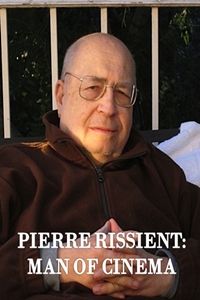
Sometimes the most powerful and influential people are protected by their relative obscurity, and it’s hard to think of a better illustration of this principle in the film world than the multifaceted, eccentric, controversial Pierre Rissient, whom I’ve known for 35 years. Among other achievements, he’s probably discovered more important filmmakers than anyone else I know — figures ranging from Cy Endfield to Lino Brocka to Jane Campion to Abbas Kiarostami. It takes most of Todd McCarthy’s well-used 110 minutes in this lively documentary to explain all the creative, behind-the-scene activities Rissient generates in relation to criticism, filmmaking, distribution, exhibition, and programming, and even though this is mainly the sympathetic view of a friend, the portrait is complex and nuanced. Among the many interviewees, Olivier Assayas is especially perceptive when he describes Rissient as being like a teenager. In English, French, and Mandarin with subtitles. (JR)
 Read more
From the Chicago Reader (July 14, 2007). — J.R.
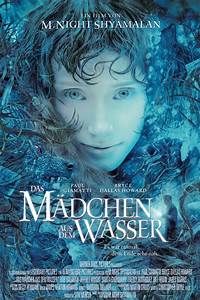
Paul Giamatti plays a stuttering everyman, an apartment-building janitor who’s itching for redemption and finds it in the shape of a new age allegory by M. Night Shyamalan. More specifically, he finds a fairy-tale nymph named Story (Bryce Dallas Howard) living under the building’s swimming pool and menaced by occult beasties until the tenants join forces against them. It’s hard to think of a deadlier shotgun marriage than Jacques Tourneur’s poetry of absence and Spielbergian uplift, but Shyamalan has patented the combo, adding pretentious camera movements that are peculiarly his own — even the jokes are pretty solemn. But count on Christopher Doyle’s lush cinematography and a lively cast to take up the slack. With Bob Balaban, Jeffrey Wright, Sarita Choudhury, Freddy Rodriguez, Bill Irwin, Jared Harris, and Shyamalan, playing a writer. PG-13, 110 min. (JR) Read more
From the Chicago Reader (June 1, 2007). — J.R.

Just a way station between Ocean’s Twelve (2004) and the inevitable Ocean’s Fourteen, this third installment in the franchise is outlandish even as fantasy, a labyrinthine revenge caper undertaken after evil lug Al Pacino double-crosses sweet-tempered lug Elliott Gould (part of the usual crew) out of his share of a Vegas hotel-casino. George Clooney, Brad Pitt, Matt Damon, Don Cheadle, Bernie Mac, and Carl Reiner are all back, though Julia Roberts has taken a powder as designated sex object and been replaced by a villainous Ellen Barkin, the butt of much ageist ridicule. Predictably adolescent and smarmy, with the mix of sentimentality and cynical flippancy that’s becoming Steven Soderbergh’s specialty (even when he’s pretending to make art films), this is chewing gum for the eyes and ears, and not bad as such. PG-13, 122 min. (JR) Read more
From the Chicago Reader (February 16, 2007). — J.R.
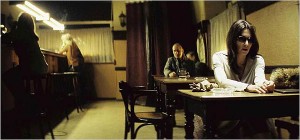
I spent only an afternoon in East Germany before the Berlin Wall fell, but the fearful silence in public places left a lingering impression. The reasons behind it are explored by writer-director Florian Henckel von Donnersmarck in his accomplished first feature, about the Stasi, the country’s secret police, which had a staff of over 90,000, plus countless informers, and spied on friend and foe alike. The fictional story here, set between 1984 and 1991, focuses on the investigation of a popular and patriotic playwright (Sebastian Koch); that the captain assigned to his case (touchingly played by Ulrich Muhe) is mainly sympathetic and working surreptitiously on the playwright’s behalf only makes this more disturbing. With Martina Gedeck (The Good Shepherd). In German with subtitles. R, 137 min. Century 12 and CineArts 6, Landmark’s Century Centre.
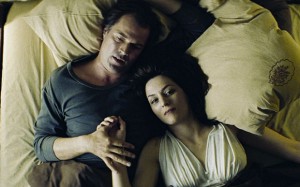 Read more
Film A Staggering Statistic
Check out the June 26 post on Dave Kehr’s blog for an important piece of news and a staggering statistic.
The important piece of news is the launch of the Turner Classic Movies database, TCMDB, a potential alternative to the often less-than-reliable Internet Movie Database. (Sitting on a panel in Austin with Monte Hellman several years ago, I heard him recount writing to the IMDB to inform them that some of his film credits on the site were incorrect, only to be informed by them that because he wasn’t a qualified film scholar they couldn’t make the required corrections.)
As Dave points out, the TCMDB “has as its core the unsurpassable AFI Catalog of American Feature Films, previously accessible only with a $50 AFI membership (or through certain libraries). For those who don’t know it, the AFI Catalog is a towering work of scholarship that covers the period 1893 to 1971 in exquisite detail, with full credits, reliable plot summaries and significant side notes.” I can only concur with Dave. Indeed, there are times when I think that the only two irrefutably towering achievements of the American Film Institute are David Lynch’s Eraserhead, produced on its west-coast premises, and this reference work.
Read more
Here’s the substance of two emails I recently sent to an obit writer at the Tribune:
Read more
From the June 1984 issue of Film Comment. This chronicles my very first visit to the Rotterdam International Film Festival. I believe I was the first member of the American press ever to have been invited (a perk I owe to Sara Driver and Jim Jarmusch having spoken to festival director Huub Bals) — the first of my 20 visits to this very special festival. I’m sorry that Rotterdam no longer invites me (I believe that my last visit there was in 2007), but I guess even the best perks can’t be expected to last forever. My first visit there, in any case, was one of the most memorable; Joseph L. Mankiewicz was there to accept the Erasmus Prize (and to give a press conference at which, if memory serves, he spent almost half an hour answering the first question), and I received my very first glimpses of the work of Raúl Ruiz. I should add that I did festival reports this first year for both Film Comment and Sight and Sound, although it was part of Huub’s singularity that he never required any coverage from me in order for me to get invited back the following year. Read more
This is my fifth column for Cahiers du Cinéma España, which ran in their February 2008 issue. Incidentally, any Americans who might still be skeptical about the multiracial and multicultural composition of the Iranian population are urged to check out the CIA’s web site on this matter: page down to Iran’s ethnic groups, where you’ll find “Persian 51%, Azeri 24%, Gilaki and Mazandarani 8%, Kurd 7%, Arab 3%, Lur 2%, Baloch 2%, Turkmen 2%, other 1%,” and compare this to their 2007 estimates for the U.S. (“white 79.96%, black 12.85%, Asian 4.43%, Amerindian and Alaska native 0.97%, native Hawaiian and other Pacific islander 0.8%, two or more races 1.61%” — something I wish I’d known about when I was having my editorial dispute at the Reader. — J.R.
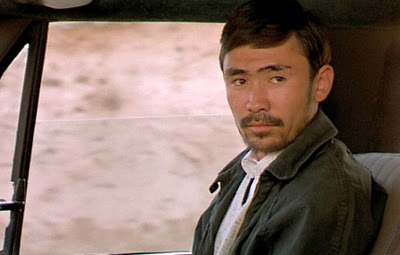
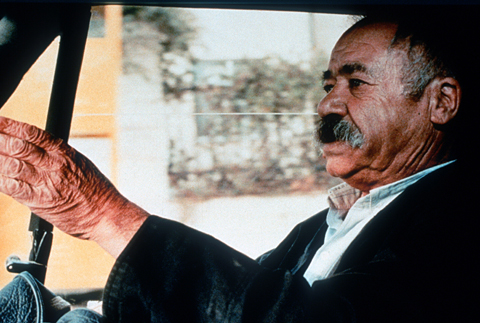
After reflecting in my last column about the “attractions and perils of internationalism,” I’ve been pondering how to distinguish these concerns from those of language, race, and ethnicity. The lack of a common ground in discussing some issues only adds to the confusion. Some months ago, I was shocked when my editor at the Chicago Reader, a weekly “alternative” newspaper where I’ve worked since 1987 (and from which I’m preparing to retire as a staff member in early 2008), eliminated a phrase from an article in which I asserted that Iran was just as multicultural and as multiracial as the U.S., Read more
From the Chicago Reader (October 21, 2007). — J.R.

I haven’t seen David Mamet’s controversial two-character play on the stage, but his own film adaptation (2007) is easily his best movie since House of Games. The two characters are a pontificating, bullying male college professor (William H. Macy) up for tenure and his initially cowed, eventually empowered female student (Debra Eisenstadt), who winds up charging him with sexual harassment. The stage versions have often been attacked for siding with the professor, but what seems most impressive about the movie, which may have benefited from certain refinements in the material, is that the two characters are so evenly matched by the dramaturgy that they become Strindbergian antagonists in a life-and-death struggle — equally odious in their authoritarian reliance on institutions to define their own identities and equally crippled by what might be described as their political impotence, which drives them to reach desperately for whatever institutional weapons are available to them. Within this context, education becomes as much an alibi as political correctness, and the most telling aspect of the struggle is that the two characters, even in their carefully coded sexual roles, become two different versions of the same blocked individual. Read more
Jonathan Rosenbaum was film critic for the Chicago Reader from 1987 to 2008. Born in Alabama in 1943, the son and grandson of movie exhibitors, he grew up in a house designed by Frank Lloyd Wright. While living in Paris (1969-1974), he worked as an extra for Robert Bresson and as a script consultant for Jacques Tati, before working as assistant editor for Monthly Film Bulletin and staff writer for Sight and Sound in London (1974-1977).
His books include IN DREAMS BEGIN RESPONSIBILITIES: A JONATHAN ROSENBAUM READER (forthcoming in early 2024), CINEMATIC ENCOUNTERS 2:PORTRAITS AND POLEMICS (2019), CINEMATIC ENCOUNTERS: INTERVIEWS AND DIALOGUES (2018), GOODBYE CINEMA, HELLO CINEPHILIA: FILM CULTURE IN TRANSITION (2010), THE UNQUIET AMERICAN: TRANSGRESSIVE COMEDIES FROM THE U.S. (2009), DISCOVERING ORSON WELLES (2007), ESSENTIAL CINEMA: ON THE NECESSITY OF FILM CANONS (2004), MOVIE MUTATIONS: THE CHANGING FACE OF WORLD CINEPHILIA (coedited with Adrian Martin, 2003), ABBAS KIAROSTAMI (with Mehrnaz Saeed-Vafa, 2003, expanded second edition 2018), MOVIE WARS: HOW HOLLYWOOD AND THE MEDIA LIMIT WHAT FILMS WE CAN SEE (2000), DEAD MAN (2000), MOVIES AS POLITICS (1997), PLACING MOVIES: THE PRACTICE OF FILM CRITICISM (1995), THIS IS ORSON WELLES by Orson Welles and Peter Bogdanovich (edited, 1992), GREED (1991), MIDNIGHT MOVIES (with J. Read more