From the Chicago Reader (March 26, 1999). — J.R.
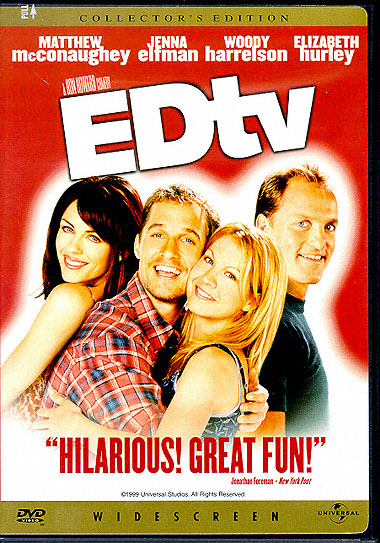
EDtv
Rating ** Worth seeing
Directed by Ron Howard
Written by Lowell Ganz and Babaloo Mandel
With Matthew McConaughey, Jenna Elfman, Woody Harrelson, Sally Kirkland, Martin Landau, Ellen DeGeneres, Rob Reiner, Dennis Hopper, and Elizabeth Hurley.
I tend to like Ron Howard movies. They’re usually energetic, Capra-like popular entertainments that respect the audience — not a common virtue these days. Howard is one of the few remaining filmmakers from the Hollywood studio tradition who can be counted on to offer honest diversion without making any undue claims for what he’s doing — and I include everything from Grand Theft Auto and Night Shift to Splash and Cocoon, from Gung Ho and Parenthood to the underrated Far and Away, Backdraft, and The Paper, and even dubious efforts such as Willow and Apollo 13. Even when his films are satirical, as Gung Ho is, they don’t offer their commentaries from the top of soap boxes, and their messages are sweet tempered rather than caustic.
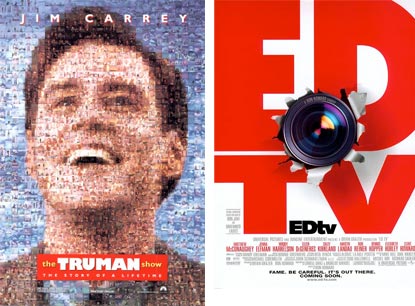
EDtv conforms to this pattern, though it runs up against a current conundrum — how can one criticize the excesses of the contemporary media without blaming the audience? Read more
From the Chicago Reader (February 1, 2002). It was great to see this amazing, radical masterpiece on TCM, even if Ben Mankiewicz consistently mispronounced the director’s name and gave almost completely erroneous information about it. — J.R.
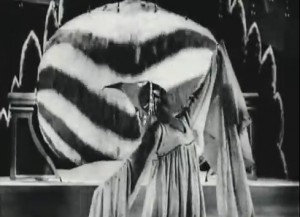

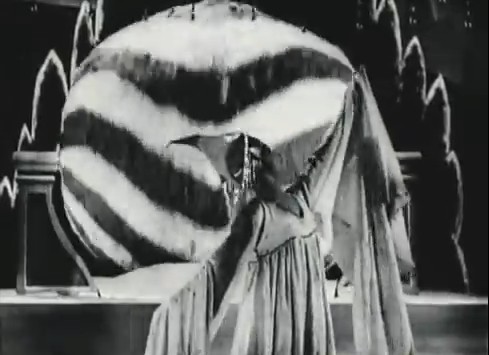
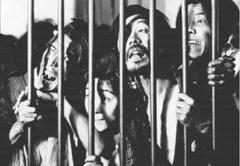
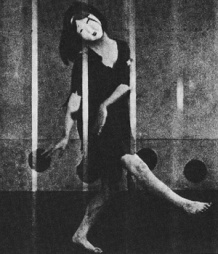
Teinosuke Kinugasa’s mind-boggling silent masterpiece of 1926 was thought to have been lost for 40 years until the director discovered a print in his garden shed. A seaman hires on as a janitor at an insane asylum to free his wife, who’s become an inmate after attempting to kill herself and her baby. The film’s expressionist style is all the more surprising because Japan had no such tradition to speak of; Kinugasa hadn’t even seen The Cabinet of Dr. Caligari when he made this. Yet the rhythmic pulsation of graphic, semiabstract depictions of madness makes the film both startling and mesmerizing. I can’t vouch for the live musical accompaniment by Pillow, an unorthodox quartet that’s reportedly quite percussive, but its instrumentation — clarinet, dry ice, tubes, electric guitar, accordion, contrabass, cello — sounds appropriate. 75 min. Presented by Columbia College and Chicago Filmmakers. Columbia College Ferguson Theater, 600 S. Michigan, Friday, February 1, 8:00, 773-293-1447.
 Read more
From the Chicago Reader (July 3, 1998). — J.R.
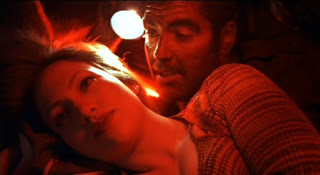
Out of Sight
Rating * Has redeeming facet
Directed by Steven Soderbergh
Written by Scott Frank
With George Clooney, Jennifer Lopez, Ving Rhames, Don Cheadle, Dennis Farina, Albert Brooks, Steve Zahn, and Catherine Keener.
The Brigands: Chapter VII
Rating *** A must see
Directed and written by Otar Iosseliani
With Amiran Amiranachvili, Alexi Djakeli, Dato Gogibedachvili, Guio Tzintsadze, Nino Ordjonikidze, Keti Kapanadze, and Nino Kartsivadze.

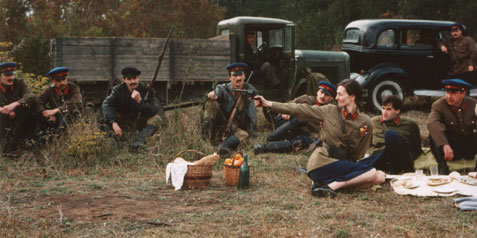
Which would you rather see? A Hollywood thriller with hot stars whose director is so alienated from his material that he’s reduced to a kind of ingenious doodling while his characters disintegrate? Or a witty, despairing French-Russian-Italian-Swiss art movie set in 16th-century Georgia, Stalinist Georgia, contemporary Georgia, and contemporary Paris, whose writer-director is so much in command of his materials that he can plant the same actors in all four settings yet provide a seamless continuity?
My question is mainly rhetorical because it’s already been decided for most people reading this. Out of Sight, a major Universal release written by Scott Frank and directed by Steven Soderbergh, is playing all over town and will be around for weeks; The Brigands: Chapter VII, written and directed by Otar Iosseliani, doesn’t even have a U.S.
Read more
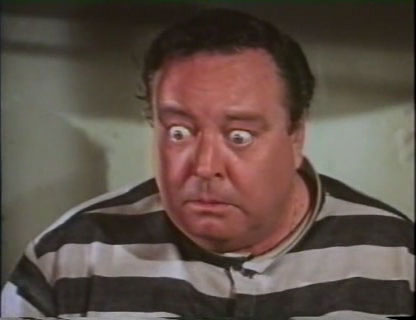
Otto Preminger took LSD before making this demented, vulgar 1968 screwball musical about hippies taking over the world, in which his own trip is re-created as Jackie Gleason’s. This isn’t exactly funny, and it’s the last Preminger film one would pick to convince a skeptic of his talent, but it’s fascinating throughout. The satirical plot pits hippies against corporate gangsters lorded over by someone named God (Groucho Marx in his last film performance), whom Gleason used to work for. The cast mainly consists of aging TV stars (Gleason, Marx, Carol Channing, Frankie Avalon, Arnold Stang) and Hollywood has-beens (Peter Lawford, Burgess Meredith, George Raft, Cesar Romero, Mickey Rooney, Fred Clark). Preminger’s celebration of the counterculture may be peculiar (Channing serves as the major go-between and, oddly enough, the sanest character), but it’s certainly sincere. Don’t miss the hallucinatory Garbage Can Ballet — the apotheosis of this cheerful garbage can of a movie — and the sung credits at the end. 98 min. (JR)
 Read more
From the August 14, 1997 Chicago Reader. — J.R.

COLD HEAVEN
*** (A must-see)
Directed by Nicolas Roeg
Written by Allan Scott
With Theresa Russell, Mark Harmon, James Russo, Talia Shire, Will Patton, Richard Bradford, and Julie Carmen.
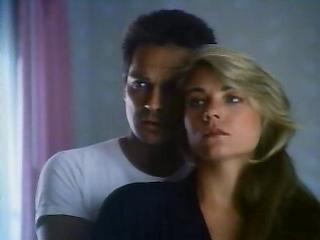
The sexy, volatile cinema of Nicolas Roeg might be said to operate under a kind of curse. Born in London in 1928, Roeg entered movies as a clapper boy at the age of 22 but didn’t become a cinematographer until his early 30s. After shooting such interesting films in the 60s as The Masque of the Red Death, Fahrenheit 451, and Petulia, he directed his powerful and still-dangerous Performance (in collaboration with Donald Cammell) in 1968, but then had to wait two years for Warner Brothers to release it.
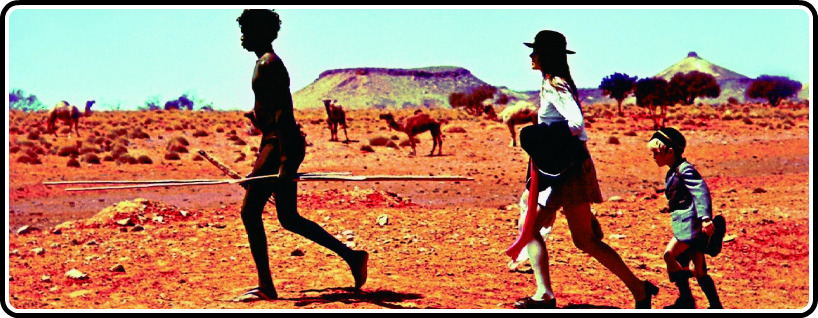

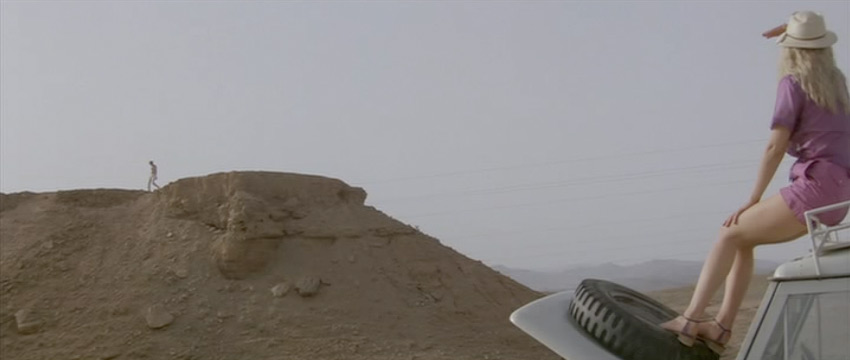
After Roeg’s first solo directorial effort (Walkabout, 1971) came his first and only commercial hit (Don’t Look Now, 1973). He followed that up with two controversial cult items (The Man Who Fell to Earth, 1976, and Bad Timing: A Sensual Obsession, 1979). In 1982 he made a feature (Eureka) that had a very limited release. Next in line was Insignificance (1985), then another feature with virtually no theatrical life in the United States (Castaway, 1986), then a third limited release (Track 29, 1988). Read more
From the Chicago Reader (May 2, 1997). — J.R.
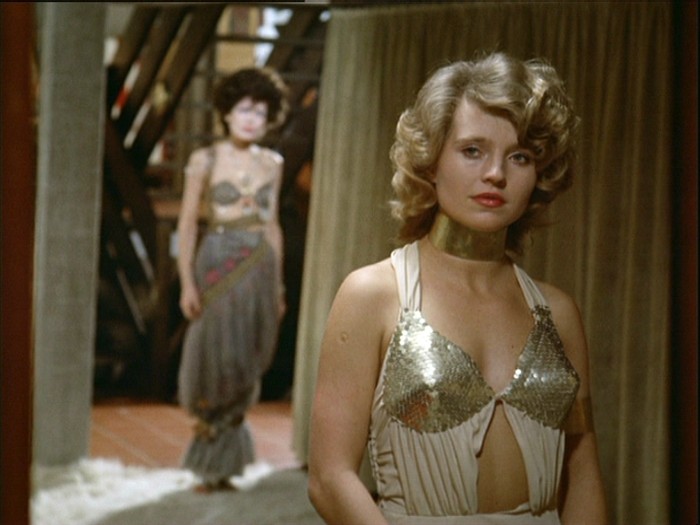
Films by Rainer Werner Fassbinder
I’m still trying to figure out what I think of Rainer Werner Fassbinder (1945-1982), the German whiz kid who’s the focus of a nearly complete retrospective showing at the Film Center, Facets Multimedia Center, and the Fine Arts over the next couple of months. An awesomely prolific filmmaker (he turned out seven features in 1970 alone), Fassbinder became the height of Euro-American fashion during the mid-70s, then went into nearly total eclipse after his death from a drug overdose — reminding us that the fate of a fashionable filmmaker is often to be discarded (as, more recently, have been David Lynch and Quentin Tarantino).
As skeptical as I often was in the 70s about Fassbinder as a role model, I’ve been more than a little disconcerted by the speed with which he’s vanished from mainstream consciousness. Having now seen two dozen of his 37 features, one of his four short films, and one of his four TV series — though I haven’t seen many of them since they came out — I find much of his work, for all its deliberate topicality, as fresh now as when it first appeared. Read more
From the Chicago Reader (September 23, 2005).– J.R.
Dear Wendy
* (Has redeeming facet)
Directed by Thomas Vinterberg
Written by Lars von Trier
With Jamie Bell, Bill Pullman, Alison Pill, Danso Gordon, Michael Angarano, Novello Nelson, Chris Owen, and Mark Webber
Reel Paradise
** (Worth seeing)
Directed by Steve James
Two new releases are defined by an inability to fathom another culture — Reel Paradise, a U.S. documentary about an American spending a year in the South Pacific with his family, and Dear Wendy, a Danish feature with English dialogue that was shot in rural Denmark and Germany but is set in a poor mining town in the American southeast. Both demonstrate a middle-class complacency that fosters this inadequacy.
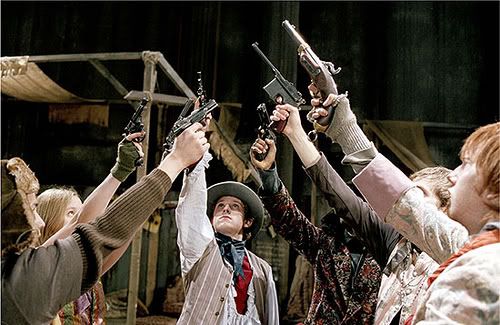
The acknowledged subject of Dear Wendy, written by Lars von Trier and directed by Thomas Vinterberg, is the American obsession with guns and violence. “Wendy” is a small handgun that’s addressed, fondled, and ultimately used by the young narrator-hero played by Jamie Bell (Billy Elliot), who prides himself on being a pacifist even after he starts a gun club, the Dandies. Like the other misfits in the club, he claims to be interested only in target practice, but when they wind up in a bloody shoot-out with the police (among them Bill Pullman) we aren’t the least bit surprised. Read more
I no longer recall who asked me to write this or why, but I estimate that I must have written it in late 1997 or early 1998, and probably for some foreign publication. I’m happy to see that much of what I wrote, especially about the Times, is now out of date. — J.R.
The New York Film Festival is held every fall, usually in late September and early October. Unlike every other major film festival that comes to mind, it features relatively few programs, less than thirty — a concentration that allows the festival to give more of its attention to each film it shows than many others do. (As a rule, every feature is accorded a press conference, and public dialogues with the filmmaker usually follow each screening.) This often means that many of the foreign and independent films that show at the festival have a more substantial commercial launching than most of those that don’t. (It’s different for Hollywood films, which already have enormous promotional budgets at their disposal. In fact, most mainstream American releases aren’t even submitted, in part because the studios are afraid that a New York Film Festival showing might handicap a movie with the stigma of “art film”.) Read more
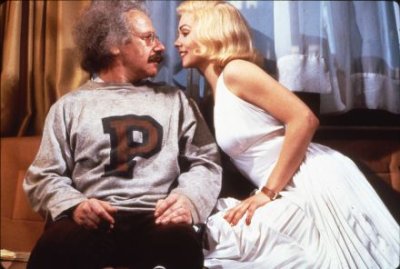
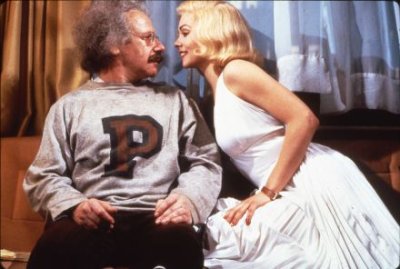
Nicolas Roeg’s 1985 film adaptation of Terry Johnson’s fanciful, satirical play — about Marilyn Monroe (Theresa Russell), Albert Einstein (Michael Emil), Joe DiMaggio (Gary Busey), and Senator Joseph McCarthy (Tony Curtis) converging in New York City in 1954 — has many detractors, but approached with the proper spirit, you may find it delightful and thought-provoking. The lead actors are all wonderful, but the key to the conceit involves not what the characters were actually like but their cliched media images, which the film essentially honors and builds upon. The Monroe-Einstein connection isn’t completely contrived. Monroe once expressed a sexual interest in him to Shelley Winters, and a signed photograph of Einstein was among her possessions when she died. But the film is less interested in literal history than in the various fantasies that these figures stimulate in our minds, and Roeg’s scattershot technique mixes the various elements into a very volatile cocktail — sexy, outrageous, and compulsively watchable. It’s a very English view of pop Americana, but an endearing one. (JR) Read more
From the Chicago Reader (April 7, 1995). — J.R.

Tank Girl
**
Directed by Rachel Talalay
Written by Tedi Sarafian
With Lori Petty, Malcolm McDowell, Naomi Watts, Ice-T, Don Harvey, Reg E. Cathey, Scott Coffey, Jeff Kober, Iggy Pop, and Ann Cusack.
I wasn’t exactly encouraged by the opening sequences of Tank Girl, a spin-off of a British comic book with a postapocalyptic setting. The movie starts with a kind of music-video visual dribble, set to the pounding strains of Devo’s “Girl U Want,” a song whose chanting refrain (“She’s just a girl — the girl you want”) seems to promise the kind of machocentric SF soft-core porn dished out by Barbarella 27 years ago. I’d been prepared for a steady influx of contemporary rock and rap and the concomitant collapse of any believable vision of the future, but this particular anthem seemed designed to cater only to guys. My expectations were raised, however, by the first appearance of Lori Petty, in the title role of Rebecca Buck — a hard-nosed renegade punk who clearly wouldn’t let herself be palmed off as a bimbo. But Kesslee, the movie’s arch-villain (played by the original movie punk, Malcolm McDowell), brought me back to the facetious S and M rhetoric of the glib and cutesy Barbarella. Read more
From the Chicago Reader (December 3, 1993). — J.R.

THE PUPPET MASTER **** (Masterpiece)
Directed by Hou Hsiao-hsien
Written by Wu Nien-jen, Chu Tien-wen, and Li Tien-lu
With Li Tien-lu, Lin Chung, Cheng Kuei-chung, Cho Ju-wei, Hung Liu, and Bai Ming-hwa
Let’s start with three central and related facts, the first about Taiwan, the second about Taiwanese cinema, and the third about us. (1) Until six years ago, Taiwan spent this whole century under martial law, and over three previous centuries it suffered from nearly continuous occupation — by the Dutch in the 17th century and the Manchus in the 17th, 18th, and 19th centuries. In 1895 it was ceded to Japan as one of the spoils of the Sino-Japanese war, and it remained a Japanese colony for the next half century, until the Japanese surrender at the end of World War II. At this point mainland China took control; but four years later, when the communists seized the mainland, the deposed Kuomintang, led by Chiang Kai-shek, shifted their base to Taiwan — claiming that their rule was only temporary, until they could wrest the mainland back from the communists. But as it turned out they remained in power until 1987, when Taiwan finally became a democracy. Read more
I can’t easily find words to express my admiration for Bruce Ricker, whom I just learned from a New York Times obituary died last Friday of pneumonia, at age 68. He wasn’t only a man who distributed jazz documentaries and made a few of his own, all of them terrific (including a wonderful tribute to Brubeck, In His Own Sweet Way, which made my ten-best list last year), and who also played what I’m sure was incalculable role in advising Clint Eastwood in his multiple jazz ventures. He was also a lawyer, the literary executor of Seymour Krim, and an amazing human being. I already miss him, and cherish my memories of him. [5/19/11]
Read more
From the Chicago Reader (May 19, 1989). — J.R.
WHO KILLED VINCENT CHIN?
** (Worth seeing)
Directed by Christine Choy.
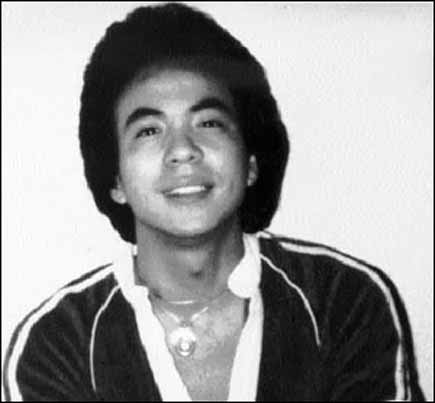
Item: The December 22, 1941, issue of Life magazine features a two-page spread headlined “How to Tell Japs From the Chinese: Angry Citizens Victimize Allies With Emotional Outburst at Enemy.” It begins: “In the first discharge of emotions touched off by the Japanese assaults on their nation, U.S. citizens have been demonstrating a distressing ignorance on the delicate question of how to tell a Chinese from a Jap. Innocent victims in cities all over the country are many of the 75,000 U.S. Chinese whose homeland is our stanch ally. So serious were the consequences threatened, that the Chinese consulates last week prepared to tag their nationals with identification buttons. To dispel some of this confusion, Life here adduces a rule-of-thumb from the anthropometric conformations that distinguish friendly Chinese from enemy alien Japs.” Around this text and the two paragraphs that follow are four large photographs with inscriptions that attempt to spell out distinguishing characteristics of Chinese and Japanese physiognomies and body types.
Item: In 1982 in Highland Park, Michigan, Vincent Chin, a 27-year-old Chinese auto engineer, got into a fight with Ronald Ebens, a somewhat older Caucasian autoworker, in a topless bar called the Fancy Pants. Read more